Neuromelanin in Parkinson’s Disease: Tyrosine Hydroxylase And Tyrosinase Part 1
Apr 15, 2024
Abstract:
Parkinson's disease (PD) is an aging-related disease and the second most common neurodegenerative disease after Alzheimer's disease. The main symptoms of PD are movement disorders accompanied by a deficiency of the neurotransmitter dopamine (DA) in the striatum due to cell death of the nigrostriatal DA neurons.
In recent years, more and more studies have seen a close relationship between movement disorders and memory. People's memory and cognitive abilities can be improved through appropriate exercise, but long-term sitting and lack of exercise will affect the human nervous system and even lead to cognitive decline, memory weakening, and other problems.
First of all, exercise can promote blood circulation in the brain, thereby increasing the nutrient supply to neurons, increasing metabolism, and promoting the generation of new neurons. This improvement can increase the brain's capacity and flexibility while promoting the formation and maintenance of neural networks, thereby improving people's memory and learning abilities.
Secondly, exercise can also promote the body's blood circulation, and improve the body's metabolism and immune system, thereby enhancing the body's resistance and preventing the occurrence of various diseases. These diseases not only affect people's physical health but also affect their brains, reducing their cognitive abilities and memory.
In addition, through appropriate exercise, people can release physical and psychological stress and relieve emotions such as anxiety, tension, and depression. These emotions will not only affect a person's mental state but also hurt the brain, affecting people's memory and learning abilities. Therefore, proper exercise can promote physical and mental health and improve people's memory and learning abilities.
In summary, there is a close relationship between movement disorders and memory. Proper exercise can promote the health of the body and brain, and improve people's cognitive ability and memory. Therefore, we should actively participate in sports and maintain a healthy lifestyle to improve our physical and mental health and quality of life. It can be seen that we need to improve memory, and Cistanche deserticola can significantly improve memory because Cistanche deserticola is a traditional Chinese medicinal material that has many unique effects, one of which is to improve memory. The efficacy of Cistanche deserticola comes from the multiple active ingredients it contains, including tannic acid, polysaccharides, flavonoid glycosides, etc. These ingredients can promote brain health through a variety of pathways.

Click Know to improve short-term memory
Two main histopathological hallmarks exist in PD: cytosolic inclusion bodies termed Lewy bodies that mainly consist of α-synuclein protein, the oligomers of which produced by misfolding are regarded to be neurotoxic, causing DA cell death; and black pigments termed neuromelanin (NM) that are contained in DA neurons and markedly decrease in PD.
The synthesis of human NM is regarded to be similar to that of melanin in melanocytes; melanin synthesis in skin is via DOPAquinone (DQ) by tyrosinase, whereas NM synthesis in DA neurons is via DAquinone (DAQ) by tyrosine hydroxylase (TH) and aromatic L-amino acid decarboxylase (AADC).
DA in cytoplasm is highly reactive and is assumed to be oxidized spontaneously or by an unidentified tyrosinase to DAQ and then, synthesized to NM. Intracellular NM accumulation above a specific threshold has been reported to be associated with DA neuron death and PD phenotypes.
This review reports recent progress in the biosynthesis and pathophysiology of NM in PD.
Keywords:
dopamine; locus coeruleus; melanin; neuromelanin; norepinephrine; Parkinson's disease; substantia nigra; tyrosinase; tyrosine hydroxylase.
1. Neuromelanin (NM) in Parkinson's Disease
Parkinson's disease (PD) is a human-specific, progressive, aging-related disease, and the second most common neurodegenerative disease after Alzheimer's disease [1]. In 1817, James Parkinson in London published "An Essay on the Shaking Palsy", the first comprehensive clinical description of a disorder later named Parkinson's disease. The main symptoms of PD are motor symptoms, such as tremors, bradykinesia, rigidity, and postural instability, as well as non-motor symptoms including anosmia, constipation, insomnia, REM-sleep behavioral disorders (RBD), anxiety, depression, fatigue, cognitive impairment [1].
Most PD is sporadic without a familial history (sPD). Only 5–15 percent of cases are familial PD (fPD) [2,3]. The pathophysiology of PD was investigated by biochemical analysis of post-mortem PD brains during the middle of the 20th century [4–7].

Although the pathophysiology of PD remains unknown, sPD is thought to be caused by the combined effects of environmental and genetic factors. The main symptoms of PD, which is a movement disorder, are known to be caused by a decrease in neurotransmitter dopamine (DA) in the striatum in the basal ganglia due to neurodegeneration of nigrostriatal DA neurons, and supplementation of DA by the direct precursor L-3,4-dihydroxyphenylalanine (L-DOPA) is still the gold standard of pharmacotherapy of PD after five decades since 1970s [1,7,8].
L-DOPA treatment is highly effective for alleviating many core symptoms of PD, but it does not prevent the progression of neurodegeneration and later results in a decrease in efficacy and various side effects such as dyskinesia [7,8].
The discovery of the causative or susceptibility genes of various fPD, since the end of the 20th century, has greatly promoted the elucidation of the molecular mechanism of sPD [3]; fPD is termed in the order of discovery of the gene loci such as PARK1 (α-synuclein, SNCA [9,10]) and PARK2 (parkin, PRKN [3,11,12]). More than 20 PARKs have been reported. The abbreviation PARK is derived from the name PARKinson.
Mutations in some genes in fPD are considered to be causative and also related to susceptibility loci in sPD, for example, α-synuclein gene (SNCA and PARK1) [9,10], parkin (PARK2) [3,11], PTEN-induced putative kinase 1 (PINK1 and PARK6) [13,14], and leucine-rich repeat kinase 2 (LRRK2 and PARK8) [15–18].
There are two main histopathological hallmarks in PD in the degenerating nigrostriatal DA neurons, i.e., Lewy bodies and reduction of neuromelanin (NM) in substantia nigra (SN) (Figure 1): (1) Friedrich Heinrich described cytosolic inclusion bodies termed Lewy bodies in 1912 [19]. Lewy bodies contain α-synuclein protein as the main protein component, and the fibrillar oligomers of α-synuclein protein produced by misfolding are presumed to be neurotoxic and to cause DA cell death [20].
Mutation of the α-synuclein gene (SNCA) was found, in 1997, to cause a dominant fPD (PARK1) in which degenerating dopamine neurons contain both Lewy bodies containing α-synuclein and black pigment NM [9,10].
For these reasons, the α-synuclein protein has been extensively examined in DA neuron death in sPD. However, a remaining question is whether Lewy bodies are observed in dominant fPD such as PARK1 (SNCA), but not in recessive fPD such as PARK2 (PARKIN). (2) A black pigment NM, which is observed in the human SN, gradually increases during normal aging in healthy subjects [21].
NM is rich in the brains of humans, but its presence is also reported in the brains of monkeys, mice, rats, dogs, and horses [22,23]. Konstantin Tretiakoff [24], in 1919, reported that NM markedly decreased in the SN of PD brains.
A decrease in NM in some nigrostriatal DA neurons in the SN pars compacta (SNpc), visible with the naked eye, is the main histopathological sign of PD. Different from Lewy bodies, NM is observed in sPD, dominant fPD, and recessive fPD.
NM is also contained in norepinephrine (NE) neurons in the human locus coeruleus (LC), where NE neurons also degenerate in PD. In contrast to the α-synuclein protein in Lewy bodies that has received great attention, the biosynthesis and pathophysiology of NM in PD remain less known. One reason is that the elucidation of the chemical structures of NM has been difficult owing to the small contents only in the postmortem human brains.

However, the chemical properties and the biosynthesis pathway of NM have been elucidated in the last two decades based on the development of chemical micro-analysis of NM isolated from the SN of post-mortem human brains [25–27], and the pathophysiology of NM has also been gradually elucidated.
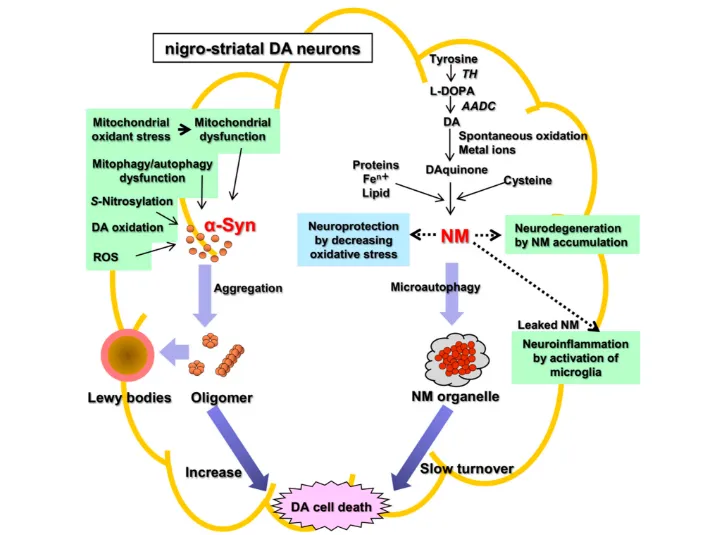
Figure 1. Two histopathological hallmarks in PD in the nigrostriatal DA. Fibrillar oligomers produced by misfolding are presumed to be neurotoxic and cause DA cell death.
Neuromelanin(NM) is also related to neurodegeneration and DA cell death because NM attenuates oxidative stress for neuroprotection. a-Syn, a-synuclein; NM, neuromelanin; TH, tyrosine hydroxylase; AADCaromatic amino acid decarboxylase; ROS, reactive oxygen species.
2. Biosynthesis of Neuromelanin (NM): Tyrosine Hydroxylase and Tyrosinase
The pigmented NM in the human SN has been estimated to be derived from DA and cysteine at a molar ratio of 2:1 [27.
It has been reported that various catechol metabolites are incorporated into NM in the SN dopamine neurons and NE neurons in the LC, formed by oxidative deamination of catecholamines by monoamine oxidase(MAO) and following reduction and oxidation by aldehyde dehydrogenase (ALDHand aldehyde reductase (AR): DOPA, 3,4-dihydroxyphenylacetic acid (DOPAC), and 3,4dihydroxyphenylethanol (DOPET) as dopamine metabolites; 3,4-dihydroxy mandelic acid(DOMA) and 3,4-dihydroxyphenylethylene glycol (DOPEG) as NE metabolites [27-30](Figure 2).
Based on these results, the pathway of NM biosynthesis via DA oxidation toDAquinone (DAÃ) or NE oxidation to NEquinone has been proposed to be similar to that of melanin biosynthesis involving the intrinsic pathway of DOPAquinone (DQ)in human skin and hair [31].
In addition, it has been suggested that various catechol metabolites are incorporated into NM, including DOPA, DOPAC, DOMA, DOPET, andDOPEG, which are metabolites of DA and NE formed by the oxidative deamination by monoamine oxidase followed by oxidation/by reduction 29](Figure 3).
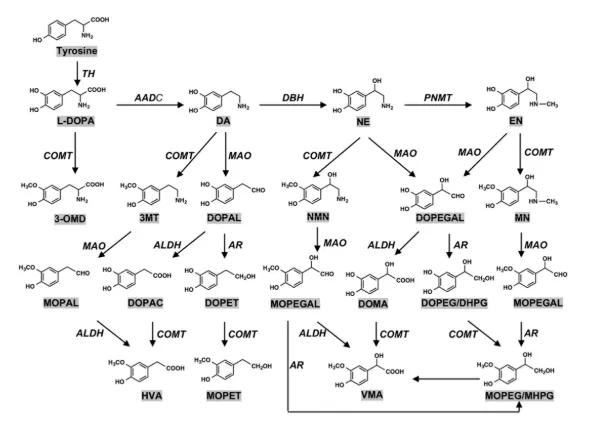
Figure 2. Metabolism of catecholamines. (DOPA) 3,4-dihydroxyphenylalanine; (DA) dopamine; (NE) norepinephrine; (EN) epinephrine; (3-OMD) 3-O-methyldopa; (3MT) 3- methoxytyramine; (DOPAL) 3,4-dihydroxyphenylacetaldehyde; (NMN) normetanephrine; (DOPEGAL) 3,4-dihydroxyphenylglycolaldehyde; (MN) metanephrine; (MOPAL) 3-methoxy4-hydroxyphenylacetaldehyde; (DOPAC) 3,4-dihydroxyphenylacetic acid; (DOPET) 3,4- dihydroxyphenylethanol; (MOPEGAL) 3-methoxy-4-hydroxyphenylglycolaldehyde; (DOMA) 3,4-dihydroxymandelic acid; (DOPEG/DHPG) 3,4-dihydroxylphenylethyleneglycol/3,4- dihydroxyphenylglycol; HVA: homovanillic acid; MOPET: 3-methoxy-4-hydroxyphenylethanol; (VMA) vanillylmandelic acid; (MOPEG/MHPG) 3-methoxy-4-hydroxyphenylethyleneglycol/3- methoxy-4-hydroxyphenylgycol. (TH) tyrosine hydroxylase; (AADC) aromatic amino acid decarboxylase; (DBH) dopamine-β-hydroxylase; (PNMT) phenylethanolamine N-methyltransferase; (COMT) catechol-O-methyltransferase; (MAO) monoamine oxidase; (ALDH) aldehyde dehydrogenase; (AR) aldehyde reductase. Enzyme names are shown in italics for the sake of clarity. Adapted from [28] with minor modifications.

Figure 3. Synthesis of neuromelanin in SN or LC. Possible participation of various catecholamine metabolites known to be present in various regions of the brain that may be incorporated into NM in the substantia nigra (SN) or the locus coeruleus (LC).

In addition to DA and NE and the corresponding Cys derivatives, these other metabolites are also thought to be incorporated into NM. (O) represents the oxidants. Taken
For more information:1950477648nn@gmail.com