Optimization Of Musalais Wine Formula Based On Response Surface Methodology
Apr 29, 2025
Abstract:
In this study, using Musalais wine as base wine, and medicinal and edible homology plants such as black wolfberry, Cistanche deserticola, jujube and sea buckthorn as auxiliary materials, the Musalais wine with new formula was prepared by soaking the base wine with auxiliary materials. Using total flavonoids content and sensory score as response values, the formula of Musalais wine was optimized bya single factor combined with response surface tests. The basic physicochemical indexes were analyzed, and the effects of different auxiliary materials on the physicochemical indexes and sensory evaluation of Musalese wine were investigated. The results showed that the optimal formula of Musalais wine was black wolfberry 8.8 g/L, C. deserticola 8.3 g/L, jujube 10.4 g/L, sea buckthorn 4.2 g/L. The total flavonoids content in the Musalais wine with new formula reached 0.61 g/L under these optimal conditions, with a sensory score of 91, and the contents of total phenols, total flavonoids, fructose and glucose were increased by 0.45 g/L, 0.29 g/L, 5.15 g/L, 7.13 g/L, respectively. All 4 auxiliary materials could increase the malic acid, fructose and glucose contents of the wine, and the addition of jujube and C. deserticola significantly increased the lactic acid content of the wine, while the addition of sea buckthorn significantly increased the total flavonoids content of the wine. The addition of auxiliary materials enhanced the organoleptic complexity of Musalais wine, and the finished wine had a good overall performance in terms of comprehensive, appearance, aroma, taste, and balance.

Keywords: Musalais wine; auxiliary material; total flavonoids content; sensory evaluation

Famous Herb Cistanche Wine In China
As one of the important intangible cultural heritages of the Xinjiang Uygur Autonomous Region, the traditional brewing process of Musalais wine has been passed down through generations.
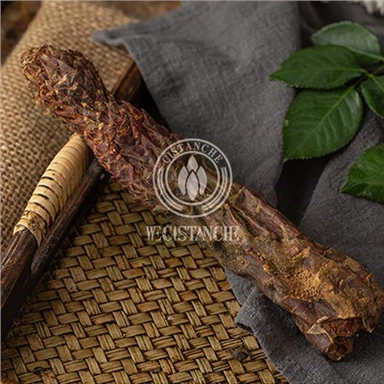
Unlike conventional winemaking methods, the production of Musalais follows a unique process: grape juice is extracted and boiled to obtain the initial fermentation liquid. After cooling to room temperature, it is transferred into fermentation vessels for natural fermentation[^1][^2]. Occasionally, local ingredients such as Cistanche deserticola (Rou Cong Rong), white apricots, and goji berries are added, making it a natural beverage with potential health benefits[^3].
Studies by Gao Xinyu et al.[^4] have shown that adding auxiliary ingredients such as roses, Agastache rugosa, goji berries, and dried apricots can improve the quality of Musalais. In particular, black goji berries, Cistanche, red dates, and sea buckthorn are not only rich in nutritional value but also possess notable medicinal properties. Black goji berries are rich in flavonoids, polysaccharides, and polyphenols[^5–6], and have demonstrated antioxidant, anti-tumor, and immune-modulatory effects[^7–9]. Cistanche deserticola is known for its antioxidant properties, ability to regulate gut microbiota, and immune modulation functions[^10–14], and is often used in functional beverages and health wines[^15–16]. Red dates contain abundant bioactive compounds such as polysaccharides, flavonoids, and polyphenols[^17], which contribute to gastrointestinal health and immune enhancement[^18–21]. Sea buckthorn fruits are recognized for their antioxidant and anti-aging properties[^22–23].
In traditional Musalais production, these adjuncts are typically added by soaking. However, due to a lack of standardized knowledge regarding formulation techniques, the use of ingredients is often inconsistent, resulting in variability in product quality, which negatively affects the development of Musalais[^4].

Famous Herb Cistanche Whiskey For Sale
In this study, Musalais wine was used as the base wine, and four medicinal and edible plants - black goji berries, Cistanche deserticola, red dates, and sea buckthorn - were selected as adjuncts. A new formula of Musalais was prepared by soaking the adjuncts in the base wine. Total flavonoid content and sensory evaluation scores were used as the main evaluation indices. A combination of single-factor experiments and response surface methodology (RSM) was employed to optimize the formulation process. In addition, basic physicochemical properties of the new formula Musalais were analyzed, and the effects of different adjuncts on its physicochemical parameters and sensory quality were investigated. The aim is to fully harness the nutritional and medicinal value of these ingredients, enrich Musalais product varieties, and improve its overall quality.

3. Conclusion
Based on the results of single-factor experiments and subsequent optimization using response surface methodology, the optimal formulation for Musalais wine was determined as follows: 8.8 g/L of black goji berries, 8.3 g/L of Cistanche deserticola, 10.4 g/L of red dates, and 4.2 g/L of sea buckthorn.
Under these optimized conditions, the total flavonoid content in the newly formulated Musalais reached 0.61 g/L, and the sensory score was 91 points, indicating a well-balanced body and rich aroma. Compared to the base wine, the new formulation showed increases in total phenols (+0.45 g/L), total flavonoids (+0.29 g/L), fructose (+5.15 g/L), and glucose (+7.13 g/L).
All four auxiliary ingredients contributed to increased levels of malic acid, fructose, and glucose in the wine. Notably, the addition of red dates and Cistanche significantly increased lactic acid content (P < 0.05), while sea buckthorn significantly enhanced total flavonoid content (P < 0.05).
The addition of these medicinal and edible ingredients enhanced the sensory complexity of Musalais. The final product exhibited excellent overall performance in terms of appearance, aroma, taste, and balance. The resulting Musalais wine displayed a clear and bright color, smooth and full-bodied mouthfeel, lingering aftertaste, and distinctive character.