Part 1:Magnesium Efflux From Drosophila Kenyon Cells Is Critical For Normal And Diet-enhanced Long-term Memory
Mar 17, 2022
for more information:Ali.ma@wecistanche.com
Yanying Wu1, Yosuke Funato2, Eleonora Meschi1, Kristijan D Jovanoski1, Hiroaki Miki2, Scott Waddell1*
1Centre for Neural Circuits and Behaviour, The University of Oxford, Tinsley Building, Oxford, United Kingdom; 2Department of Cellular Regulation, Research Institute for Microbial Diseases, Osaka University, Suita, Japan
Abstract Dietary magnesium (Mg2+) supplementation can enhance memory in young and aged rats. Memory-enhancing capacity was largely ascribed to increases in hippocampal synaptic density and elevated expression of the NR2B subunit of the NMDA-type glutamate receptor. Here we show that Mg2+ feeding also enhances long-term memory in Drosophila. Normal and Mg2+- enhanced fly memory appears independent of NMDA receptors in the mushroom body and instead requires expression of a conserved CNNM-type Mg2+-efflux transporter encoded by the unextended (uex) gene. UEX contains a putative cyclic nucleotide-binding homology domain and its mutation separates a vital role for uex from a function in memory. Moreover, UEX localization in mushroom body Kenyon cells (KCs) is altered in memory-defective flies harboring mutations in cAMP-related genes. Functional imaging suggests that UEX-dependent efflux is required for slow rhythmic maintenance of KC Mg2+. We propose that regulated neuronal Mg2+ efflux is critical for normal and Mg2+-enhanced memory.

Click to Cistanche vitamin shop and Cistanche for memory
Introduction
Magnesium (Mg2+) plays a critical role in cellular metabolism and is considered to be an essential co-factor for more than 350 enzymes (Romani and Scarpa, 2000; Vink and Nechifor, 2011). As a result, alterations of Mg2+ homeostasis are associated with a broad range of clinical conditions, including those affecting the nervous system, such as glaucoma (DeToma et al., 2014), Parkinson’s disease (Hermosura et al., 2005; Hermosura and Garruto, 2007; Lin et al., 2014; Shindo et al., 2016), Alzheimer’s disease (Andra´si et al., 2000; Andra´si et al., 2005; Cilliler et al., 2007; Durlach et al., 1997; Glick, 1990; Lemke, 1995; Chui et al., 2011; Vural et al., 2010), anxiety (Sartori et al., 2012), depression (Whittle et al., 2011; Murck, 2002; Murck, 2013; Rasmussen et al., 1990; Ghafari et al., 2015), and intellectual disability (Arjona et al., 2014).
Perhaps surprisingly, increasing brain Mg2+ through diet can enhance neuronal plasticity and memory performance of young and aged rodents, measured in a variety of behavioral tasks (Slutsky et al., 2010; Landfield and Morgan, 1984; Mickley et al., 2013; Abumaria et al., 2013). In addition, elevated Mg2+ reduced cognitive deficits in a mouse model of Alzheimer’s disease (Li et al., 2013) and enhanced the extinction of fear memories (Abumaria et al., 2011). These apparently beneficial effects have led to the proposal that dietary Mg2+ may have therapeutic value for patients with a variety of memory-related problems (Billard, 2011).
Despite a large number of potential sites of Mg2+ action in the brain, the memory-enhancing property in rodents has largely been attributed to increases in hippocampal synaptic density and the activity of N-methyl-D-aspartate glutamate receptors (NMDARs). Extracellular Mg2+ blocks the channel pore of the NMDAR and thereby inhibits the passage of other ions (Mayer et al., 1984; digest The proverbial saying ‘you are what you eat’ perfectly summarizes the concept that our diet can influence both our mental and physical health. We know that foods that are good for the heart, such as nuts, oily fish, and berries, are also good for the brain. We know too that vitamins and minerals are essential for overall good health. But is there any evidence that increasing your intake of specific vitamins or minerals could help boost your brainpower?
While it might sound almost too good to be true, there is some evidence that this is the case for at least one mineral, magnesium. Studies in rodents have shown that adding magnesium supplements to food improves how well the animals perform memory tasks. Both young and old animals benefit from additional magnesium. Even elderly rodents with a condition similar to Alzheimer’s disease show less memory loss when given magnesium supplements. But what about other species?
Wu et al. now show that magnesium supplements also boost memory performance in fruit flies. One group of flies was fed with standard cornmeal for several days, while the other group received cornmeal supplemented with magnesium. Both groups were then trained to associate an odor with a food reward. Flies that had received the extra magnesium showed better memory for the odor when tested 24 hours after training.
Wu et al. show that magnesium improves memory in the flies via a different mechanism to that reported previously for rodents. In rodents, magnesium increased levels of a receptor protein for a brain chemical called glutamate. In fruit flies, by contrast, the memory boost depended on a protein that transports magnesium out of neurons. Mutant flies that lacked this transporter showed memory impairments. Unlike normal flies, those without the transporter showed no memory improvement after eating magnesium-enriched food. The results suggest that the transporter may help adjust magnesium levels inside brain cells in response to neural activity.
Humans produce four variants of this magnesium transporter, each encoded by a different gene. One of these transporters has already been implicated in brain development. The findings of Wu et al. suggest that the transporters may also act in the adult brain to influence cognition. Further studies are needed to test whether targeting the magnesium transporter could ultimately hold promise for treating memory impairments.
Bekkers and Stevens, 1993; Jahr and Stevens, 1990; Nowak et al., 1984). Importantly, prior neuronal depolarization, driven by other transmitter receptors, is required to release the Mg2+ block on the NMDAR and permit glutamate-gated Ca2+ influx. The NMDAR, therefore, plays an important role in neuronal plasticity as a potential Hebbian coincidence detector. Acute elevation of extracellular Mg2+ concentration ([Mg2+]e) within the physiological range (0.8–1.2 mM) can antagonize induction of NMDAR-dependent long-term potentiation (Dunwiddie and Lynch, 1979; Malenka et al., 1992; Malenka and Nicoll, 1993; Slutsky et al., 2004). In contrast, increasing [Mg2+]e for several hours in neuronal cultures leads to enhancement of NMDAR mediated currents and facilitation of the expression of LTP (Slutsky et al., 2004). The enhancing effects of increased [Mg2+]e were also observed in vivo in the brain of rats fed with Mg2+-L-threonate (Slutsky et al., 2010). Hippocampal neuronal circuits undergo homeostatic plasticity (Turrigiano, 2008) to accommodate the increased [Mg2+]e by upregulating expression of NR2B subunit-containing NMDARs (Slutsky et al., 2004; Slutsky et al., 2010). The higher density of hippocampal synapses with NR2B containing NMDARs are believed to compensate for the chronic increase in [Mg2+]e by enhancing NMDAR currents during burst firing. In support of this model, mice that are genetically engineered to overexpress NR2B exhibit enhanced hippocampal LTP and behavioral memory (Tang et al., 1999).
Olfactory memory in Drosophila involves a heterosynaptic mechanism driven by reinforcing dopaminergic neurons, which results in presynaptic depression of cholinergic connections between odor-activated mushroom body (MB) Kenyon cells (KCs) and downstream mushroom body output neurons (MBONs) (Schwaerzel et al., 2003; Aso et al., 2010; Aso et al., 2012; Claridge-Chang et al., 2009; Burke et al., 2012; Liu et al., 2012; Plac¸ais et al., 2013; Owald et al., 2015; Hige et al., 2015; Barnstedt et al., 2016; Parisse et al., 2016; Aso et al., 2014; Oswald and Waddell, 2015). In addition, olfactory information is conveyed to KCs by cholinergic transmission from olfactory projection neurons (Yasuyama et al., 2002; Leiss et al., 2009). Although it is conceivable that glutamate is delivered to the MB network via an as yet to be identified route, there is currently no obvious location for NMDAR-dependent plasticity in the known architecture of the cholinergic input or output layers (Barnstedt et al., 2016). The fly, therefore, provides a potential model to investigate other mechanisms through which dietary Mg2+ might enhance memory.
The reinforcing effects of dopamine depend on the Dop1R D1-type dopamine receptor (Kim et al., 2007; Qin et al., 2012; Handler et al., 2019), which is positively coupled with cAMP production (Tomchik and Davis, 2009; Boto et al., 2014). Moreover, early studies in Drosophila identified the dunce and rutabaga encoded cAMP phosphodiesterase and type I Ca2+-stimulated adenylate cyclase, respectively, to be essential for olfactory memory (Dudai et al., 1976; Byers et al., 1981; Dudai and Zvi, 1984; Chen et al., 1986; Livingstone et al., 1984; Levin et al., 1992). Studies in mammalian cells have shown that hormones or agents that increase cellular cAMP level often elicit a significant Na+-dependent extrusion of Mg2+ into the extracellular space (Romani and Scarpa, 1990b; Romani and Scarpa, 1990a; Romani and Scarpa, 2000; Vink and Nechifor, 2011; Vormann and Gu¨nther, 1987). However, it is unclear whether Mg2+ extrusion plays any role in-memory processing.
Here we demonstrate that Drosophila long-term memory (LTM) can be enhanced with dietary Mg2+ supplementation. We find that the unextended (uex) (Maeda, 1984; Coulthard et al., 2010) gene, which encodes a functional fly ortholog of the mammalian Cyclin M2 Mg2+-efflux transporter (CNNM) proteins, is critical for the memory-enhancing property of Mg2+. UEX function in MB KCs is required for LTM and functional restoration of uex reveals the MB to be the key site of Mg2+-dependent memory enhancement. Chronically changing cAMP metabolism by introducing mutations in the dnc or rut genes alters the cellular localization of UEX. Moreover, mutating the conserved cyclic nucleotide-binding homology (CNBH) domain in UEX uncouples an essential role for uex from its function in memory. UEX-driven Mg2+ efflux is required for slow rhythmic maintenance of KC Mg2+ levels suggesting a potential role for Mg2+ flux in-memory processing.

Results
Mg2+ feeding enhances LTM of wild-type flies
Prior studies reported that feeding rats with food containing a high concentration of Mg2+-enhanced their learning and memory capability (Slutsky et al., 2010; Landfield and Morgan, 1984; Abumaria et al., 2011; Mickley et al., 2013; Abumaria et al., 2013). We, therefore, tested whether similar effects exist in flies by feeding them with food containing a high concentration of Mg2+ before training. Surprisingly, wild-type flies fed for 4 days before training with food supplemented with additional magnesium chloride (MgCl2) exhibited significantly enhanced 24 hr memory performance. Memory enhancement depends on concentration and was maximal when food was supplemented with 80 mM MgCl2 (Figure 1A). Immediate memory performance was not obviously enhanced (Figure 1B). The enhancing effect of MgCl2 was also observed in flies fed with magnesium sulfate (MgSO4) but not calcium chloride (CaCl2) (Figure 1C). In addition, feeding flies for 4 days with food containing between 5 and 80 mM strontium chloride (SrCl2) resulted in high levels of mortality and flies that survived 5 mM SrCl2 feeding did not show enhanced immediate or 24 hr memory performance (data not shown). The memory-enhancing effects can therefore be specifically attributed to dietary supplementation of divalent Mg2+.
Mg2+-enhanced memory is independent of NMDAR in the mushroom bodies
Since magnesium-L-threonate enhanced memory in rats was correlated with an upregulation of hip- pocampal NR2B subunit-containing NMDARs (Slutsky et al., 2010), we tested for changes in glutamate receptor expression in flies fed with MgCl2. RT-qPCR analyses did not reveal a significant difference in the abundance of mRNAs for the putative NMDA (Nmdar1, Nmdar2), AMPA (GluRIA), or kainate-type (GluRIIA) receptors in heads taken from flies fed for 4 days with 80 mM MgCl2 versus those fed with 1 mM MgCl2 (Figure 1D).
We next directly tested whether Mg2+-enhanced memory required NMDAR function, by knocking down expression of the Nmdar1 or Nmdar2 genes using transgenic UAS-driven RNA interference
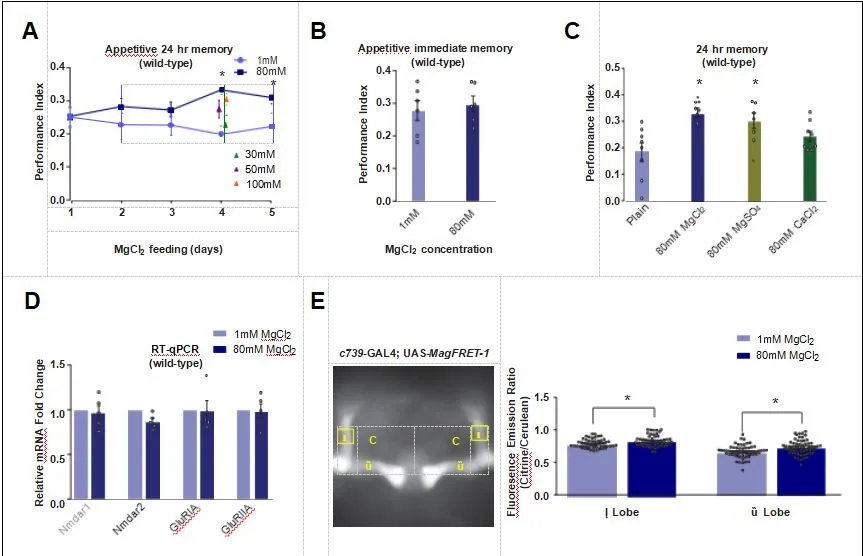
Figure 1. Dietary Mg2+ supplementation enhances Drosophila's long-term memory. (A) Wild-type flies were trained and tested for 24 hr appetitive memory after 1–5 days of ad libitum feeding on food supplemented with Mg2+. Memory was significantly enhanced in flies fed for 4 days with 80 mM MgCl2, as compared to those fed with 1 mM. 80 mM MgCl2 produced marginally higher performance than 50 mM or 100 mM and so was considered optimal (asterisks denote p<0.05, t-test between 1 mM and 80 mM groups for each time point, n = 6–8). (B) 4 days of 80 mM MgCl2 food did not enhance immediate memory. (C) Appetitive 24 hr memory was enhanced by feeding wild-type flies for 4 days with MgCl2 and MgSO4, but not CaCl2. Asterisks denote significant differences (p<0.05, ANOVA, n = 6) between Mg2+ fed and plain groups. (D) RT-qPCR showed no significant differences in glutamate receptor mRNA expression between 1 mM and 80 mM fed flies (t-test, n = 5). (E) c739-GAL4; UAS-MagFRET-1 flies were fed for 4 days on food supplemented with Mg2+. Brains were dissected and fixed and a fluorescence emission ratio measurement (Citrine/Cerulean) was taken as an indicator of [Mg2+]i. The MagFRET signal was significantly greater in the ab lobes of flies fed with 80 mM MgCl2 than those fed with 1 mM MgCl2 (p<0.05, t-test, n = 52–60). Unless otherwise noted, all data are mean ± standard error of the mean (SEM). Asterisks denote significant differences (p<0.05), individual data points displayed as open circles.
The online version of this article includes the following figure supplement(s) for figure 1:
Figure supplement 1. Knockdown of N-methyl-D-aspartate glutamate receptor (NMDAR) in mushroom bodies does not impair Mg2+-enhanced memory.
(RNAi) constructs (Dietzl et al., 2007; Perkins et al., 2015). Of the two independent UAS-Nmdar1R- NAi and four UAS-Nmdar2RNAi lines we tested, only one Nmdar1RNAi (BDSC 25941) line, when driven in all neurons by neuronal Synaptobrevin (nSyb)-GAL4, exhibited significantly decreased 24 hr memory performance, as compared to that of heterozygous control flies (Figure 1—figure supplement 1A). In contrast, more selective expression of this UAS-Nmdar1RNAi in LTM-relevant ab KCs using c739-GAL4 did not significantly impair 24 hr memory performance (Figure 1—figure supplement 1B). Moreover, flies expressing Nmdar1RNAi in ab neurons retained robust Mg2+-enhanced memory (Figure 1—figure supplement 1C). These results suggest that Mg2+-enhanced memory does not alter the expression of glutamate receptors, or require NMDAR function in ab KCs.

Mg2+ concentration in ab neurons is elevated in flies fed high Mg2+ We used MagFRET, the first genetically encoded fluorescent Mg2+ sensor (Lindenburg et al., 2013), to test whether Mg2+ feeding altered the intracellular Mg2+ concentration ([Mg2+]i). We constructed flies harboring a UAS-MagFRET-1 transgene and combined it with c739-GAL4 to express MagFRET- 1 in ab KCs. We compared the FRET signals in fixed brains from c739; UAS-MagFRET-1 flies fed with either 1 mM or 80 mM MgCl2 food for 4 days. The MagFRET signal was significantly higher in both the a and b collaterals of ab KCs of flies fed with 80 mM, than in those fed with 1 mM (Figure 1E). This result indicates that Mg feeding elevates neuronal [Mg2+]i. Given the affinity of MagFRET-1 (Kd = 148 mM) and the ~50% increase in FRET signal upon Mg2+ binding (Lindenburg et al., 2013), we estimate that the ~8% enhancement of the MagFRET signal measured in flies fed 80 mM MgCl2 corresponds approximately to a 50 mM increase of ab KC [Mg2+]i on average.
The unextended encoded CNNM-type Mg2+ transporter has a role in memory
We identified unextended (uex; Maeda, 1984; Coulthard et al., 2010) as a gene-altering appetitive olfactory LTM, reinforced with a sucrose reward. Flies with the uexMI01943 MiMIC insertion (Venken et al., 2011) showed a strong defect in 24 hr memory, but their performance immediately after training was indistinguishable from that of wild-type controls. More detailed analysis of uexMI01943 flies revealed a steady decay of memory that first became significantly different to that of wild-type flies 12 hr after training (Figure 2A). No memory defect was evident in heterozygous uexMI01943/+ flies, demonstrating that this putative sex allele is recessive.
uex piqued our attention because it is the single fly ortholog of the four human CNNM genes that encode Mg2+ transporters (Ishii et al., 2016), and it also contains a putative CNBH domain that is structurally related to those in cyclic nucleotide-gated channels (Zagotta et al., 2003; Flynn et al., 2007; Kesters et al., 2015). Alignment of the 834 amino acid UEX sequence with CNNM1-4 reveals particularly high sequence conservation with CNNM2 and CNNM4 in the DUF21, CBS pair, and CNBH domains (Figure 2—figure supplement 1A–C). We, therefore, hypothesized that UEX had the potential to link the memory-enhancing effects of dietary Mg2+ with cAMP-dependent neuronal plasticity.
Although uexMI01943 is assigned to the uex gene, the MiMIC element is annotated to lie 17 kb downstream of the uex coding region (Venken et al., 2011; Figure 2B). RYa (Yoon et al., 2016) is the next nearest gene to uexMI01943 but is >230 kb further away. We first confirmed the MiMIC location by inverse PCR (Attrill et al., 2016). Importantly, no additional MiMIC insertion was detected in these flies. We next tested whether uexMI01943 was responsible for the memory defect by precisely removing the MiMIC element by Minos transposase-mediated excision (Arca` et al., 1997; Figure 2— figure supplement 2A and B). MiMIC removal in uexMI01943.ex1 and uexMI01943.ex2 flies restored normal 24 hr memory performance, demonstrating that the MiMIC insertion is required for the uexMI01943 memory defect (Figure 2C).

Both qRT-PCR of mRNA and western blot analysis of protein extracts from fly heads failed to reveal a significant difference in uex/UEX expression in uexMI01943 flies. We, therefore, used CRISPR to introduce a stop codon into the fifth coding exon of the uex locus (Figure 2B and Figure 2—fig- ure supplement 2C). Flies homozygous for the resulting uexD mutation were not viable as adults, dying at the larval stage. In contrast, heterozygous uexMI01943/uexD flies were viable, but their 24 hr appetitive memory was significantly impaired (Figure 2D). These data demonstrate that uex is an essential gene and that uexMI01943 is a viable hypomorphic allele of uex.
We also tested the aversive memory performance of uexMI01943 mutant flies. Homozygous uexMI01943 flies exhibited immediate memory that was indistinguishable from that of heterozygous and wild-type controls (Figure 2E). However, their 24 hr memory, formed following either five trials of aversive spaced training (Tully et al., 1994; Jacob and Waddell, 2020), or one trial of fasting facilitated training (Hirano et al., 2013), was significantly impaired (Figure 2E). These experiments suggest that uexMI01943 flies are more generally compromised in their ability to form LTM. Unless otherwise specified, all subsequent analyses of memory in this study use appetitive sugar-rewarded conditioning.
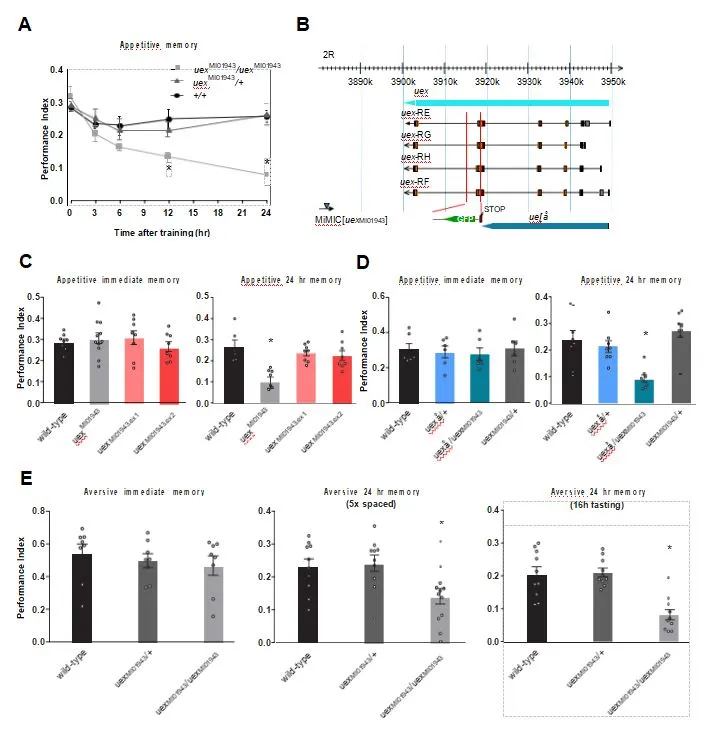
Figure 2. uexMI01943 mutant flies have defective long-term memory (LTM). (A) Appetitive memory retention was tested at various times after training. Flies homozygous for uexMI01943 showed a significant defect in memory from 12 hr after training, as compared to the performance of heterozygous uexMI01943/+ and wild-type control flies (p<0.05, ANOVA, n = 6–10). (B) The uex locus lies on chromosome 2R between 3,900,285 and 3,949,425 (light blue bar). The four alternate uex transcripts, uex-RE, uex-RG, uex-RH, and uex-RF, all encode the same protein. The uexMI01943 MiMIC (blue triangle) resides ~17 kb downstream of the uex coding region. The CRISPR/Cas9 edited uexD allele replaces a 3047 bp fragment, including Exon 7 of uex with a STOP signal (termination codon in all three reading frames) and a GFP cassette, truncating the uex reading frame (dark blue bar). (C) Precise excision of the uexMI01943 MiMIC restores normal 24 hr memory to uexMI01943.ex1 and uexMI01943.ex2 flies (p<0.05, ANOVA, n = 8–11). (D) uexD fails to complement the 24 hr memory defect of uexMI01943 (p<0.05, ANOVA, n = 6–8). (E) Flies homozygous for uexMI01943 showed a significant defect in aversive LTM, as Figure 2 continued on next
Figure 2 continued
compared to the performance of heterozygous uexMI01943/+ and wild-type control flies (p<0.05, ANOVA, n = 8–12). An LTM defect was also observed following five cycles of aversive spaced training and a 16 hr fasting facilitated one-cycle training protocol. Immediate aversive memory was unaffected in uexMI01943 homozygous mutant flies.
The online version of this article includes the following source data and figure supplement(s) for figure 2:
Source data 1. Table of sugar and olfactory sensory acuity controls for all behavioral experiments in this manuscript.
Figure supplement 1. Conservation of UEX with its orthologs.
Figure supplement 2. Construction schemes for uex Mino's excision and creation of the uexD allele.