Part 2:Effect Of Acteoside As A Cell Protector To Produce A Cloned Dog
Mar 05, 2022
Ji Hye Lee1☯, Ju Lan Chun1☯, Keun Jung Kim1 , Eun Young Kim1 , Dong-hee Kim1, Bo Myeong Lee1 , Kil Woo Han1 , Kang-Sun Park1 , Kyung-Bon Lee2 , Min Kyu Kim1*
Contact: joanna.jia@wecistanche.com
Pls click here to part 1
Pls click here to Part 3

Acteoside in cistanche has many health benefits
Statistical analysis
Data were analyzed using IBM SPSS statistics (SPSS Inc., Chicago, IL USA) by one-way ANOVA and Tukey’s honestly significant difference test. Differences were considered statistically significant when the P-value was less than 0.05.
Results
Effect of acteoside on the cell cycle synchronization
The effect of acteoside on cell cycle synchronization was investigated using fluorescence-activated cell sorting (FACS) (Table 1). Canine fetal fibroblasts were treated with various concentrations of acteoside (10, 30, 50 μM) for different durations (24, 48, 72 h), and the cells were separated into G0/G1 stage, S stage, and G2/M stage by FACS. The results of FACS were compared with those of the cells synchronized by serum starvation and contact inhibition. Serum starvation resulted in the highest rate of cell cycle synchronization (88.2%) at the G0/G1 stage compared to those of the contact inhibition (84.6%) and acteoside treatment (80.8–84.5%). Acteoside treatment for 24 h induced G0/G1 cell cycle synchronization at the lowest efficiency (80.8, 81.1, and 82.0%). Acteoside was most effective in inducing G0/G1 cell cycle synchronization at 30 μM concentration and treatment duration of 48 h (84.5%). However, there was no significant difference among concentrations and durations of acteoside treatment in the induction of G1/G0 cell cycle synchronization. Overall, acteoside treatment showed no significant difference compared to serum starvation and contact inhibition in terms of G0/G1 cell cycle synchronization. There was also no difference in cell cycle synchronization at the S stage among the three groups. In addition, the proportion of cells arrested at the G2/M stage was similar to that of cells arrested at the G0/G1 stage.
Table 1. Effect of contact inhibition, serum starvation, and acteoside treatment on cell cycle synchronization in canine fetal fibroblasts.


Fig 1. ROS levels in canine fetal fibroblasts. Cell cycle synchronization by (A) contact inhibition, (B) serum starvation, and (C) 30 μM acteoside treatment for 48 h. Histograms show levels of ROS detected in canine fetal fibroblasts.
Effect of acteoside on ROS and apoptosis
The effect of acteoside on ROS was determined by FACS using carboxy-H2DCFDA, an oxidative stress indicator that is activated in cells when esterases remove acetate groups between cells (Fig 1). ROS was detected at lower levels in acteoside treated cells than in cells synchronized by serum starvation or contact inhibition. The level of ROS was significantly lower in the acteoside treatment group (42.8%) than in the contact inhibition and serum starvation groups (54.3 and 99.5% respectively) (Table 2).
To understand the effect of acteoside on cell survival and death, apoptosis was investigated in cells after induction of cell cycle synchronization. The survival rate of acteoside-treated cells (94.8 ± 1.2%) was significantly higher than both contact inhibition and serum starvation groups (87.3 ± 0.5%) (Fig 2D). The rates of apoptosis in the serum starvation group
(52.1 ± 5.3%) were significantly higher than those in the contact inhibition and acteoside treatment groups (Fig 2E). Apoptosis observed in the contact inhibition group was 10.6%, which was also significantly higher than the acteoside treatment group (4.2%) (Fig 2E). In addition, there was less necrosis found in acteoside treated cells compared to that in the contact inhibition group (Fig 2F).
Cistanche deserticola acteoside can enhance immunity and reduce apoptosis
Effect of acteoside on in vitro development of canine nuclear transfer embryos
To investigate the effect of acteoside in SCNT embryo development, nuclear donor cells were transferred into canine enucleated oocytes after cell cycle synchronization by acteoside. As shown in Table 3, there were no significant differences in early embryo development from the nuclear
Table 2. Quantification of ROS

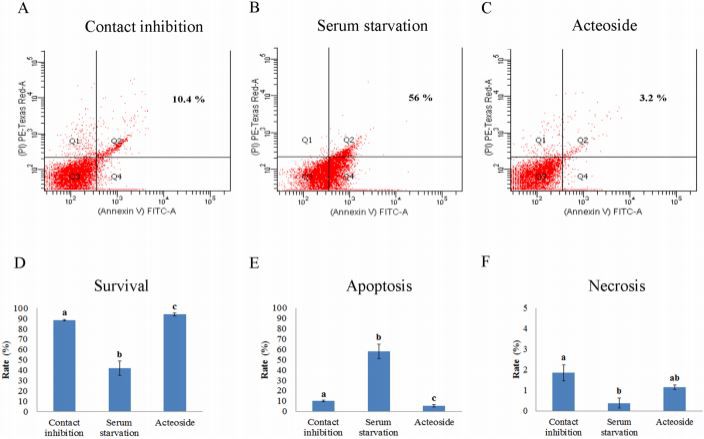
Fig 2. Rates of cell survival, apoptosis, and necrosis of canine fetal fibroblasts. Apoptotic cells in the (A) contact inhibition, (B) serum starvation and (C) 30 μM acteoside treatment for 48 h group were determined by FACS; Quantitative analysis of the FACS results of (D) cell survival, (E) apoptosis, and (F) necrosis. This experiment was repeated four times independently. (P<0.05)
donor cells with different cell cycle synchronization methods of either contact inhibition or acteoside treatment. However, only the canine SCNT embryos engineered by using the nuclear donor cells synchronized at G0/G1 stage with acteoside developed beyond the 10-cell embryo stage.
Production of a cloned dog using cells cultured with acteoside
Fifty-seven cloned canine embryos produced using contact inhibited donor cells were surgically transferred into the oviducts of 6 recipients. None of the 6 recipients produced offspring
Table 3. In vitro development of canine nuclear transfer embryos.

Table 4. Production of a cloned dog by SCNT.

or even became pregnant. Thirty-eight cloned canine embryos produced from acteoside- treated donor cells were also surgically transferred into the oviducts of 3 recipients. Pregnancy was confirmed in one of the three surrogate mothers, who eventually gave birth, by cesarean section, to a healthy puppy weighing 354 g (Table 4 and Fig 3). To determine the origin of the genome, microsatellite amplification was performed with the genes of the cloned dog. Microsatellites are short tandem repeated sequences used in genome screens for tracing the heredity and linkage analysis in families. Seven microsatellite markers were used to identify the origin of the genome in the cloned dog (Table 5). The cloned dog and donor cells used to clone the dog possessed the same microsatellite markers, whereas the oocyte donor and surrogate shared only partial alleles (Table 5). In the maternal ancestry test, the cloned dog and the recipient oocyte had identical mitochondrial DNA (mtDNA) sequences, showing that the mtDNA of the cloned dog was derived from the oocyte donor (Table 6).

acteoside in cistanche
Discussion
Synchronization of the donor cell cycle is an important factor to improve SCNT efficiency [43]. The rate of SCNT embryo development and the efficiency of cloning animal productions

Fig 3. A cloned dog: (A) Ultrasonogram of the fetus in the fetal vesicle at 32 days after embryo transfer; (B) The cloned beagle at 2 months of age.

acteoside in cistanche can anti-aging