Part1: Anti-Malignant Ascites Effect Of Total Diterpenoids From Euphorbiae Ebracteolatae Radix Is Attributable To Alterations Of Aquaporins Via Inhibiting PKC Activity in The Kidney
May 18, 2022
For more info. contact tina.xiang@wecistanche.com
Abstract: This study evaluated the anti-ascites effect of total diterpenoids extracted from Euphorbiae ebracteolate Radix(TDEE)on malignant ascitic mice and elucidated its underlying mechanism. TDEE was extracted by dichloromethane and subjected to column chromatography. The purity of six diterpenoids isolated from TDEE was determined to be 77.18% by HPLC. TDEE (3 and 0.6 g raw herbs/kg, p.o.) reduced ascites and increased urine output. Meanwhile, analysis of tumor cell viability, cycle, and apoptosis indicated that TDEE had no antitumor activity. In addition, the expression levels of aquaporins (AQPs) and the membrane translocation levels of protein kinase C (PKC) α and PKCβ in kidneys and cells were measured. TDEE reduced the levels of AQP1-4 and inhibited PKCβ expression in the membrane fraction. Four main diterpenoids, except compound 2, reduced AQP1 levels in human kidney-2 cells. Compounds 4 and 5 inhibited AQP2-4 expression in murine inner medullary collecting duct cells. The diterpenoid-induced inhibition of AQP1-4 expression was blocked by phorbol-12-myristate-13-acetate (PMA; agonist of PKC). The diterpenoids from TDEE are the main anti-ascites components. The anti-ascites effect of diterpenoids may be associated with alterations in AOPs in the kidneys to promote diuresis. The inhibition of AOP1-4 expression by TDEE is related to the inhibition of PKCβ activation.
Keywords: Euphorbia ebracteolate Hayata; diuresis; bioactive components; terpenoids; kidney cells; PKC inhibitor

Click to learn cistanche herb benefits
1. Introduction
Euphorbia ebracteolate Hayata (EEH) is a member of the genus Euphorbia in the family Euphorbiaceae and is widely used in the treatment of abdominal distension and edema, parasitic infection, tuberculosis, and other diseases in traditional Chinese medicine(TCM)[1]. The root of EEH (EER) contains various terpenoids, which are considered to be effective components. Recent studies on terpenoids have been conducted to determine their anti-inflammatory, antiviral,anti-tuberculosis, and other effects in vitro [2-5]. However, basic research investigations on the traditional effects of EER in the treatment of abdominal distension and edema are limited. According to the theory of TCM, EER can rapidly eliminate abdominal distension and edema by promoting urination and diarrhea [6]. Our previous studies have shown that total diterpenoids from EER (TDEE) can cause diarrhea by regulating the expression of aquaporin (AQP)-1 and AQP3 [7]. However, to date, the effective substances of anti-ascites in EER remain unclear.
Abdominal distension and edema are described as ascites in modern medicine. Ascites are a pathological accumulation of peritoneal fluid [8]. There are many causes of ascites formation, such as cirrhosis, tumor, heart failure, and nephrotic syndrome [9]. The occurrence of ascites is related to portal hypertension, which leads to splanchnic arterial vasodilation, reduction in the effective circulating volume, activation of endogenous vasoconstrictor systems, and avid water retention in the kidneys [10]. AQPs are rapid membrane transporters of water for crossing epithelial and endothelial barriers and thus play a fundamental role in maintaining water balance [11]. Numerous studies have shown that AQPs play a key role in the formation and disorder of ascites [12-15]. There are many kinds of AQPs in the kidneys, such as AQP1, AQP2, AQP3, and AQP4[16]. Because TDEE can regulate the expression of AQPs in the intestine [7], we propose that TDEE may be utilized in the treatment of ascites by regulating AQPs in the kidneys.
AQPs play a critical role in urine formation, however, the mechanisms of regulating AQPs expression in kidneys have not been clarified. Currently, only a limited number of reports indicate that AQPs are regulated through protein kinase C(PKC) and protein kinase A(PKA)pathways [17-20]. Some terpenoids isolated from Euphorbia (e.g., uphold and ingenol 3-angelate) have regulatory effects on PKC. TDEE may regulate AQPs expression in kidneys by the PKC pathway.
In this study, we extracted TDEE and evaluated its anti-ascites effect as well as ana-lyzed AQPs expression, PKC, and PKA activities in the kidneys of ascitic mice. Then, we isolated and purified the main diterpenoids from TDEE to investigate its effects on AQPs protein and mRNA expression levels in two kinds of kidney cells (human kidney-2 cells (HK-2) and murine inner medullary collecting duct cells(mIMCD3)). Finally, we choose a diterpenoid compound (euphebracteolatin A), using phorbol-12-myristate-13-acetate (PMA; agonist of PKC) to activate the PKC pathway, to identify whether the expression of AQPs in kidneys is regulated by PKC pathway. This study aimed to determine the anti-ascites effect of TDEE in EER and provide a basis for the clinical application of EER and identification of candidate drugs for diuresis and anti-ascitic effects.

2. Results
2.1.Effects of TDEE on Ascitic Fluid Weight, Urine Weight, and Fecal Water Content
Treatment of ascitic mice with total extract of EER (TEER) and TDEE (3 and 0.6 g raw herbs/kg, p.o.) and furosemide (positive drug) significantly reduced the increase in ascitic fluid weight compared to the model group (Figure 1A). Figure 1C showed that the urine weights significantly (p<0.05, compared to the model group)increased in ascitic mice pretreated with TEER, TDEE, and furosemide. In addition, in the TEER and TDEE groups at a dose of 3 g raw herbs/kg, a significant increase in fecal water content was observed compared with the model group (Figure 1D). However, the non-diterpenoid fraction of EER(NTDEE) groups showed no significant influence on ascites weight, urine weight, and fecal water content compared to the model group.

2.2. Effects of TDEE on Serum Albumin Levels in Ascitic Mice
Serum albumin is the most abundant protein in vertebrate plasma and can maintain the osmotic pressure of blood and regulate water transport. Figure 1B showed that the production of ascites in model mice caused a significant decrease in serum albumin compared to the normal group. After treatment with furosemide, TEER, and TDEE(3 and 0.6 g raw herbs/kg, p.o.), the levels of serum albumin were effectively recovered compared to the model group. No improvement in this index was observed in the NTDEE groups.
2.3.Effects of TDEE on Tumor Cell Viability, Cycle, and Apoptosis in Ascitic Mice
In malignant ascites, tumor cells float in the ascitic fluid. We evaluated whether the reduction in ascites is related to the anticancer activity of the TEER and TDEE. The results showed that these drugs did not inhibit the tumor cell viability (Figure 2A)and did not lead to cell cycle arrest(Figure 2B) and apoptosis (Figure 2C, D).


2.4.Effects of TDEE on AQPs Expression in the Kidneys of Ascitic Mice
The kidney is an important organ for water reabsorption and urinary concentration. AQP water channels mediate the rapid transport of water in the kidneys. Thus, we examined the expression of AQPs in the kidneys. Figure3 showed that the enhancement of ascites had little effect on AQPsexpression in the kidneys in comparison with the normal group. When treated with TEER and TDEE, the expression of AQP1, AQP2, AQP3, and AQP4 proteins was markedly lower than in the model group at most doses. TEER resulted in a significant decrease in AQP2, AQP3, and AQP4 expression at doses of 3.0 and 0.6g raw herbs/kg, whereas AQP1 expression was only reduced at a low dose(0.6g raw herbs/kg). Notably, TDEE had the same inhibitory effects on AQP3 and AQP4 expression as TEER at two doses. The difference between TDEE and TEER is that TDEE inhibited the expression of AQP1 and AQP2 only at a high dose (3g raw herbs/kg).NTDEE had weak effects on AQPslevels in kidneys, and only regulated the expression of AQP4 protein at a dose of 3g raw herbs/kg.

2.5.Effects of TDEE on PKC and PKA Activation in the Kidneys of Ascitic Mice
Previous studies have indicated that AQPs expression could be regulated by PKC and PKA activation. We examined the effects of TDEE on PKC-a, PKC-β, and PKA activation. PKC activation was measured by its translocation from the cytosol to the cell membrane. As shown in Figures 4A, and B, the protein expression level of PKC-β in the membrane fraction was significantly decreased in TDEE groups, whereas there was no significant effect on the expression level of PKC-α membrane protein. Phospholipase C(PLC) is an important upstream signaling molecule that mediates the activation of PKC.TDEE treatment did not have any effect on the levels of phosphorylated and total PLC (Figure 4D). The PKA is a heterotetramer consisting of two catalytic subunits bound to two regulatory subunits. The release of catalytic subunits is a hallmark of PKA activation. In Figure 4C, TDEE did not affect the expression of PKA catalytic subunits.

2.6.Determination of Content of Six Diterpenoids in TDEE by High-Performance Liquid Chromatography (HPLC)
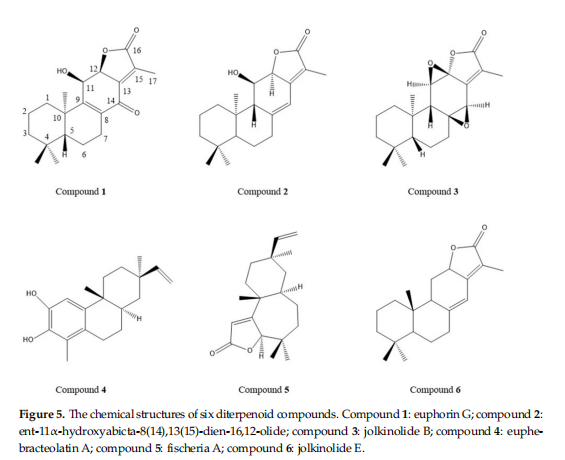
The results of animal experiments showed that TDEE was the main effective fraction of EER. We isolated six diterpenoids(the structures of compounds 1 to 6 are shown in Figure 5; the spectral data were added to the Supplementary Material) from TDEE and used these compounds as standards to determine diterpenoids content in TDEE. The HPLC chromatograms for TDEE and the six diterpenoid standards are presented in Figure 6. The content of compounds 1 to6 were 1.07%,12.00%,12.69%,9.15%, 39.26% and 3.02%, respectively, accounting for 77.18% of TDEE.

2.7.Effects of Diterpenoids from TDEE on AQPs Expression in Kidney Cells
TDEE was the active fraction of EER that inhibited ascites by reducing AQP1, AQP2, AQP3, and AQP4 expression in the kidneys. At the same time, TDEE also significantly reduced the protein and mRNA expression of AQP1, AQP2, AQP3, and AQP4 in human kidney-2 cells(HK-2)and murine inner medullary collecting duct cells (mIMCD3)(Figure 7). The main components of TDEE are diterpenoids. We compared the effects between TDEE and diterpenoids mixture (six isolated diterpenoids were mixed according to their content in TDEE). The results showed that the inhibitory effects of diterpenoids mixture and TDEE on AQP1, AQP2, AQP3, and AQP4 expression were similar (Figure 7). The activities of four main diterpenoids from TDEE were evaluated in vitro. Figures 8 and 9 showed that the protein and mRNA expression levels of AQP1 in HK-2 cells were significantly reduced by compounds 3,4 and 5. Treatment with compound 2 did not induce a notable decrease in AOP1 at the protein and mRNA levels. For these compounds, compound 3(an ent-abietane type diterpenoid)was more active than the other compounds. In mlMCD3 cells, four diterpenoid compounds induced different degrees of inhibition of AQP2, AQP3, and AQP4 expression. The results of the protein and gene expression are presented in Figures 8 and 9. Compounds 4 and 5possessed potent AQP2, AQP3, and AQP4 inhibitory effects compared with the control group at the gene and protein levels. Compounds 2 and 3 only showed different effects on Aqp2, Aqp3, and Aqp4 mRNA expression.


2.8.Effects of Activator of PKC on Diterpenoid-Induced Inhibition of AQPs
The results from the animal experiment indicated that TDEE simultaneously inhibited PKCβ activity and AQPs expression in the kidneys of H22 tumor cell-bearing mice. To further clarify whether the PKC regulated the expression of AQPs in kidney cells, the PKC agonist (PMA) was pretreated in HK-2 and mIMCD3 cells at 1.5 h before diterpenoid (Euphebracteolatin A)stimulation. The change of membrane PKCβ, AOP1, AOP2, AOP3, and AOP4 expression was detected. Western Bolt results showed that euphebracteolatin A could reduce the protein expression of membrane PKCβ, AOP1, AOP2, AOP3, and AOP4, and the effects could be attenuated by PMA pretreatment (Figure 10).