People From The U.S. And China Think About Their Personal And Collective Future Diferently Part 2
Oct 16, 2023
The present study
The current study had three main goals. First, we wanted to replicate past research demonstrating a valence dissociation between personal and collective future thinking in a U.S. sample. Second, we wanted to test the generalizability of this valence dissociation across cultures. We did this by testing participants from the U.S. and China.
Valence dissociation is a psychological theory that points out the difference between how people think about problems and how they experience emotions. In short, people should strive to separate their emotions from the objective facts of the event. The skill of valence separation is very important in our lives and work because it can help us better manage emotions, reduce the impact of negative emotions, and enhance memory and thinking skills.
First, valence separation can help us better manage our emotions. When we encounter upsetting events, we are easily overwhelmed by negative emotions and find it difficult to control our emotions. But if we can separate our emotions from the event itself, we can better control our emotions, avoid becoming overly emotional, and cope with problems better.
Second, valence separation can reduce the impact of negative emotions. When our emotions are affected by negative events, we tend to have more negative emotions. However, if we can view it separately from the event, we can reduce the impact of negative emotions on us and shorten the time it takes to recover emotionally.
Finally, valence separation can enhance memory and thinking skills. When we can see the problem itself, we can process information better and improve our thinking and memory abilities. This is useful for a variety of challenges in life and work.
Therefore, we should train our valence separation skills and learn to look at our emotions and events separately to promote our emotional control and thinking abilities. Although life may bring many challenges and difficulties, if we master the skill of valence separation, we will be better able to face them. It can be seen that we need to improve our memory. Cistanche deserticola can significantly improve memory, because Cistanche deserticola can also regulate the balance of neurotransmitters, such as increasing the levels of acetylcholine and growth factors. These substances are very important for memory and learning. In addition, meat can also improve blood flow and promote oxygen delivery, which can ensure that the brain receives sufficient nutrients and energy, thus improving brain vitality and endurance.

Click know ways to improve brain function
Finally, we wanted to test the theory that people draw on memories to make future predictions by examining whether the valence dissociation (or lack of dissociation) between the personal and collective domains in future thinking also occurs in memories. This study is one of the few studies to test all four domains together—past, future, personal, and collective.
Experiment 1
In Experiment 1, we investigated collective future thinking in both a Western (the U.S.) and Eastern (China) sample using the future fufluencyask. We preregistered three hypotheses:
1. We expected that the findings in the U.S. would mirror past research on collective future thoughts (Shrikanth et al., 2018). We hypothesized that participants in the U.S. would list more positive than negative items about their future but more negative than positive items about their country’s future.
2. Second, we expected that the participants in China would show a similar but slightly different pattern of results. Based on work showing that people from China have a more positive view of the past than people from other countries (Liu et al., 2009), we hypothesized that participants in China would list more positive than negative personal items; however, for the collective future, they would either (a) generate an equal number of positive and negative items or (b) generate more positive than negative items.1
3. Finally, we expected to see an interaction between country (U.S. vs. China) and valence (positive vs. negative) for the number of collective future thought items generated. In particular, we expected that the US participants would display a negativity bias whereas the Chinese participants would not display a negativity bias.
Method
All experiments were preregistered at OSF.IO/C9V78. The link also contains supplemental materials, including data files and analysis scripts. We report how we determined our sample size, all data exclusions (if any), all manipulations, and all measures in the study.
Participants
We recruited 40 U.S. participants from Furman University, a small private university in South Carolina (MAge = 21.2 years, SD = 5.25, 90% female), and 38 Chinese participants from Hubei University, a large public university in Wuhan, China (MAge = 22.13, SD = 2.12, 68% female). We preregistered that our goal was to collect data from 100 participants (50–75 people from each country). We based this number on prior research examining collective future thought (Shrikanth et al., 2018) and available funding for the project.
Our sample originally had 51 participants from the U.S. and 50 from China, but we excluded 23 participants (11 from the U.S. and 12 from China) for not responding to one of the future fluency prompts. We also had a preregistered exclusion criterion for participants who had not spent at least three years in their home country, but no participants fit that criterion. Additionally, we made one post hoc exclusion of a U.S. participant who was an international student from China.
The Furman University IRB approved both studies for data collection in the U.S. and the University of Chicago IRB approved both studies for data collection in China.
Materials and counterbalancing
We adapted the future fluency task from Shrikanth et al. (2018), who in turn adapted the task from MacLeod et al. (1997). The task consisted of a series of 12 prompts in which participants thought about their personal and collective futures in different ways. For each prompt, participants had 60 seconds to type as many events as possible related to the prompt. For example, one prompt asked, “Please list as many things as you can that you are personally excited about in the next week of your life.”
Another prompt asked, “Please list as many things that you think your country may be worried about in the next year.” After 60 seconds, the program automatically advanced to the next prompt. Critically, when responding to personal prompts, participants were told to list events that would occur in their personal lives. When responding to collective prompts, participants were told to list events that would occur in the country’s future.

The prompts varied by domain (personal vs. collective), valence (excited vs. worried), and time (week, year, and decade). The prompts appeared in two blocks based on domain (personal vs. collective); the presentation order of the blocks was randomized. Within each block, each valence level was paired with each time level to create six prompts, which appeared in a random order. Thus, participants responded to each of the 12 prompts. Participants also completed demographic questions and the National Identity Scale, which measures identification with one’s home country (Zaromb et al., 2018; results are in the supplemental materials).
All materials were written in English and translated into Chinese with the help of two researchers who speak both languages fluently. Qualtrics were used to present the materials.
Design
Experiment 1 used a 2 (domain: personal vs. collective) × 2 (valence: positive vs. negative) × 2 (country: U.S. vs. China) mixed-model design. We manipulated domain, valence, and time within participants. The country was a between-participants factor. To be consistent with prior research, and to allow us to gather more observations, we included the manipulation of time (week vs. year vs. decade), but as we had no strong predictions about this variable, we collapsed across it for the main analyses.
Procedure
Participants in the US and China completed the task individually or in small groups on a computer in the summer of 2019, at their respective institutions. The introduction to the task read, “Sometimes, the questions will be about you for example, things that you are excited about or worried about in your own life. Other times, the questions will be about ‘your country,’ by which we mean the United States of America/China. For these questions, we want you to think about the country as a whole, rather than the people who live in your country.” After completing the future fluency task, participants completed the National Identification Scale and answered demographic questions.
Results and discussion
In line with prior studies, we excluded responses where participants listed a personal item for a collective prompt or vice versa, along with repeated items, incomplete, or nonsensical items. We only marked responses as “repeated” if a participant listed the same item twice within the same prompt. Our rationale was that some events, such as starting a new class or worrying about a health issue, could be relevant in more than one time frame. Two trained coders examined all of the responses and had a high agreement (r > 95%) for both data sets. The significance of all analyses was the same regardless of whether we included or excluded those items.
Preregistered analyses
We originally preregistered running three separate ANOVAs: one testing for a Domain × Valence interaction in the U.S. sample, one looking for a Domain × Valence interaction in the Chinese sample, and one looking for a Valence × Country interaction within the collective domain in both countries. At the request of reviewers, instead of running three separate ANOVAs, we ran a single 2 (domain: personal vs. collective) × 2 (valence: positive vs. negative) × 2 (country: U.S. vs. China) ANOVA, with valence and domain treated as within-subjects variables and country treated as an observed between-subjects variable. We report and discuss the main effects and interactions that are consistent with our preregistered analysis plan (Cramer et al., 2016).
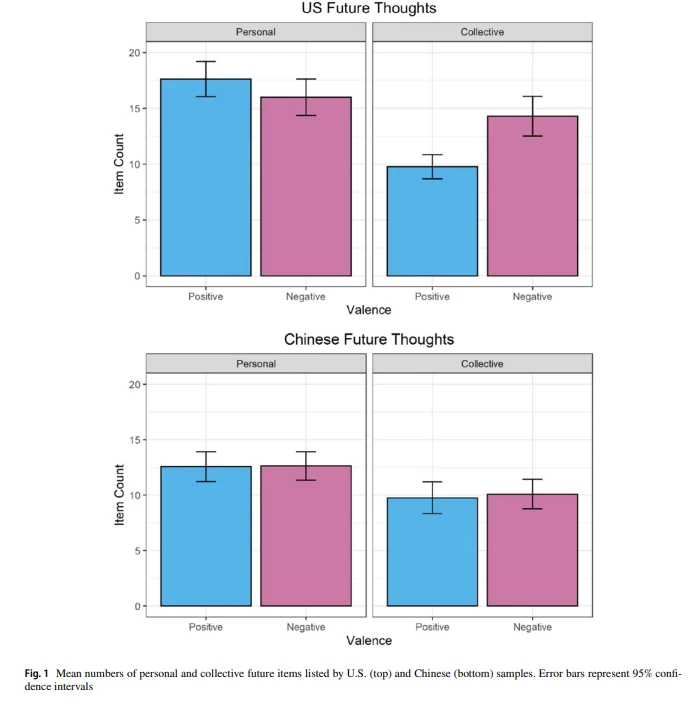
As seen in Fig. 1, there was a significant three-way interaction between domain, valence, and country, F(1, 76) = 28.22, p < .001, ηG 2 = .021.2 This interaction suggests that the U.S. sample displayed a Valence- × Domain Crossover interaction, whereas the Chinese sample did not. We unpacked this three-way interaction via simple effects tests, running a 2 (domain) × 2 (valence) repeated-measures ANOVA for each country’s data. 3
The U.S. ANOVA revealed that participants listed more personal than collective items, F(1, 39) = 55.93, p < .001, ηG 2 = .20, Mdif = 9.55, 95% CI [6.97, 12.13], and more negative than positive items, F(1, 39) = 12.02, p = .001, ηG 2 = .02, Mdif = −2.90, 95% CI [−4.59, −1.21]. Most importantly, there was a Valence- × Domain interaction, F(1, 39) = 49.21, p < .001, ηG 2 = .09 (Fig. 1, top panel). For personal items, U.S. participants listed more positive than negative items (Mdif = 1.63, 95% CI [0.50, 2.75]). But for collective items, U.S. participants listed more negative than positive items (Mdif = −4.53, 95% CI [−5.85, −3.20]). Thus, the data replicated the personal versus collective dissociation shown in prior studies.
The Chinese ANOVA revealed that participants listed more personal than collective items, F(1, 37) = 16.47, p < .001, ηG 2 = .08, Mdif = 5.05, 95% CI [2.53, 7.58], and listed a similar number of positive and negative items, F(1, 37) = 1.20, p = .280, ηG 2 = .003, Mdif = −0.89, 95% CI [−2.55, 0.76]. Critically, they did not display a Valence × Domain interaction, F(1, 37) = 0.48, p = .494, ηG 2 < .001. They listed similar numbers of positive and negative items for both the personal (Mdif = −0.24, 95% CI [−1.31, 0.84]) and the collective (Mdif = −0.66, 95% CI [−1.65, 0.33]) domains.
In other words, participants in China did not display a valence bias for personal or collective items in contrast to participants in the U.S. The lack of interaction supported our prediction that Chinese participants would not show a valence difference in collective future thought. However, we were surprised to also find that Chinese participants did not show a valence difference for personal future thoughts.

Experiment 1 made two contributions. First, it replicated the valence dissociation between personal and collective future thoughts seen in prior research with Western samples (Shrikanth et al., 2018). Second, it found that this valence dissociation did not occur in a sample from East Asia. We initially predicted that people in China would display either a positive or neutral outlook toward the collective future. Our results demonstrated that for people in China, the future of China is neither strongly good nor bad. One exploratory analysis, reported in the supplemental materials, revealed that national identification was correlated with the proportion of positive events generated in the collective domain, r(76) = .27, p = .015, whereas there was no such correlation in the personal domain.
Time‑frame analyses
One post hoc exploratory question was whether people would be more optimistic about the far future, as opposed to the near future. On one hand, US participants’ negative bias toward the future may be partially based on the valence of current and past events (see Shrikanth & Szpunar, 2021; Shrikanth et al., 2018). Thus, it should be easier for U.S. participants to dissociate from the negative events or to expect improvement in a more remote (10 years) compared with a near (1 week) or intermediate (1 year) future (Spronken et al., 2016). This would result in higher optimism about events in the remote future compared with the more recent future (though one may also argue that the events can be expected to get worse; Wang et al., 2015). On the other hand, because the Chinese participants had an equal number of positive and negative items in the future fluency task, we expected the valence to remain relatively stable into the remote future (no interaction between time frame and valence).
To investigate our predictions, we ran a 3 (time frame: 1 week vs. year vs. decade) × 2 (valence: positive vs. negative) × 2 (domain: personal vs. collective) repeated-measure ANOVA, with a Holm correction to control the Type I error rate (Cramer et al., 2016), for just the U.S. responses. We replicated our main analysis, showing a Valence × Domain interaction, F(1, 39) = 49.21, p < .001, ηG 2 = .069.
In addition, there was a main effect of time frame, F(1.72, 67.22) = 14.86, p < .001, ηG 2 =. 030. Post-hoc tests (with Holm adjustment) indicate that participants listed the fewest items for the future week (M = 17.52, 95% CI [15.86, 19.19]), more items for the future year (M = 19.42, 95% CI [17.65, 21.20]), and the most items for the future decade (M = 20.75, 95% CI [18.76, 22.74]). This outcome is unsurprising given that more remote time frames cover larger periods.
There was also a Time Frame × Domain interaction, F(1.94, 75.69) = 4.73, p = .037, ηG 2 = .008, but no time Frame × Valence interaction, F(1.99, 77.78) = 2.07, p = .266, ηG 2 = .004. The lack of interaction between time frame and valence did not support our prediction that U.S. participants would be more optimistic about the remote future compared with the more recent future.
We also ran a 3 (time frame: 1 week vs. year vs decade) × 2 (valence: positive vs. negative) × 2 (domain: personal vs. collective) repeated-measure ANOVA, with Holm correction, for just the Chinese responses. Replicating the main analyses, there was a main effect of the domain, F(1, 37) = 16.47, p = .001, ηG 2 = .058. More importantly, there was a main effect of time frame, F(1.98, 73.16) = 10.63, p < .001, ηG 2 = .023. Post-hoc tests (with Holm adjustment) indicate that participants listed a similar number of items for the future decade (M = 15.95, 95% CI [14.23, 17.67]) and the future year (M = 14.92, 95% CI [13.39, 16.45]), but fewer items for the future week (M = 13.39, 95% CI [11.73, 15.06]). The lack of interaction between time frame and valence supports our prediction that valence would remain relatively stable into the remote future for Chinese participants.
In sum, the valence pattern did not vary between near and remote futures for either the U.S. or the Chinese participants.
Experiment 2
In Experiment 2, we aimed to replicate Experiment 1 and investigate the hypothesis that future thinking is connected to memory. To do so, we used the fluency task again but had participants generate events about both the past and the future. We preregistered three specific hypotheses:
1. We expected to replicate Experiment 1 in showing a valence dissociation in future thinking in the U.S. but not China.
2. Second, we expected to find the same valence patterns in participants’ memories as we did in future thinking.
3. Third, we expected that the temporal period (past vs. future) would not affect the valence pattern in either country.
Method
Participants
We recruited 81 U.S. participants from Furman University (MAge = 19.32 years, SD = 1.20, 68% female) and 95 Chinese participants from Hubei University (MAge = 19.55 years, SD = 2.49, 85% female).
We originally aimed to recruit 100 participants from each country, doubling our sample size from Experiment 1 to account for an additional independent variable. Our original sample for Experiment 2 consisted of 296 participants, but we excluded participants who did not meet preregistered criteria: 69 participants for not responding to any questions in the survey, 50 participants for not having a single response to three or more future fluency prompts, and one participant for not being a fluent English speaker (from the U.S. site). Our exclusion criteria in Experiment 2 were more lenient than in Experiment 1 (not responding to three or more prompts instead of just one) because we excluded more participants than expected in E1 and because the results were similar regardless of whether we excluded or kept those participants in our analyses.
Materials and counterbalancing
The materials for Experiment 2 were generally the same as in Experiment 1 with three key differences. First, there were only two levels of time frame variable (1 week vs. 5–10 years). Second, the fluency task included an additional variable, temporal period, in which participants generated items for either the future (as seen in Experiment 1) or from the past, resulting in 16 total prompts. Third, we administered an exploratory Locus of Control Scale instead of the National Identification Scale.4
The prompts for the fluency task were presented in a hierarchical blocked pattern, with each blocking level counterbalanced across participants (Fig. 2). The highest level of blocking was a temporal period, so participants responded to all of the past prompts and then all of the future prompts. The next levels of blocking were domain (personal vs. collective) and valence (positive vs. negative). Time frames were always presented with the 1-week prompts followed by the 5–10 years prompts.
Design
Experiment 2 used a 2 (domain: personal vs. collective) × 2 (valence: positive vs. negative) × 2 (temporal period: past vs. future) × 2 (country: the U.S. vs. China) mixed-model design. Domain, valence, and temporal period were manipulated within participants, whereas country was treated as a between-participants factor. Note that because the additional manipulation of the time frame (1 week vs. 5–10 years) was only relevant for exploratory analyses, we collapsed across this variable for the main analyses.
Procedure
We collected data during the late fall and winter of 2020. The procedure was similar to Experiment 1, except for the differences described in the materials section above and that participants completed the experiment online from their computers rather than coming to the laboratory due to social distancing requirements. After completing the fluency task, participants completed the Locus of Control scale and answered demographic questions.

Results and discussion
Two trained coders examined all of the responses as in Experiment 1 and had a high agreement (r > 93%) for both the U.S. and Chinese data sets. All analyses were the same regardless of whether we included or excluded those items.
Preregistered analyses
In our preregistration, we identified a series of ANOVAs that addressed three questions: whether responses to the future prompts replicated Experiment 1, whether each country showed the same valence pattern in memories as in future thinking, and whether the temporal period affected the valence pattern. Here we report a 2 (domain: personal vs. collective) × 2 (valence: positive vs. negative) × 2 (temporal period: past vs. future) × 2 (country: U.S. vs. China) mixed model ANOVA, with country treated as a between-subjects factor and all other variables treated as within-subjects factors. We interpret the effects that line up with our preregistered ANOVAs.5
First and most importantly, there was a three-way interaction between country, valence, and domain (plotted in Fig. 3), F(1, 174) = 75.28, p < .001, ηG 2 = .02. Simple effects tests revealed there was a significant domain-by valence interaction in the U.S. sample, F(1, 80) = 108.56, p < .001, ηG 2 =.055. US participants listed more positive than negative personal items (Mdif = 2.37, 95% CI [0.93, 3.81]) but more negative than positive collective items (Mdif = −5.49, 95% CI [−6.71, −4.27]). In contrast, there was no domain-by-valence interaction in the Chinese sample, F(1, 94) = 0.03, p = .872, ηG 2 < .001. Chinese participants listed an equal number of positive and negative items for both personal (Mdif = 0.18, 95% CI [−0.58, 0.94]) and collective domains (Mdif = 0.09, 95% CI [−0.70, 0.89]).6'

Notably, the interaction above included responses to both the past and future prompts. There was a main effect of the temporal period, indicating that participants listed more future items than past items, F(1, 174) = 5.98, p = .015, ηG 2 = .003, Mdif = −1.63, 95% CI [−2.88, −0.38]. However, the ANOVA failed to find any significant interactions involving the temporal period, (all Fs < 2.47). The lack of interactions suggests that the overall pattern of responses (and in particular the lack of presence of a Valence × Domain interaction for each country) is similar for the past and future.
In sum, our central analyses in Experiment 2 revealed three findings. First, we replicated Experiment 1 in showing a valence-by-domain interaction for U.S. participants, but not Chinese participants in thinking about the future. Second, we also showed that U.S. participants displayed a Valence × Domain interaction for thinking about the past, whereas Chinese participants did not. Third, we showed that the pattern displayed by each country for the past mirrored the pattern seen for the future.
For more information:1950477648nn@gmail.com