Phenylethanol Glycosides From Cistanche Deserticola: Extraction Technologies & Impacts On Human Exercise Performance
Oct 10, 2026
1. Introduction
Cistanche deserticola, commonly known as desert ginseng, is a well‑recognized food‑medicine homologous parasitic plant widely distributed in arid desert zones of Northwest China. After decades of agricultural research, large‑scale artificial planting systems for Cistanche have matured completely. Current annual raw herb output reaches approximately 7000 tons, and the whole industrial chain market scale has exceeded 20.6 billion RMB in China alone. This desert botanical resource attracts growing global attention from nutraceutical, sports nutrition, cosmetic and pharmaceutical research communities.
Among hundreds of bioactive compounds isolated from Cistanche deserticola and Cistanche tubulosa, phenylethanol glycosides (PhGs) stand out as the signature functional constituent. Major marker molecules within this group include echinacoside and verbascoside, which largely determine the commercial and medicinal value of raw Cistanche materials. A large volume of laboratory and animal studies indicate that PhGs deliver antioxidant, neuro‑protective, anti‑inflammatory, anti‑fatigue and metabolic‑regulating biological activities. In recent years, sports nutrition researchers have focused special interest on how PhGs modulate exercise‑related physical performance, delay physical exhaustion, and mitigate oxidative stress caused by intensive physical training.
Traditional academic papers published in Chinese databases focus heavily on laboratory parameters and orthogonal experimental data, yet few easy‑to‑understand English‑language popular science articles summarize both extraction manufacturing technology and exercise‑related bio‑functions for international audiences. This article aims to bridge this gap. We systematically sort out mainstream PhGs extraction methods, compare their respective strengths and limitations, elaborate how PhGs act on exercise physiology, discuss existing bottlenecks of industrial manufacturing, and preview promising product development directions for global functional food markets.
Disclaimer: All content presented here summarizes existing pre‑clinical animal research outcomes. Phenylethanol glycoside extracts from Cistanche are dietary raw materials, not prescription medicine. They cannot cure disease or replace professional sports medical guidance. Individual results vary, readers should consult health practitioners before taking any new herbal supplements.

2. What Is Cistanche Deserticola and Phenylethanol Glycosides (PhGs)
2.1 Background of Cistanche as Food‑Medicine Homologous Herb
Cistanche is an obligate parasitic plant growing on roots of desert shrubs such as Haloxylon ammodendron. For thousands of years, it occupies an important position in traditional Chinese herbal practice, historically applied to support kidney health, improve vitality, relieve physical weakness caused by overwork and aging‑related energy decline. Modern regulatory frameworks in China classify Cistanche deserticola as food‑medicine homologous material, which means qualified processed extracts can be used both in traditional herbal formulas and modern commercial functional food formulations.
Two primary commercial species dominate global raw‑material supply: Cistanche deserticola and Cistanche tubulosa. Chemical profiling demonstrates that Cistanche tubulosa accumulates significantly higher concentrations of total phenylethanol glycosides, so most industrial extraction projects select tubulosa as preferred starting botanical material.
2.2 Core Chemical Properties of Phenylethanol Glycosides
Phenylethanol glycosides (PhGs) represent a subclass of natural phenolic compounds built by phenylethanol aglycone combined with sugar moieties. Echinacoside and verbascoside are the two most researched representatives of PhGs inside Cistanche, and they are used as official quality‑control markers in Chinese Pharmacopoeia for judging raw herb quality.
PhGs feature both water‑soluble and alcohol‑soluble characteristics. This dual solubility property lays the technical foundation for diverse solvent‑based extraction workflows. Apart from anti‑fatigue and antioxidant effects related to sports performance, published studies report PhGs exert neuroprotection, liver lipid regulation, protective effect on kidney tissue, skin anti‑aging and skin‑whitening bioactivities, creating multi‑scenario application possibilities across pharma, dietary supplement and cosmetic sectors.
When human bodies undergo high‑intensity or endurance exercise, massive reactive oxygen species (ROS) are generated inside muscle tissue, accompanied by lactate buildup, blood urea nitrogen elevation, consumption of antioxidant enzyme reserves, eventually leading to exercise‑induced fatigue. PhGs molecules can interact with these physiological pathways, which explains why sports‑science research teams keep exploring this botanical ingredient for athletic support purposes.
3. Main Industrial Extraction Technologies for Cistanche Phenylethanol Glycosides
High‑quality PhGs extracts rely on appropriate extraction workflows. Extraction directly decides total PhGs yield, preservation of bio‑activity, impurity level, production cost and safety risk of final products. Five major technical routes are widely studied: conventional solvent extraction (ethanol extraction and hot‑water extraction), microwave‑assisted extraction, ultrasonic‑assisted extraction, flash extraction, and enzymatic hydrolysis extraction. Each technology carries distinct advantages and practical constraints for laboratory‑scale testing and mass manufacturing.
3.1 Conventional Solvent Extraction
Solvent extraction works by letting liquid solvent penetrate plant cell walls, dissolving target soluble bioactive components, driven by concentration difference between inside plant tissue and external solvent. This classic technology remains widely deployed for Cistanche PhGs preparation due to simple operation and acceptable impurity control performance. Two main solvent options are ethanol‑water mixed solution and pure hot water.
3.1.1 Ethanol Extraction (Alcohol Extraction)
Ethanol‑water mixed solvent is the most common option for PhGs recovery. Multiple orthogonal experiments and response‑surface optimization researches have explored optimal parameter combinations. One research group identified optimized condition: 63% ethanol concentration, solid‑liquid ratio 1:8 (g/mL), extraction duration 1.5 hours, repeated twice. Another study targeting Cistanche tubulosa achieved 3.64% PhGs yield under condition of 83% ethanol, solid‑liquid ratio 1:12, extraction temperature 48 °C, two extraction cycles lasting 2 hours each.
Strengths of ethanol extraction: Final extracts retain relatively high biological activity; ethanol solvent can be recycled through distillation. Weaknesses: Ethanol raw‑material cost is relatively high; ethanol belongs to flammable solvent, requiring strict fire‑safety management inside production workshops, raising factory infrastructure investment thresholds.
3.1.2 Hot‑Water Extraction
Water extraction uses pure heated water as extracting solvent. Research optimized for Cistanche tubulosa suggested best parameters: solid‑liquid ratio set as 1:15 (g/mL), extraction temperature 80 °C, 2‑hour soaking duration. Under this setup, researchers obtained PhGs yield up to 17.59% in lab trial conditions. Research data also pointed out that crushing particle size of raw Cistanche powder negatively correlates with PhGs yield; finer powder does not always guarantee better outcomes, because ultra‑fine powder brings extra non‑target impurity dissolution risk.
Strengths of water extraction: No organic solvent consumption, low production cost, environmentally friendly and mild reaction condition. Weaknesses: Aqueous system is vulnerable to microbial contamination during long‑time high‑temperature processing; large quantities of water‑soluble polysaccharide, protein and other impurities co‑extract together with PhGs, increasing subsequent purification workload.
3.2 Microwave‑Assisted Extraction
Microwave‑assisted extraction applies microwave thermal effect to heat raw herbal material and solvent mixture, rapidly breaking plant cell structures so target compounds dissolve outward. Compared with traditional reflux solvent extraction, microwave technology greatly compresses processing time, cuts solvent dosage and reduces waste discharge.
Comparative research among alcohol extraction, ultrasonic extraction and microwave extraction showed microwave‑assisted workflow delivers superior PhGs yield within extremely short processing window. The optimized lab condition used 70% ethanol solvent, solid‑liquid ratio 1:16 (g/mL), microwave power 200 W, extraction time merely 1.5 minutes, repeated twice. Independent comparative research reached consistent conclusion: microwave‑assisted extraction demonstrates promising application prospect for PhGs preparation.
Strengths: Ultra‑short extraction cycle, reduced solvent consumption, satisfactory PhGs recovery rate. Weaknesses: Microwave radiation creates potential occupational safety hazard for workshop operators; microwave equipment scaling‑up to full industrial production scale still faces technical barriers.
3.3 Ultrasonic‑Assisted Extraction
Ultrasonic‑assisted extraction leverages physical cavitation effect produced by ultrasonic wave inside liquid solvent to disrupt plant cell walls and accelerate mass transfer of intracellular bioactive ingredients into solvent medium. This technology runs under relatively low‑temperature environment, protecting thermally‑unstable active substances from thermal degradation.
One experiment achieved PhGs yield of 7.31% under parameters: 70% ethanol, solid‑liquid ratio 1:16 (g/mL), ultrasonic power 160 kW, extraction time 5 minutes. Another response‑surface optimization study recommended 51% ethanol concentration, solid‑liquid ratio 1:41.7 (g/mL), extraction temperature 40 °C, obtaining PhGs yield of 1.44% in separate trial. Ultrasonic processing is also frequently adopted as sample pre‑treatment step for laboratory quantitative detection of PhGs content in Cistanche raw material samples.
Strengths: Low working temperature, short time consumption, easy lab‑operation, relatively few co‑extracted impurities. Weaknesses: Ultrasonic energy attenuates across liquid medium, creating dead zones without sufficient cavitation effect inside large‑volume extraction tanks, limiting stable performance on big production batches.

3.4 Flash Extraction
Flash extraction relies on high‑speed rotating cutting blades and mechanical vibration to smash herbal plant tissue in seconds, releasing intracellular bioactive components quickly. This method fits root, stem and fruit‑type herbal raw‑materials. Optimized experimental condition for Cistanche PhGs: 60% ethanol solution, solid‑liquid ratio 1:30 (g/mL), rotational speed 5500 r/min, extraction time only 90 seconds.
Strengths: Extremely short processing time, minimal thermal damage for heat‑sensitive PhGs components, energy‑saving characteristic. Weaknesses: Low selectivity between target PhGs and miscellaneous plant components; tissue fragmentation may trigger rapid degradation of some bio‑compounds; reliable large‑scale industrial application cases remain limited.
3.5 Enzymatic Hydrolysis Extraction
Enzymatic hydrolysis uses plant‑cell‑wall‑degrading enzymes (e.g. cellulose enzyme) to decompose cellulose and hemicellulose constructing cell walls, so intracellular PhGs can diffuse out more easily. Controlled research demonstrated that after proper enzymatic pre‑treatment, antioxidant capacity of final Cistanche extract improved significantly comparing with non‑enzymatic traditional extraction.
The documented optimal enzymatic hydrolysis condition: cellulose enzyme additive dosage 0.1%, reaction temperature 55 °C, hydrolysis duration 2.5 hours. Under these settings, PhGs yield hit 7.26%, representing 64% improvement compared with pure hot‑water extraction control group. Experimental observation also confirmed that enzyme‑assisted ethanol extraction achieves better outcomes than enzyme‑assisted water extraction.
Strengths: Mild reaction environment, no toxic chemical reagent added, obvious yield promotion potential. Weaknesses: Enzymatic performance is highly sensitive towards temperature, pH value and substrate concentration; commercial enzyme preparation increases material cost; strict parameter control requirement creates difficulty for stable mass‑production batch consistency.
4. Physiological Mechanisms of Cistanche PhGs for Exercise Function
Exercise‑induced physical fatigue refers to physiological status where organism capacity declines after sustained or high‑intensity physical activity, making subjects unable to sustain original exercise intensity level. Fatigue involves complex multi‑factor mechanisms: accumulation of metabolic waste substances (lactate, blood urea nitrogen), depletion of energy substrate, oxidative stress damage triggered by excess reactive oxygen species, drop of endogenous antioxidant enzyme activity, partial skeletal‑muscle contractility decline. Existing animal‑model researches reveal that Cistanche phenylethanol glycosides relieve exercise‑related fatigue mainly through anti‑fatigue metabolic regulation and powerful antioxidant effects.
4.1 Anti‑Fatigue Performance of PhGs in Exercise Model
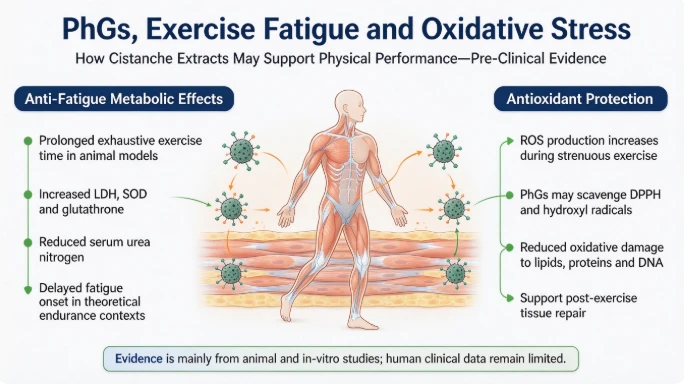
Swimming‑to‑exhaustion mouse test represents classic pre‑clinical evaluation method for anti‑fatigue ingredients. One research project studied functional effect of mixture containing Cistanche PhGs together with gardenia yellow pigment. Comparing against positive control group using Rhodiola capsule reference material, experimental group supplemented with PhGs significantly extended exhaustive swimming time of laboratory mice. Meanwhile, biomarker analysis of blood and tissue samples displayed important changes: concentration of lactate dehydrogenase (LDH), superoxide dismutase (SOD) activity and glutathione content increased obviously, while serum urea nitrogen level decreased markedly. Researchers concluded anti‑fatigue efficacy positively correlated with PhGs dosage inside formula mixture.
Multiple sub‑components belonging to PhGs family deliver observable anti‑fatigue performance. Verbascoside (one key PhGs compound) was tested on gastrocnemius muscle of toad via in‑vitro electrical‑stimulation model; experimental result proved verbascoside could effectively slow skeletal‑muscle fatigue development. Salidroside, another phenylethanol glycoside derivative, demonstrates capacity for raising body energy reserve, lowering lactate accumulation and reducing harmful metabolic‑by‑product buildup during physical exertion.
How does this translate to human exercise physiology context? During endurance training or strength workout, muscle cells produce large quantity of lactate, and urea nitrogen reflects protein decomposition caused by physical overconsumption. When PhGs modulate these biochemical markers, theoretical outcome includes delayed fatigue onset, improved endurance potential and accelerated post‑exercise recovery speed. It should be emphasized that above evidence mainly comes from animal trials. Human clinical trial data remain limited, we cannot directly confirm identical effects will definitely appear for human athletes.

4.2 Antioxidant Protection Against Exercise‑Induced Oxidative Stress
Under resting physiological state, human cells generate moderate reactive oxygen species (ROS), while endogenous antioxidant enzyme system (SOD, glutathione etc.) neutralizes redundant ROS and maintains redox balance. After strenuous long‑duration exercise, ROS production surges dramatically, breaking original redox homeostasis. Excess ROS attacks cell‑membrane lipid, protein molecules and nucleic acid material, triggering oxidative injury, local inflammatory response, muscle soreness and delayed recovery after training session.
In‑vitro chemical assays verified Cistanche PhGs possess strong scavenging capability targeting DPPH free radical and hydroxyl free radical. Other research work indicated PhGs can offer protective effect for human sperm DNA suffering oxidative damage, further validating its anti‑oxidative molecular property. When applied into sports nutrition scenario, PhGs antioxidant compounds may mitigate exercise‑provoked oxidative stress, reduce oxidative damage of muscle tissue caused by free‑radical explosion, support post‑training tissue repair process. This antioxidant pathway works synergistically with metabolic anti‑fatigue mechanism to realize overall exercise‑function improvement potential.
5. Additional Biological Benefits of Cistanche‑Derived Phenylethanol Glycosides
Apart from exercise‑relevant anti‑fatigue and antioxidant function, modern research discovers multiple other valuable bio‑activities for Cistanche PhGs, supporting its cross‑domain application value for pharmaceutical, functional‑food and cosmetic industries.
In pharmaceutical research field, experimental animal models suggest PhGs deliver intervention potential for diabetic nephropathy and alcoholic fatty liver disease. Research teams observed PhGs can improve lipid‑metabolism homeostasis inside liver tissue of alcoholic‑liver‑injury model mice, and produce protective effect for renal tissue under diabetic pathological status.
For cognitive health area, PhGs‑containing extracts are studied for memory‑improvement purpose. Related patent literatures explore development direction of memory‑support health food using Cistanche PhGs as core functional raw‑material. Neuro‑protective properties of PhGs draw attention from neurodegenerative‑disease research community as well.
Cosmetic industry utilizes antioxidant capacity of PhGs for skin‑care product formulation. PhGs‑added topical formulations are researched for skin brightening, anti‑wrinkle and anti‑photo‑aging purpose, taking advantage of free‑radical‑scavenging feature to resist extrinsic skin aging caused by environmental stressors such as ultraviolet radiation.
All above‑mentioned application directions are mostly supported by in‑vitro cell experiments or rodent animal studies. Rigorous human clinical evidence is still insufficient, so these functions remain within research‑exploration phase rather than proven medical therapy.
6. Challenges Restricting Large‑Scale Commercial Production of PhGs
Even though Cistanche planting industry has achieved huge scale, high‑purity phenylethanol glycosides mass‑production still faces multiple practical bottlenecks limiting wider global commercial adoption.
First of all, traditional extraction workflows either suffer relatively low PhGs recovery ratio, or bring excessive co‑extracted impurities. Many modern high‑efficiency extraction technologies (microwave‑assisted, enzymatic hydrolysis etc.) exhibit excellent performance in laboratory small‑scale tests. But transferring lab‑optimized parameters into ton‑level continuous industrial production brings many technical obstacles: equipment cost, batch‑to‑batch consistency control, safety management and production‑process stability all create realistic barriers.
Second, PhGs are biologically active phenolic compounds. They are sensitive towards temperature, light exposure, pH shift and microbial activity. During multi‑step extraction, concentration and drying processing, partial degradation of target PhGs components may happen if process parameters are not precisely controlled, decreasing final product bio‑activity.
Third, quality‑control standardization still needs further refinement. Different Cistanche species, geographic planting location, harvest season, storage condition, crushing granularity all influence initial PhGs content inside raw herbal material. Variation of starting raw material quality adds difficulty for stable end‑product quality control for finished supplement manufacturers.
Fourth, global‑market‑oriented safety data and human clinical research remain insufficient. Majority existing research papers are published inside Chinese academic circle. International‑standard human clinical trials investigating oral safety, effective dosage, bioavailability of Cistanche PhGs are limited. This slows down registration progress for dietary‑supplement products in North America, European and Southeast‑Asian markets.
7. Future Development Directions for Cistanche PhGs Functional Products
Looking forward, the research community and botanical‑extract industry will focus on several development directions for Cistanche phenylethanol glycosides.
First, optimize combined‑process extraction workflows. Researchers intend to merge advantages of different extraction methods. For example, applying mild enzymatic hydrolysis pre‑treatment before ethanol solvent extraction; or combining ultrasonic auxiliary technology with traditional solvent system. This hybrid‑process strategy pursues balanced outcomes: higher PhGs yield, preserved bio‑activity, acceptable manufacturing cost and scalable industrial feasibility. Developing low‑residue, high‑purity, low‑impurity preparation workflow becomes core technical target for next‑generation processing technology.
Second, deepen mechanism research, especially human‑subject studies. At present most exercise‑function‑related evidence comes from animal‑model testing. Carrying out standardized human clinical trials will help clarify safe oral dosage, bio‑absorption characteristic, real‑world anti‑fatigue and recovery‑support effect for human exercisers, whether amateur fitness population or endurance‑sport athletes. Solid clinical data will strongly support international market promotion of Cistanche‑based sports‑nutrition goods.
Third, develop targeted functional finished‑products. Leveraging confirmed anti‑fatigue and antioxidant features of PhGs, enterprises can design sports‑nutrition dietary supplements: endurance‑support capsules, post‑workout recovery powder blends, herbal energy drink formula etc. Meanwhile multi‑scene development including cognitive‑support supplement, liver‑care functional food, anti‑aging cosmetic raw‑material can be further explored, expanding market boundary for Cistanche food‑medicine homologous resource.
Fourth, strengthen whole‑chain quality‑management system. Establish unified quality‑evaluation standard covering raw‑herb planting, harvest, storage, extraction, purification and finished‑product testing. Deploy high‑precision liquid‑chromatography quantitative detection for marker compounds echinacoside and verbascoside, to guarantee batch‑consistency for exported Cistanche PhGs extract material facing global customers.

8. Frequently Asked Questions (FAQ)
Q1: Can phenylethanol glycosides from Cistanche replace sports medicine or performance‑enhancing drugs?
A: No. Cistanche PhGs are plant‑derived dietary‑supplement raw‑materials. Existing pre‑clinical research suggests anti‑fatigue and antioxidant potential, but they are not pharmaceutical drugs. They cannot treat sports‑related injury, cannot serve as performance‑enhancing agent. Exercisers should follow advice of sports‑medicine professionals.
Q2: Which extraction method produces best‑quality PhGs extract for sports‑nutrition usage?
A: There is no universal best single technology. Industrial manufacturers often combine multiple processing steps. Ethanol‑solvent extraction paired with purification steps remains mainstream commercial solution. Microwave and enzymatic‑hydrolysis technologies show promising lab‑data, yet large‑scale mature application is still limited. Quality depends not merely on extraction technology, but also raw‑material quality and post‑extraction purification procedure.
Q3: Do human clinical studies prove Cistanche PhGs reduce fatigue for athletes?
A: Available public evidence is dominated by mouse and in‑vitro lab experiments. High‑quality human clinical trial volume remains limited. More human‑subject research is required before we draw definitive conclusions for human athletic populations.
Q4: What are main PhGs‑related application markets at present?
A: Current application covers three primary fields: traditional herbal product, functional food & sports‑nutrition prototype research, and antioxidant cosmetic raw‑materials. Pharmaceutical application is mostly within experimental research stage, not widely used for formal clinical treatment.
Q5: What limitations should buyers pay attention to while purchasing Cistanche PhGs raw‑material?
A: Pay attention to original botanical species (Cistanche deserticola vs Cistanche tubulosa), total PhGs assay value, content of marker echinacoside & verbascoside, residual‑solvent test report, heavy‑metal and microbial safety indicators. Different vendors' extract products show large quality gap.

9. Final Conclusion
Cistanche deserticola represents precious food‑medicine homologous botanical resource originating from Chinese desert ecosystem. Phenylethanol glycosides (PhGs) constitute its most vital bio‑active compound family. This article summarizes six major PhGs extraction technical routes: conventional ethanol and hot‑water solvent extraction, microwave‑assisted extraction, ultrasonic‑assisted extraction, flash extraction and enzymatic hydrolysis extraction. Every technology has distinct merits and defects regarding extraction yield, bio‑activity preservation, cost, safety and industrial‑scaling feasibility.
Pre‑clinical animal‑model researches demonstrate PhGs deliver notable anti‑fatigue effect for exercise physiology, able to prolong exhaustive exercise time, optimize exercise‑related blood biochemical markers, and scavenge excess free radicals to mitigate exercise‑triggered oxidative stress injury. Beyond sports‑nutrition potential, PhGs also display research‑stage bio‑activities including liver‑protection, kidney‑protection, neuro‑protection and skin‑anti‑aging, opening multi‑industry development opportunities.
Nevertheless, multiple bottlenecks still block further global‑scale commercialization: technical difficulty scaling lab‑level high‑efficiency extraction technology, component degradation risk during processing, raw‑material quality fluctuation, shortage of international‑standard human clinical research data. Moving forward, industry and academia need to develop optimized combined‑extraction workflows, invest more human‑subject clinical research, construct full‑chain quality‑control specification, and create diversified finished‑product solutions targeting sports‑nutrition and other functional‑product market segments.
For global readers and merchants focusing on herbal functional ingredients, it is critical to keep rational understanding: most exercise‑function evidence for Cistanche PhGs comes from pre‑clinical study. Do not over‑interpret laboratory experimental results. Consumers are reminded that extracts cannot substitute doctor's medical diagnosis and treatment advice. As more high‑quality research outcomes are published in future, people will gain deeper comprehension for this unique desert‑plant‑derived natural active ingredient.