Piercing Eye! Is Cistanche Deserticola Wild Or Artificial At A Glance
Nov 03, 2025
Unveiling the Appearance
When we receive a Cistanche deserticola, the first thing that catches our eye is its appearance, and within this appearance, there are actually many key codes that distinguish between wild and artificially cultivated.

Cistanche deserticola slice
Look at the cross-section.
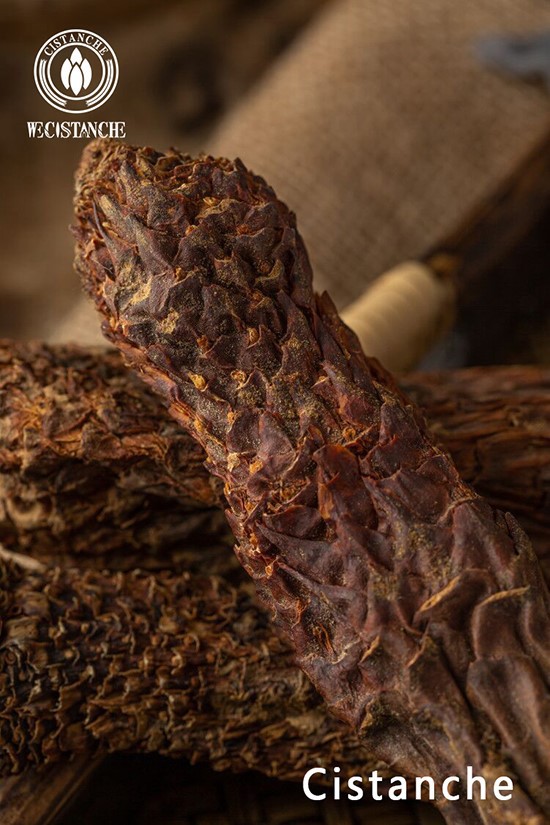
Cutting the Cistanche deserticola, its cross-sectional features are like the "fingerprint" of a plant, unique and unparalleled. The cross-section of wild Cistanche deserticola has obvious chrysanthemum patterns, which are arranged in a wave-like circular pattern, very unique, and usually have a diameter of 2-8 centimeters. The color is mostly brown or gray brown, which is a natural color that has been accumulated over time in the wild environment. The artificially cultivated Cistanche deserticola has a granular cross-section and is usually gray brown in color, which is significantly different from the wild. If you see that the surface color of Cistanche deserticola is dark black or charcoal black, it can be basically concluded that it is not a wild variety, and it is likely to have undergone some improper processing or be a counterfeit product itself.
cistanche body building
Observing colors
From the overall color perspective, when wild Cistanche deserticola is first excavated from the desert, it presents a light yellow color with a bright color, as if carrying the bright atmosphere of desert sunshine. This is because it grows in a slow and stable rhythm in the natural environment, fully absorbs the essence of heaven and earth, and its internal pigment synthesis and accumulation are in a natural and healthy state. However, the artificially cultivated Cistanche deserticola, due to its relatively superior growth environment and fast growth rate, has a slightly dull color, as if it lacks the natural vitality and liveliness. After being dried into medicinal herbs, the surface of wild Cistanche deserticola often appears brown or gray brown, still retaining its natural simplicity; Artificially planted Cistanche deserticola may appear dark brown in color and have heavy pigment precipitation due to factors such as planting techniques or storage conditions, giving it an unnatural depth.
Check the shape and texture.
Wild Cistanche deserticola grows in harsh desert environments and has undergone the baptism of wind and sand. Its appearance may be rough, with more cracks and irregular shapes on the surface, just like an old man who has experienced many hardships. Every grain tells the story of the hardships of growth. Its texture varies from soft to hard. Generally speaking, wild Cistanche deserticola with a soft texture has better quality. This is because Cistanche deserticola often has a longer growth cycle, accumulates more abundant nutrients, and its meat is more delicate and oily, with relatively higher medicinal value. Artificially cultivated Cistanche deserticola, under superior growth conditions carefully nurtured by humans, may have a smoother appearance and a more regular shape, as if it has been carefully carved. This is because artificial cultivation can control its growth environment and ensure its stability, but it is also this excessive intervention that has caused it to lose the natural wildness and uniqueness of wild Cistanche deserticola.

Cistanche male benefits
Differences in taste and aroma
In addition to appearance, the taste and aroma of Cistanche deserticola are also important clues to distinguish between wild and artificially cultivated species. Just like the unique flavor of food, Cistanche deserticola from different "backgrounds" also have their own characteristics in this regard.
Smell the scent
When we pick up a Cistanche deserticola and smell it closely, wild Cistanche deserticola usually does not have a strong odor, only may emit a faint fragrance. It is a natural scent originating from the depths of the desert, pure and simple, as if carrying the scent of sunshine, sandstorms, and red willows in the desert. This fragrance is formed by its natural growth in the wild environment, without any traces of artificial intervention. However, artificially planted Cistanche deserticola may have different odors due to the relatively simple growth environment, which may be affected by factors such as fertilizers and pesticides during the growth process. Some may have a slight earthy smell. This is because the soil environment of artificially planted Cistanche deserticola is different from that of wild environments, and the components in the soil are different, resulting in different substances absorbed by Cistanche deserticola, which affects its odor. There may also be a slight pungent odor due to the use of some chemical agents during the planting process, which contrasts sharply with the delicate fragrance of wild Cistanche deserticola.

Harvest of Cistanche deserticola
Click here to view Cistanche for Kidney disease products
【Ask for more】Email:cindy.xue@wecistanche.com / WhatsApp: 0086 18599088692 / Wechat: 18599088692
taste the flavor
Let's talk about the taste again. Wild Cistanche has a unique flavor, with a sweet and slightly bitter taste. This sweetness is not the intense sweetness, but a light and natural sweetness, like the occasional sweet spring in the desert, giving people a fresh feeling; And bitterness is just the right embellishment, making its taste more layered. Some people believe that the aroma of wild Cistanche deserticola is stronger, and when tasted, a unique aroma can be clearly felt spreading in the mouth, which is a reflection of its rich nutritional content. At the same time, its salty taste is more prominent because wild Cistanche grows in desert environments, and the soil contains a certain amount of salt. Cistanche absorbs this salt during its growth process, making its taste slightly salty. Although artificially cultivated Cistanche deserticola also has a basic taste of sweetness with a hint of bitterness, the sweetness may be relatively light, while the bitterness may be more pronounced. This may be due to the faster growth rate of artificially cultivated Cistanche deserticola and the less abundant accumulation of nutrients compared to wild Cistanche deserticola, resulting in differences in its taste. In terms of aroma, the artificially cultivated Cistanche deserticola has a relatively light aroma, without the rich and unique aroma of wild Cistanche deserticola. It also has almost no salty taste and appears to have a relatively simple taste.
Growing environment and price clues
In addition to direct identification methods such as appearance, taste, and odor, the growth environment and price of Cistanche deserticola are also important reference factors for us to determine whether it is wild or artificially cultivated.

cistanche benefits for men
Determination of growth environment
Wild Cistanche deserticola usually grows in natural, undisturbed sandy, Gobi, and other environments. These places have loose soil and good air permeability, which is conducive to the rooting and nutrient absorption of Cistanche deserticola. At the same time, they often have certain shading conditions, such as growing near plants such as red willows, forming symbiotic relationships with these plants, parasitizing on the roots of red willows 30-100 centimeters deep, and obtaining the water and nutrients needed for growth from the roots of red willows. Moreover, the growth area of wild Cistanche deserticola is generally far away from human activity areas, which can avoid the influence of human factors such as pesticides and fertilizers, and grow and develop completely in a natural state. Its growth cycle also follows natural laws, usually taking 3-5 years or even longer to mature.
The artificially cultivated Cistanche deserticola is grown in carefully selected locations by people. Growers will choose suitable soil and climate conditions based on the growth habits of Cistanche deserticola. Generally, it is chosen to be located in areas such as desert edges, which not only meet the needs of Cistanche deserticola for arid environments, but also facilitate manual management. Before planting, a series of soil preparation work will be carried out, such as improving soil structure, adjusting soil acidity and alkalinity, to make it more suitable for the growth of Cistanche deserticola. In order to improve the yield and quality of Cistanche deserticola, fertilization and irrigation are also carried out during the planting process. These human intervention measures can affect the growth rate and morphology of Cistanche deserticola.
Price difference analysis
In terms of price, there is also a significant difference between wild Cistanche deserticola and artificially cultivated Cistanche deserticola. Due to the harsh growth environment and long growth cycle of wild Cistanche deserticola, coupled with its scarce resources and difficult harvesting, its price is usually higher. In the market, the price of wild Cistanche deserticola may be around 300-1000 yuan per kilogram, or even higher, especially for some high-quality, high-aged wild Cistanche deserticola, which is even more expensive. For example, wild Cistanche deserticola with a growth period of more than 5 years, full texture, and sufficient oil content may be priced at over 800 yuan per kilogram; Rare and high aged wild Cistanche deserticola, which is over 10 years old, may be priced as high as 1500-3000 yuan/jin or even higher, and is mostly used in high-end nourishing or collectible fields.

Superman herbs cistanche
In contrast, artificially cultivated Cistanche deserticola has become more mature in planting technology, with relatively stable yields and lower costs, making its price more affordable. Generally speaking, the price of artificially grown Cistanche deserticola is around 80-300 yuan per kilogram, and the specific price may vary depending on factors such as planting technology, quality, and place of origin. For example, the market price of artificially planted Cistanche deserticola in Xinjiang and other places is mostly between 80-150 yuan/jin; And some artificially planted Cistanche deserticola with better quality and advanced planting techniques may cost 200-300 yuan/jin. But overall, the price of artificially cultivated Cistanche deserticola is much lower than that of wild Cistanche deserticola. So, when we see low-priced "wild Cistanche deserticola" in the market, we need to be extra vigilant, as it is likely to be artificially cultivated Cistanche deserticola or counterfeit products.
Comprehensive judgment, cautious selection
To distinguish between wild and artificially cultivated Cistanche deserticola, we need to start from multiple aspects, comprehensively using clues such as appearance, taste, odor, growth environment, and price. Every aspect is like a piece of a puzzle; only by piecing them together completely can we accurately determine the "identity" of Cistanche deserticola. A single identification method may have limitations, as different growth conditions and processing methods may affect the characteristics of Cistanche deserticola. For example, some artificially cultivated Cistanche deserticola may have undergone special treatment in appearance, attempting to imitate the appearance of wild Cistanche deserticola. However, as long as we observe and analyze from multiple perspectives, we can still discover the differences.
When purchasing Cistanche deserticola, it is important to choose legitimate channels such as large traditional Chinese medicine markets, reputable pharmacies, or qualified online platforms. These legitimate channels usually strictly control the quality of their products, providing clear sources of Cistanche deserticola and ensuring better quality. At the same time, we should also choose carefully and not be tempted by low prices to avoid purchasing counterfeit and inferior products. If you still have doubts about the quality of Cistanche deserticola, you may consult a professional Chinese medicine practitioner or Chinese herbal medicine appraiser. With their rich experience and professional knowledge, they can provide us with more accurate judgments and suggestions. I hope everyone can select satisfactory Cistanche deserticola through the correct methods, and let it contribute to our health.