Pinecone Chrysanthemum Glycoside Content: The Core Criterion For Selecting Extracts From Cistanche Tubulosa
Sep 02, 2026
Abstract
Cistanche tubulosa (Y.C.Ma) or Cistanche tubulosa (Schenk) Wight, a plant in the family Rhamnaceae, is a dry fleshy stem with scaly leaves. It has a sweet and salty taste, a warm nature, and belongs to the Kidney and Large Intestine meridians. It has the functions of tonifying kidney yang, nourishing essence and blood, moistening the intestines and promoting bowel movements, and is known as the "desert ginseng". Pinecone glycoside and verbascoside belong to the phenylethanoid glycoside class and are the indicator components of Cistanche tubulosa specified in the Chinese Pharmacopoeia. The content of pinecone glycoside directly determines the quality of the extract. This article focuses on the core criterion of pinecone glycoside content, systematically comparing the compositional differences between desert Cistanche tubulosa and tube flower Cistanche tubulosa, elucidating the selection advantages of tube flower Cistanche tubulosa in terms of high content, high cost-effectiveness, and industrial supply, and providing reference for the scientific selection and industrial application of Cistanche tubulosa extracts.

Echinoside, the main chemical component of Cistanche tubulosa
Keywords: Echinochlorin; Guanhua Cistanche; Cistanche tubulosa extract; Phenylethanoid glycoside; Content determination; material selection
1, Pinecone chrysanthemum glycoside - the material basis of the efficacy of Cistanche tubulosa
Cistanche tubulosa mainly contains phenylethanolic glycosides, cyclohexene ether terpenes and their glycosides, lignans, polysaccharides, and other components. Among them, the effective substances that play a role in tonifying kidney yang, anti-aging, and anti-fatigue are mainly phenylethanolic glycosides such as pinecone chrysanthemum glycoside and verbascoside. Modern pharmacological research has shown that pineal glycoside has significant antioxidant, free radical scavenging, immune enhancement, anti-fatigue, liver protection, and promotion of osteoblast proliferation and differentiation effects. It is a core biomarker for evaluating the intrinsic quality of Cistanche tubulosa.

Main Chemical Constituents of Cistanche tubulosa
From "content determination" to "quality scale". The Chinese Pharmacopoeia uses the total amount of echinacroside (C ∝₅ H ₄₆ O ₂₀) and verbascoside (C ₉ H ∝₆ O ₁₅) as indicators for determining the content of Cistanche tubulosa, based on their high content, clear activity, and mature detection methods in medicinal materials. For the extract of Cistanche tubulosa obtained through deep processing, the content of pineal glycosides is not only a compliance indicator, but also a core criterion for measuring the quality of raw materials, process level, and final product potency. Under the same process, the higher the content of pineal glycosides, the better the raw material quality, enrichment efficiency, and final product quality assurance.
Therefore, when selecting extracts of Cistanche tubulosa, one should not only focus on whether they meet the standards, but also consider the absolute content of echinacroside and its synergistic ratio with verbascoside as the primary dimensions of examination. This is also the fundamental reason why this article proposes that "the content of echinacroside is the core criterion".
2, Pharmacopoeia standard: Two types of raw materials, two "content rulers"
The Chinese Pharmacopoeia includes both desert Cistanche tubulosa and tube flower Cistanche tubulosa as authentic medicinal materials, but they adopt a separate standard for the total amount limit of echinacoside and verbascoside, reflecting the quality control principle of "objective evaluation based on the source".
The main differences in the total amount limit of pineal chrysanthemum glycoside and verbascoside (medicinal herb) and alcohol extract limit of the original variety are the main components
Desert Cistanche tubulosa shall not be less than 0.30% and not less than 35.0%, containing Cistanche glycosides A (potential exclusive ingredient)
Guanhua Cistanche tubulosa shall not be less than 1.5% and not less than 25.0%. Pinecone glycoside/verbascoside shall be significantly higher
Table 1 Comparison of content and extract limits of desert and tube flower Cistanche tubulosa in the Chinese Pharmacopoeia (calculated by dry product)
As shown in Table 1, the pharmacopoeial limit for the total amount of Cistanche tubulosa (1.5%) is five times that of desert Cistanche tubulosa (0.30%). This "5-fold difference" is not due to loose standards, but rather a true reflection of the accumulation levels of phenylethanoid glycosides in the natural state of two types of primogens - the content of echinacoside, verbascoside, and isoverbascoside in Cistanche tubulosa is significantly higher than that in desert Cistanche tubulosa (P<0.01), and there are objective differences in the types and contents of the two components.
For the purchaser of the extract, this classification standard conveys a clear selection signal: if the product is positioned in functional directions such as "high phenylethanolic glycoside content" and "anti fatigue/antioxidant", Cistanche tubulosa is a more suitable base selection for the core criteria; And the polysaccharides of desert Cistanche tubulosa are prominent, with gentle warming and tonifying effects, and are more inclined towards the application scenarios of medicinal and edible homology and mild kidney tonifying.

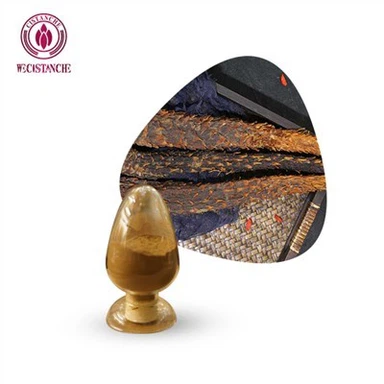
Cistanche tubulosa extract
Click here to view Cistanche Tubulosa Extract Natural Supplement Powder
【Ask for more】 Email:cindy.xue@wecistanche.com / WhatsApp: 0086 18599088692 / WeChat: 18599088692
3, Cistanche tubulosa: a natural endowment with high content
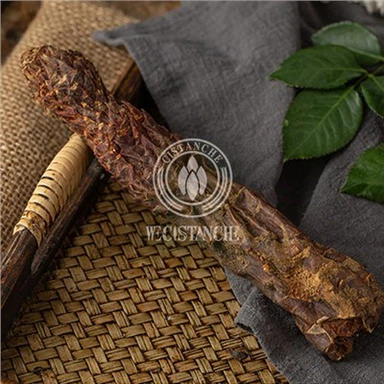
Guanhua Cistanche, commonly known as Southern Xinjiang Big Yun, Red Willow Big Yun, and Hard Big Yun, is mainly produced in southern Xinjiang and parasitizes the roots of plants in the genus Tamarix (Red Willow). It has a high woody nature and a high proportion of woody fibers. The host red willow has a deep and wide root system, which can provide sufficient nutrients for parasitism. In addition, the extreme desert environment of "drought, little rain, and strong sunshine" in southern Xinjiang promotes the accumulation of secondary metabolites in Cistanche tubulosa under stress conditions, resulting in effective ingredient content far exceeding the pharmacopoeia standards.

desert living cistanche
Multiple research data have confirmed the outstanding advantage of Cistanche tubulosa in terms of pineal glycoside content:
• High baseline content: The pharmacopoeia stipulates that the total amount of paeoniflorin and verbascoside in Cistanche tubulosa should not be less than 1.5%; The total amount of testing in actual high-quality production areas (such as Shaya in Xinjiang) can reach about 5.6%, far exceeding the requirements of the pharmacopoeia.
Significant genetic differences: Among the 7 germplasm samples of Cistanche tubulosa, the content of echinacroside ranges from 21.09% to 50.86%, while that of verbascoside ranges from 2.08% to 3.28%. The total content of the two high-quality germplasm samples can reach about 54%, making them highly promising materials for development.
• Obvious enrichment in different parts: The content of pineal glycoside in the roots is the highest (up to 79.12 mg/g DW), which is 2.87 times and 6.75 times higher than that in the middle and top parts, respectively, providing a scientific basis for "selecting raw materials according to different parts".
• Optimal selection between production areas: The content of echinaceae glycosides in Cistanche tubulosa from different production areas in southern Xinjiang ranges from 0.35% to 11.93%, indicating that high-content raw materials can be stably obtained through production area screening.

In summary, Cistanche tubulosa has become the preferred raw material for extract processing, pharmaceuticals, and health products due to its average content of 3-8 times higher than that of desert Cistanche tubulosa in terms of phenylethanoid glycosides such as pineal glycosides. It is also the most widely used industrial raw material for Cistanche tubulosa.
4, Why should Echinochlorin be the "first criterion" for selecting extracts
In the actual procurement and quality evaluation of Cistanche tubulosa extract, common indicators include total phenylethanolic glycoside content, pineal glycoside content, verbascoside content, moisture, heavy metals, pesticide residues, microbial limits, etc. Among them, echinacoside should be placed in the "first ruler" position for the following reasons:
(1) Pinecone chrysanthemum glycoside is the most abundant and representative indicator component
Among the two types of Cistanche tubulosa, echinacoside is the most abundant phenylethanoid glycoside, followed by verbascoside. With pineal chrysanthemum glycoside as the core, it can reflect both the authenticity of the raw material and the degree of enrichment of the active ingredients in the extract.

Cistanche tubulosa experiment
(2) The content of echinacoside is directly related to the expected potency of the product
The antioxidant, anti-fatigue, immune regulation, and promotion of bone activity of pineal chrysanthemum glycoside have been supported by multiple studies. For extract products positioned as "anti-fatigue, enhancing immunity, antioxidant, and improving male function," the higher the echinacoside content, the stronger the product's functional-substance basis and the more supportable the quality premium.
(3) The content of echinacoside is a rapid criterion for distinguishing between primogens and superior or inferior ones
The content of phenylethanoid glycosides in Cistanche tubulosa is significantly higher than that of iridoid glycosides, while the content of phenylethanoid glycosides in desert Cistanche tubulosa is significantly lower and contains exclusive Cistanche glycosides A. By measuring the content level of phenylethanoid glycosides, it is possible to quickly determine whether the extract is based on Cistanche tubulosa, whether the raw material is of high quality, and whether the process is effectively enriched.
(4) Industry consensus has gathered towards high-content pipe flowers'
In the commonly used internal control standards for Cistanche tubulosa extract in the industry, the total phenylethanolic glycoside shall not be less than 40%, the pineal glycoside shall not be less than 15%, and the verbascoside shall not be less than 3%. This threshold naturally points to the high accumulation of pineal glycosides in Cistanche tubulosa, which is difficult to stably achieve such high pineal glycoside specifications using desert Cistanche tubulosa as raw material. Therefore, when pursuing high-quality extracts, Cistanche tubulosa is almost an inevitable choice.