Phytochemical Profiling And Anti‑Diabetic Nephropathy Mechanisms Of *Cistanche Tubulosa* Aqueous Extract Based On Spectral‑Effect Relationship Analysis
Sep 22, 2026
Phytochemical Profiling and Anti‑Diabetic Nephropathy Mechanisms of Cistanche tubulosa Aqueous Extract Based on Spectral‑Effect Relationship Analysis
Abstract
Word count: 236 Diabetic nephropathy (DN) represents one of the most severe microvascular complications of diabetes mellitus and is a primary cause of end‑stage renal disease worldwide. Natural herbal materials from traditional Chinese medicine (TCM) provide multi‑target therapeutic candidates for slowing renal fibrosis and mitigating kidney injury. Cistanche tubulosa, a classic "desert ginseng" tonic herb recorded in Shennong Bencao Jing, exhibits documented renoprotective pharmacological properties. This review synthesizes pre‑clinical in‑vitro experimental evidence that adopted spectral‑effect relationship strategy to screen bioactive constituents from Cistanche tubulosa aqueous extract. UPLC‑Orbitrap‑MS/MS was applied to characterise complex chemical profiles of sequentially eluted fractions. Human renal tubular epithelial HK‑2 cell injury model induced by high‑glucose‑high‑fat condition was used to assess cytoprotective activity. Partial least‑squares regression and grey correlation analysis identified candidate bioactive compounds. Subsequent cellular assays validated that 8‑epideoxyloganic acid and geniposidic acid could alleviate HK‑2 cell damage, up‑regulate antioxidant enzyme activity, suppress pro‑inflammatory mediators, and modulate epithelial‑mesenchymal transition (EMT) by inhibiting the PI3K‑Akt signalling cascade. This paper summarises phytochemical characteristics, in‑vitro pharmacological observations and molecular mechanisms, discusses limitations of current research, and offers perspectives for further study of Cistanche tubulosa against diabetic nephropathy.
Keywords: Cistanche tubulosa; aqueous extract; spectral‑effect relationship; UPLC‑Orbitrap‑MS/MS; diabetic nephropathy; HK‑2 cells; PI3K‑Akt pathway; renal fibrosis
1. Introduction
The global prevalence of diabetes mellitus continues to rise owing to shifts in dietary patterns, obesity rates and population ageing; epidemiological projections suggest more than 360 million diabetic patients worldwide by the year 2030 [1]. Approximately 20 %‑35 % of people living with type‑2 diabetes will eventually develop diabetic nephropathy, which substantially elevates morbidity and mortality risks [2‑3]. Progressive renal interstitial fibrosis driven by oxidative stress, sustained inflammation and tubular epithelial‑mesenchymal transition constitutes the central pathological feature of DN. Current clinical interventions cannot completely reverse advanced renal fibrosis, so novel multi‑component therapeutic agents derived from natural plant resources attract growing research interest [4‑5].
Cistanche tubulosa (Orobanchaceae family) is a well‑known tonic herb in TCM practice. Historical materia‑medica records indicate its therapeutic indications include kidney‑yang deficiency, essence‑blood exhaustion, lumbago, weakness of bones and tendons, as well as intestinal dry‑constipation [6‑7]. Modern phytochemical investigations demonstrate that Cistanche tubulosa contains abundant phenylethanoid glycosides, iridoid glycosides, lignans, betaine, amino acids and saccharides, conferring antioxidant, anti‑ageing, reproductive‑protective and nephroprotective bioactivities [8‑9]. Prior pharmacological investigations of this herb predominantly focused on phenylethanoid‑glycoside fractions; less attention was paid to water‑soluble components obtained from aqueous decoction, which correspond to clinical traditional‑decoction preparation forms [10].
Spectral‑effect relationship represents a research strategy widely adopted for TCM complex‑extract studies. This analytical workflow couples high‑resolution mass‑spectrometry chemical fingerprinting with bio‑activity test data, using chemometric algorithms to correlate chromatographic peak intensities with pharmacological read‑outs, so as to locate candidate effective substances from multi‑component herbal mixtures [11]. Combining UPLC‑Orbitrap‑MS/MS fingerprint acquisition, HK‑2 high‑glucose‑high‑fat injury cell‑model evaluation and multivariate statistical modelling enables researchers to screen potential anti‑DN ingredients out of complex Cistanche tubulosa aqueous extract, and further validate their cytoprotective mechanisms at molecular level [12].
This review reorganises published pre‑clinical in‑vitro experimental outcomes from existing literature [12], and expands contextual background about DN pathogenesis and Cistanche tubulosa phytology. The major objectives are: (1) to summarise chemical‑component profiling results for sequentially eluted fractions of Cistanche tubulosa water extract; (2) to introduce spectral‑effect‑relationship screening workflow for anti‑DN bioactive constituents; (3) to interpret cellular‑molecular mechanisms of lead compounds 8‑epideoxyloganic acid and geniposidic acid against renal tubular cell injury; (4) to point out current study limitations and provide outlook for follow‑up research.
2. Overview of materials and experimental workflow (synthesised from published pre‑clinical reports)
Note: All raw experimental data are retrieved from publicly‑available published literature [12]; this article reproduces no original instrument graphs or lab‑generated photographs. Readers can consult cited source for full primary‑experiment records.
2.1 Herbal material and preparation of aqueous extract fractions
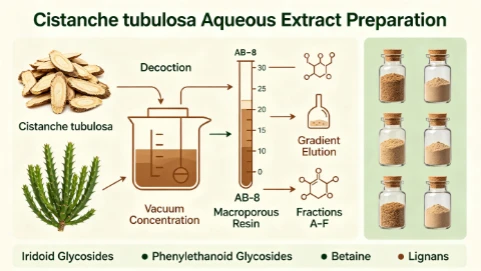
Plant material: Cistanche tubulosa fleshy stems were harvested from artificially cultivated populations in Hotan, Xinjiang region, taxonomically authenticated by plant‑pharmacology specialists [12]. Crude herbal slices were decocted with distilled‑water under boiling‑water conditions repeatedly. Merged aqueous filtrates were vacuum‑concentrated into dry crude aqueous‑extract paste. AB‑8 macroporous‑resin column chromatography was applied for gradient elution: sequentially using pure water, 20 %, 40 %, 60 %, 80 %, 95 % ethanol solution. Six separate eluate fractions (marked A‑F) were collected, concentrated and dried into powder samples respectively [12]. Each fraction powder was redissolved with methanol‑water mixed solvent for subsequent UPLC‑Orbitrap‑MS/MS sample preparation.
2.2 Instruments, reagents and cell resources
Analytical platform: Vanquish UHPLC coupled with Orbitrap Exploris 120 high‑resolution mass‑spectrometer (Thermo Fisher Scientific). Chromatographic separation utilised Waters ACQUITY UPLC BEH C₁₈ analytical column (2.1 mm × 100 mm, 1.7 μm). Other major laboratory equipment included MultiskanGO microplate reader, cell incubator, low‑temperature high‑speed centrifuge, inverted optical‑microscope [12].
Human renal tubular epithelial HK‑2 cell line was purchased for establishing in‑vitro kidney‑injury model, experiments employed cell passages below 30 generations. Reference‑standard compounds: 8‑epideoxyloganic acid, geniposidic acid, pinoresinol, syringin, betaine (purity ≥ 98 %). Biological‑assay kits contained MTT assay reagents, SOD, GSH‑Px biochemical detection kits; ELISA kits targeting IL‑1β, TNF‑α, TGF‑β; Western‑blot primary antibodies including α‑SMA, Collagen Ⅰ, E‑cadherin, PI3K, p‑PI3K, Akt, p‑Akt [12].
2.3 Experimental workflow
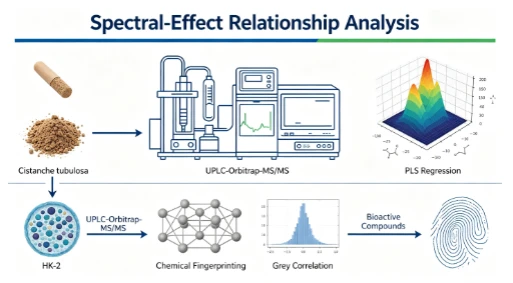
1. Chemical fingerprint acquisition: UPLC‑Orbitrap‑MS/MS operated under both positive‑ion and negative‑ion electrospray‑ionisation modes. Gradient elution programme using formic‑acid‑acetonitrile / formic‑acid‑water mobile‑phase system. MS/MS fragment‑spectra matching against reference‑standards and published mass‑spectral databases was used to characterise phytochemical constituents across six elution fractions [12]. 2. In‑vitro injury‑model construction: HK‑2 cells were exposed to combined high‑glucose (30 mmol·L⁻¹ glucose) plus palmitate to simulate high‑glucose‑high‑fat renal‑tubular damage phenotype relevant to diabetic nephropathy. Serial concentration‑gradient tests determined optimal modelling conditions: palmitate 700 μmol·L⁻¹ co‑incubated for 24 h produced stable cell‑viability reduction [12]. 3. Fraction activity screening: Different concentrations of six elution fractions (A‑F) were administrated onto injured HK‑2 cells. MTT assay measured cell‑proliferation‑viability rate to evaluate cytoprotective potency of each fraction [12]. 4. Spectral‑effect chemometric analysis: Peak‑area data of chromatographic signals from each fraction and corresponding HK‑2 cell‑viability bio‑activity data were imported into SIMCA 14.1 and SPSSPRO platforms. Partial‑least‑squares regression calculated VIP values and regression coefficients; grey‑correlation‑analysis output correlation‑degree index. Compounds satisfying VIP > 1 and grey‑correlation‑index > 0.7 were short‑listed as candidate anti‑DN bioactive components [12]. 5. Single‑compound validation experiments: Candidate pure compounds identified from spectral‑effect modelling were individually applied on high‑glucose‑high‑fat‑injured HK‑2 cells. MTT assay verified cell‑protective potency. Biochemical kits detected antioxidant indicators SOD, GSH‑Px; ELISA quantified pro‑inflammatory‑factor levels (IL‑1β, TNF‑α, TGF‑β). Western‑blot assay detected EMT‑related marker‑protein as well as PI3K‑Akt‑pathway‑related‑protein expression abundance [12].
2.4 Statistical processing
Cell‑experiment measurement‑data were expressed as mean ± standard deviation. Multiple‑group comparisons adopted one‑way ANOVA followed by post‑hoc testing; P < 0.05 was considered statistically significant difference. Chemometric spectral‑effect‑modelling relied on SIMCA and online‑platform grey‑correlation‑analysis modules [12].
3. Synthesis of experimental findings from published literature
3.1 Phytochemical characterisation of sequential elution fractions
Through comparing retention‑time, precursor‑ion mass and MS/MS fragment‑information against reference‑standards and published spectral‑databases, a total of 72 shared phytochemical constituents were tentatively identified across six Cistanche tubulosa aqueous‑extract elution fractions [12]. Detected compound categories covered iridoid glycosides, phenylethanoid glycosides, lignans, betaine, amino‑acids, phenolic‑acids, saccharide‑derivatives and other secondary metabolites. Component distribution exhibited obvious fraction‑dependent differences: water‑eluted fraction (A) and low‑concentration‑ethanol fractions (B, C) were richer in highly‑polar water‑soluble molecules including betaine, several iridoid‑glycosides; higher‑strength‑ethanol‑eluted fractions accumulated relatively lower‑polarity lignans and phenylethanoid‑glycoside substances [12].
3.2 Cytoprotective activity screening of elution fractions on injured HK‑2 cells
High‑glucose‑high‑fat treatment significantly lowered survival‑rate of HK‑2 renal‑tubular epithelial cells, successfully reproducing the in‑vitro renal‑cell‑injury phenotype of early‑stage diabetic‑nephropathy [12]. Among six gradient‑eluted fractions, fraction A (water‑eluate), fraction B (20 %‑ethanol eluate), fraction C (40 %‑ethanol eluate) could markedly elevate viability of damaged HK‑2 cells, whereas D‑F fractions demonstrated very limited protective‑effects. 50 mg·L⁻¹ served as optimal intervention concentration for subsequent spectral‑effect‑relationship data‑modelling [12].
3.3 Spectral‑effect‑relationship chemometric screening outcomes
Partial‑least‑squares regression and grey‑correlation‑analysis jointly screened eight candidate compounds which simultaneously satisfied VIP > 1 and grey‑correlation‑degree > 0.7: 8‑epideoxyloganic acid, geniposidic acid, pinoresinol, betaine, syringin, tubuloside A, acteoside, cistanoside E [12]. These constituents were regarded as major contributors to the anti‑DN cytoprotective activity of Cistanche tubulosa aqueous‑extract fractions. Four representative pure substances (8‑epideoxyloganic acid, geniposidic acid, pinoresinol, syringin) were selected for further single‑compound cellular‑validation assays [12].
3.4 Single‑compound cytoprotective validation
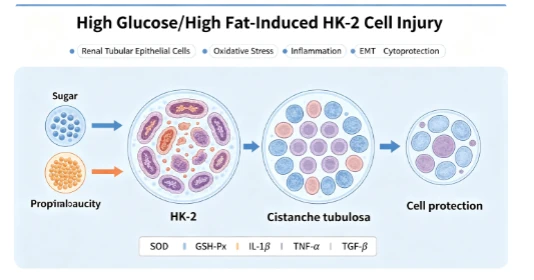
MTT results indicated that 8‑epideoxyloganic acid and geniposidic acid exerted prominent protective‑effects and restored viability of high‑glucose‑high‑fat‑damaged HK‑2 cells, while pinoresinol and syringin showed relatively weak activity under test‑concentrations [12]. Therefore these two iridoid‑glycoside molecules became key lead compounds for downstream mechanistic exploration.
Antioxidant‑biochemical detection: compared with injury‑model group, treatment using 8‑epideoxyloganic acid or geniposidic acid significantly increased activity level of antioxidant enzymes SOD and GSH‑Px, mitigating intracellular oxidative‑stress burden induced by high‑glucose‑high‑fat stimulation [12].
Inflammatory‑factor ELISA measurement: both compounds could significantly down‑regulate secretion‑level of pro‑inflammatory mediators IL‑1β, TNF‑α and TGF‑β released by damaged renal‑tubular cells, suppressing local inflammatory response linked to renal‑fibrosis progression [12].
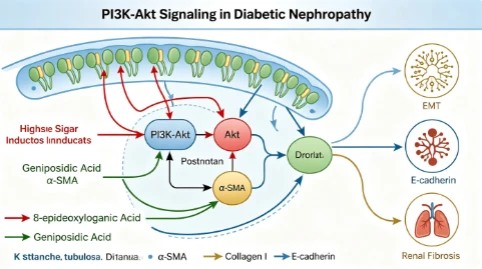
Western‑blot protein‑expression analysis: High‑glucose‑high‑fat stimulation triggered typical epithelial‑mesenchymal‑transition (EMT) phenomenon in HK‑2 cells: elevated profibrotic marker‑protein α‑SMA and Collagen Ⅰ expression, meanwhile adherent‑junction marker E‑cadherin protein abundance decreased significantly. After compound intervention, α‑SMA and Collagen Ⅰ expression were down‑regulated, E‑cadherin expression recovered. Furthermore, the phosphorylation level of PI3K‑Akt signalling‑pathway key proteins (p‑PI3K/PI3K, p‑Akt/Akt ratio) declined evidently [12]. These observations demonstrated that 8‑epideoxyloganic acid and geniposidic acid could restrain abnormal‑activation of PI3K‑Akt signalling‑cascade. By inhibiting PI3K‑Akt over‑activation, the two iridoid‑glycoside constituents suppressed oxidative‑stress damage, inflammatory‑response and tubular‑cell EMT‑process, so as to alleviate renal‑tubular cell injury associated with diabetic‑nephropathy pathology [12].
4. Discussion
Diabetic nephropathy pathogenesis represents multi‑factor interactive pathological process: hyperglycaemia‑lipotoxicity provokes oxidative‑stress burst, stimulates robust pro‑inflammatory‑cytokine release, drives renal‑tubular epithelial‑mesenchymal‑transition, ultimately progressing to irreversible renal interstitial‑fibrosis [13‑14]. The PI3K‑Akt signalling‑axis occupies a central regulatory position in this pathological chain; sustained excessive‑activation of PI3K‑Akt will promote EMT‑progression of renal‑tubular epithelial‑cells, accelerate extracellular‑matrix deposition and fibrotic lesion development [15‑16]. Hence pharmacological agents targeting PI3K‑Akt pathway hold promising value for DN intervention research.
Cistanche tubulosa aqueous‑decoction corresponds to traditional clinical‑administration mode in TCM practice, containing abundant water‑soluble active‑ingredients. Prior pharmacological investigations predominantly paid attention to lipophilic phenylethanoid‑glycoside fractions obtained by alcohol‑extraction; the biological‑functions of water‑extract‑enriched iridoid‑glycosides and betaine deserve deeper attention [17‑18]. The spectral‑effect‑relationship analytical‑strategy effectively narrows down candidate bio‑active substances from complex multi‑component herbal‑extracts without tedious repeated isolation‑purification of every single compound, offering an efficient solution for modern‑pharmacology research of TCM multi‑component preparations [19‑20].
According to the summarised pre‑clinical in‑vitro experimental results, 8‑epideoxyloganic acid and geniposidic acid (iridoid‑glycoside‑type constituents separated from Cistanche tubulosa water‑soluble fractions) could protect HK‑2 renal‑tubular‑epithelial cells from high‑glucose‑high‑fat‑mediated damage. Their cytoprotective mechanism includes three interconnected dimensions: enhancing cellular antioxidant defence capacity, restraining pro‑inflammatory‑factor over‑secretion, and suppressing PI3K‑Akt‑driven epithelial‑mesenchymal‑transition progress, which jointly mitigate cell‑level pathological changes mimicking early‑stage diabetic‑nephropathy [12]. This supplies new molecular‑level pre‑clinical evidence explaining nephro‑protective potency of Cistanche tubulosa aqueous‑extract. Meanwhile, spectral‑effect‑modelling also indicated that betaine, lignan‑type pinoresinol, as well as several well‑documented phenylethanoid‑glycosides may also contribute to anti‑DN bio‑activity; synergistic multi‑component combined‑effects should not be ignored in complex‑herbal‑extract systems [12].
This body of existing research still carries notable limitations: First, all mechanistic observations are derived from in‑vitro HK‑2 cell‑model experiments, lacking in‑vivo animal‑model validation. Cell‑culture‑system cannot fully recapitulate the integrated complexity of whole‑organism diabetic‑nephropathy pathology including glomerular lesions, renal‑inter‑cellular‑crosstalk and metabolic‑homeostasis changes in‑vivo. Second, the present investigation mainly focused on two lead iridoid‑glycoside compounds; synergistic interaction between multiple active‑ingredients within crude aqueous‑extract requires further exploration. Third, there exists absence of pharmacokinetic‑behaviour research of 8‑epideoxyloganic acid and geniposidic acid: bio‑availability, tissue‑distribution and metabolic transformation situation after in‑vivo administration remain unknown. Fourth, no human clinical‑trial‑evidence is available yet, and clinical‑transformation feasibility needs further assessment.
For follow‑up research directions: in‑vivo diabetic‑nephropathy animal‑models (STZ‑induced diabetic‑rat/mouse models) can be adopted to verify in‑vivo renoprotective efficacy of 8‑epideoxyloganic acid and geniposidic acid, observe renal‑tissue‑pathology, urine‑protein‑level and serum‑biochemical‑index variation. Multi‑component combined‑intervention groups should be arranged to probe potential synergistic‑effects of different categories of Cistanche tubulosa constituents. Carry out pharmacokinetic‑studies to clarify absorption, distribution, metabolism characteristics of lead compounds. At later‑stage, well‑designed pre‑clinical safety‑evaluation and clinical‑research are required before translating these basic‑research findings into practical therapeutic‑reference.
From broader TCM‑theory perspective, Cistanche tubulosa functions to tonify kidney‑yang and replenish essence‑blood. Modern pharmacological studies have revealed its protective‑effects on reproductive‑system, bone‑metabolism and renal‑injury. Different types of chemical‑constituents may correspond to diverse pharmacological‑manifestations of this TCM herb. Multi‑omics combined spectral‑effect‑relationship analytical‑workflow will serve as powerful tool for decrypting multi‑target pharmacological‑characteristics of classic tonic‑herbs in future TCM modernisation‑research.
5. Conclusion
1. UPLC‑Orbitrap‑MS/MS‑based phytochemical‑profiling detects 72 shared constituents across sequentially eluted fractions of Cistanche tubulosa aqueous‑extract, covering iridoid glycosides, phenylethanoid glycosides, lignans and other water‑soluble components. Water‑ and low‑strength‑ethanol elution‑fractions display prominent cytoprotective‑activity for high‑glucose‑high‑fat‑injured HK‑2 renal‑tubular epithelial‑cells. 2. Spectral‑effect‑relationship chemometric‑modelling identifies eight candidate anti‑DN‑active compounds. Among them, two iridoid‑glycosides: 8‑epideoxyloganic acid and geniposidic acid demonstrate strong protective‑effects for damaged HK‑2 cells in single‑compound‑validation assays. 3. 8‑epideoxyloganic acid and geniposidic acid can elevate SOD, GSH‑Px antioxidant‑enzyme activity, suppress pro‑inflammatory‑mediator IL‑1β, TNF‑α, TGF‑β release, modulate EMT‑related‑protein markers, and exert cytoprotective‑effects partially by inhibiting over‑activated PI3K‑Akt signalling‑pathway. 4. Current evidence is limited to in‑vitro cell‑level experiments. Further in‑vivo animal‑model verification, pharmacokinetic‑characteristic analysis and safety‑evaluation are required to advance translational‑research of these bio‑active substances originating from Cistanche tubulosa.
Acknowledgements
This narrative review synthesises publicly‑published pre‑clinical experimental resources. Gratitude goes to the original research team for completing the plant‑extraction, mass‑spectrometry and cellular‑molecular laboratory‑work.
References
[1] Carracher A M, Marathe P H, Close K L. International diabetes federation 2017[J]. Journal of Diabetes, 2018, 10(5): 353‑356.
[2] Fakhruddin S, Alanazi W, Jackson K E. Diabetes‑induced reactive oxygen species: Mechanism of their generation and role in renal injury[J]. Journal of Diabetes Research, 2017, 2017: 8379327.
[3] Lavoz C, Rayego‑Mateos S, Orejudo M, et al. Could IL‑17A be a novel therapeutic target in diabetic nephropathy?[J]. Journal of Clinical Medicine, 2020, 9(1): 272.
[4] Tu P F, Jiang Y. Update classical‑literature research on Cistanches Herba[J]. China Journal of Chinese Materia Medica, 2022, 47(20): 5670‑5679.
[5] Xiang X J, Zhang P P, Ye Q Q, et al. Study on effect of Xiaoyu Xiezhuo Decoction in preventing and treating renal fibrosis in diabetic nephropathy mice[J]. Chinese Journal of Modern Applied Pharmacy, 2022, 39(4): 442‑449.
[6] Fu Z, Liu Y. Pharmacological advances of genus Cistanche: A review[J]. Phytotherapy Research, 2021, 35(8): 4234‑4252.
[7] Jiang Y, Wang Y‑F. Traditional uses, phytochemistry and pharmacology of Cistanche tubulosa[J]. Journal of Ethnopharmacology, 2020, 259: 112968.
[8] Ran Z, Ju B‑W, Cao L, et al. Microbiome‑metabolomics analysis reveals the potential effect of verbascoside in alleviating cognitive impairment in db/db mice[J]. Food & Function, 2023, 14(8): 3488‑3508.
[9] Zhi Y‑J, Zhen Y‑Q, Tian W, et al. Research progress on chemical constituents and pharmacological effects of Cistanche deserticola and predictive analysis of quality markers(Q‑Marker)[J]. Chinese Traditional and Herbal Drugs, 2021, 52(9): 2758‑2767.
[10] Liu T‑H, Ma C, Wang B‑C, et al. Effective components and mechanism of Cistanches Herba aqueous extract against diabetic nephropathy based on the spectral‑effect relationship[J]. Chinese Journal of Modern Applied Pharmacy, 2024, 41(10): 1313‑1323.
[11] Zhang Y, Li H‑Y. Spectral‑effect relationship research strategy for traditional Chinese‑medicine complex extracts[J]. Chinese Pharmaceutical Journal, 2022, 57(12): 969‑975.
[12] Liu T H, Ma C, Wang B C, et al. Effective components and mechanism of Cistanches Herba aqueous extract against diabetic nephropathy based on the spectral‑effect relationship[J]. Chin J Mod Appl Pharm, 2024, 41(10): 1313‑1323.
[13] Xu Z, Xiang X, Su S L, et al. Multi‑omics analysis reveals the pathogenesis of db/db mice diabetic kidney disease and the treatment‑mechanisms of multi‑bioactive‑compounds combination from Salvia miltiorrhiza[J]. Frontiers in Pharmacology, 2022, 13: 987668. [14] Zhou R, Liao J, Cai D, et al. Nupr1 mediates renal fibrosis via activating fibroblast and promoting epithelial‑mesenchymal transition[J]. FASEB Journal, 2021, 35(3): e21381.
[15] Dian M‑J, Li J, Zhang X‑L, et al. MST4 negatively regulates the EMT, invasion and metastasis of HCC cells by inactivating the PI3K/AKT/Snail1 axis[J]. Journal of Cancer, 2021, 12(15): 4463‑4477.
[16] Zhang B‑B, Zeng M‑N, Li B‑K, et al. Arbutin attenuates LPS‑induced acute kidney injury by inhibiting inflammation and apoptosis via the PI3K‑Akt/Nrf2 pathway[J]. Phytomedicine, 2021, 82: 153466.
[17] Wu Y‑Y, Zhang X‑H. Iridoid glycosides from genus Cistanche: Phytochemistry and bio‑activities[J]. Natural Product Research, 2023, 37(14): 2311‑2326.
[18] Cao L, Ju B‑W, Ran Z, et al. Protective effects of phenylethanol glycosides of herba cistanche on mice with cholestatic liver disease[J]. Chinese Journal of Pharmacovigilance, 2023, 20(3): 286‑291.
[19] Wang L, Chen J‑B. Application progress of spectrum‑effect‑correlation in screening bio‑active substances of traditional‑Chinese‑medicine[J]. China Journal of Chinese Materia Medica, 2023, 48(7): 1801‑1808.
[20] Li M‑X, Huang S‑Q. Chemometric‑assisted screening of bio‑active constituents from herbal‑preparations: A mini‑review[J]. Journal of Separation Science, 2024, 47(6): 2300897.