Pharmacological Mechanisms Of Cistanche Herba Related To Kidney‑Meridian Tropism In Traditional Chinese Medicine
Sep 22, 2026
Pharmacological Mechanisms of Cistanche Herba Related to Kidney‑Meridian Tropism in Traditional Chinese Medicine
Author Note: This review synthesizes published pre‑clinical experimental data from multiple sources, including a Chinese master's dissertation on Cistanche Herba kidney‑meridian research. Affiliation: Academic Review, Independent Research Summary Document Type: Narrative Review Article Date: September, 2026
Abstract
Meridian tropism is a core component of traditional Chinese medicine (TCM) property theory, describing the selective pharmacological tendency of herbal medicines toward specific visceral functional systems. Cistanche Herba (Rou‑cong‑rong) is a classic kidney‑tonifying herbal material in TCM practice, indicated for kidney‑yang deficiency, essence‑blood depletion, reproductive impairment and bone‑related weakness. Although its clinical application has thousands‑year‑long historical records, modern biological explanations for its kidney‑meridian tropism remain to be systematically sorted out. This review integrates existing pre‑clinical animal, cell, metabolomics and literature‑mining data to interpret the material basis and molecular mechanisms behind Cistanche Herba kidney‑meridian effects under the theoretical framework of "kidney stores essence, governs reproduction and bone". Pre‑clinical animal evidence shows Cistanche Herba extract exerts protective influences on reproductive organs and bone tissue in kidney‑deficient rat models with low sex‑hormone status. Phenylethanoid glycosides are regarded as primary candidate bioactive constituents, which can interact with estrogen receptor‑α and modulate sex‑hormone‑related signalling. Serum metabolomics reveals interventions in lipid, amino‑acid, steroid‑hormone and energy metabolic pathways. Additionally, literature mining of TCM herbs with sex‑hormone‑like bioactivities offers new thoughts for establishing modern evaluation indicators for kidney‑meridian attribution. This article summarizes current experimental achievements and discusses existing limitations, to provide reference for further basic research on TCM meridian tropism theory.
Keywords: Cistanche Herba; kidney‑meridian tropism; TCM kidney storing essence; phenylethanoid glycosides; metabolomics; reproductive protection; osteoporosis; traditional Chinese medicine property theory
1. Introduction
In traditional Chinese medicine theory, the concept of "kidney (Shen)" does not equate to the anatomical kidney organ in western biomedicine. TCM kidney represents a complex functional system responsible for essence storage, reproduction, bone marrow generation, growth development and ageing progression. The classical doctrine "kidney stores essence, governs reproduction and bone" lays the theoretical foundation for understanding kidney‑tonifying herbal medicines[1]. Kidney‑essence exhaustion in TCM corresponds clinically to phenotypes such as gonadal function decline, sperm quality reduction, perimenopausal changes and osteoporosis, which are closely associated with sex‑hormone level disturbances in modern medical viewpoints.
Meridian tropism theory summarizes the selective organ‑targeting tendency of herbal agents obtained from long‑term clinical practice. Nevertheless, converting this ancient experiential summary into quantifiable biological markers is one major bottleneck in modern TCM basic research[2]. Multiple research strategies have been applied to decode meridian tropism, including mathematical modelling, tissue distribution tracking of chemical ingredients, receptor‑target hypothesis, multi‑omics system biology and literature big‑data mining. Among these perspectives, the receptor‑target hypothesis supposes that herbal active components may bind with receptors broadly distributed in specific organs, partially explaining the preferential pharmacological effects of TCM materia medica. System‑biology‑oriented metabolomics further captures holistic endogenous metabolic perturbations triggered by herbal intervention, which is consistent with TCM holistic thinking[3].
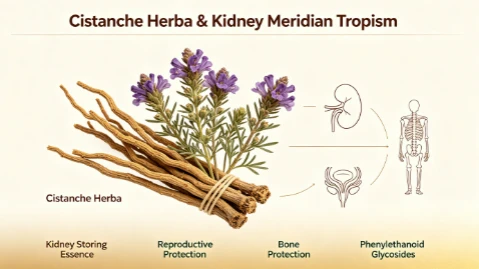
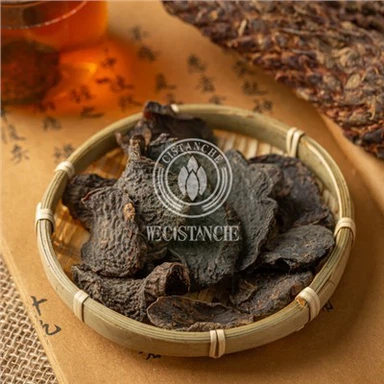
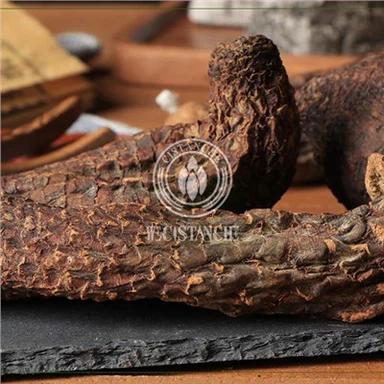
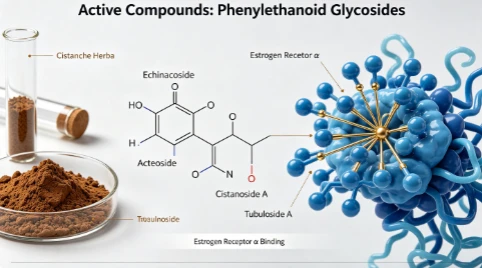
Cistanche Herba originates from Orobanchaceae parasitic plants Cistanche deserticola or Cistanche tubulosa. Its TCM properties are recorded as warm nature, sweet‑salty flavour, attributing to kidney meridian and large‑intestine meridian; main functions include tonifying kidney‑yang, replenishing essence‑blood and relaxing intestines[4]. Phytochemical investigations indicate phenylethanoid glycosides constitute its signature bioactive fraction: representative compounds include echinacoside, acteoside, cistanoside A and tubuloside A. These substances have been reported to possess estrogen‑like activity, anti‑osteoporotic, antioxidative and neuroprotective pharmacological properties[5].
Existing animal‑model systems for studying TCM kidney‑essence‑deficiency accompanied by low sex‑hormone status mainly contain two classic rat models. Adenine‑induced kidney‑yang‑deficient male rats can mimic male kidney‑essence‑depletion manifestations: decreased testosterone, impaired spermatogenesis, testicular‑epididymal pathological damage, hypothermia and reduced body weight. Bilateral ovariectomized female rats remove endogenous ovarian estrogen supply, generating uterine‑vaginal atrophy, high bone‑turnover osteoporosis, simulating female perimenopausal kidney‑essence‑exhaustion‑like pathological changes[6]. These two complementary in‑vivo models allow researchers to observe herbal intervention effects on both male and female reproductive‑bone related endpoints.
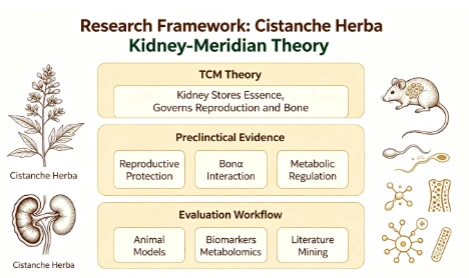
A set of systematic pre‑clinical experiments published in Chinese academic literature adopted the above‑mentioned two rat models to explore Cistanche Herba kidney‑meridian‑related pharmacodynamics, metabolomic profiles and active‑substance basis[7]. This review reorganizes and synthesizes those experimental outcomes together with other related publications, aiming to sort out the current evidence chain of Cistanche Herba acting on TCM kidney‑meridian functional system, and discuss challenges and prospects for meridian‑tropism modern‑interpretation research.
2. Materials and experimental overview (synthesized from published literature)
Note: All animal experimental raw data are derived from publicly‑available pre‑clinical reports[7]; this article does not reproduce original figures. Detailed operating protocols can be accessed from the cited source documents.
2.1 Herbal extract preparation and phytochemical detection
Dried Cistanche deserticola slices were extracted with 70 % ethanol reflux method twice, vacuum‑dried to obtain dry extract powder. High‑performance liquid chromatography (HPLC) was deployed to quantify phenylethanoid‑glycoside constituents. Major detected ingredients covered echinacoside, acteoside, cistanoside A, tubuloside A and salidroside[7].
2.2 Laboratory animals and ethical compliance
SPF‑grade SD rats were used for animal assays. Male 9‑week‑old rats for adenine‑induced kidney‑yang‑deficiency experiments; 9‑month‑old female rats for ovariectomy model. All animal experimental operations passed institutional animal‑ethics committee approval and followed ARRIVE guidelines[7]. Animals were housed under standardized laboratory feeding conditions with constant temperature‑humidity and natural light‑dark cycle.
2.3 Establishment of two kidney‑deficient animal models
1. Adenine‑induced male kidney‑yang‑deficiency rat: Intragastric adenine 200 mg/kg was administrated daily for 14 days to establish the model. Rats presented weight loss, low anal temperature, rough fur, lethargy, polyuria and declined serum testosterone level. Animals were separated into normal‑control, model‑control, low‑dose Cistanche Herba extract (1× clinical equivalent), high‑dose extract (2× clinical equivalent) and positive‑control L‑carnitine groups. Continuous intragastric intervention lasted 49 days[7]. 2. Ovariectomized female rat: Bilateral ovariectomy surgery removed ovarian estrogen source to construct estrogen‑deficient kidney‑deficiency model; sham‑operation group only resected surrounding adipose tissue. Vaginal smear screening confirmed successful modelling. Groups included sham‑control, OVX‑model, low‑/high‑dose Cistanche Herba extract and estradiol valerate positive‑control. Drug intervention lasted 12 weeks[7].
2.4 Main detecting indicators
2.4.1 Reproductive‑system related indexes
For male rats: computer‑assisted sperm‑analysis (CASA) detected sperm kinetic parameters; eosin‑hematoxylin staining assessed sperm count and malformation rate; fluorescence staining measured sperm viability; HE histopathological staining observed testicular and epididymal tissue lesions; ELISA kit determined serum testosterone concentration[7].
For female rats: HE staining evaluated uterus and vagina histomorphological changes; ELISA detected serum estradiol (E₂), luteinizing hormone (LH), follicle‑stimulating hormone (FSH); immunofluorescence assay tested estrogen receptor ERα, ERβ expression in uterine tissue[7].
2.4.2 Bone‑system related indexes
Micro‑CT scanned femoral trabecular‑bone micro‑structural parameters: bone mineral density (BMD), bone‑volume fraction (BV/TV), trabecular number (Tb.N), trabecular thickness (Tb.Th), trabecular separation (Tb.Sp), connectivity density (Conn.D). TRAP staining identified osteoclast activity. ELISA detected bone‑turnover biomarkers: alkaline phosphatase (ALP), bone‑gla‑protein (BGP), C‑telopeptide of type I collagen (CTX‑I)[7].
2.4.3 Untargeted serum metabolomics
UPLC‑Triple‑TOF‑MS untargeted metabolomics technology was adopted to analyse serum samples from control, model and low‑dose‑intervention groups of two rat models. Multivariate statistical analysis OPLS‑DA screened differential metabolites with filtering criteria VIP > 1, P < 0.05. KEGG pathway enrichment and Spearman correlation analysis between metabolites and bone‑biochemical markers were performed[7].
2.4.4 Cell‑molecular experiments for active‑substance exploration
MCF‑7 human breast‑cancer cell line was applied to screen estrogen‑like bioactivity of isolated phenylethanoid‑glycoside compounds via CCK‑8 cell‑proliferation assay. Autodock Vina molecular docking predicted binding affinity between candidate small‑molecule ingredients and ERα protein; surface plasmon resonance (SPR, Biacore S200) further verified real‑time molecular‑protein interaction and calculated dissociation equilibrium constant KD[7].

2.4.5 Literature‑mining analysis for herbs with sex‑hormone‑like bioactivity
Multi‑databases including CNKI, PubMed, Web of Science were retrieved to collect experimental literature reporting single‑herb sex‑hormone‑like pharmacological effects. Frequency statistics and co‑occurrence analysis were performed for herbal nature, flavour and meridian tropism records. Protein‑protein‑interaction (PPI) network was built for herbs belonging to "warm‑sweet‑kidney" property combination[7].
2.5 Statistical processing
Measurement data were expressed as mean ± standard deviation. One‑way ANOVA was used for multi‑group comparison, P < 0.05 was regarded as statistically significant difference. Metabolomics‑related analysis relied on R‑language statistical packages[7].
3. Synthesis of experimental results
3.1 Pharmacodynamic performance of Cistanche Herba extract in kidney‑deficient rat models
In adenine‑induced kidney‑yang‑deficient male rats, model group showed obvious reproductive‑system damage: testis‑epididymis organ coefficients decreased, seminiferous‑tubule structural disorder, spermatogenic‑cell disarrangement, sperm quality declined markedly, serum testosterone dropped sharply[7]. Compared with model group, Cistanche Herba extract intervention alleviated yang‑deficiency‑related phenotypes. Both 1‑fold and 2‑fold clinical‑equivalent doses generated protective outcomes, and the 1× clinical‑equivalent dose group exhibited better comprehensive efficacy. It improved sperm quantity, sperm viability and multiple sperm kinetic indexes, lowered sperm malformation rate, relieved seminiferous‑tubule and epididymal pathological injuries, and restored serum testosterone level[7]. Positive‑control L‑carnitine achieved comparable improving effects.
For ovariectomized female rats, OVX‑model animals displayed uterine‑vaginal atrophy, disordered estrous‑cycle, serum E₂ decline, elevated LH and FSH, severe trabecular‑bone destruction and high bone‑turnover osteoporosis[7]. Cistanche Herba extract treatment reversed genital‑organ atrophy, thickened endometrium, promoted vaginal epithelial keratinization, up‑regulated uterine ERα expression, raised serum E₂ and decreased LH concentration. In bone‑system aspects, extract administration improved femoral trabecular‑bone micro‑architecture parameters, restrained excessive osteoclast activation and adjusted serum bone‑turnover biomarkers to mitigate high‑bone‑turnover status[7]. Similarly, 1× clinical‑equivalent dose showed superior overall protective effect. Estradiol valerate positive‑control produced parallel protective tendencies on reproduction and bone indexes.
Observation summary from animal assays: Cistanche Herba extract can exert both reproductive‑protective and bone‑protective pharmacological activities in male and female kidney‑deficient low‑sex‑hormone‑level rat models; pharmacological response does not present simple "dose‑higher‑effect‑stronger" linear pattern[7].
3.2 Serum untargeted metabolomics findings
In adenine‑induced kidney‑yang‑deficient male rats, Cistanche Herba extract significantly callback 22 differential serum metabolites. These metabolites were mainly involved in linoleic‑acid metabolism, ether‑lipid metabolism, pantothenate‑and‑coenzyme A biosynthesis pathways. Intervention modulated lipid‑peroxidation products and pantetheine‑related energy‑metabolism molecules, which helped reduce oxidative‑stress‑caused reproductive‑tissue damage[7].
For ovariectomized female rats, 23 key differential metabolites were significantly regulated by herbal extract. These included long‑chain polyunsaturated fatty‑acids (DHA, DPA, arachidonic acid), amino‑acid substances, phenolic‑acid and carbohydrate‑related metabolites. Enriched metabolic pathways contained steroid‑hormone biosynthesis, arachidonic‑acid metabolism, tyrosine and tryptophan metabolism, biotin metabolism etc. Spearman correlation analysis demonstrated long‑chain polyunsaturated fatty‑acid metabolites showed negative correlation with bone‑turnover biomarkers; partial carbohydrate and phenolic‑acid metabolites presented positive correlation with bone‑biochemical markers[7]. Cistanche Herba extract intervened lipid metabolism, amino‑acid metabolism, carbon‑metabolism and nucleotide‑metabolism, thereby regulating LCPUFAs, sex‑hormone and amino‑acid homeostasis to ameliorate endocrine disturbance and bone‑energy‑metabolism disorder under kidney‑deficiency status[7].
3.3 Bio‑active material‑basis experimental outcomes
HPLC quantification results confirmed that Cistanche Herba ethanol extract contained abundant phenylethanoid‑glycoside constituents: echinacoside, acteoside, cistanoside A, tubuloside A and salidroside[7]. CCK‑8 cell‑proliferation assay showed these phenylethanoid‑glycoside compounds as well as their metabolite hydroxytyrosol could significantly promote MCF‑7 cell proliferation, proving estrogen‑like bioactivity. Molecular‑docking results indicated echinacoside, acteoside, cistanoside A, tubuloside A had binding energy lower than −7 kJ/mol when docking with ERα protein. SPR experiments further verified direct binding interaction between those four ingredients and ERα, with KD values distributed within 10⁻³ ~ 10⁻⁶ mol/L range[7]. Therefore, phenylethanoid glycosides represented candidate core pharmacodynamic substances for Cistanche Herba sex‑hormone‑like biological functions.
3.4 Literature‑mining outcomes of sex‑hormone‑like TCM herbs
After database screening, a total of 107 single TCM herbs with validated sex‑hormone‑like pharmacological effects were obtained[7]. Statistical analysis showed most of those herbs are warm‑nature, sweet‑flavour, and mainly attributed to liver meridian and kidney meridian. Several materia medica which were not explicitly recorded as kidney‑meridian‑entering in official pharmacopoeia exhibited sex‑hormone‑like effects, implying potential supplementary kidney‑meridian attribution. PPI network of "warm‑sweet‑kidney" property‑combination contained 325 nodes and 1225 interaction edges. Functional enrichment analysis revealed target proteins primarily participated in hormone‑stimulus response, cell autophagy‑apoptosis, inflammatory reaction, skeletal‑system development, glucose metabolism, angiogenesis, ER‑signalling, MAPK and NF‑κB signalling cascades[7]. These biological processes correspond to clinical indications including reproductive‑system disorders, osteoporosis, neurodegenerative diseases and metabolic syndromes. Based on these findings, researchers put forward a preliminary assessment workflow for kidney‑meridian‑attributed herbs: applying kidney‑deficient low‑sex‑hormone‑level animal models, observing reproductive‑bone pathological phenotypes, detecting sex‑hormone‑receptor expression and serum metabolomic‑biomarker alterations[7].
4. Discussion
The modern interpretation of TCM meridian‑tropism theory cannot rely only on ancient documentary records; multi‑angle pre‑clinical experimental evidence is indispensable. Synthesizing existing animal, cell and omics‑scale data, Cistanche Herba shows kidney‑meridian‑related pharmacological manifestations via protecting reproductive function and bone tissue under kidney‑essence‑deficient pathological conditions[7]. Its candidate bioactive materials are phenylethanoid‑glycoside components which can interact with estrogen receptor ERα, and meanwhile modulate androgen‑receptor expression in testicular tissue, presenting bidirectional sex‑hormone‑regulating characteristics, matching TCM cognition that Cistanche Herba tonifies kidney essence for both male and female populations. Metabolomics data indicate its intervention effects cover multiple metabolic networks including lipid, amino‑acid, carbon and nucleotide metabolism, rather than acting on only single molecular target.
Literature mining for sex‑hormone‑like TCM herbs demonstrates that many kidney‑tonifying herbs with warm‑sweet properties can regulate sex‑hormone‑related signalling networks. This provides a new measurable perspective to interpret part of kidney‑meridian‑tropism biological connotation[7]. Nevertheless, sex‑hormone‑network alteration cannot represent the whole picture of TCM kidney‑meridian doctrine. TCM kidney functional system involves far more biological dimensions beyond gonadal‑hormone regulation. Therefore, sex‑hormone‑related indicators are only one partial evaluating dimension, not the sole standard for judging kidney‑meridian tropism.
This body of research still has obvious limitations. First, all experimental evidence comes from animal and cell‑level pre‑clinical studies; high‑quality human clinical validation data are still absent. Second, this series of experiments focused mainly on phenylethanoid‑glycosides; other chemical fractions in Cistanche Herba such as polysaccharides and iridoids may also contribute to overall kidney‑tonifying efficacy and require further exploration. Third, meridian tropism is a multi‑factor complex biological phenomenon; one single animal‑model system cannot fully simulate the complete TCM kidney‑essence‑deficiency clinical syndrome[7]. In future work, multi‑omics combination together with real‑world clinical research will help to supplement and perfect this theoretical system.
For TCM basic‑research practice, when using modern laboratory indexes to decode ancient property theories, we need to avoid simple one‑to‑one mechanical correspondence between TCM functional concept and single‑molecule western‑medicine target. We should maintain the holistic thinking characteristics of traditional Chinese medicine while introducing modern technological means.
5. Conclusion
1. Pre‑clinical animal experiments show Cistanche Herba extract can produce significant reproductive‑protective and bone‑protective effects in rat models of kidney‑essence deficiency accompanied by low sex‑hormone levels. The 1‑fold clinical‑equivalent dose demonstrates optimal comprehensive pharmacological performance. 2. Cistanche Herba may regulate lipid metabolism, amino‑acid metabolism, pantothenate‑CoA biosynthesis and nucleotide‑metabolism pathways, adjusting levels of long‑chain polyunsaturated fatty acids, sex‑hormones and amino‑acid substances to maintain endocrine homeostasis and improve bone‑energy‑metabolism disturbance under kidney‑deficient conditions. 3. Phenylethanoid glycosides (echinacoside, acteoside, cistanoside A, tubuloside A) are candidate core pharmacodynamic material basis for Cistanche Herba kidney‑meridian‑associated activity, capable of directly binding with ERα protein. Sex‑hormone‑regulatory‑network change can serve as one partial biological clue to interpret TCM kidney‑meridian tropism. 4. Preliminary evaluation workflow for kidney‑meridian‑attributed herbs can be constructed based on sex‑hormone‑network signatures. This supplies experimental reference for modern basic research on TCM meridian‑tropism theory, while more evidence is still needed for further verification.
Acknowledgements
This review synthesizes publicly‑published pre‑clinical experimental resources. Thanks to the researchers who completed the original animal and molecular laboratory work.
References
[1] Su L, Cao G, Zhu J. Discussion on intervention significance of TCM "Tian‑Gui" theory for male late‑onset hypogonadism[J]. Acta Chinese Medicine, 2018, 40(6):1041‑1048.
[2] Cao C, Dong X, Tian Y. Historical evolution, current research situation and thinking of TCM meridian tropism theory[J]. China Journal of Traditional Chinese Medicine and Pharmacy, 2023, 38(1):1‑6.
[3] Su H Y, Liu J H, Wang B Q. Overview of material‑basis research on kidney‑deficiency syndrome based on metabolomics[J]. Shandong Medical Journal, 2020, 60(11):106‑110.
[4] Chinese Pharmacopoeia Commission. Pharmacopoeia of the People's Republic of China[M]. Beijing: China Medical Science Press, 2020. [5] Xu C H, Ni J T, Wang Y, et al. Research progress on bio‑activities of phenylethanoid glycosides from Cistanche Herba[J]. Food and Drug, 2023, 25(3):261‑266.
[6] Tang W W, Zhang H Y, Li Q. Progress in construction and evaluation of animal models for kidney‑yang‑deficiency syndrome[J]. China Journal of Chinese Materia Medica, 2022, 47(20):567‑573.
[7] Li J S. Mechanism of Cistanche Herba in relation to the kidney based on the theory of kidney as the storehouse of essence and sustaining the reproductive system[D]. Beijing: China Academy of Chinese Medical Sciences, 2024.