Progress And Analysis in R&D Of Cistanches Herba Products And Key Issues in Industrial Advancement
Apr 25, 2025
Abstract Cistanches Herba (CH) is a famous tonic traditional Chinese medicine, with the effects of tonifying the kidney and marrow, moistening the intestines and laxative effect, and modern pharmacological researches have shown that it has antifatigue, immune regulation, neuroprotection, and anti-aging activities, which makes it an ideal raw material for the development of pharmaceuticals and health products. 2023, CH was added in the catalog of medicinal and food substances, providing policy support for its application in conventional food products and expanding pathways for industrial diversification. To comprehensively understand current CH product development, this study systematically investigated professional databases including Yaozhi (https://db.yaozh.com), Chinese Pharmacopoeia, Compendium of National Standards for Proprietary Chinese Medicines, and Kezhuang (https://www.jeebei.com), supplemented by market research data. We conducted a thorough review of the applications of CH as a primary ingredient in domestic and international patented TCM preparations, health foods, cosmetics, and common food products. Furthermore, this review points out current industrial challenges and future potential market prospects, aiming to provide strategic references for the development and industrialization of CH-based pharmaceutical and health products, thereby promoting the vigorous growth of the CH industry.
Keywords Cistanches Herba; product development; pharmaceuticals; dietary supplement; cosmetics; foods


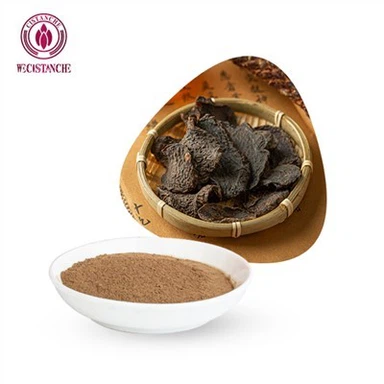
Cistanches Herba, commonly known as 肉苁蓉 (Rou Cong Rong), is the dried, fleshy stem with scaly leaves of plants from the Orobanchaceae family, specifically Cistanche deserticola Y. C. Ma (commonly known as Desert Cistanche) or Cistanche tubulosa (Schenk) Wight (commonly called Tubular Cistanche). First recorded in Shen Nong Ben Cao Jing (Shennong's Classic of Materia Medica), it is a renowned tonic herb. Primarily grown in the deserts and arid regions of northwest China, such as Xinjiang and Inner Mongolia, it is often referred to as the "Ginseng of the Desert." Cistanches Herba has a range of benefits, including tonifying kidney yang, nourishing kidney yin, replenishing essence and blood, and promoting bowel movement. It is commonly used to treat kidney yang deficiency, deficiency of essence and blood, impotence, infertility, weak waist and knees, muscular weakness, and dry constipation [1].
Chemical Constituents and Benefits
Cistanches Herba contains a variety of components such as phenylethanoid glycosides, iridoid glycosides, lignans, polysaccharides, oligosaccharides, betaine, mannitol, amino acids, and trace elements [2-5]. These active ingredients contribute to its effects, including:
Improving sexual function
Enhancing immunity
Combating fatigue and aging
Boosting learning and memory
Providing neuroprotective effects against Alzheimer's and Parkinson's diseases
Supporting liver health
Promoting bowel movement
Preventing osteoporosis [3-6]
This makes Cistanches Herba highly suitable for pharmaceutical and health product development.
Historical Dietary Use
Historical medical texts also mention the edible nature of Cistanches Herba. Tao Hongjing remarked, "While fresh, it resembles meat and can be used to make lamb soup, which is excellent for replenishing deficiency. It can also be eaten raw" [7]. This was the first recorded suggestion that Cistanches Herba could be consumed as a medicinal food. The Illustrated Classic of Materia Medica states: "Cistanches Herba... Westerners often consume it as food, scraping off the scales, washing it with alcohol to remove the black juice, slicing it thinly, and cooking it with yams and lamb to make soup that is both delicious and nutritious, surpassing the effects of taking tonics" [8]. Chen Zangqi wrote, "To strengthen the muscles and marrow, mix Cistanches Herba and eel powder with Polygonatum wine into pills; the strength will increase tenfold" [9].
In regions like Inner Mongolia and Xinjiang, Cistanches Herba has historically been used as a food ingredient, incorporated into dishes such as stews, teas, staple foods, and traditional medicinal wines.
Regulation and Market Recognition
The dual-use of Cistanches Herba as both food and medicine was officially recognized in recent years. The National Health Commission and the State Administration for Market Regulation issued notices in November 2019 and November 2023, respectively, regarding the inclusion of Cistanches Herba in the list of substances traditionally used as both food and medicine. These notices-Notice on the Pilot Management of 9 Substances Including Codonopsis as Both Food and Traditional Chinese Medicinal Materials (2019 No. 311) [10] and Announcement on the Addition of 9 Substances Including Codonopsis to the List of Substances Traditionally Used as Both Food and Medicine (2023 No. 9) [11]-marked an important milestone, officially granting Cistanches Herba the dual status of food and medicinal material. However, only Desert Cistanche has been included in the list for food use, while Tubular Cistanche remains excluded. This means that both species of Cistanches Herba are permitted for medicinal use, but only Desert Cistanche can currently be used as food.

Product Development and Market Potential
To gain a comprehensive understanding of the development of Cistanches Herba products, a systematic survey was conducted. This included searches of professional databases like Yaozhi (https://db.yaozh.com), Chinese Pharmacopoeia, National Standards for Chinese Patent Medicines Compendium, and KeZhuang (https://www.jeebei.com), as well as market research and other multi-source information collection. The findings summarized and analyzed the development and utilization of Cistanches Herba products in pharmaceuticals, health foods, cosmetics, and regular food categories. Challenges in product development and market prospects were also discussed to provide references for deeper exploration and application of Cistanches Herba products, supporting the diversification, sustainability, and high-quality development of the Cistanches Herba industry.
1 Materials and Methods
1.1 Analysis of Cistanches Herba-Based Chinese Patent Medicines
Using the keyword "Cistanches Herba" (肉苁蓉), searches were conducted in the Chinese Patent Medicine Database on Yaozhi.com (https://db.yaozh.com/chufang) to collect information on related Chinese patent medicines, including their dosage forms and therapeutic effects. The database sources include Chinese Pharmacopoeia and the National Standards for Chinese Patent Medicines Compilation.
1.2 Analysis of Cistanches Herba-Based Health Foods
Information was gathered from the State Administration for Market Regulation (https://www.samr.gov.cn/) and Yaozhi.com's Health Food Database (https://db.yaozh.com/baojian/) using the keyword "Cistanches Herba." Approved health food data were collected to analyze product dosage forms, primary functions, and active ingredients.
1.3 Analysis of Cistanches Herba-Based Cosmetics
Using the keyword "Cistanches Herba," searches were conducted in Yaozhi.com's Cosmetics Database (https://db.yaozh.com/huazhuang) and data published on KeZhuang.com (https://www.jeebei.com). Additionally, information was retrieved from the National Medical Products Administration's Domestic General Cosmetics Filing Information Database (https://hzpba.nmpa.gov.cn/gccx/) to compile filing records for related products.
Below is the English-translated table for the provided image:
Table 1 Distribution of efficacies of Chinese patent medicines containing Cistanches Herba %
| Efficacy | Percentage (%) |
|---|---|
| Tonifying Kidney Yang | 86.94 |
| Strengthening Bones | 34.71 |
| Regulating Menstruation | 20.47 |
| Nourishing Qi and Blood | 17.18 |
| Nourishing the Liver | 12.03 |
| Replenishing Kidney Essence | 11.68 |
| Promoting Health | 11.03 |
| Relieving Pain | 10.36 |
| Nourishing the Heart | 10.14 |
| Improving Constipation | 9.96 |
| Strengthening Energy | 4.76 |
| Eye Care | 3.16 |
| Others | 2.26 |

Fig. 1 Dosage forms and quantities of Chinese patent medicines containing Cistanches Herba
2 Results and Analysis
2.1 Cistanches Herba-Based Chinese Patent Medicines
The Yaozhi Traditional Chinese Medicine Database identified 291 domestic Chinese patent medicines containing Cistanches Herba. These include:
26 formulations sourced from the Chinese Pharmacopoeia (2020 Edition)
44 from the National Standards for Chinese Patent Medicines Compilation
74 from National Drug Standards
101 from the Ministry of Health Drug Standards
4 from the New Compilation of National Chinese Patent Medicines
19 from the New Drug Approval Standards
18 from Registration Standards
5 from provincial or other standards
The compiled product information includes names, dosage forms, formulations, and indications (enhanced materials available in the China National Knowledge Infrastructure).
Cistanches Herba is traditionally known for its kidney-yang tonifying properties, which align with the primary focus of related Chinese patent medicines. Yaozhi recorded 291 medicines with therapeutic effects such as tonifying kidney yang, strengthening bones, nourishing the liver, regulating menstruation, and replenishing qi and blood-13 functions in total. Among these, 86.94% of products focus on tonifying kidney yang.
The dosage forms include oral liquids, pills, tablets, mixtures, teas, capsules, and tinctures, spanning 15 types in total. Capsules are the most prevalent, followed by pills, as shown in Figure 1.
Cistanches Herba-Based Chinese Patent Medicines in Regions Outside Mainland China
Apart from being registered in mainland China, a significant number of Cistanches Herba-based products were also identified in Hong Kong, Macau, and Taiwan. Specifically:
Hong Kong: 74 records
Macau: 61 records
Taiwan: 859 records
According to Yaozhi.com data, since 1970, Taiwan has approved 859 Chinese patent medicines using Cistanches Herba as a key ingredient. Notably, unlike mainland China, where Cistanches Herba products predominantly focus on tonifying kidney yang, Taiwan emphasizes its role in nourishing qi and blood, as well as yin-regulating and menstruation-adjusting functions. In Taiwan, 65.54% of the products are formulated for nourishing qi and blood, providing a "female perspective" for product development.
As described in historical texts, Shen Nong Ben Cao Jing documented that Cistanches Herba can "strengthen yin, benefit essence and qi, and promote fertility, addressing gynecological disorders." Similarly, Ri Hua Zi Ben Cao recorded its efficacy in treating "male impotence and female infertility" [12-13]. These records highlight that Cistanches Herba can both assist yang and nourish yin, suggesting that further research into its kidney-yin nourishing properties could open new avenues for product innovation.
Innovative Drug Development with Cistanches Herba
In addition to traditional Chinese patent medicines, innovative drugs have been developed using extracts of Cistanches Herba. For example:
Total Glycosides of Cistanche Capsules: This formulation, derived from phenylethanoid glycosides extracted and purified from Cistanche tubulosa, was approved in 2005. It is used for tonifying kidney essence, improving brain function, and treating mild to moderate vascular dementia caused by marrow deficiency.
Development of Active Components:
Echinacoside and its Tablets (Application No. CXZL0600234)
Total Glycoside Extracts and Oral Liquid (Application No. CXZL1900009)
Both have completed Phase I and II clinical trials, showcasing their potential as innovative drugs.

buy Echinacoside(≥40%),Acteoside/Verbascoside(≥16%),Phenylethanoid glycoside(≥85%),Flavonoids(≥10%) Cistanche Extract
Standardized Granules and Classic Formulations
In recent years, regional and national standards for Cistanches Herba granules have been successively introduced. These include:
Cistanches Herba granules (C. deserticola)
Cistanches tubulosa granules
Wine-processed Cistanches Herba granules (C. deserticola and C. tubulosa)
These standards have provided new avenues for clinical use of Cistanches Herba raw materials.
Additionally, classical Chinese medicine formulations have become a focus of new drug approvals in recent years. Among the five approved Class 3.1 classical Chinese medicine compound preparations, one includes Cistanches Herba:
Jichuan Decoction Granules (Approval No. C20230002), approved in December 2023.
Moreover, another classical formula containing Cistanches Herba, "Dihuang Yin Zi," is currently under development.