Proteomics And Cytokine Analyses Distinguish Myalgic Encephalomyelitis/chronic Fatigue Syndrome Cases From Controls Part 2
Oct 12, 2023
Correlations of protein levels with clinical metadata indicate their importance in disease state
All proteins were analyzed for correlations with the clinical metadata using the same methods previously described. Only significant results after adjustment for multiple comparisons (q<0.1) are shown in Table 2. There were significant correlations between plasma cytokines, plasma proteomics, and the clinical metadata, but none were found with the EV cytokine dataset (Table 2).
Cistanche can act as an anti-fatigue and stamina enhancer, and experimental studies have shown that the decoction of Cistanche tubulosa could effectively protect the liver hepatocytes and endothelial cells damaged in weight-bearing swimming mice, upregulate the expression of NOS3, and promote hepatic glycogen synthesis, thus exerting anti-fatigue efficacy. Phenylethanoid glycoside-rich Cistanche tubulosa extract could significantly reduce the serum creatine kinase, lactate dehydrogenase, and lactate levels, and increase the hemoglobin (HB) and glucose levels in ICR mice, and this could play an anti-fatigue role by decreasing the muscle damage and delaying the lactic acid enrichment for energy storage in mice. Compound Cistanche Tubulosa Tablets significantly prolonged the weight-bearing swimming time, increased the hepatic glycogen reserve, and decreased the serum urea level after exercise in mice, showing its anti-fatigue effect. The decoction of Cistanchis can improve endurance and accelerate the elimination of fatigue in exercising mice, and can also reduce the elevation of serum creatine kinase after load exercise and keep the ultrastructure of skeletal muscle of mice normal after exercise, which indicates that it has the effects of enhancing physical strength and anti-fatigue. Cistanchis also significantly prolonged the survival time of nitrite-poisoned mice and enhanced the tolerance against hypoxia and fatigue.

Click on fatigue
Why we will be tired? How can we solve the fatigue problems?
【Contact】Email: george.deng@wecistanche.com / WhatsApp:008613632399501/Wechat:13632399501
Within the plasma cytokine dataset, both Colony Stimulating Factor 2 (CSF2) and leptin were negatively correlated with sex and positively correlated with BMI in both the ME/CFS and control groups (Fig. 6a). Interestingly, individuals with ME/CFS and IBS have higher concentrations of CSF2 and leptin than people with ME/CFS and without IBS, and these correlations were not observed in the control group (Fig. 6b).
The ME/CFS cohort also revealed unique significant correlations with the health questionnaire data related to physical function (SF-36) and fatigue (MFI-20) that were not found in the control group. CSF2 and leptin were negatively correlated with Physical Function (r=− 0.539, q=0.002 for CSF2; r=− 0.558, q=0.002 for leptin) and the Physical Component Summary (r=− 0.459, q=0.035 for CSF2; r=− 0.445, q=0.035 for leptin), and positively correlated with General Fatigue (r=0.439, q=0.047 for CSF2; r=0.436, q=0.047 for leptin) (Table 2, Fig. 6c).
We found other signifcant correlations between cytokines and the clinical data in ME/CFS subjects that were not found in controls: CCL2, CXCL10, and CCL11 were positively correlated with age (r=0.440, q=0.060 for CCL2; r=0.394, q=0.099 for CXCL10; r=0.431, q=0.060 for CCL2) (Fig. 6d). Both (TNFα and IL1RA were positively correlated with BMI (r=0.543, q=0.001 and r=0.468, q=0.010 respectively), and negatively correlated with the Physical Function category of the SF-36 (r=− 0.508, q=0.004 and r=− 0.480, q=0.007 for TNFα and IL1RA respectively) (Fig. 6e). Lastly, IL13 positively correlated with the Reduced Activity score from the MFI- 20 questionnaire (r=0.482, q=0.025).


As mentioned above, additional significant correlations were found between the plasma proteomics dataset and the clinical metadata. There were 9 significant correlations in the control group and only two in the ME/CFS subjects (Table 2, bottom part). In control samples, Protein S (PROS1) and Fc Receptor-Like 3 (FCRL3) were negatively correlated with Vitality (r=− 0.590, q=0.015 for PROS1, r=− 0.538, q=0.039 for FCRL3). Additionally, PROS1 was negatively correlated with the SF-36 Physical Component Summary (r=− 0.608, q=0.008) and positively correlated with the MFI-20 General Fatigue score (r=0.590, q=0.016). The Cholesteryl Ester Transfer Protein (CETP) was positively correlated with General Fatigue (r=0.547, q=0.032) and Total scores from the MFI-20 (r=0.557, q=0.025), and the Hemoglobin Subunit Alpha 1 (HBA1) was negatively correlated with the two same scores (r=− 0.558, q=0.046 and r=− 0.556, q=0.025 respectively) (Fig. 7a). In the ME/ CFS group, Serpin Family A Member 5 (SERPINA5) was positively correlated with General Health (r=0.646, q=0.004) and Social Functioning (r=0.593, q=0.027) from the SF-36 questionnaire (Fig. 7b).
Robust linear regression reveals additional relationships between certain proteins and clinical information
To better understand the relationship between proteins and the metadata, we performed robust linear regression and t-tests for the estimated coefficients. Robust linear regression was performed for EV cytokines, plasma cytokines, and plasma proteomics, respectively. Each model included a specific protein level as the predicted variable and the cohort (ME/CFS or control), sex, age, BMI, and Irritable Bowel Syndrome (IBS) as a covariate. Interactions between the cohort and the metadata covariates were also included in the model. The interactions test the hypothesis that the relationship between the metadata and the level of a protein is different in ME/CFS than in the control group. The significant effects are summarized in Table 3. It is standard practice in biostatistics to include both main effects whenever two variables have a statistically significant interaction. The reasoning here is that the interaction shows that the variables are having effects even if the main effect does not achieve statistical significance. We followed this practice. In Table 3, Male is a dummy (indicator or 0–1) variable that equals 1 for males and 0 for females. Similarly, ME/CFS is a dummy variable that is 1 or 0 for cases or controls, respectively, and IBS is a dummy variable equal to 1 or 0 for subjects with or without IBS, respectively. ME/CFS: Age is the product of ME/CFS and Age and so is equal to 1 for ME/ CFS cases and equal to 0 for controls. ME/CFS: Male is the product of two dummy variables and so is equal to 1 for males in the ME/CFS group and equal to 0 for all other subjects. ME/CFS:(+) IBS is equal to 1 for ME/CFS cases with IBS and 0 otherwise.

In EV cytokine samples, age was significant for predicting CXCL1 level (β=− 0.013, q=0.035) and CCL11 level (β=0.032, q=0.035). Tus, CXCL1 decreases with age but CCL11 increases with age. (Table 3).
In plasma cytokines, both BMI and males significantly predicted Leptin and CSF2 levels. The effect for the dummy variable Male is the difference between the means for males and females. For example, the mean of the variable Leptin (or CSF2) is, all else equal, 1.119 (or 1.230) lower for males compared to females. For both CCL2 and CSF3, the main effect of age, and the interaction term between age and cohort were significant. The intercepts for the regression of CCL2 on age are 0.690 and 0.690− 2.696= − 2.006 for controls and cases, respectively. For every one-year increase in age, the average of CCL2 will decrease by 0.037 in controls and increase by 0.075–0.037=0.038 in cases. The intercepts for the regression of CSF3 on age are 0.576 and 0.576−1.994=− 1.418 for controls and cases, respectively. For every one-year increase in age, the average of CFS3 will decrease by 0.047 in controls and increase by 0.075–0.047=0.028 in cases.
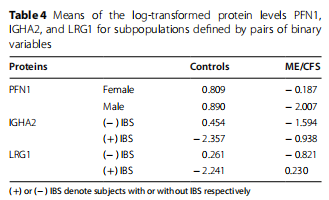
In plasma proteomics data, age was also significant for predicting SAA1 level (β=0.047, q=0.049). For PFN1, the interaction between ME/CFS and sex was significant (β=− 1.901, q=0.030). The mean of PFN1 is 0.809 for female controls, 0.809−0.996=− 0.187 for female cases, 0.809+0.081=0.890 for male controls, and 0.809+0.081−0.996−1.901=− 2.007 for males cases. Thus, mean PFN1 is higher in controls than in cases for both sexes, but the difference is much greater in males (0.809+0.187=0.996 for females versus 0.890+2.007=2.897 for males).

For IGHA2, the interaction between ME/CFS and IBS was significant (β=3.467, q < 0.001). The mean of IGHA2 is 0.454 for controls without IBS, 0.454−2.048=− 1.594 for ME/CFS cases without IBS, 0.454−2.811=− 2.357 for controls with IBS, and 0.45 4−2.048−2.811+3.467=− 0.938 for cases with IBS. Therefore, the mean IGHA2 is higher for controls than cases for subjects without IBS but higher in cases than controls for subjects with IBS. For LRG1, the interaction between ME/CFS and IBS was significant (β=3.093, q < 0.001). The mean of LRG1 is 0.261 for controls without IBS, 0.261−1.082=− 0.821 for ME/CFS cases without IBS, 0.261−2.502=− 2.241 for controls with IBS, and 0.261−1.082−2.502+3.093= 0.230 for cases with IBS. We see that mean LRG1 is higher in controls than cases for subjects without IBS but higher in cases than controls for subjects with IBS (Table 4).

IBS has opposite effects in cases and controls on IGHA2 and LRG1 (Table 4). Although these differences are statistically significant, it should be noted that there was only one control subject with IBS.

Three machine learning approaches result in predictive and discriminative models
The top 20 protein analytes and feature importance values for each of the three machine-learning approaches can be found in Table 5. All three methods had an excellent performance at distinguishing ME/CFS from controls using the top 20 protein analytes with 250 replications of fivefold cross-validation. Figure 8 shows the ROC curves and the AUROC values from these three classifiers with the top 20 proteins ranked in importance measurements. The XGBoost classifier performed the best with a high degree of accuracy (86.1%, Additional file 1: Fig. S3a) with a cross-validated AUROC value of 0.947 (95% CI 0.895–0.998). Furthermore, using the top 8 proteins from each classifier, logistic regression (LASSO) gave the best results with an AUC of 0.873 (95% CI 0.792–0.953) and accuracy of 78.6% (Fig. 8b and Additional file 1: Fig. S3b). Finally, Random Forest with 7 protein analytes common to all three top 20 lists (bold proteins in Table 5) distinguished ME/CFS from the controls with an AUROC value of 0.891 (95% CI 0.817–0.966) and accuracy of 79.1% (Fig. 8c and Additional file 1: Fig. S3c).


Discussion
In this study, we utilized samples and data from 98 of the 100 subjects who previously provided samples that were analyzed for fecal metagenomics and plasma cytokines [26] and also for plasma proteins assayed by mass spectrometry [14]. Furthermore, extracellular vesicles were isolated from these 98 samples, and we found that the mean size and concentrations of particles were significantly higher in ME/CFS (Fig. 2). Although a previous report using the same EV purification method as the present study found that the mean size of ME/CFS EVs was reduced [42], the authors analyzed EVs isolated from 10 ME/CFS patients and 5 healthy controls vs. 49 ME/ CFS and 49 controls in this study, did not use thrombin to remove fibrinogen and used low centrifugal forces to pellet EVs (1500 g vs. 12,000 g in this study). All together this could explain the different results observed with our current study. Finally, our results confirmed other findings reporting higher concentrations of vesicles in ME/ CFS [24, 25, 42] and these observations are also seen in conditions such as Alzheimer’s disease [17] and cerebrovascular disease [20].
Our work demonstrates the value of using multiple assays on the same samples, and also the importance of performing correlations with clinical data. Doing so has allowed us to identify several associations of particular proteins with patient symptoms. Importantly, we demonstrate that the data can distinguish between patients and controls at high accuracy. ME/CFS has long been incorrectly viewed by some as a psychological illness. Being able to separate patients and controls through analyses of plasma is a strong demonstration of the biological nature of the illness. A summary of our experimental assays and key findings is shown in Fig. 9.

Our current analysis of 98 samples agrees with the prior comparison of plasma cytokines in 100 ME/CFS and controls, which did not identify any significant differences between cohorts after adjustment for multiple testing [26]. In contrast, we identified 17 EV cytokines that distinguish patients and controls with adjusted p-values of less than 0.2, all higher in ME/CFS subjects. Out of these 17 proteins, the majority (10 out of 17) are known to be pro-inflammatory cytokines/chemokines (TNFα, IL1β, CXCL8, CXCL1, IL15, CCL7, IL17, CCL5, IL1α, and IL1R1), 5 are related to adaptive immunity (IL2, CSF2, IL3, IL4, and IL7), IL12p40 has anti-inflammatory properties and NGFβ is both pro- and anti-inflammatory. Higher levels of pro-inflammatory cytokines are in line with previous reports [43–45].
Although differences in EV cytokine levels did not reach statistical significance after correction for multiple comparisons in a prior pilot study with only 38 subjects, 13 of the 17 EV cytokines in the present study were also found at higher levels in EVs from ME/CFS subjects in comparison to controls [25]. The most significant difference was IL2 (q=0.007, Fig. 3). IL2 is a secreted cytokine produced by activated CD4+ and CD8+T lymphocytes and promotes strong proliferation of activated B-cells and subsequently immunoglobulin production. It plays a pivotal role in regulating the adaptive immune system by controlling the survival and proliferation of regulatory T-cells. IL2 levels were found to be higher in cerebrospinal fluid [46] and plasma from ME/CFS patients [47]. The higher levels of IL2 found in EVs in the present study might be part of a specific immune response in ME/CFS. Several cytokines/chemokines that were observed to be dysregulated are either produced by B cells or are also B cell regulators (e.g. CXCL1 and CXCL12).

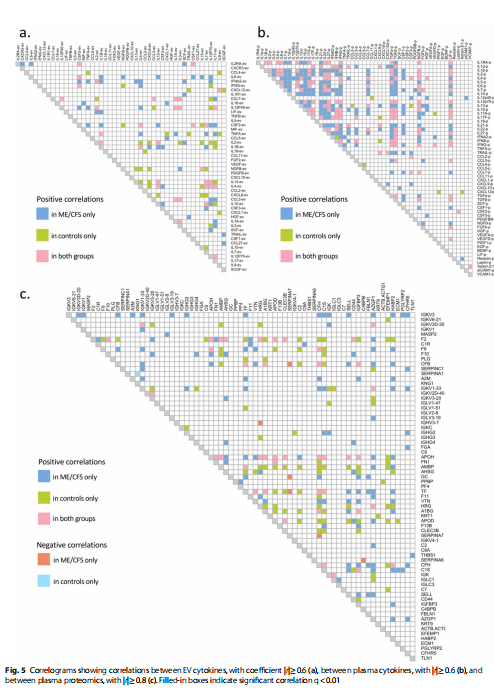
Correlations of cytokines with other cytokines provide information about the networks of interactions between signaling molecules. Several other studies demonstrated that the networks of plasma or extracellular vesicle cytokines differ between ME/CFS subjects and controls [25, 41, 44, 48]. We have chosen to display correlations between the three types of data: plasma and EV cytokines and plasma proteomics—using correlograms. Inspection of the visual representation of these protein–protein interactions immediately reveals that there are positive correlations between EV cytokines and between plasma cytokines that occur in cases but not controls and vice versa (Fig. 5). A particularly striking observation is a greater number of positive correlations between plasma cytokines in ME/CFS than in controls (Fig. 5b), indicating that cytokine signaling is substantially different, perhaps reflective of an inflammatory environment.
Seventy-one proteins characterized by mass spectrometry exhibited significant correlations with other plasma proteins (Fig. 5c). For example, F2 exhibited 31 positive correlations with other proteins, of which eleven were seen in cases but not controls. F2 is coagulation factor II or thrombin and converts fibrinogen to fibrin and activates factors V, VII, VIII, and XIII. Thrombin promotes platelet activation and aggregation, but it is also thought to have other functions during inflammation and wound healing [49].
Despite not observing significant differences in levels of plasma cytokines between the two cohorts, we did observe correlations of plasma cytokines with clinical data. CSF2, also known as Granulocyte Monocyte Colony Stimulation factor (GM-CSF), is lower in males in both ME/CFS and controls and increases with BMI in both cohorts according to both the robust linear regression and correlation analyses (Fig. 6a, Tables 2 and 3). In the ME/CFS cohort, with increasing CSF2, scores on the SF36 Physical Function and the MFI-fatigue scales indicate a greater impact of physical and fatigue symptoms, respectively. An increase in GM-CSF is associated with chronic inflammation [50]. GM-CSF induces classical monocytes to differentiate into monocyte-derived dendritic cells and macrophages in vitro [51]. Classical monocytes exhibit a unique gene expression pattern in ME/CFS compared to controls [52], and elevated GM-CSF could be a signaling factor involved in this response.

Increases in levels of three cytokines, CCL2, CXCL10, and CCL11 were associated with increasing age only in the ME/CFS cohort, according to Spearman correlations. CCL2, also known as MCP-1 (Monocyte Chemoattractant Protein-1), attracts monocytes across the endothelium into tissues [53], and could also be a factor in the altered monocyte gene expression profile [54]. CCL2 was also observed to decrease with age in the total cohort by both robust linear regression and Spearman correlation, but increases in the ME/CFS cohort with increasing age, according to Spearman correlation (Fig. 6d, Table 3). Using robust linear regression, plasma CCL11 was not significantly increasing with age but EV CCL11 was predicted to be higher with increasing age. CXCL10 (IP10) is also involved in cell migration, in particular, the attraction of macrophages, monocytes, and activated T and NK cells [55]. CCL11, also known as eotaxin, is known to increase with age, and higher levels are associated with decreased neurogenesis [56]. Two large studies previously observed an association of leptin, GM-CSF, IP10, and eotaxin with ME/CFS severity [43] or higher eotaxin in long-term ME/CFS cases [41]. Almost all of the ME/ CFS subjects in this study have been ill for more than 3 years.
Higher leptin is correlated with female sex and higher BMI in both patients and controls by robust linear regression and correlation analyses (Tables 2 and 3). Higher leptin is also associated with IBS in the patient cohort (Fig. 6b). Increase in leptin is also correlated with worse scores on the SF36 physical function measures and MFI-fatigue scale (Fig. 6c). Leptin was previously correlated with fatigue and severity in ME/CFS [43, 54]. Increasing levels of another inflammatory cytokine, TNFα, also correlate with lower patient Physical Function scores on the SF36 and have previously been reported to be elevated in ME/CFS [41, 57, 58] (Fig. 6e).
Higher levels of IL1-RA, which antagonizes IL1 inflammatory cytokines, were associated with higher BMI and lower SF-36 Physical Function in ME/CFS cases (Fig. 6e). Although IL1-RA could be considered to be anti-inflammatory it is known that IL1-RA levels are higher in obesity [59] and higher levels are considered to be a marker for metabolic dysregulation [60], which could be resulting in the lower physical ability.
We observed that lower levels of the anti-inflammatory cytokine IL13 were associated with lower activity in the ME/CFS cases. IL-13 was previously reported to be lower in females with ME/CFS vs. controls [61]. In contrast, higher IL13 was correlated with increased symptom severity in one study [43], while no difference between cases and controls was seen in another [41].
【Contact】Email: george.deng@wecistanche.com / WhatsApp:008613632399501/Wechat:13632399501