Radiometric Identification Of Signals By Matched Whitening Transform Part 2
Apr 13, 2023
4. Results
Cistanche has the function of promoting collagen production, which can increase the elasticity and luster of the skin and help repair damaged skin cells. Cistanche Phenylethanol Glycosides have a significant down-regulating effect on tyrosinase activity, and the effect on tyrosinase is shown to be competitive and reversible inhibition, which can provide a scientific basis for developing and utilizing the whitening ingredients in Cistanche. Therefore, cistanche has a key role in skin whitening. It can inhibit melanin production to reduce discoloration and dullness; and promote collagen production to improve skin elasticity and radiance. Due to the widespread recognition of these effects of cistanche, many skin whitening products have begun to infuse herbal ingredients such as Cistanche to meet consumer demand, thus increasing the commercial value of Cistanche in skin whitening products. In summary, the role of cistanche in skin whitening is crucial. Its antioxidant effect and collagen-producing effect can reduce discoloration and dullness, improve skin elasticity and luster, and thus achieve a whitening effect. Also, the wide application of Cistanche in skin whitening products demonstrates that its role in commercial value cannot be underestimated.

Click on Cistanche Tubulosa Supplement
For more info:
david.deng@wecistanche.com WhatApp:86 13632399501
This section implements the proposed radiometric identification using simulated and real data. First, data are corrected for offset frequency and used to reverse the time-varying phase offset. Second, the proposed algorithm that is governed by rule (6) is implemented producing confusion matrices.

4.1. Signal Phase and Offset Frequency Correction
Data are simulated for a QPSK signal subject to local oscillator frequency offset. Table 1 shows the simulation parameters.
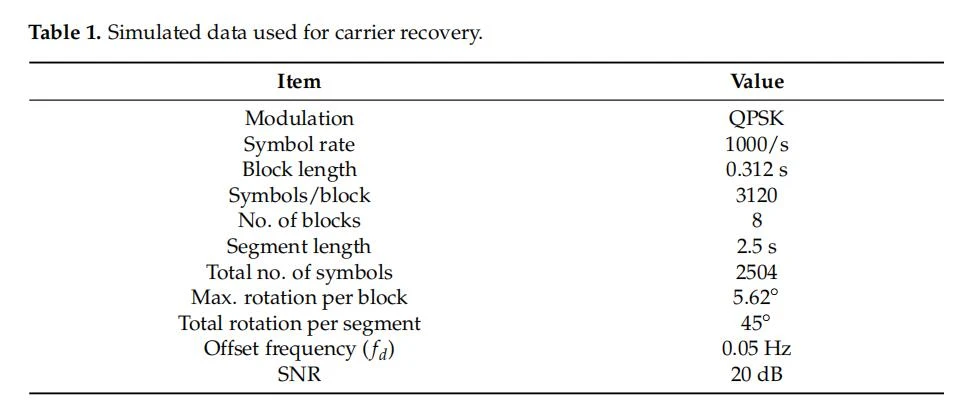
Figure 5 shows the process by which instantaneous phase values are gathered and used in the model fitting step. This step can also be explained as the sampling of the phase curve. The symbol phases per block are histogrammed followed by fitting a polynomial. The peak of the polynomial is ˆθk for the kth block. This step is repeated over multiple blocks and is shown in Figure 5a–f. The estimated phases { ˆθk, k = 1, 2, . . . , M} define the linear phase trajectory the slope of which determines fd. Figure 6 is the least squares fit of the phase model to the data. Figures 6a, and b correspond to SNR = 20 dB and 10 dB, respectively. Figure 6c illustrates that a nonlinear phase trajectory can be modeled and tracked as well. The estimated f ˆ d = 0.0505 Hz and f ˆ d = 0.0455 Hz at SNR = 20 dB and 10 dB, respectively. The true offset frequency is 0.05 Hz.


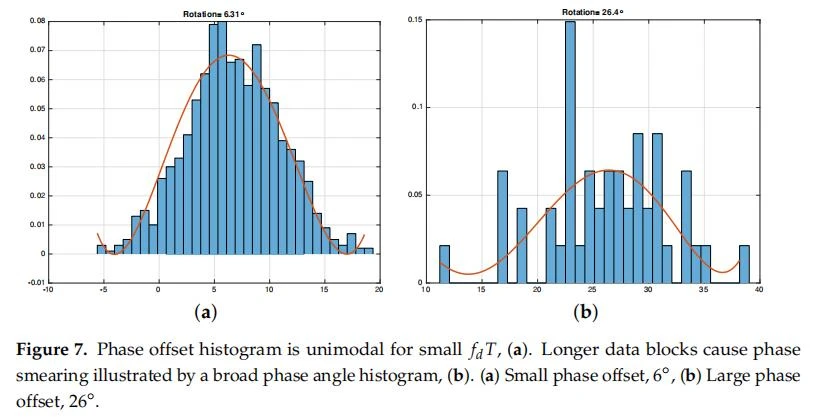
Symbols rotate by 2π fdT radians over the length of a block. This rotation must be kept to a small fraction of the quadrant that the symbols belong to. For example, in QPSK, each quadrant is π/2 radians. The proper block length is guided by the modality of phase histograms. A unimodal phase histogram with a distinct peak indicates that phase variations remain close to the nominal value, Figure 7a. For large 2π fdT, either due to large fd or long block length T, the histogram becomes multimodal with no distinct peaks, Figure 7b. Another disadvantage of large fdT is the 2π phase ambiguity where symbols move around the circle multiple periods.
4.2. Radiometric Identification
We now apply the proposed radiometric identification method to the signals generated by the following waveform generators or standards: Agilent [54], Viasat EBEM [55], Teledyne Paradise [56], KRATOS Real-Time Channel Simulator (RTsim) [57], and USRP [58]. The data have QPSK modulation sampled at 2.95 MHz for a total of 35 million symbols per model. Figures 8a, and b show signal constellations that are affected by varying amounts of smearing. Figure 8b is a particularly severe case due to the large fdT product causing symbols to rotate potentially multiples of 2π. Following the estimation of fdT and derotation of symbols, the original constellation is restored in Figure 8c. Figure 9 is a close-up of six constellations after all phase and frequency offsets have been removed. The task now is to attribute the signals to individual sources. Given the similarity of the constellations in structure and features, it is clear that radiometric identification is a much more challenging problem than conventional signal classification based on modulation information.


4.3. Class Confusion Matrices
Training the classifier involves the computation of 5 matched whitening matrices, Wi, i = 1, 2, . . . , 5. The data consists of 35 million symbols taken from QPSK-modulated signals originating from five different radios. The training set consists of 5 × 10⁵symbols which is about 1.4% of the total data. The Majority Vote classifier needs a voting scheme. Votes are generated by dividing the data into 72 blocks of 5 × 10⁵samples each. Each block generates one vote which is then tabulated over the entire signal length. The test blocks are drawn from an “unknown" source, corrupted by Gaussian noise, and repeatedly projected on whitening matrices corresponding to each source. The Förstner-Moonen distance is used to compute the mode function in (6) leading to the compilation of the confusion matrices.
Before creating the confusion matrices, the behavior of the Förstner-Moonen distance measure must be studied. According to (3), as the process is increasingly whitened, the Förstner-Moonen distance between the whitened covariance matrix and the identity matrix is narrowed. The theoretical minimum distance is zero for white noise. To test for this behavior, two random variables with adjustable correlation coefficients are created and placed in a two-column matrix. The covariance of this matrix is calculated as a function of correlation values and the corresponding Förstner-Moonen distance is plotted. The results are plotted in Figure 3. As Figure 3a shows, the distance is an increasing function of correlation, reflecting that the covariance matrix is moving away from that of a white noise process for increasing correlation. This is expected. The second property of the Förstner-Moonen measure is that the unknown data is closer to a white noise process when whitened by its whitening transformation than any other, hence matched whitening. To show this property, the data from Agilent is whitened by its whitening matrix and then by the whitening matrix of Viasat EBEM. Distance calculations are performed over 40 blocks of data and plotted in Figure 3b. What stands out is that the Förstner-Moonen distance for the Agilent data is almost always less than that when the Viasat EBEM whitening matrix is used. This behavior is expected, meaning that a correct decision is made every time it happens. This count is essentially the basis for populating the confusion matrices over all sources.

Following the above observations, the corresponding confusion matrices can now be computed and are shown in Table 2. The numbers indicate the percent of correct votes cast for each source over 72 frames of the test data. Note that the mode classifier in (6) looks for a plurality of the votes to pick a winner. It’s a hard voting scheme. For example, Paradise has received only 77.1% of the votes but the unknown signal is still correctly classified as Paradise. Therefore, Table 2 indicates 100% correct classification. Confusion matrices can be used in a soft voting scheme as well by keeping the actual vote percentages.
Next, we investigate the impact of smaller data sets and added noise above and beyond what is already in the data. The total sample size is now 107 which are broken into blocks of a quarter million samples each translating to less than 100 msec. This length generates 40 blocks that are used to get classification statistics in the form of confusion matrices. Table 3 shows the results @ SNR = 15 dB added Gaussian noise. This is above and beyond what is already in the data. All sources are identified correctly except for KRATOS RTSim which is identified as Teledyne Paradise. Even then, the 2.5% difference is well within the statistical variations of the run. The percent correct classification numbers for each source show a large drop compared to Table 2 but the majority voting scheme still makes the correct decision, albeit at a reduced margin. For example, Agilent data are correctly associated with Agilent only 30% of the time but that is still higher than any others. Tables 4 and 5 repeat the process for SNR = 5 dB and 0 dB. Even though the rates and margins are lower, the majority vote scheme still picks the correct class. When margins are low, statistical variability plays a role in making correct source identification. Notice that the large margin of USRP in Table 2 helps it largely maintain correct identification even at 5 dB SNR in Table 4. To show how dire the situation is, Figure 10 shows the constellation in SNR = 5 dB noise. The lack of identifying features is evident throughout. Note that RTSim and Paradise are tied. This difficulty is of course reflected in Table 4 as well but correct identification is still possible. Four out of five sources are correctly identified and the fifth one is tied. Table 5 is the extreme case of SNR = 0 dB. EBEM and Paradise are still correctly identified.


4.4. Comparisons
A comprehensive comparison of SVM, CNN, and D(eep)NN is reported for six radios in [13]. The correct classification rates are 44.8% (SVM), 82.4% (CNN), and 71.9% (DNN). However, in the absence of accepted benchmarks for radiometric identification, which do not exist, pure numerical comparisons are not conclusive. Factors such as the complexity of the algorithm, processing speed, training data size, and other assumptions are considered, and the comparison is difficult. Even the choice of radios or protocols is not common. The reported training sample size in [13] is 10% whereas it is 1.4% here. More importantly, no carrier recovery step was reported. By assuming perfect phase and frequency alignment at the local oscillator, no mitigation for constellation smearing of the kind reported here has been carried out. This is a signifificant omission. There is also no noise in the system. Dealing with high dimensionality is another factor. The whitening transformation is featureless thus bypassing the dimensionality reduction whereas feature vectors extracted in [10] have 960 dimensions. RF device fingerprinting in the cognitive Zigbee networks shows good accuracy (≈90%) but at high SNR (≥20 dB) [15]. In [19], the input data are preprocessed as Hilbert spectrum gray-scale images and achieve acceptable accuracy under moderate SNR levels (Avg 70% accuracy rate for SNR of 15 dB).
5. Conclusions

References
1. Nandi, A.K.; Azzouz, E.E. Algorithms for automatic modulation recognition of communication signals. IEEE Trans. Commun. 1998, 46, 431–436.
2. Phukan, G.J.; Bora, P.K. Parameter estimation for blind classification of digital modulations. IET Signal Process. 2016, 10, 758–769.
3. Ata’a, A.W.; Abdullah, S.N. Deinterleaving of radar signals and PRF identification algorithms. IET Radar Sonar Navig. 2007, 1, 340–347.
4. Gok, G.; Alp, Y.K.; Arikan, O. A New Method for Specific Emitter Identification With Results on Real Radar Measurements. IEEE Trans. Inf. Forensics Secur. 2020, 15, 3335–3346.
5. Sa, K.; Lang, D.; Wang, C.; Bai, Y. Specific Emitter Identification Techniques for the Internet of Things. IEEE Access 2020, 8, 1644–1652.
6. Wu, H.; Wang, W. A Game Theory Based Collaborative Security Detection Method for Internet of Things Systems. IEEE Trans. Inf. Forensics Secur. 2018, 13, 1432–1445.
7. Padilla, J.; Padilla, P.; Valenzuela-Valdés, J.; Ramírez, J.; Górriz, J. RF fingerprint measurements for identifying devices in wireless communication networks based on feature reduction and subspace transformation. Measurement 2014, 58, 468–475.
8. Bihl, T.J.; Bauer, K.W.; Temple, M.A. Feature Selection for RF Fingerprinting with Multiple Discriminant Analysis and Using ZigBee Device Emissions. IEEE Trans. Inf. Forensics Secur. 2016, 11, 1862–1874.
9. Xu, S.; Huang, B.; Xu, L.; Xu, Z. Radio Transmitter Classification using a New Method of Stray Features Analysis Combined with PCA. In Proceedings of the MILCOM 2007-IEEE Military Communications Conference, Orlando, FL, USA, 29–31 October 2007; pp. 1–5.
10. Jia, Y.; Ma, J.; Gan, L. Combined Optimization of Feature Reduction and Classification for Radiometric Identification. IEEE Signal Process. Lett. 2017, 24, 584–588.
11. Danev, B.; Capkun, S. Transient-based identification of wireless sensor nodes. In Proceedings of the 2009 International Conference on Information Processing in Sensor Networks, San Francisco, CA, USA, 13–16 April 2009; pp. 25–36.
12. Kennedy, I.O.; Scanlon, P.; Mullany, F.J.; Buddhikot, M.M.; Nolan, K.E.; Rondeau, T.W. Radio Transmitter Fingerprinting: A Steady State Frequency Domain Approach. In Proceedings of the 2008 IEEE 68th Vehicular Technology Conference, Calgary, AB, Canada, 21–24 September 2008; pp. 1–5.
13. Youssef, K.; Bouchard, L.; Haigh, K.; Silovsky, J.; Thapa, B.; Valk, C.V. Machine Learning Approach to RF Transmitter Identification. IEEE J. Radio Freq. Identify. 2018, 2, 197–205.
14. Jafari, H.; Omotere, O.; Adesina, D.; Wu, H.; Qian, L. IoT Devices Fingerprinting Using Deep Learning. In Proceedings of the MILCOM 2018—2018 IEEE Military Communications Conference (MILCOM), Los Angeles, CA, USA, 29–31 October 2018; pp. 1–9.
15. Merchant, K.; Revay, S.; Stantchev, G.; Nousain, B. Deep Learning for RF Device Fingerprinting in Cognitive Communication Networks. IEEE J. Sel. Top. Signal Process. 2018, 12, 160–167.
16. Rajendran, S.; Meert, W.; Giustiniano, D.; Lenders, V.; Pollin, S. Deep learning models for wireless signal classification with distributed low-cost spectrum sensors. IEEE Trans. Cogn. Commun. Netw. 2018, 4, 433–445.
17. Ding, L.; Wang, S.; Wang, F.; Zhang, W. Specific Emitter Identification via Convolutional Neural Networks. IEEE Commun. Lett. 2018, 22, 2591–2594.
18. Masood, S.; Rai, A.; Aggarwal, A.; Doja, M.N.; Ahmad, M. Detecting distraction of drivers using convolutional neural network. Pattern Recognit. Lett. 2018, 139, 79–85.
19. Pan, Y.; Yang, S.; Peng, H.; Li, T.; Wang, W. Specific Emitter Identification Based on Deep Residual Networks. IEEE Access 2019, 7, 54425–54434.
20. Qian, Y.; Qi, J.; Kuai, X.; Han, G.; Sun, H.; Hong, S. Specific Emitter Identification Based on Multi-Level Sparse Representation in Automatic Identification System. IEEE Trans. Inf. Forensics Secur. 2021, 16, 2872–2884.
21. Du, M.; He, X.; Cai, X.; Bi, D. Balanced Neural Architecture Search and Its Application in Specific Emitter Identification. IEEE Trans. Signal Process. 2021, 69, 5051–5065.
22. Huang, G.; Yuan, Y.; Wang, X.; Huang, Z. Specific Emitter Identification Based on Nonlinear Dynamical Characteristics. Can. J. Electr. Comput. Eng. 2016, 39, 34–41.
23. Huang, G.; Yuan, Y.; Wang, X.; Huang, Z. Specific emitter identification for communications transmitter using multi-measurements. Wirel. Pers. Commun. 2017, 94, 1523–1542.
24. Yuan, Y.; Huang, Z.T.; Wu, H.; Wang, X. Specific emitter identification based on Hilbert-Huang transform-based time-frequency-energy distribution features. IET Commun. 2014, 8, 2404–2412.
25. Padilla, P.; Padilla, J.; Valenzuela-Valdes, J. Radiofrequency identification of wireless devices based on RF fingerprinting. Electron. Lett. 2013, 49, 1409–1410.
26. Hu, A. Preamble-based detection of Wi-Fi transmitter RF fingerprints. Electron. Lett. 2010, 46, 1165–1167.
27. Candore, A.; Kocabas, O.; Koushanfar, F. Robust stable radiometric fingerprinting for wireless devices. In Proceedings of the 2009 IEEE International Workshop on Hardware-Oriented Security and Trust, San Francisco, CA, USA, 27–29 July 2009; pp. 43–49.
28. Dudczyk, J.; Kawalec, A. Fast-decision identification algorithm of emission source pattern in the database. Bull. Pol. Acad. Sci.-Tech. Sci. 2015, 63, 385–389.
29. Kawalec, A.; Rapacki, T.; Wnuczek, S.; Dudczyk, J.; Owczarek, R. Mixed Method Based on Intrapulse Data and Radiated Emission to Emitter Sources Recognition. In Proceedings of the 2006 International Conference on Microwaves, Radar Wireless Communications, Krakow, Poland, 22–24 May 2006; pp. 487–490.
30. Demers, F.; St-Hilaire, M. Radiometric identification of LTE transmitters. In Proceedings of the 2013 IEEE Global Communications Conference (GLOBECOM), Atlanta, GA, USA, 9–13 December 2013; pp. 4116–4121.
31. Tan, K.; Yan, W.; Zhang, L.; Tang, M.; Zhang, Y. Specific Emitter Identification Based on Software-Defifined Radio and Decision Fusion. IEEE Access 2021, 9, 86217–86229.
32. Jana, S.; Kasera, S.K. On fast and accurate detection of unauthorized wireless access points using clock skews. IEEE Trans. Mob. Comput. 2009, 9, 449–462.
33. Conning, M.; Potgieter, F. Analysis of measured radar data for specific emitter identification. In Proceedings of the 2010 IEEE Radar Conference, Washington, DC, USA, 10–14 May 2010; pp. 35–38.
34. Polak, A.C.; Goeckel, D.L. Wireless device identification based on RF oscillator imperfections. IEEE Trans. Inf. Forensics Secur. 2015, 10, 2492–2501.
35. Polak, A.C.; Goeckel, D.L. RF fingerprinting of users who actively mask their identities with artificial distortion. In Proceedings of the 2011 Conference Record of the Forty Fifth Asilomar Conference on Signals, Systems, and Computers (ASILOMAR), Pacific Grove, CA, USA, 6–9 November 2011; pp. 270–274.
36. Liu, M.W.; Doherty, J.F. Specific emitter identification using nonlinear device estimation. In Proceedings of the 2008 IEEE Sarnoff Symposium, Princeton, NJ, USA, 28–30 April 2008; pp. 1–5.
37. Li, Y.; Chen, X.; Lin, Y.; Srivastava, G.; Liu, S. Wireless transmitter identification based on device imperfections. IEEE Access 2020, 8, 59305–59314.
38. Dolatshahi, S.; Polak, A.; Goeckel, D.L. Identification of wireless users via power amplifier imperfections. In Proceedings of the 2010 Conference Record of the Forty Fourth Asilomar Conference on Signals, Systems and Computers, Pacific Grove, CA, USA, 7–10 November 2010; pp. 1553–1557.
39. D’Agostino, S.; Foglia, G.; Pistoia, D. Specifific emitter identifification: Analysis on real radar signal data. In Proceedings of the 2009 European Radar Conference (EuRAD), Rome, Italy, 30 September–2 October 2009; pp. 242–245.
40. Guo, S.; White, R.E.; Low, M. A comparison study of radar emitter identification based on signal transients. In Proceedings of the 2018 IEEE Radar Conference (RadarConf18), Oklahoma City, OK, USA, 23–27 April 2018; pp. 286–291.
41. Talbot, K.I.; Duley, P.R.; Hyatt, M.H. Specific emitter identification and verification. Technol. Rev. 2003, 113, 113–133.
42. Dragomiretskiy, K.; Zosso, D. Variational mode decomposition. IEEE Trans. Signal Process. 2013, 62, 531–544.
43. Chang, C.I. Orthogonal Subspace Projection (OSP) revisited: A comprehensive study and analysis. IEEE Trans. Geosci. Remote Sens. 2005, 43, 502–518. ): Richland, WA, USA, 2007.
45. Mayer, R.; Bucholtz, F.; Scribner, D. Object detection by using whitening/dewhitening to transform target signatures in multitemporal hyperspectral and multispectral imagery. Geosci. Remote Sens. IEEE Trans. 2003, 41, 1136–1142.
46. Kessy, A.; Lewin, A.; Strimmer, K. Optimal Whitening and Decorrelation. Am. Stat. 2018, 72, 309–314.
47. Bell, A.J.; Sejnowski, T.J. The “independent components” of natural scenes are edge filters. Vis. Res. 1997, 37, 3327–3338.
48. Srivastava, N.; Hinton, G.; Krizhevsky, A.; Sutskever, I.; Salakhutdinov, R. Dropout: A simple way to prevent neural networks from overfitting. J. Mach. Learn. Res. 2014, 15, 1929–1958.
49. Förstner, W.; Moonen, B. A metric for covariance matrices. In Geodesy—The Challenge of the 3rd Millennium; Springer: Berlin/Heidelberg, Germany, 2003; pp. 299–309.
50. Kulis, B.; Sustik, M.A.; Dhillon, I.S. Low-Rank Kernel Learning with Bregman Matrix Divergences. J. Mach. Learn. Res. 2009, 10, 341–376.
51. Herdin, M.; Czink, N.; Ozcelik, H.; Bonek, E. Correlation Matrix Distance, a Meaningful Measure for Evaluation of Non-Stationary MIMO Channels. In Proceedings of the 2005 IEEE 61st Vehicular Technology Conference, Stockholm, Sweden, 30 May–1 June 2005; Volume 1, pp. 136–140.
52. Kuncheva, L.I. A theoretical study on six classifier fusion strategies. IEEE Trans. Pattern Anal. Mach. Intell. 2002, 24, 281–286.
53. Proakis, J.G.; Salehi, M. Digital Communications; McGraw-Hill: New York, NY, USA, 2008.
54. Agilent Vector Signal Generator. 2021. (accessed on 26 November 2021).
55. Viasat Enhanced Bandwidth Effificient SATCOM Modem. 2021. (accessed on 26 November 2021).
56. Teledyne Paradise Datacom. 2021. (accessed on 26 November 2021).
57. Kratos RTSIM. 2021. (accessed on 26 November 2021).
58. Ettus USRP. 2021.
For more info: david.deng@wecistanche.com WhatApp:86 13632399501