Reflection About The Hemodialysis Water Microbiological Quality in Brazil
Apr 26, 2024
Dialysis has been widely used in the treatment of patients with chronic kidney diseases and is considered a global public health issue. This treatment, which has changed the prognosis and quality of life in patients with chronic renal failure, can lead to complications that are often fatal. For this reason, there is a need for validation of alternative tests that favor the monitoring of treated water for dialysis in real-time to promote and prevent injuries to patients submitted to this procedure.
Keywords: Quality control. Dialysis. Water microbiological characteristics. Biological contamination.

HOW LONG DOES IT TAKE FOR CISTANCHE TO WORK?
INTRODUCTION CHRONIC KIDNEY DISEASE AND DIALYSIS TREATMENT
Kidneys are organs situated on the posterior abdominal wall, positioned on either side of the spine, however, because of the location of the liver, the right kidney is smaller and it is situated a little lower than the left kidney. Each kidney is composed of approximately 800,000 to 1 million nephrons, its functional unit (Guyton, Hall, 2017; Koeppen, Stanton, 2017).
The kidneys exert great importance in the body, as they eliminate undesirable metabolism products, foreign chemicals, and toxins. They maintain homeostasis by regulating the water balance and electrolytes, they also maintain the regulation of blood pressure through the excretion of hormones or vasoactive substances such as renin, besides regulating the acid-base balance through the excretion of acids and promoting the regulation of body buffers, moreover they stimulate the production of erythrocytes by the excretion of erythropoietin in the circulation, supporting the formation of the bones by the vitamin D production and performing the glucose synthesis during prolonged fasting, in other words, they perform gluconeogenesis (Guyton, Hall, 2017; Pizzorno, 2015).

The progressive and irreversible loss of these functions added by renal injury results in chronic kidney disease. This disease has several stages being as renal dialysis or renal transplantation is recommended for chronic renal failure, the last stage, in which the kidneys are no longer able to maintain normality (Banasik, Copstead, 2018). In this context, dialysis has been widely used, modifying the prognosis and quality of patients' lives. The Scottish chemist Granham, in 1854, used the term "dialysis" for the first time by observing the separation of colloidal and crystalloid substances using semipermeable membranes constituted of vegetal material (Richet, 2001; Wisniak, 2013).

In the Netherlands, in mid-1944, Kolff created the artificial kidney but only in 1945 the first successful dialysis was performed (Nakamoto, 2018). It was only in 1949 that the first hemodialysis was performed in Brazil, at the Hospital das Clínicas, in São Paulo, beginning the development of this technique, but it was only in the 1960s that hemodialysis was introduced as a therapy for patients with chronic renal failure (Gregório, 1996).
In Brazil, there are 758 dialysis centers with an active program for chronic dialysis, according to data from the last chronic dialysis survey conducted in 2017. There was an increase in the number of chronic dialysis centers compared to the previous survey in 2016, in which the number was 747. It is estimated that today, 126,583 patients are submitted to this treatment, an increase can be observed in relation to the previous census which was 122,825. Brazil has a prevalence of dialysis treatment of 610 patients per million population (pmp), being the Midwest region the most prevalent (Figure 1). In the analysis by state, Alagoas, Minas Gerais, and Federal District have the highest number of patients. There were 40,307 new patients, that is, an incidence rate of 194 pmp, the southeastern region has the highest incidence (Figure 2), but the state of Alagoas has the highest number of new patients, 340 pmp (Sesso et al., 2017; Thomé et al., 2019).
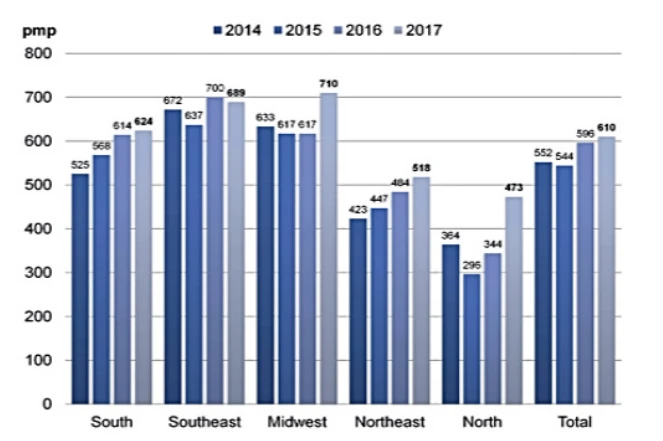
FIGURE 1 - Estimated prevalence of dialysis patients in Brazil, by region in the period of 2014-2017 (SOURCE: Adapted from Thomé et al., 2019)

FIGURE 2 - Estimated incidence of dialysis patients in Brazil, by region in the period of 2014-2017 (SOURCE: Adapted from Thomé et al., 2019).
The dialytic treatment consists in to remove the excess of water and solutes through a semipermeable membrane. There are two types of dialysis treatments: peritoneal dialysis and hemodialysis (Vadakedath, Kandi, 2017). In the chronic dialysis survey conducted in 2017, 91.8% of dialysis patients underwent conventional hemodialysis, 1.3% underwent frequent hemodialysis (less than 4 times per week) and 6.9% were under peritoneal dialysis (Thomé et al., 2019). In peritoneal dialysis, the peritoneum acts as a membrane that will separate the dialysis solution (dialysate) from the peritoneal capillaries, the water, and solutes exchanges occur by diffusion, ultrafiltration, and absorption simultaneously, draining the solution will be eliminated from the body toxins and water excess. The dialysis solution is industrially packaged in transparent and flexible plastic bags, which are available in volumes of 1.5 to 3 liters (Daugirdas, Blake, Ing, 2016; Vadakedath, Kandi, 2017)
At hemodialysis, patients are exposed weekly to 360 liters of water, a considerably larger volume when compared to a person's usual consumption of 14 liters per week (Agar, Perkins, Heaf, 2019). Conventionally or according to the clinical evaluation of each patient, the weekly treatment may consist of three hemodialysis sessions of approximately 4 hours duration, making a total of 12 hours weekly (Okada et al., 2001).
The hemodialysis machine performs the mixing of the electrolyte concentrate with the treated water, resulting in the dialysis solution, which is sent to the dialyzer where the blood is exposed to the dialysis solution through the semipermeable membranes, providing substances exchanges between the blood and the dialysis solution. In each session, approximately 120 to 200 liters of purified water will be in contact with the patient's blood (Daugirdas, Blake, Ing, 2016).