ReKindling A Dying Fire: Cistanche And Kidney Yang Deficiency
Sep 21, 2026
A fire burns deep into the night: charcoal still glows red, yet produces no flame. If you toss on damp firewood, smoke billows and the fire dims further. Fanning hard sends sparks flying, flashing bright for a moment before fading. Those who truly know how to tend fire do neither. They loosen the charcoals, add dry kindling, and let air circulate gently. Little by little, the fire revives.

Declining kidney-yang follows this exact analogy. It seldom extinguishes abruptly; instead, it fades slowly, imperceptibly. There is still fire, only feeble. Treatment therefore aims not to ignite violently, but to nurture and restore strength. Among Chinese medicinal herbs, few embody this art of "nurturing" as well as cistanche.
What Does Kidney-Yang Deficiency Look Like?
In TCM, kidney-yang is often termed Gate-of-Life Fire (Mingmen Fire). The Classic of Difficulties describes Mingmen as "the root of original qi". Zhang Jingyue elaborated: Mingmen is the foundation of original qi, the residence of water and fire. The yin of all five zang-organs draws nourishment from it; the yang of all five zang-organs emanates from it. In short, kidney-yang is not merely one form of organ-yang; it is the source of all yang-forces, the bottom layer of charcoal sustaining the body's internal fire.
Huangdi Nei Jing·Su Wen compares yang-qi to the sun: "Yang-qi is like heaven and the sun. When it loses its proper place, life span shortens and vitality wanes."
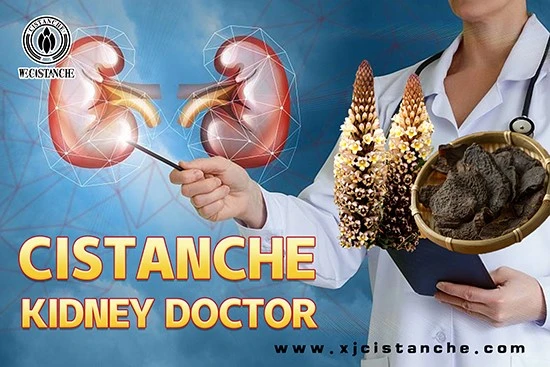
Cistanche tubulosa efficacy: Tonifying the kidney
As this core charcoal dwindles, systemic, gradual changes unfold:
Cold intolerance, preference for warmth, cold hands and feet
Soreness and weakness of the lower back and knees, worse after prolonged standing or walking
Lethargy, daytime drowsiness, frequent nocturia
Pale-white or dark sallow complexion; pale, plump tongue with tooth-marks; deep, slow, weak pulse
Disordered fluid metabolism: fifth-watch diarrhea, edema, clear-thin phlegm-rheum
Reproductive impairment: impotence, cold semen, uterine cold-infertility, premature greying hair.
Notably, none of these symptoms are acute. There is no sharp pain, fever, or urgent distress - things simply "gradually stop working". This matches the description in Huangdi Nei Jing·Plain Questions: Ancient Naive Truth: "At fifty-six, kidney-qi declines; hair falls, and teeth wither. At sixty-four, yang-qi exhausts in the upper body; complexion withers, temples turn grey."
Hence the ancient maxim: "Mild fire generates qi; fierce fire consumes qi." A dying fire remains mild fire, still capable of regeneration. The danger lies in improper intervention that snuffs it out entirely.

Effects of cistanche-Improve Kidney Function
For this reason, two approaches are harmful for kidney-yang deficiency:
Mistaking deficiency-cold for excess-heat and applying bitter-cold herbs to suppress fire - equivalent to dousing charcoal with water.
Seeking quick results by using harsh, fiery medicinals to "force-boost yang" - burning away what little charcoal remains.
Two Approaches to Tonifying Yang
Herbs such as aconite, dried ginger, and cinnamon work by fanning flames. Acrid-hot and forceful, they dispel severe yin-cold and rescue yang on the verge of collapse. Deer antler and epimedium strongly tonify original yang and restore erectile function. Such agents are irreplaceable for acute cases of extreme yin-cold and yang desertion.
Yet "dying fire" is not "fire near extinction". Most chronic kidney-yang deficiency develops over years, with consumption of both yin and yang. Some patients show pure yang depletion; far more suffer from yang deficiency accompanied by insufficient yin-fluids. Relying solely on acrid-hot drying herbs commonly produces three outcomes:
Dryness scorches yin-fluids: dry mouth, irritability, insomnia, nosebleeds.
Deficiency fails to accept tonification: poor middle-jiao transport turns tonics into stagnant accumulation.
Temporary improvement followed by diminishing returns; paradoxical co-existence of heat signs and cold intolerance. The superficial fire flares up, while the underlying charcoal is further depleted.
This gives rise to the second therapeutic path: gentle moist tonification. Its theoretical basis is Zhang Jingyue's well-known principle: "He who excels at tonifying yang must seek yang within yin. Then yang receives yin-support and generates endlessly."
Yang never exists in isolation; it depends on tangible substances: essence, blood, and body fluids. Firewood represents fuel; fire represents function. Blowing air without adding wood creates brief flames. Adding wood without ventilation creates smoke. Genuine gentle tonification combines warming yang and replenishing essence: slightly reviving fire while continuously replenishing material fuel, avoiding dry damage to yin.
Cistanche stands as the prime herb for this strategy.
Desert-Born Composure: The Materia Medica Story of Cistanche
Cistanche is a parasitic herb of the Orobanchaceae family, growing on roots of desert shrubs including Haloxylon and Tamarix. Major production regions include Inner Mongolia, Xinjiang, Gansu, and Qinghai. It remains buried in sand for most of its life, sprouting flower spikes only in spring. Harvest must occur before or just as shoots break ground; delayed gathering results in hollowed-out fleshy stems with diminished potency.
Sun-dried specimens partially buried in sand are called "sweet great". Those preserved in salt-lake brine are "salty great ". Slices processed by wine-steaming or wine-simmering become "wine-processed cistanche", with enhanced kidney-yang tonifying power.

Chinese herb cistanche
It entered medicinal use very early. Shennong's Classic of Materia Medica ranks it as an upper-grade herb: "Treats the five consumptions and seven injuries, tonifies the middle burner, relieves cold-heat pain in the genital tract, nourishes the five zang-organs, strengthens yin, boosts essence-qi, promotes fertility, treats abdominal masses in women; long-term use lightens the body."
"Upper-grade" in this classic means safe for prolonged consumption and capable of sustaining life - uncommon among yang-tonifying herbs. Rihua-zi Materia Medica expands its indications: "Treats male impotence, female infertility, moistens five zang-organs, builds muscle, warms lumbus and knees." Materia Medica Shu names it "the premier herb for nourishing kidney and replenishing essence-blood".
Li Shizhen best explained its name cong rong: "It tonifies without harshness; hence 'congrong', meaning calm and unhurried." Few medicinal herbs bear a name embodying such temperament. Materia Medica Huiyan summarizes its character in eight phrases: warm without heat, tonifying without severity, warming without dryness, lubricating without purging. It carries a warm nature yet no harsh drying tendency; acts gradually rather than chasing instant effects; warms without scorching yin fluids; lubricates intestines unlike drastic purgatives such as rhubarb and mirabilite.
Yu-Qiu's Medicinal Explanations notes its laxative property "does not generate damp-stagnation damaging the spleen", an advantage over most cloying moistening medicinals. This quality renders it especially valuable for long-term management of chronic deficiency.

Cistanche tubulosa
How One Herb "Nurtures Fire": Three-Tiered Therapeutic Logic
Chinese Pharmacopoeia records cistanche as sweet-salty, warm in nature; acts on kidney and large intestine meridians. Functions: tonify kidney-yang, replenish essence-blood, moisten intestines to relieve constipation. Indications: kidney-yang deficiency, essence-blood depletion, impotence, infertility, soreness-weakness of the lumbar and knees, flaccid tendons-bones, intestinal dryness, constipation. This concise description contains three sequential layers.
1. Tonify kidney-yang: add gentle heat
Its warm nature enters the kidney meridian and invigorates Mingmen fire, applicable to cold limbs, lumbosacral cold pain, impotence, and uterine-cold infertility. Its warmth is mild, not fierce. Unlike the fast-acting dispersive force of aconite or the acrid dryness of cinnamon, it suits gradual chronic yang decline rather than acute overwhelming yin-cold.

Effects of Cistanche: Improve Kidney Function
Click here to view Cistanche for Kidney disease products
【Ask for more】 Email:cindy.xue@wecistanche.com / WhatsApp: 0086 18599088692 / WeChat: 18599088692
2. Replenish essence-blood: add firewood
This distinguishes cistanche from most yang-warming herbs. Shennong's Classic of Materia Medica states it "boosts essence-qi" and "strengthens yin". Medicinal Properties Treatise notes it "replenishes marrow, brightens complexion, prolongs life". Yang is rooted in yin; qi arises from essence. Essence-blood is the actual fuel burned by bodily fire.
Warming yang without replenishing essence is blowing air without adding wood. Sweet-salty and rich-moist, cistanche tonifies yang while nourishing essence and blood. Materia Medica Huiyan therefore calls it a "balanced tonic", suited for chronic depletion: male deep-seated kidney-cold with persistent impotence, female thoroughfare-conception vessel disharmony and reproductive debility.
3. Moisten intestines and unblock fu-organs: free movement
Often dismissed as a secondary effect, intestinal moistening carries profound meaning. Constipation in elderly or chronically ill patients seldom stems from excess-heat accumulation. It arises from fluid-blood exhaustion and impaired propulsion. The kidney governs defecation and urination; deficient kidney-yang weakens qi-transformation and large-intestinal conduction.
Abundant polysaccharides and galactitol enable cistanche to "replenish fluid to float the boat", lubricating bowels gently, without abdominal cramping or dependency associated with stimulant laxatives. More deeply: obstructed fu-qi traps turbid yin and prevents clear-yang ascent; middle-jiao stagnation stops tonics from being absorbed. Restoring bowel movement re-establishes qi-movement, letting tonification take effect. Cistanche realizes the principle: "Tonify only after unblocking."

Effects of cistanche-treat constipation
Insights from Modern Research
Phenylethanoid glycosides, chiefly echinacoside and acteoside (verbascoside), constitute its signature active components, adopted by the Chinese Pharmacopoeia as quality-control markers. Pharmacological studies report sex-hormone-like activity, hypothalamic-pituitary-gonadal axis modulation, anti-fatigue, anti-oxidation, immunomodulation, anti-osteoporosis, and neuroprotective effects.
Notable research led by Professor Tu Pengfei (Peking University) systematically compared Cistanche deserticola and Cistanche tubulosa. The former exhibits stronger laxative efficacy; the latter excels at tonifying kidney-essence. Modern findings corroborate ancient observations combining intestinal lubrication and essence replenishment.

Main Chemical Constituents of Cistanche tubulosa
Principles of Formula Combination: Cistanche in Prescriptions
TCM rarely relies on single herbs; cistanche achieves full potential through matching. Three classical patterns emerge.
Concurrent tonification and unblocking - represented by Jichuan Decoction from Jing-Yue's Complete Works. Cistanche combines with angelica sinensis, achyranthes, alisma, cimicifuga, and immature bitter orange. Indicated for kidney-qi deficiency: constipation, clear profuse urine, lumbosacral cold soreness. Cistanche acts as the chief herb to warm the kidney and moisten intestines. Angelica nourishes blood; Achyranthes guides effects downward; bitter orange relaxes intestines; Cimicifuga lifts clear-yang. Ascending-descending qi movement resolves constipation. This formula targets constipation in elders and deficient patients, not excess-heat stasis.
Dual regulation of yin-yang - represented by Dihuang Yinzi Cistanche pairs with prepared rehmannia, cornus, ophiopogon and schisandra. Warm-natured cistanche assists within a framework of heavy yin-nourishing medicinals, realizing "seek yang within yin". Its mild warmth minimizes adverse heat reactions.
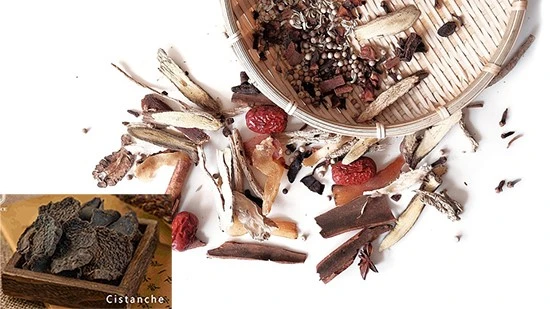
Chinese medicinal materials such as Cistanche tubulosa
Synergistic pairing of similar-action herbs
Cistanche Pill (Ishinpo): cistanche + dodder, teasel root, eucommia, for five consumptions-seven injuries, impotence, residual urine dripping.
Jingang Pill (Zhang's Medical Compendium): cistanche + morinda, human placenta, eucommia, for kidney-deficiency bone flaccidity and impaired mobility.
Cistanche and cynomorium: both tonify kidney-yang, replenish essence-blood, and lubricate intestines. Cistanche is more gently moist, superior at moistening intestines and enriching essence-blood. Cynomorium leans warmer-drying, stronger for arousing yang. Together they balance softness and force.
Common Mistakes in Tonification
Understanding cistanche clarifies widespread conditioning pitfalls.
Misdiagnosis: Coldness does not always mean yang-deficiency; fatigue is not always deficiency; dry mouth is not always yin-deficiency. Modern "upper-heat lower-cold" and mixed deficiency-excess patterns often combine spleen-dampness and yin-depletion. Blind warm tonification readily injures yin. Though mild, cistanche is warm-natured and worsens inappropriate patterns.
Chasing instant results: Kidney-yang deficiency accumulates over decades. No single herbal paste or liquor can reverse it rapidly. Vigorous tonics may create transient improvement by stirring residual yang rather than genuine recovery.
Reducing kidney-tonification merely to "stimulating sexuality": Ignoring essence-blood as the fundamental root. This is the most prevalent misconception.
Neglecting the spleen-stomach: Kidney is the congenital root; spleen-stomach is the acquired root. Congenital essence depends on food-based nourishment. Poor digestive function turns fine tonics into a burden. Ancient formulas often add citrus or amomum to activate spleen-qi.
Unrealistic time expectations: Tonifying yang is slow simmering, not sprinting. Assess progress across seasons, not days.
Revive Fire Through Slow Nurturing
Returning to the dying fire analogy: nurturing kidney-yang follows identical logic. Assess fire condition, add suitable fuel, maintain airflow, allow sufficient time. Cistanche does not fan for sudden flame. It adds fuel, opens circulation: warms yang to support fire, replenishes essence to supply fuel, lubricates intestines to descend turbidity. Steadily, it revives the fading fire.
Congrong (composure) is not merely the herb's name. It embodies its core wisdom: genuine tonification takes time.