Research Progress And Key Technologies For The Secondary Development Of Major Traditional Chinese Medicine Products
Sep 08, 2026
A Case Study of Xuefu Zhuyu Preparations - and What It Means for Western Consumers Interested in Natural Men's Health (e.g., Cistanche)
Abstract
Traditional Chinese medicine (TCM) preparations still carry potential safety and quality risks because they contain complex mixtures, often have an unclear "active material basis," show insufficient quality controllability, and may have mechanisms of action that are not fully clarified-factors that limit both large-scale adoption and internationalization.
To address these issues, the TCM field has gradually formed a systematic approach to redevelopment, centered on the concept of "new use of old drugs and renewal of classics." This approach promotes deeper excavation and re-evaluation of widely used, high-impact TCM products ("large varieties" or major products).
With the rapid and increasingly practical application of artificial intelligence (AI), process analytical technology (PAT), network pharmacology, mass spectrometry, and the Quality-by-Design (QbD) concept in TCM research and manufacturing, the modernization and scientific development of major TCM products has entered a new phase of opportunity.
In this paper, Xuefu Zhuyu preparations-a representative major TCM product used to promote blood circulation and remove blood stasis-are used as the case study. For the first time, the key technical system involved in its secondary development is systematically organized across five dimensions: quality control, mechanism analysis, clarified efficacy, efficacy improvement, and international recognition. At the same time, combined with application examples of AI and large language models (LLMs), the relevant technical paths are optimized and common experience is distilled to explore future directions for major TCM product development, providing a reference paradigm for modernization and upgrading of similar products.
Key words: major TCM products; Xuefu Zhuyu preparations; secondary development; process analytical technology; artificial intelligence
1. Why "Secondary Development" Matters Now (and Why Western Readers Should Care)
In recent years, global public health events have occurred frequently-from the COVID-19 pandemic to repeated seasonal respiratory outbreaks-creating new challenges for human health. In this context, TCM, with its system of holistic regulation and pattern-based treatment, has shown distinctive value in preventing and managing both infectious diseases and chronic conditions, and its international influence has grown.
Historically, TCM advances through a spiral pathway: clinic → theory → clinic. Many classical multi-herb formulas come from long-term clinical experience and intergenerational transmission. Major products such as Xuefu Zhuyu preparations typically have strong characteristics: clear clinical value, broad user populations, and mature industrial foundations-and therefore become pillars for high-quality development of the TCM industry.
However, only a small fraction of major TCM products currently meet modern international pharmaceutical expectations (such as ICH frameworks and the regulatory habits of the FDA/EMA). Take Xuefu Zhuyu as an example: originating from Wang Qingren's Yilin Gaicuo (Qing dynasty), it contains 11 herbs including peach kernel, safflower, angelica, ligusticum, and red peony. It is widely used for "invigorating blood, removing stasis, regulating qi, and relieving pain," and has broad clinical application.
Yet the road to modernization is still constrained by familiar bottlenecks:
unclear pharmacodynamic material basis (what exactly "does the work"),
insufficient scientific interpretation (how it works),
low standardization of production processes,
incomplete quality control systems,
difficulty achieving end-to-end traceability.
These limitations reduce clinical confidence, market competitiveness, and international access-and can even push some products toward elimination. Meanwhile, developing brand-new drugs is slow and expensive, and cannot always match real-world clinical needs.
This is why policy and industry have increasingly emphasized secondary development-modernizing established classics instead of starting from zero. With the rise of AI, LLMs, near-infrared (NIR)/Raman spectroscopy, PAT, and chemometrics, intelligent quality control is becoming a core engine for turning the "black box" of herbal manufacturing into something measurable, predictable, and auditable.
For Western men's wellness and herbal supplement customers:
When you buy a "natural" product, what you really want is not marketing language-you want batch-to-batch consistency, safety, and believable efficacy. The technical system described below is exactly about earning that trust.
2. The Core Technical System for Secondary Development (5 Dimensions)
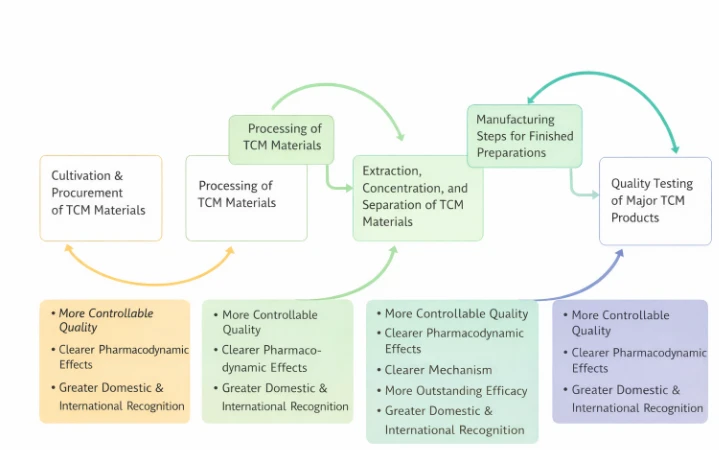
The production of major herbal preparations spans a full chain-cultivation & sourcing → processing → extraction & separation → dosage form manufacturing → quality testing. Variability at any point can shift final quality and clinical performance.
To reach the secondary-development goals of controllable quality, clarified efficacy, clearer mechanisms, improved outcomes, and international recognition, the approach must be systems-oriented: integrate modern analytics, process control tools, and AI algorithms to manage quality from source to finished product.
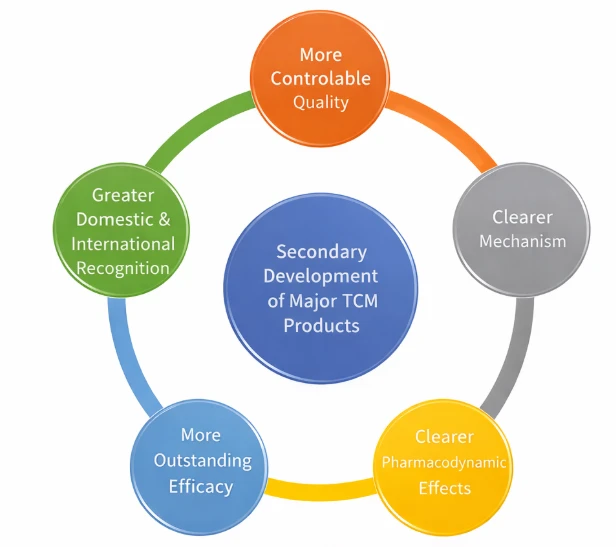
As shown conceptually in the "five-core-direction" model, secondary development typically focuses on:
More controllable quality
Clearer mechanisms
Clearer efficacy (material basis and measurable bioactivity)
More outstanding clinical performance (formulation and delivery upgrades, better evidence)
Greater domestic and international recognition (standards, clinical evidence, pharmacovigilance)
3. Dimension 1 - Making Quality Truly Controllable (from "end testing" to "built-in quality")
Quality controllability is the foundation for everything else.
3.1 Process Analytical Technology (PAT)
PAT is a quality management and analytical framework centered on process understanding and real-time control. It brings online or in situ analytical tools into manufacturing to dynamically monitor critical quality attributes (CQAs) and critical process parameters (CPPs), then model them and feed back into process adjustment.
For complex herbal systems-multi-source, multi-component, high variability-traditional "final product sampling + experience" cannot capture enough process information and cannot reliably support industrial scaling and international compliance. PAT provides a practical pathway:
multi-dimensional sensing →
data modeling →
intelligent decision-making.
It can be used for:
authenticity identification of raw herbs,
monitoring extraction and concentration,
evaluating mixing uniformity,
determining process endpoints,
early warning for deviations.
3.1.1 Spectroscopy (NIR and Raman)
NIR is fast, non-destructive, requires little sample prep, and is well-suited for complex natural matrices. Combined with chemometrics, it supports real-time monitoring and even "green" release strategies.
Raman provides richer structural information and is less affected by water, making it valuable for aqueous systems and interaction tracking in multi-herb decoctions.
Limitation to acknowledge (important for credibility):
Spectral models can drift across batches, instruments, and production lines. Robust application requires standardized sample libraries (multi-origin, multi-processing, multi-process conditions) and external validation.
3.1.2 Imaging (Hyperspectral Imaging, HSI)
HSI merges spatial imaging with spectral analysis-capturing both appearance and chemical information. It has strong potential for:
geographic origin tracing,
surface uniformity evaluation,
foreign body detection,
process monitoring.
Real-world barrier: cost, complexity, and real-time analysis difficulty due to high-dimensional data.
3.1.3 Machine Vision (MV)
Machine vision focuses on macroscopic physical signals-color, texture, morphology-that often correlate with viscosity, solid content, particle distribution, and process status. Compared with human judgment, MV is objective and scalable.
Key limitation: MV does not directly measure chemical composition, so it works best when fused with spectral/chemical data.
3.2 Quality by Design (QbD)
QbD breaks away from "quality depends on final inspection." It emphasizes:
define CQAs,
identify critical material attributes (CMAs),
model key process units,
build a design space (acceptable operating ranges),
embed risk management.
Tools such as response surface methods, fishbone analysis, and FMEA help identify CPPs and optimize processes.
How this inspires a Cistanche extract factory:
If you want "premium Cistanche extract" to be believable in the West, you must define CQAs that matter for your intended market (e.g., specific phenylethanoid glycosides, moisture, residual solvents, microbial limits, adulteration signals), then build a design space where those CQAs are stable.
3.3 Holistic Quality Control (Multi-dimensional Fingerprints)
Herbal products cannot be "explained" by one marker. Fingerprinting aims to represent the whole.
Chemical fingerprints (often HPLC-based) reflect multi-component composition.
Physical fingerprints capture macroscopic properties linked to manufacturability and stability.
Together they enable consistency evaluation-but they still mainly indicate "similarity," not necessarily "same clinical effect."
Next-step scientific gap:
Build robust, quantifiable links between "multi-dimensional fingerprints → CQAs → in vitro/in vivo biological effects."
3.4 AI and Large Language Models (LLMs) in Quality Control
AI and LLMs are pushing quality control toward data-driven, intelligent decision-making:
multi-modal fusion (process + spectra + chemical profiles),
faster and greener analysis (e.g., compressed fingerprints),
intelligent midstream release of intermediates,
LLMs converting model outputs into operator-friendly guidance.
Practical deployment challenge:
High-quality, standardized industrial data is often the weak point-heterogeneous sources, inconsistent sampling rates, unclear labels, rare abnormal batches, and cross-factory data incompatibility.
For Western supplement consumers:
The "AI story" should not be used as hype. Its real value is boring-but essential: preventing bad batches, improving consistency, and making quality decisions auditable.
Table 1. Differences Between Physical Fingerprints and Chemical Fingerprints
| Item | Physical Fingerprint | Chemical Fingerprint |
|---|---|---|
| Principle | Based on the sample's macroscopic physical properties (e.g., morphology, particle size, density, viscosity, thermal behavior) to perform physical testing; stable external attribute features are extracted to form a fingerprint profile. | Based on the types and contents of chemical constituents in the sample; chemical composition features are obtained through separation, identification, and quantitative analysis to construct a fingerprint profile. |
| Common methods | Microscopy (optical microscopy, electron microscopy, scanning electron microscopy/SEM); measurement of physical constants (refractive index, optical rotation, viscosity, density, mean particle size, solid content); thermal analysis (DSC, TGA). | Chromatography (HPLC, GC, TLC); spectroscopy (IR, NIR, Raman, UV–Vis, NMR, MS); hyphenated techniques (e.g., LC–MS, GC–MS). |
| Advantages | Intuitive and easy to interpret; fast and convenient measurements; low cost and low sample consumption. | Directly linked to chemical constituents; rich information content with high specificity and sensitivity; reflects the intrinsic quality attributes of medicinal materials. |
| Limitations | Mainly reflects external physical properties and is insensitive to changes in chemical composition; strongly affected by environment and sample handling, with relatively weaker stability. | High instrument cost and high technical requirements; complex experimental procedures and data processing; time-consuming method development. |
| Application scenarios | Authentication and trait/appearance identification of traditional Chinese medicinal materials (TCMs); consistency evaluation of physical properties; monitoring of certain processing steps. | Botanical/source identification of TCMs; chemical quality consistency evaluation; component analysis; studies linking composition to efficacy. |
4. Dimension 2 - Making Mechanisms Clearer
TCM's strength is multi-component, multi-target, multi-pathway synergy-exactly what makes mechanistic explanation difficult with classic single-target pharmacology.
Modern approaches combine:
network pharmacology (component–target–pathway–disease networks),
molecular docking (virtual binding assessment),
multi-omics: transcriptomics, metabolomics, proteomics,
AI-assisted simulations (docking, molecular dynamics),
emerging validation platforms (organ chips).
4.1 Network Pharmacology + Docking
Useful for hypothesis generation and prioritization (core components, core targets, key pathways). But it depends heavily on database completeness and must be validated experimentally.
4.2 Transcriptomics, Metabolomics, Proteomics
These "omics" tools shift the narrative from "it works clinically" to "it changes measurable biological networks," strengthening the evidence chain.
4.3 AI-assisted Mechanism Studies
AI strengthens "predict–dock–simulate–support" workflows, but simulation is still not equal to human physiology; multi-component synergy and metabolism remain challenging to model.
5. Dimension 3 - Making Efficacy Clearer
To internationalize, herbal products need clearer answers:
What are the major and minor constituents?
Which ones correlate with bioactivity?
Can the bioactivity be tested consistently?
5.1 Chromatography–Mass Spectrometry (LC–MS / GC–MS)
These techniques enable high-throughput identification of complex formula components and build chemical "maps" of the product.
5.2 AI + Efficacy Evaluation Platforms
AI can connect chemical profiles and bioactivity endpoints more efficiently than manual integration. Future directions include:
data-driven identification of active component groups,
integration with organoids/organ chips for more human-relevant screening,
LLM-generated mechanism narratives that remain grounded in data.
6. Dimension 4 - Making Clinical Performance More Outstanding (delivery, evidence, and formulation upgrades)
Even if a formula is "good," performance depends on whether active components:
dissolve,
absorb,
reach the site,
act consistently.
Classic dosage forms may struggle with modern precision requirements. Work in this area includes:
6.1 Re-evaluating Clinical Benefit
Not just "expand indications," but identify:
best-fit populations,
best endpoints,
real-world evidence + prospective trials,
mechanism-aligned biomarkers.
6.2 Nanotechnology and Advanced Delivery
Nanocrystals, liposomes, nanoparticles, micelles, and hydrogels can improve solubility, bioavailability, stability, and targeting.
Reality check: multi-component formulas are hard to nano-formulate as a whole. A more feasible route is focusing on key active components and designing delivery systems accordingly.
6.3 AI-assisted Delivery Design
AI can reduce trial-and-error in formulation optimization by predicting stabilizer interactions, particle behavior, and performance under storage conditions.
7. Dimension 5 - Achieving International Recognition (standards + evidence + pharmacovigilance)
Internationalization is essentially translation: from traditional experiential language to a modern, reviewable evidence system aligned with ICH and mainstream regulatory expectations.
7.1 AI-enabled Quality Standards
Use QbD-defined CQAs, PAT-enabled monitoring, and AI-supported decision systems to build a "quality design → process control → scientific release" path.
7.2 Clinical Evidence and Pharmacovigilance
International acceptance requires:
well-designed clinical trials with recognized endpoints,
structured adverse event reporting,
lifecycle risk management (post-market monitoring),
real-world data to support ongoing benefit–risk assessment.
AI helps with data structuring and signal detection, but it is not the evidence itself.
A new TCM herb Cistanche for BPH and Sexual Performance


8. Related Reflections (What Developers Should Learn)
Quality is not created at the final inspection stage-it is the system outcome of raw material selection + process control + product evaluation.
8.1 Raw Materials: from "experience" to "multi-dimensional data"
Herbal variability is real (origin, cultivar, harvest season, processing). Future selection should build quantitative "raw material portraits" using chemical, physical, and biological effect data-enabling grading and adaptive processing.
8.2 Process: making manufacturing perceivable and predictable
Key process information must be sensed and modeled in real time, and linked back to raw-material variability so processes can adapt rather than fail.
8.3 Product Evaluation: from pass/fail to multi-dimensional quality scoring
A modern product should be evaluated across chemical fingerprints, physical properties, safety, stability, and bioeffect alignment-supporting batch grading and risk identification.
9. Conclusion and Outlook (and a Direct Message to the Western Men's Wellness Audience)
Using Xuefu Zhuyu preparations as a representative example, this article organizes the secondary-development technology system across five core dimensions: controllable quality, clearer mechanism, clearer efficacy, improved performance, and international recognition. It highlights a modernization pathway built from PAT, QbD, multi-dimensional fingerprints, chromatography–mass spectrometry, multi-omics, and AI/LLM-enabled intelligent control-ultimately translating traditional experience into modern scientific evidence.
Looking forward, secondary development will increasingly be driven by AI, focusing on three breakthroughs:
Build unified models and databases covering components–omics–process–quality–clinical data.
Deepen the integration of PAT + QbD + AI and develop affordable, deployable intelligent sensors for full-chain digitalization.
Strengthen evidence systems using real-world data and international-aligned clinical methods, and explore organoid/organ-chip + AI efficacy evaluation.