Cistanche Extract: A Mild Tonifying Traditional Nourishing Raw Material From The Western Regions
Sep 08, 2026
Amid the Gobi deserts and sand seas of the Western Regions, deep within the root systems of Haloxylon ammodendron and Tamarix ramosissima, grows a parasitic plant known to ancient Chinese people as "dayun", "cunyun," or "dijing" Cistanche. Absorbing the essence of desert wilderness and nourished by desert sun and moon, it features thick, fleshy stems and boasts a long medicinal history. Listed as a top-grade herb in Shennong's Classic of Materia Medica, it is later hailed as "Ginseng of the Desert". Unlike Aconitum carmichaelii or Cinnamon bark, which generate fierce internal heat by reinforcing yang, nor Rehmannia glutinosa or Colla corii asini that cause stagnation and impair spleen function, Cistanche's most remarkable trait is well-documented in the Materia Medica Summary compiled in the Ming Dynasty: "Warm without overheating, tonifying without harsh potency, warming without dryness, lubricating without purging; hence the name 'congrong' (composed-and-gentle)".

Chinese herb cistanche
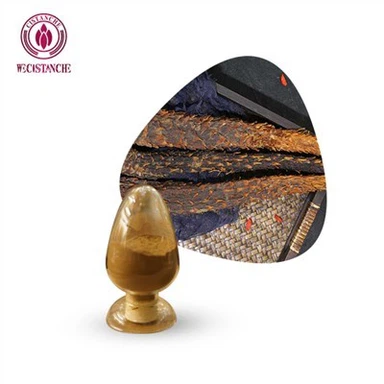
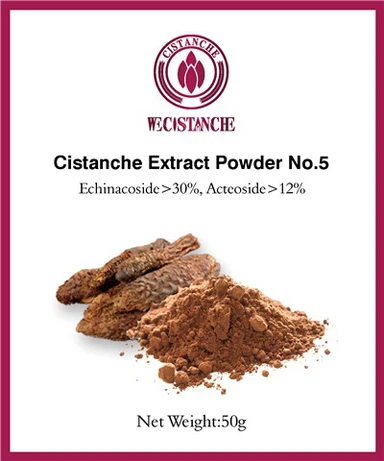
When this herb from the Western Regions enters modern extraction workshops, bioactive phenylethanoid glycosides such as echinacoside and acteoside are concentrated into brown-tan powder. Cistanche extract thus serves as a natural bridge linking medicinal customs of the Silk Road to contemporary functional foods, health foods, and skin-care products.
Botanical Origin and Producing Regions: From Desert Parasite to Standardized Feeding Material
Cistanche is a parasitic herb of the Orobanchaceae family. Two major botanical origins are recorded in the Chinese Pharmacopoeia:
Cistanche deserticola Y.C.Ma: Commonly known as "soft dayun". It mainly grows in Alxa of Inner Mongolia, Gansu, and partial desert zones of Xinjiang, parasitizing on the roots of Haloxylon ammodendron. It has a soft, moist texture.

Cistanche deserticola Y.C.Ma
Cistanche tubulosa (Schrenk) Wight: Commonly known as "hard dayun". It is primarily produced in Hotan and Aksu of Xinjiang, parasitizing the roots of Tamarix ramosissima (tamarisk). It possesses a dense, firm texture.
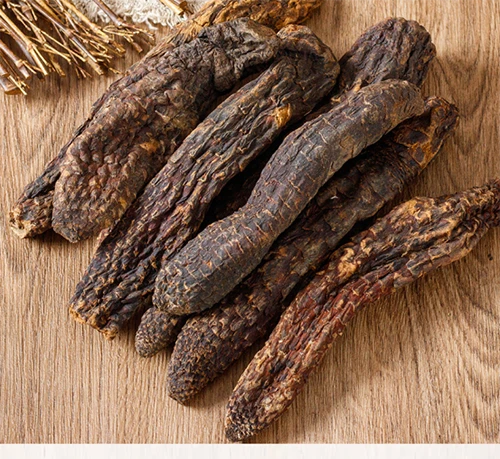
Cistanche tubulosa (Schrenk) Wight
Both varieties are sweet-salty in flavor, warm in nature, and act on the kidney and large intestine meridians, sharing core therapeutic effects: tonifying kidney-yang, benefiting essence-blood, and moistening intestines to relieve constipation. Nevertheless, Cistanche tubulosa is more favored in extraction industries. It delivers high phenylethanoid glycoside content: the combined content of echinacoside and acteoside in fresh materials can reach 1.5-4 g per 100 g, while Cistanche deserticola generally registers only around 0.3 g per 100 g. For this reason, industrial purification, health-food manufacturing and export-grade raw materials mostly adopt Xinjiang-sourced Cistanche tubulosa as the base material.
In November 2023, Cistanche deserticola was included in the list of "substances traditionally used as both food and medicinal herbs", granting it legal status in ordinary food applications. By contrast, Cistanche tubulosa is still mainly used as raw material for Chinese medicinal herbs and corresponding extracts. Such regulatory distinction determines compliance pathways for downstream formula development.
Extraction and Product Specifications: From Ethanol Extraction to Total-Glycoside Powder

Cistanche tubulosa experiment
The industrial production chain for Cistanche extract is relatively straightforward, yet process details directly govern retention of active ingredients.
Pre-treatment: Dry fleshy stems are sliced or pulverized, with sediment and lignified basal portions removed.
Extraction: Water extraction yields polysaccharides and partial glycosides, yet phenylethanoid glycosides deliver low recovery in aqueous systems. For high-content total glycosides, the standard workflow is ethanol extraction (usually 50%-70% ethanol) → macroporous resin enrichment → elution → concentration → spray drying.
Standardization: High-performance liquid chromatography (HPLC) is applied to quantify echinacoside, acteoside, and total phenylethanoid glycosides (PhGs).
Three mainstream commercial grades are available on the market:
Crude extract: Total phenylethanoid glycosides 10%-20%, largely applied in veterinary medicine and feed industries.
General health-food grade: Total phenylethanoid glycosides 20%-40%, with echinacoside ≥15% and acteoside ≥3% (internal corporate standards are frequently stricter than pharmacopoeia requirements).
High-purity grade: Total phenylethanoid glycosides 50%-80%, intended for functional foods, cosmetics, and scientific research.
Redline standards specified in the 2020 edition of the Chinese Pharmacopoeia: the sum of echinacoside and acteoside shall be ≥0.30% for Cistanche deserticola medicinal material, and ≥1.5% for Cistanche tubulosa. Though no independent monograph exists for Cistanche extract in the pharmacopoeia, leading suppliers adopt "total glycosides ≥40%, echinacoside ≥15%, acteoside ≥3%" as the threshold for high-quality products.

Cistanche tubulosa extract
Ingredient Profile: Phenylethanoid Glycosides as Principal Components, Polysaccharides and Iridoids as Auxiliary Constituents

Main Chemical Constituents of Cistanche tubulosa
Biological activities of Cistanche extract stem from synergistic effects of multiple secondary metabolites rather than a single molecule:
Phenylethanoid glycosides (core components): echinacoside, acteoside (formerly verbascoside), cistanoside A/B/C/H, osmanthuside, and echinacoside homologues. Molecules in this category carry phenolic hydroxyl groups and sugar chains, exhibiting prominent antioxidant, neuroprotective, and endothelium-relaxing properties.
Iridoids: 8-epiloganic acid and others, contributing to hepatoprotective and anti-inflammatory effects.
Lignans: pinoresinol and analogous substances, assisting lipid metabolism regulation.
Polysaccharides: Predominantly acidic heteropolysaccharides composed of galacturonic acid, arabinose, glucose, and more, linked with immunomodulation and intestinal prebiotic functions.
Other constituents: betaine, mannitol, β-sitosterol, over 15 free amino acids, plus mineral elements including Fe, Ca, Zn, and Mn.
It deserves emphasis that echinacoside and acteoside serve not merely as quantitative markers, but also as the chemical fingerprint verifying authenticity and the mild tonifying property of Cistanche extract.

Phenylethanol glycoside is the main active component of Cistanche tubulosa
Traditional Rationale: Interpreting the Phrase "Warm without Dryness"
Traditional Chinese medicine holds that Cistanche "tonifies kidney-yang while replenishing essence-blood, lubricates intestines without damaging yang-qi". Unlike pilose antler or hippocampus that exert forceful tonification and readily trigger internal heat, nor rhubarb or natrii sulfas that purge and impair healthy qi, it functions in the following ways:
Warming kidney without generating internal heat: For kidney-yang deficiency manifested as cold-sore lumbago-knee joints, cold intolerance, frequent nocturia, erectile dysfunction, and premature ejaculation, Cistanche works alongside Cuscuta chinensis, Eucommia ulmoides, and Euphorbia bupleurifolia. It delivers gradual tonification and rarely causes mouth ulcers or sore throat after long-term administration.
Replenishing essence without generating stagnation: For essence-blood deficiency marked by sallow complexion, premature greying hair, and scanty menstruation, its salty nature enters the kidney and sweet nature benefits the spleen, exerting moistening effects without producing dampness.
Lubricating intestines without purging: For constipation caused by physical deficiency in the elderly or fluid depletion after childbirth, it promotes intestinal motility and retains moisture via dual mechanisms of "moistening property and warm-tonifying action", differing from pure lubrication of hemp seed and drastic purging of rhubarb.
The sixteen-character description from Materia Medica Summary
"Warm without overheating, tonifying without harsh potency, warming without dryness, lubricating without purging"
constitutes the fundamental theoretical basis for partially replacing harsh yang-tonifying herbs with Cistanche extract in formulations. It is especially suitable for modern-day individuals caught in the dilemma of desiring tonification yet fearing internal heat.
Modern Pharmacology: From Gonadal-axis Modulation to Neuroprotection

Desert ginseng improves immunity
Research over the past two decades has quantified the "gentle-acting" characteristics of Cistanche.
Hypothalamic-pituitary-gonadal axis regulation: Animal studies demonstrate that Cistanche extract elevates serum testosterone levels, increases testicular weight and sperm count, yet does not disrupt native hormonal negative-feedback loops. Hence, it is described as possessing "hormone-like effects" rather than acting as exogenous hormones.
Anti-fatigue and exercise recovery: It reduces accumulation of blood lactic acid after quantitative physical loads and accelerates its clearance, enhancing acid-resistance capacity. This validates ancient records stating it "treats consumptive injuries and tonifies middle-jiao".
Neuroprotection: Acteoside crosses the blood-brain barrier, inhibits aggregation of Aβ amyloid protein, raises hippocampal SOD activity, and lowers MDA levels, improving memory acquisition in aging animal models. It provides a modern interpretation for ancient claims such as "beautifying complexion and prolonging life" and "treating abdominal masses in women".
Bidirectional immunomodulation: Polysaccharides increase thymus and spleen indices and stimulate lymphocyte transformation, while total glycosides suppress antibody plaque-forming responses at high dosages, collectively facilitating bodily homeostasis. - Intestinal motility and laxative effects: Aqueous extracts stimulate colonic peristalsis and inhibit large-intestinal water absorption, yielding satisfactory efficacy for geriatric and postpartum constipation.
Cardiovascular and metabolic benefits: It produces mild hypotensive and lipid-lowering effects, resists atherosclerosis, and protects ischemic myocardium.
Antioxidant complex: Phenylethanoid glycosides exhibit stronger DPPH and ABTS radical-scavenging capacity than many ordinary polyphenols, and cooperate with polysaccharides to protect mitochondria.
The American Herbal Products Association (AHPA) classifies Cistanche as an herb with relatively high safety under appropriate dosage, recommending a reference daily intake of 200-400 mg for extracts standardized to 16% polyphenols.
Application Scenarios: Cross-category Migration of Nourishing Raw Material
1. Health Foods and Nourishing Foods

cistanche supplement near me
Click here to view Cistanche Enhance Immunity products
【Ask for more】 Email:cindy.xue@wecistanche.com / WhatsApp: 0086 18599088692 / WeChat: 18599088692
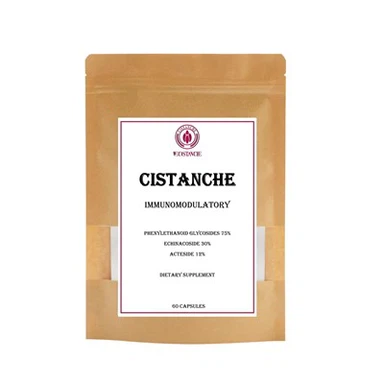
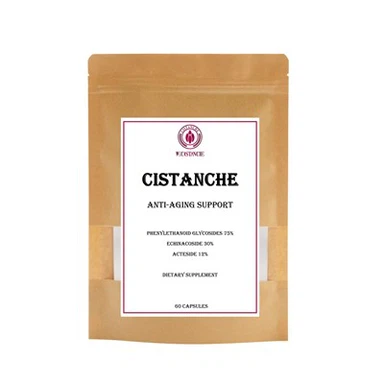
Tablets/capsules: 40% total-glycoside Cistanche powder, equivalent to 300-500 g raw herb per single unit. Often compounded with extracts of Polygonatum sibiricum, Chinese wolfberry, and ginseng for "simultaneous tonification of kidney-essence".
Health-preserving wines: Raw Cistanche tubulosa from Xinjiang remains widely used for wine infusion. Extract powder avoids sediment formation in compound-formulated wines.
Solid beverages: "Mild-tonifying formula for night-owls" blending Cistanche, spiny jujube seed and black sesame, with total-glycoside addition ranging 0.2%-1.5%.
Medicinal-diet foods: Food-drug homologous Cistanche deserticola is applied in mutton soups, multigrain congee, and energy bars, matching food-medicine integrated marketing narratives.
2. Functional Snacks and Middle-aged-Elderly Nutrition
For senior populations suffering from the combined symptoms of soreness-weakness of lumbago-knee joints, constipation, and cold intolerance, Cistanche extract delivers distinct traditional Chinese medicine characteristics superior to single-ingredient dietary fiber. It is frequently compounded with fructooligosaccharides and chia seeds.
3. Skin-care and Personal-care Products
When incorporated at 0.1%-10% in external formulations, Cistanche tubulosa extract promotes the generation of dermal elastic microfibrils and restores elastic-fiber retraction function, making it applicable in anti-wrinkle essences and neck-wrinkle creams. Its polyphenol-driven antioxidant capacity also suits men-oriented skincare lines targeting dull skin caused by fatigue.
4. Sports Nutrition
Supported by anti-fatigue and recovery-boosting properties, it enters endurance-sports supplements, forming the "plateau-desert dual-herb" concept alongside maca and rhodiola extracts.
Why Cistanche Sourced from the Western Regions Is Preferred by Modern Manufacturers

cistanche extract powder
Cistanche tubulosa planted in Hotan and Yutian of Xinjiang grows under tamarisk forests on the southern margin of the Taklamakan Desert. Annual sunshine duration exceeds 2500 hours, paired with drastic diurnal temperature differences. Competition among parasitic root systems drives secondary metabolism toward phenylethanoid glycoside synthesis - a chemical gift bestowed by geography. By comparison, Inner-Mongolia-sourced soft-texture Cistanche is more suitable for moist tonification in food-diet applications, whereas Xinjiang hard-texture Cistanche is better fitted for glycoside-targeted industrial extraction. One Silk Road witnesses two functional orientations: one goes into mutton-soup pots, the other enters extraction tanks.
Cistanche extract is not a potent tonic delivering instant effects. Its value lies precisely in moderation and stability: tonifying kidney-yang without consuming body fluids, lubricating intestines without inducing diarrhea, exerting antioxidant effects without cold-nature properties. Gradual improvements manifest as relieved lumbago-knee discomfort, elevated vitality, and normalized bowel movements after sustained intake. For modern-day populations plagued by yang-deficiency complicated by deficient internal heat, sedentary-lifestyle-induced sub-health, and constipation, this "gentle herb" originating from desert sand seas, in the form of brown-tan powder, is returning to daily nourishment routines in edible and cosmetic products.