Significance Of Different Content Limits For Marker Components Of Cistanche Deserticola And C. Tubulofloris in Chinese Pharmacopoeia Based On Differential Components
Nov 29, 2024
3 Results
3.1 Total ion current
The total ion current of raw C. deserticola and C. tubulosa in negative ion mode is shown in Figure 1. It can be seen that the components of C. deserticola samples are very complex, and there are obvious differences between C. deserticola and C. tubulosa.
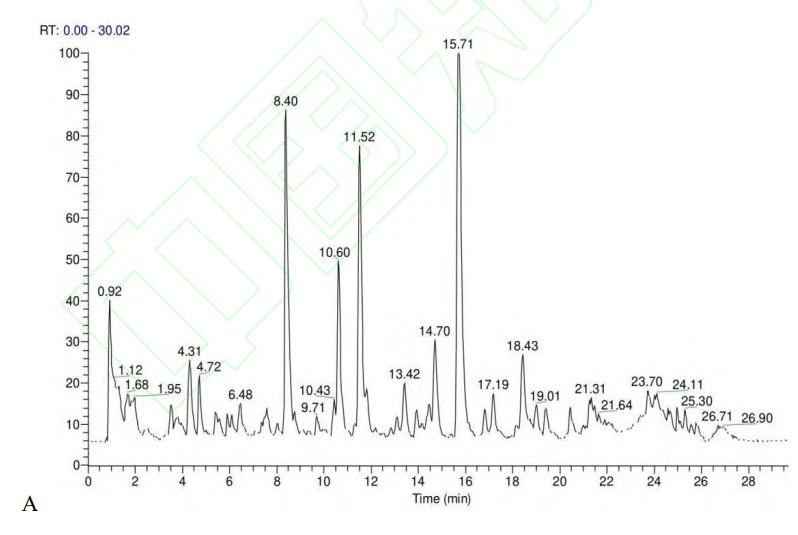

Note: A. Desert Cistanche; B. Tubulosa Cistanche.
Figure 1 Total ion current of raw Cistanche deserticola and Cistanche tubulosa in negative ion mode
3.2 PCA
The PCA diagram of raw Cistanche deserticola and Cistanche tubulosa is shown in Figure 2. Cistanche deserticola and Cistanche tubulosa can form clusters respectively, and it can be determined that there are obvious differences in their chemical compositions.

Note: 1. Cistanche deserticola; 2. Cistanche tubulosa.
Figure 2 PCA diagram of raw Cistanche deserticola and Cistanche tubulosa

C. deserticola and C. tubulosa
3.3 OPLS-DA
In order to obtain the potential differential markers between Cistanche deserticola and Cistanche tubulosa, the accurate mass-retention time data of Cistanche deserticola and Cistanche tubulosa were processed by OPLS-DA to obtain the S-Plot diagram (Figure 3). In the S-Plot diagram, the two ends of the S-shaped curve represent the most contributing characteristic differential markers in the two groups. It can be seen that there is a characteristic peak A (tR=10.63, m/z=800.273 3) at the lower left corner of the S-shaped curve. Through component analysis and comparison with the reference substance, the component was identified as Cistanche glycoside A. Similarly, the three characteristic peaks B (tR=13.38, m/z=624.205 4), C (tR=8.39, m/z=785.250 9) and D (tR=11.51, m/z=623.198 1) in the upper right corner of the S-shaped curve were identified as iso-verbascoside, echinacoside and verbascoside through component analysis and comparison with the reference substance. These four components have the same mother nucleus and similar structures (Figure 4), and all belong to the phenylethanol glycoside class. These characteristic markers can be used as characteristic components for distinguishing Cistanche deserticola from Cistanche tubulosa.

Figure 4 Differential component structure between Cistanche deserticola and Cistanche tubulosa

C. deserticola and C. tubulosa High Mterial
3.4 Content determination
3.4.1 Methodological study results
The linear regression equation, correlation coefficient and linear range of echinacoside, cistancheside A, verbascoside and isoverbscoside are shown in Table 2. In the precision experiment, the RSD values of the peak areas of the reference substances echinacoside, cistancheside A, verbascoside and isoverbscoside were 0.61%, 0.83%, 0.79% and 0.48%, respectively, indicating good precision. In the stability experiment, the RSD values of the contents of echinacoside, cistancheside A, verbascoside and isoverbscoside in the test solution were 0.92%, 1.23%, 2.40% and 1.10%, respectively, indicating that the test solution was stable within 24 h. In the repeatability experiment, the RSD values of the four components were 1.89%, 1.09%, 0.85%, and 1.23%, respectively, indicating that the results of sample analysis were stable and the repeatability of the method was good. The results of the sample recovery experiment showed that the average recoveries of the four components were 99.04%, 99.32%, 101.82%, and 7.14%, respectively, and the RSDs were 1.11%, 1.41%, 1.55%, and 2.73%, respectively, indicating that the accuracy of the method was good.
Table 2: Standard Curve Equations, Correlation Coefficients, and Linear Ranges for Echinacoside, Acteoside A, Verbascoside, and Isoverbascoside
| Component | Curve Equation | r | Linear Range (µg·mL⁻¹) |
|---|---|---|---|
| Echinacoside | Y = 1.38 × 10⁷X + 8.71 × 10⁴ | 0.999 8 | 8.27 ~ 827 |
| Acteoside A | Y = 1.74 × 10⁷X + 3.28 × 10³ | 0.999 9 | 3.07 ~ 307 |
| Verbascoside | Y = 2.27 × 10⁷X + 4.77 × 10³ | 0.999 9 | 3.84 ~ 384 |
| Isoverbascoside | Y = 1.89 × 10⁷X + 1.79 × 10³ | 0.999 9 | 3.12 ~ 312 |

3.4.2 Sample content determination
After determination, the peak separations of echinacoside, cistancheside A, verbascoside and isoverbaceous glycoside were 47.90, 17.17, 5.25 and 10.29, respectively, and the symmetry factors were 0.99, 0.95, 1.03 and 1.06, respectively, which met the content determination requirements. The chromatograms of the reference solution, Cistanche deserticola and Cistanche tubulosa samples are shown in Figure 5.

4 Discussion
This study was based on liquid chromatography-mass spectrometry and multivariate statistical analysis methods to search for the differential components of desert Cistanche deserticola and Cistanche tuberosum. The results found that the differential components of the two were mainly cistanche glycoside A, isorebascoside, echinaceaside and verbascoside; A method for simultaneous determination of the contents of four components was established through high-performance liquid chromatography. It was found that there was a big difference between the two. Cistanche deserticola A was not detected in Cistanche tuberosum, and the contents of echinaceaside, verbascoside and isolebascoside Significantly higher than desert Cistanche deserticola.

The "Chinese Pharmacopoeia" (2020 edition) stipulates that echinaceaside and verbascoside are the indicator components for the content determination of Cistanche deserticola. It is required that the total amount of echinaceaside and verbascoside in Cistanche deserticola should not be less than 0.30%; The total amount of echinaceaside and verbascoside shall not be less than 1.5%[1]. The results of this study found that echinaceaside and verbascoside are two significantly different compounds based on Cistanche deserticola. There is a large difference in the total content of the two components. Therefore, it is scientific for quality control to separately specify the total content limit of the two components. Significance: The addition of Cistanche deserticola tubulosa, the legal base of Cistanche deserticola, is of great significance for resource utilization and development. However, in clinical use, whether the efficacy of the two bases of Cistanche deserticola is consistent and whether the dosage needs to be controlled based on the content still requires further research. .
In addition, Cistanche deserticola A was not detected in Cistanche tuberosum, suggesting that it can be used as a potential exclusive component of desert Cistanche deserticola. Samples of desert Cistanche deserticola and Cistanche tuberosum of different years need to be collected for verification in the future. Cistanche deserticola is a traditional tonic drug. Many Chinese patent medicines such as Shenbao Granules, Congrong Bushen Pills, Cynomorium Cynomorium Gujing Pills, Tongbianling Capsules, etc. contain Cistanche deserticola. Due to the objective differences in the types and contents of the two basic Cistanche deserticola, When used as formulated granules or preparations, the base materials should be distinguished and the management requirements for the varieties used should be clarified.