Spring Cistanche Deserticola, Autumn Cistanche Deserticola, Who Is The King Of Effective Ingredients?
Mar 06, 2025
Basic introduction of Cistanche deserticola
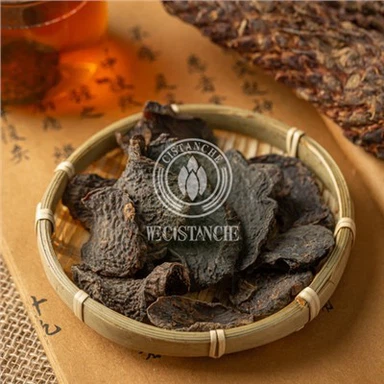
Cistanche deserticola, a precious traditional Chinese medicine known as the "desert ginseng", has been shrouded in mystery due to its characteristic of rooting and parasitism for many years. It mainly parasitizes the roots of the desert plant Salix, with a tall body and a height of 40-160 centimeters. Most of it is hidden underground. Its stem is fleshy, slightly flattened, or cylindrical, and may divide into 2-4 branches from the base. The diameter of the lower part can reach 5-10 centimeters or even thicker, gradually narrowing upwards with a diameter of 2-5 centimeters. Scaled leaves are pale yellow-white, triangular-ovate, or broadly ovate, measuring 0.5-1.5 cm in length and 1-2 cm in width. The lower leaves are denser, while the upper leaves are sparser and have a narrow lanceolate or lanceolate shape, measuring 2-4 cm in length and 0.5-1 cm in width. Both sides of the leaves are hairless. The inflorescence of Cistanche deserticola is spike-shaped, with a length of up to 15-50 centimeters and a diameter of 4-7 centimeters. The corolla is light yellow and has a cylindrical bell shape; The capsule is ovoid and has a persistent style at the top; The seeds are nearly oval or elliptical, about 0.6-1 millimeters long, with a mesh-like appearance and a glossy appearance.

cistanche tubulosa benefits and side effects
Cistanche deserticola mainly grows in desert areas, such as Inner Mongolia, Ningxia, Gansu, Xinjiang, and other places in China, where it can be found. These places have extremely arid climates, strong sunshine, annual precipitation of fewer than 250 millimeters, drastic changes in temperature and heat, strong winds and more sand, poor soil development, mostly medium-fine sand, thin soil layers with coarse texture, neutral or slightly alkaline, high salt content and lack of organic matter. Such harsh environments are the "paradise" for the growth of Cistanche deserticola.
In traditional medicine, Cistanche deserticola is sweet and salty in taste, warm in nature, and has the effects of tonifying kidney yang, nourishing essence and blood, moistening intestines, and promoting bowel movements. It is commonly used to treat diseases such as kidney yang deficiency, essence and blood deficiency, impotence, infertility, soreness and weakness of the waist and knees, muscle and bone weakness, intestinal dryness, and constipation. The Compendium of Materia Medica records many medicinal formulas for Cistanche deserticola, such as treating labor injuries, losing essence and blackening the face, using four liang of Cistanche deserticola, boiling it in water until tender, cutting it thinly and finely, and stewing lamb for consumption; To treat kidney deficiency and white turbidity, divide it into small parts such as Cistanche deserticola, deer antler, yam, and white Poria cocos, and add rice paste to make meatballs for consumption.
But you know what? The content of active ingredients in Cistanche deserticola is not constant, and it is influenced by various factors, among which the harvesting season is a key factor. This has also sparked a discussion: is the content of active ingredients in Cistanche deserticola higher in spring or in autumn? Next, let's delve deeper into it.

desert ginseng
Analysis of Effective Ingredient Content in Spring Cistanche deserticola
Research has shown that Cistanche deserticola harvested in spring has unique advantages in the content of certain active ingredients. In terms of phenylethanoid glycosides, some studies have indicated that in the parasitic Cistanche deserticola harvested in spring, the content of echinacea glycoside, Cistanche deserticola glycoside A, and verbascoside is relatively high. Pinecone chrysanthemum glycoside, as one of the key active ingredients in Cistanche deserticola, has significant anti-aging and neuroprotective effects. In spring, Cistanche deserticola may be more conducive to the synthesis and accumulation of such components due to its growth stage and physiological characteristics, providing a material basis for its medicinal value in neuroprotection, anti-aging, and other aspects.
From the perspective of the growth environment, the temperature gradually rises in spring, and the water and nutrients in the soil become more active, which creates favorable conditions for Cistanche deserticola to absorb nutrients from the roots of its host, Salix matsudana. During this period, Cistanche deserticola enters a rapid growth stage after winter nutrient reserves, and its metabolic activity increases, which may promote the synthesis of more effective ingredients. Just like in some areas of Gansu, the growth environment of Cistanche deserticola in spring is relatively suitable, and the microbial activity in the soil increases, providing a rich source of nutrition for Cistanche deserticola, resulting in a considerable content of phenylethanoid glycosides in the locally harvested Cistanche deserticola in spring.
However, spring Cistanche does not have an advantage in all ingredients. Compared to autumn, the content of Guanhua glycoside A and soluble polysaccharides in Cistanche deserticola harvested in spring, especially in the parasitic Cistanche deserticola of Tetraptera tenuifolia, is slightly lower. This may be related to the growth focus of Cistanche deserticola in different seasons, with spring focusing on the synthesis of some phenylethanoid glycosides, while autumn has an advantage in the accumulation of other components.
Analysis of Effective Ingredient Content in Autumn Cistanche deserticola
Most studies tend to believe that Cistanche deserticola harvested in autumn has a higher content of active ingredients. From the perspective of component analysis, the autumn Cistanche deserticola exhibits outstanding performance in the context of two key components, pineal glycoside, and verbascoside. A study has detected Cistanche deserticola in different harvesting seasons using high-performance liquid chromatography. The results showed that the total amount of these two components in Cistanche deserticola harvested in autumn was significantly higher than that in spring. Pinecone chrysanthemum glycoside and verbascoside have various pharmacological activities such as antioxidant, anti-inflammatory, and immune regulation. The higher content of Cistanche deserticola in autumn means that it may have more advantages in these health and medicinal effects.

cistanche benefits for men
In the process of growth and development, Cistanche deserticola grows more maturely in autumn, and its internal physiological metabolic activities gradually shift from nutritional growth to the later stage of reproductive growth. At this time, Cistanche deserticola will use more nutrients to synthesize and accumulate secondary metabolites, such as active ingredients such as pinecone glycoside and pistil glycoside, which can accumulate in large quantities. Moreover, in autumn, the temperature difference between day and night in desert areas further increases. Adequate sunlight during the day provides favorable conditions for photosynthesis, allowing Cistanche deserticola to produce more photosynthetic products. Meanwhile, low temperatures at night reduce the consumption of nutrients by respiration, which is beneficial for the accumulation of active ingredients. Just like some desert-producing areas in Xinjiang, where the temperature difference between day and night in autumn can reach 15-20 ℃, the content of active ingredients in Cistanche deserticola grown in such an environment is significantly increased.

Main Chemical Constituents of Cistanche deserticola
However, the effective ingredient content of Cistanche deserticola in autumn is not high. The complexity of the growth environment, such as soil fertility, moisture content, and the growth status of host plants, can all have an impact on it. If drought and low rainfall occur in autumn, and soil moisture is severely insufficient, it may hinder the absorption and transportation of nutrients by Cistanche deserticola, thereby affecting the synthesis and accumulation of active ingredients.
The conclusion is drawn from comparative analysis.
Overall, in most cases, the effective ingredient content of Cistanche deserticola is higher in autumn, especially in key components such as echinacoside and verbascoside. Cistanche deserticola harvested in autumn has more advantages and may exhibit more prominent medicinal effects in antioxidant, anti-inflammatory, and immune regulation. However, in spring, Cistanche deserticola has a higher content of some phenylethanoid glycosides such as 2 '- acetyl verbascoside, which also has its unique medicinal value.
There are also differences in the content of active ingredients in Cistanche deserticola from different hosts and origins. From the perspective of the host, the content of four phenylethanolic glycosides and soluble polysaccharides in the Cistanche deserticola parasitized by the Four winged Atractylodes in autumn is higher than that of the Cistanche deserticola parasitized by the Red Willow; In spring, the parasitic Cistanche deserticola of Four winged Atractylodes macrocephala has an advantage in the content of some phenylethanolic glycosides, but the content of Guanhua glycoside A and soluble polysaccharides is lower than that of the parasitic Cistanche deserticola of Red Willow. In terms of production areas, the Cistanche deserticola from Minqin, Gansu has higher levels of echinacoside and guanosine A, the Cistanche deserticola glycoside A and soluble polysaccharides from Jingtai, Gansu have higher levels, and the verbascoside content from Jingyuan, Gansu is higher.
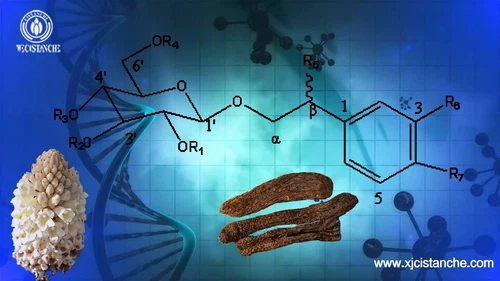
Phenylethanol glycoside is the main active component of Cistanche deserticola
Click here to view Cistanche Tubulosa Extract Natural Supplement Powder
【Ask for more】 Email:cindy.xue@wecistanche.com / Whats App: 0086 18599088692 / Wechat: 18599088692
Correctly understanding and utilizing Cistanche deserticola
Understanding the relationship between the content of active ingredients in Cistanche deserticola and the harvesting season is of great significance for our rational utilization of Cistanche deserticola. If you value the antioxidant and immune regulating effects of Cistanche deserticola more, then autumn-harvested Cistanche deserticola may be a better choice; If you focus on the neuroprotective and medicinal value of specific phenylethanolic glycosides in Cistanche deserticola, the spring harvested Cistanche deserticola also has its unique features.
However, it should be noted that Cistanche deserticola is a nationally protected plant at the second level. Illegal collection, sale, purchase, processing of nationally protected wild plants, or destruction of their growth environment are all illegal activities. When using Cistanche deserticola, it is necessary to ensure that the source is legal and compliant and follow the advice of professional doctors or pharmacists to use it reasonably, avoiding blind conformity and abuse.