Millennium Inheritance, Exploring The Application Of Cistanche Deserticola From Ancient Books
Mar 05, 2025
Cistanche deserticola: a legendary fairy grass in the desert
In the vast and boundless desert filled with yellow sand, there grows an extremely mysterious and precious plant - Cistanche deserticola. It parasitizes the roots of the desert plant Salix and spends most of its time underground. It only emerges during specific seasons, with purple or yellow-white flower spikes peeking out from the gravel, resembling strange elves blooming in the desert.
The plant of Cistanche deserticola is about 40-160 centimeters tall, with thick fleshy stems and leaves arranged in a scaly and tightly spiral shape. It presents a pale yellow-white overall, appearing warm and unique. Due to its extremely high medicinal value, comparable efficacy to ginseng, and lacking the "heat up" and "dryness" of ginseng, it enjoys the reputation of "desert ginseng" and is highly valued.

chinese herb cistanche
Millennium Inheritance: The Application of Cistanche deserticola from Ancient Books
The medicinal history of Cistanche deserticola has a long and rich history. Over the years, it has been a shining pearl in the treasure trove of traditional Chinese medicine, cherished and applied by medical practitioners throughout history. Let's travel through time and space, open up ancient books, and explore the application and usage methods of Cistanche deserticola in ancient times.
(1) From Han to the Southern and Northern Dynasties: the first signs of sharpness
Cistanche deserticola was first recorded in the "Shennong Bencao Jing", which is the earliest existing pharmaceutical monograph in China. It is classified as a top-grade herb and is called "sweet in taste, slightly warm. It is known for its five functions and seven injuries, tonifying the middle, removing cold, heat, and pain from the stem, nourishing the five organs, strengthening yin, nourishing essence and qi, having many children, and treating women's ailments. Long-term consumption can lighten the body. In just a few words, it accurately summarized the effects of Cistanche deserticola in nourishing the kidneys, nourishing essence, and regulating organs, laying the foundation for future research and application of Cistanche deserticola.
Subsequently, the "Record of Famous Doctors" also recorded that Cistanche deserticola has a sour and salty taste, is non-toxic, and can eliminate bladder evil qi, lower back pain, and stop dysentery, further enriching the medicinal effects of Cistanche deserticola. At this time, the tonifying effect of Cistanche deserticola has been applied clinically, but its application scope is not wide. In the "Liu Juanzi Ghost Legacy Formula", there is a formula for Cistanche Powder, which includes 30 grams each of Cistanche deserticola, Angelica sinensis, roasted licorice, Chuanxiong, Huangqin, Guixin, ginseng, peony, dried ginger, Wu Zhuyu, Bai He, roasted Magnolia officinalis, Huangqi, and 1 gram Sichuan pepper. These medicinal herbs were developed into a powder, with 6 grams taken each time and mixed with warm wine, taken 3 times a day. It is mainly used to treat the symptoms of excessive blood loss and exhaustion in golden sores, demonstrating the application of Cistanche deserticola in surgical trauma treatment.

dragon herbs cistanche
(2) Tang to Jin Yuan: Application Expansion
During the Tang Jin and Yuan dynasties, the clinical application scope of Cistanche deserticola gradually expanded, playing an important role in the treatment of diseases such as deficiency, constipation, and thirst. In the book "Treatise on Medicinal Properties", it is mentioned that Cistanche deserticola "benefits the marrow, enhances color, prolongs life, treats women's blood loss, strengthens male function, greatly nourishes the body, and promotes red and white hair", emphasizing its effectiveness in nourishing and strengthening the body, regulating gynecological diseases, and other aspects.
In the "Medical Heart Formula Volume 218", Cistanche deserticola pills are made by grinding 30 grams of Cistanche deserticola, Dodder's seed, Snake bed seed, Schisandra chinensis, Yuanzhi, Xuduan, and Eucommia ulmoides into a fine powder, honey and pills, such as Wuzhi Da, and taking 20 pills each time. It can treat male symptoms such as five fatigue and seven injuries, erectile dysfunction, accumulation for ten years, dribbling of small stools, and red and yellow when drowning. The Cistanche Pill in the Taiping Shenghui Prescription Vol. 18 is 60 grams each of Cistanche, Fushen, Polygala tenuifolia, and Semen cypress, 30 grams each of Cuscuta chinensis, Dioscorea, Achyranthes bidentata, Morinda Officinalis, Eucommia ulmoides, Dipsacus asper, Poria cocos, Lycium barbarum, Schisandra chinensis, Fructus credit, and Cornus officinalis. The pill is refined to the end, refined into honey and pills, such as the size of a Chinese parasol, 30 pills of warm wine on an empty stomach, twice a day. It is mainly used to treat fatigue, emaciation, impotence, forgetfulness, and waist and knee pain.
In addition to treating deficiency diseases, Cistanche deserticola also has significant therapeutic effects in treating constipation. The Big Five Soft Pill in the "Important Prescriptions for Emergencies" Volume XV uses 60g each of Cistanche deserticola, Paeonia lactiflora, Fructus aurantii, Rheum officinale, Lepidopteris chinensis, Glycyrrhiza uralensis, Scutellaria baicalensis, Achyranthes bidentata, 100 peach kernels, 40 almonds, ground powder, honey, and pills, such as the big Chinese parasol tree, to drink 20 pills each time and gradually add 40 pills three times a day, which is mainly used to treat the disorder of internal organs and the difficulty of defecation. The Runchang Pill in the Redesigned Yan's Jisheng Prescription Vol. IV takes 60g of Cistanche deserticola and 30g of agarwood incense as fine powder and uses hemp seed juice as a paste to form a pill, which is as big as the Chinese parasol. Every 50 pills taken, drink with rice on an empty stomach to warm the kidney and benefit essence, moisten the intestines, and relieve constipation. It is mainly used to treat kidney deficiency and essence deficiency, body fluid consumption, and constipation.

desert ginseng
Cistanche deserticola is also used to treat thirst. The flower cistanche pill in Waitai Secret Collection Vol. 11 uses 30 grams of cistanche, alisma orientalis, Schisandra chinensis, Morinda Officinalis, cortex digitalis, and trichosanthes respectively, 45 grams of magnetite, 36 grams of leek, keel, red licorice, and peony peel, 75 grams of dried rehmannia, 25 grams of Yu's surplus grain, 30 pieces of cuttlebone, finely ground powder, honey and pills, such as the size of Chinese parasol, 20 pills of empty milk, twice a day, mainly for kidney elimination.
(3) Ming and Qing Dynasties: Experience Inheritance
During the Ming and Qing dynasties, the clinical application of Cistanche deserticola was based on the experience of previous researchers, as well as some new summaries and developments. The "Compendium of Materia Medica" states: "Cistanche deserticola is an essential medicine for nourishing the kidneys and replenishing essence and blood... Long-term consumption can make the body fat, healthy, and light, and has the effect of benefiting the liver and kidneys and replenishing essence and blood." This further emphasizes the important position of Cistanche deserticola in nourishing the kidneys and replenishing essence and blood.
The Cistanche Powder in "Introduction to Medicine, Volume 8" is made up of 24 grams each of Cistanche deserticola, Atractylodes macrocephala, Morinda officinalis, Ophiopogon japonicus, Poria cocos, Glycyrrhiza uralensis, Achyranthes bidentata, Schisandra chinensis, and Eucommia ulmoides, 15 grams each of Plantago asiatica and dried ginger, and 250 grams of raw soil. It is taken on an empty stomach with alcohol three times a day. Its function is to warm and tonify kidney yang, and it is mainly used for treating kidney qi deficiency and cold, impotence, lumbar and spinal pain, heavy body, and weak tibia. The modified Neigu Wan in "Introduction to Medicine Volume 7" uses 90 grams each of Cistanche deserticola, Morinda Officinalis, Cornus officinalis, and Cuscuta chinensis, 60 grams each of Dendrobium officinale and Huluba, 75 grams of Fructus Psorale, 30 grams of Fennel, and 15 grams of Aconitum, which also reflects the application of Cistanche deserticola in kidney tonifying and yang strengthening formulas.

Chinese medicinal materials such as cistanche deserticola
Ancient Method and Present Mirror: The Usage of Cistanche deserticola in Ancient Times
In ancient times, Cistanche deserticola was used in a variety of forms. According to different symptoms and needs, the ancients made Cistanche deserticola into pills, powders, Congee meals, and other formulations, giving full play to its medicinal value.
(1) Pills: concentrated essence
Pill is one of the commonly used formulations of Cistanche deserticola in ancient times. When making, Cistanche deserticola and other medicinal herbs are ground into a fine powder, and then honey, rice paste, etc. are used as binders to make pills. This dosage form is easy to store and take, with long-lasting efficacy.
In the "Medical Heart Formula Volume 218", the Cistanche Seed Pill is composed of 30 grams each of Cistanche Seed, Dodder Seed, Snake Bed Seed, Schisandra chinensis, Yuanzhi, Xuduan, and Eucommia ulmoides. When making, first grind these medicinal herbs into fine powder, and then mix them with honey to make pills as big as Wuzhi. When taking 20 pills each time, it can treat symptoms such as male fatigue and seven injuries, erectile dysfunction that persists for ten years, dribbling urine, and redness and yellowing during drowning.
In the "Taiping Shenghui Fang, Volume 218", the Cistanche deserticola pill contains a richer variety of medicinal herbs, including 60 grams each of Cistanche deserticola, Poria cocos, Yuanzhi, and Platycodon grandiflorus, as well as 30 grams each of Cuscuta chinensis, Dioscorea nipponica, Achyranthes bidentata, Morinda officinalis, Eucommia ulmoides, Houttuynia cordata, Poria cocos, Goji berries, Schisandra chinensis, Fructus Cnidii, and Cornus officinalis. When making, first grind these medicinal materials into fine powder, then refine honey to make pills the size of wutong seeds. When taking it, take 30 pills on an empty stomach with warm wine twice a day. It is mainly used for treating fatigue, weakness, impotence, forgetfulness, and soreness in the waist and knees.
(2) Powder: Convenient Health Preservation
The powder is made by grinding Cistanche deserticola and other medicinal herbs into powder, which can be taken directly or diluted with alcohol, water, etc. This dosage form is easy to make, absorbs quickly, and is suitable for the treatment of various diseases.
The Cistanche Powder in the "Liu Juanzi Ghost Legacy Formula" is made by mixing 30 grams of Cistanche deserticola, Angelica sinensis, roasted licorice, Ligusticum chuanxiong, Scutellaria baicalensis, Guixin, ginseng, peony, dried ginger, Wu Zhuyu, Bai Ji, roasted Magnolia officinalis, and Huangqi, and 1 gram of Sichuan pepper. Take 6 grams each time, mix with warm wine, and take 3 times a day. It is mainly used to treat the symptoms of excessive blood loss and exhaustion in golden sores.

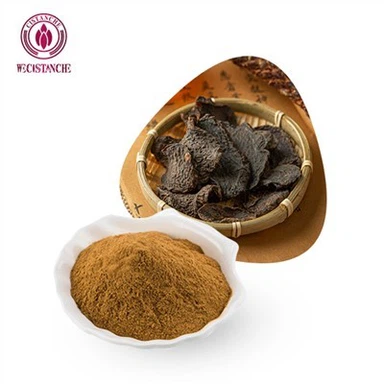
cistanche powder
Click here to view Cistanche Tubulosa Extract Natural Supplement Powder
【Ask for more】 Email:cindy.xue@wecistanche.com / Whats App: 0086 18599088692 / Wechat: 18599088692
The Cistanche Powder in "Introduction to Medicine, Volume 8" is made up of 24 grams each of Cistanche deserticola, Atractylodes macrocephala, Morinda officinalis, Ophiopogon japonicus, Poria cocos, Glycyrrhiza uralensis, Achyranthes bidentata, Schisandra chinensis, and Eucommia ulmoides, 15 grams each of Plantago asiatica and dried ginger, and 250 grams of fresh ground. The powder is ground to powder. Take 6 grams each time, adjust with alcohol on an empty stomach, 3 times a day, with the function of warming and tonifying kidney yang. It is mainly used for treating kidney qi deficiency and cold, erectile dysfunction, lower back pain, heavy body, weak tibia, and cloudy voice.
(3) Congee meal: both delicious and healthy
Congee diet is to boil cistanche deserticola with other ingredients into Congee, which is delicious and can also play a role in health care. This dosage form is suitable for daily consumption, especially for people with weak spleen and stomach who need long-term care.
The Congee with cistanche in Volume 97 of "Taiping Shenghui Prescription" is made in a particular way. We need to prepare 60 grams of Cistanche deserticola (soaked in wine overnight, scraped off wrinkles, finely cut), 100 grams of glutinous rice, 15 grams of deer antler gum (crushed, stir-fried until yellow dry, finely cut), and 120 grams of lamb (finely cut). When making, first boil mutton, then add cistanche and japonica rice to cook Congee, and then add antler glue powder when it is ready to cook. Season it with salt and sauce, and take it twice. This Congee can cure diseases such as five pains and seven injuries, chronic asthenia and coldness, impotence, etc. so that people can achieve the goal of nourishing their bodies while enjoying delicious food.
(4) Other tricks: fumigation and soaking in drinks
In addition to the common dosage forms mentioned above, there were also some unique methods of using Cistanche deserticola in ancient times. Li Shizhen recorded in the Compendium of Materia Medica that slicing and drying Cistanche deserticola, burning it to smoke wounds, can be used to treat tetanus. This fumigation method provides a new idea for surgical treatment.
In addition, in ancient times, there was also a method of brewing Cistanche deserticola with boiling water and drinking it directly. This simple and convenient drinking method enabled the health benefits of Cistanche deserticola to be more widely applied.
Inheritance and Inspiration: The Modern Significance of Cistanche deserticola
Looking back at the application and usage methods of Cistanche deserticola in ancient times, it is not difficult to find that it is not only a precious traditional Chinese medicine but also a crystallization of the wisdom of Chinese traditional medicine. From its initial record in the Shennong Bencao Jing to the continuous exploration and application of its efficacy by medical practitioners throughout history, the status of Cistanche deserticola in the field of traditional Chinese medicine has become increasingly important. Its significant effects in tonifying kidney and yang, nourishing essence and blood, moistening intestines, and promoting bowel movements have brought health and hope to countless patients.
In modern society, as people's attention to health and wellness continues to increase, the value of Cistanche deserticola has also been widely recognized. Modern medical research has found that Cistanche deserticola contains various beneficial components for the human body, such as phenylethanoid glycosides, cyclohexene ether terpenes, lignans, etc. These components have various effects such as antioxidants, anti-aging, enhancing immunity, regulating endocrine, etc., providing a scientific basis for the application of Cistanche deserticola in modern medicine.
However, we should also be aware that Cistanche deserticola, as a precious wild resource, is facing severe survival challenges. Due to excessive excavation and ecological damage, the number of wild Cistanche deserticola is decreasing, and has been listed as a second-class protected wild plant in China. Therefore, while making rational use of Cistanche deserticola, we must also strengthen the protection of its wild resources, actively carry out research on artificial planting and cultivation techniques, and achieve sustainable utilization of Cistanche deserticola resources.