Spring Nourishing: Who Is The King Between Cistanche Deserticola And Cistanche Deserticola?
Feb 25, 2025
Spring health preservation, Cistanche deserticola is a perfect time.
The spring breeze is sometimes good, and sometimes bad. The flowers cannot bloom due to the spring breeze, and the flowers are blown away by the wind. In spring, this season full of vitality and hope, the temperature gradually rises, everything recovers, and nature presents a thriving scene. In this beautiful season, the metabolism of the human body also accelerates, and the yang energy begins to rise, which is the golden period for health preservation.
Traditional Chinese Medicine believes that spring is the best time to nourish the liver. The liver is responsible for regulating and releasing fluids, and people prefer to stay healthy but dislike depression. If one can adapt to the weather and pay attention to health preservation at this time, it can not only lay a solid foundation for a year's health but also effectively prevent the occurrence of various diseases. Among numerous health ingredients, Cistanche deserticola stands out with its unique nourishing effects and is highly favored by people. Cistanche deserticola is known as the "desert ginseng" and is a parasitic plant that parasitizes the roots of the desert tree Haloxylon ammodendron. It absorbs nutrients and water from the host of Haloxylon ammodendron and is mainly distributed in desert areas such as Inner Mongolia, Xinjiang, and Gansu in China. It has a long history of application in traditional Chinese medicine and is regarded as a precious medicinal herb for tonifying the kidneys and yang, moistening the intestines promoting bowel movements, and delaying aging. In the "Shennong Bencao Jing", Cistanche deserticola is listed as a top-grade herb, known for its ability to "nourish the five organs, strengthen the yin, nourish the essence and qi, and treat women's ailments.

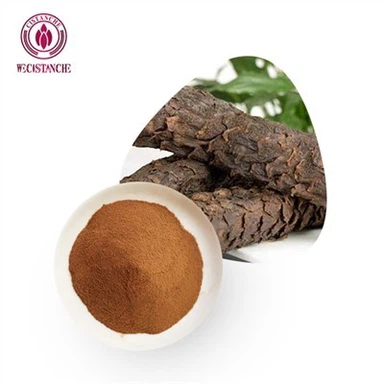
Cistanche deserticola
Nowadays, there are two common types of Cistanche on the market: Cistanche tubulosa and Cistanche deserticola. Although they both belong to the Cistanche genus and have similar names, there are many differences in their growth environment, efficacy, and other aspects. This also leaves many consumers confused when choosing, which quality is better Cistanche deserticola and Cistanche deserticola. Which effect is better? Next, let's delve deeper together and uncover their mysterious veil.
Differences in Background: Unveiling Growing Environment
People often say 'where the soil and water nourish the people', and plants are no exception. The growth environment has a crucial impact on the quality of plants. The different growth environments of Cistanche deserticola and Cistanche deserticola are like creating unique growth cradles for each and laying the groundwork for their quality differences. Now, let's delve into their growth environment.
(1) Guanhua Cistanche: a fiery "elf" in the desert
Guanhua Cistanche is mainly distributed in the southern part of Xinjiang, a vast land with unique geographical features and climatic conditions. It parasitizes the roots of plants in the genus Tamarix and grows in deserts at an altitude of around 1200 meters. The climate here is dry, with scarce precipitation, long sunshine hours, and large temperature differences between day and night, providing special environmental conditions for the growth of Cistanche deserticola.
Cistanche tubulosa prefers sandy loam soil with good air permeability and water permeability, which is beneficial for its root growth and nutrient absorption from host plants. At the same time, it also has certain requirements for soil acidity and alkalinity and is suitable for growth in alkaline soil with a pH value of 8.0-9.0. Guanhua Cistanche has strong drought tolerance and can grow and develop normally in soil environments with a moisture content of only 1.7% -3%, which enables it to survive tenaciously in arid deserts. In terms of temperature, its adapted temperature for growth is 5-28 ℃, with a ground temperature of 5-20 ℃, while its optimal temperature for growth and development is 15-25 ℃, with a ground temperature of 10-20 ℃. Under such temperature conditions, Cistanche deserticola can perform better physiological activities and accumulate nutrients.

cistanche deserticola ma
(2) Desert Cistanche: The resilient 'hermit' in the dunes
Desert Cistanche deserticola is distributed in central and northern China, including Ningxia, Inner Mongolia, Gansu, Xinjiang, Qinghai, and other places. It often grows in the dunes of the Haloxylon ammodendron desert, with an altitude between 225-1150 meters. Its host is the Haloxylon ammodendron, which is a "warrior" in the desert with strong drought, cold, high temperature, and salt alkali resistance. It can grow and form forests in harsh natural conditions in desert areas and is known as the "Desert Guardian" and "King of Desert Vegetation".
The Haloxylon ammodendron generally grows in soil or sandy areas with high groundwater levels and certain salt content. Its root system is very developed, with the main root able to penetrate up to 10 meters underground and the lateral roots extending up to 10 meters. This not only helps the Haloxylon ammodendron to fix itself in the desert and resist sandstorms but also provides sufficient water and nutrients for the desert Cistanche deserticola. The environment in which desert Cistanche deserticola grows is also dry and rainless, with annual precipitation below 150 millimeters and evaporation far exceeding precipitation. The extreme highest temperature is above 40 ℃ and the extreme lowest temperature is below -40 ℃, with strong wind and sand effects. In such harsh environments, desert Cistanche and Haloxylon ammodendron are interdependent and jointly adapt to the challenges of the desert.

Cistanche deserticola Y.C.Ma
(3) Comparative analysis: Potential impact of environment on quality
From the perspective of the growth environment, there are significant differences between Cistanche deserticola and Cistanche deserticola. In the desert areas of southern Xinjiang where Cistanche deserticola grows, the soil salinity may be relatively higher, which may affect its absorption of certain mineral elements and be reflected in its composition. The Haloxylon ammodendron desert dunes where Cistanche deserticola grows, although also dry, have different soil texture and composition compared to the growing areas of Cistanche tubulosa. The characteristics of Haloxylon ammodendron trees and their symbiotic relationship with Cistanche deserticola also affect the quality of Cistanche deserticola.
In terms of water sources, both grow in relatively arid environments, but there may be slight differences in specific water conditions. Water is an essential factor in the growth process of plants, as it affects their metabolism, transportation, and accumulation of nutrients. Guanhua Cistanche has relatively low requirements for soil moisture content, while in the environment where desert Cistanche grows, although there is less overall precipitation, the well-developed root system of the Haloxylon ammodendron may provide a relatively stable source of water for it. The differences in water conditions may lead to differences in their growth rate, morphological characteristics, as well as the content and types of active ingredients.
Soil composition is also an important factor affecting quality. The content of minerals, organic matter, and other components in the soil varies in different regions, and these components are absorbed and utilized by plants, participating in their growth and metabolic processes. For example, certain trace elements may affect the synthesis and content of active ingredients in Cistanche deserticola, thereby affecting its medicinal efficacy. Therefore, the difference in soil composition between the growth environment of Cistanche deserticola and Cistanche deserticola may be one of the important reasons for their differences in quality and efficacy.
The Battle of Efficacy: Who is More Skilled
After understanding the growth environment of Cistanche deserticola and Cistanche deserticola, let's delve deeper into their functions. As highly regarded nourishing medicinal herbs, they each have their advantages in terms of efficacy. Who is better? Let's analyze it together.
(1) Guanhua Cistanche: A 'Mighty General' for Tonifying Kidney and Nourishing Essence
Guanhua Cistanche has an excellent performance in nourishing kidney yang and nourishing essence and blood and can be regarded as a skilled hand. Traditional Chinese medicine believes that Cistanche deserticola has a sweet and salty taste, and a warm nature, and is beneficial to the kidneys and large intestine meridians. It has the effects of tonifying the kidneys and yang, replenishing essence and marrow, nourishing blood and moistening dryness, and prolonging color and life. It can be used to treat symptoms such as kidney yang deficiency, insufficient essence and blood, impotence and premature ejaculation, infertility, soreness and weakness of the waist and knees, and muscle and bone weakness.
From the perspective of modern medicine, Cistanche deserticola is rich in various beneficial components for the human body, such as phenylethanoid glycosides, iridoid glycosides, lignans, polysaccharides, alkaloids, etc. Among them, phenylethanoid glycosides are considered to be the main active ingredients that exert kidney tonifying and male-strengthening effects. These ingredients can regulate the endocrine system of the human body, and promote the secretion of sex hormones, thereby improving male sexual function and improving symptoms such as impotence and premature ejaculation. Studies have shown that the phenylethanoid glycosides such as echinacoside and verbascoside in Cistanche deserticola can significantly increase the serum testosterone levels and enhance the reproductive ability of kidney yang deficiency model mice.
In clinical applications, Cistanche deserticola is often used to treat menstrual disorders, uterine cold infertility, and other problems in women. It can regulate the female endocrine system, improve uterine blood circulation, enhance uterine function, and thus achieve the goal of regulating menstruation and promoting pregnancy. For example, for some women who experience reduced menstrual flow and irregular menstrual cycles due to insufficient kidney yang and deficiency of essence and blood, taking Cistanche deserticola can significantly improve their menstrual condition.

cistanche extract powder
Click here to view Cistanche for Anti-Aging Support Dietary supplement products
【Ask for more】 Email:cindy.xue@wecistanche.com / Whats App: 0086 18599088692 / Wechat: 18599088692
(2) Desert Cistanche: A 'master' of moistening the intestines and promoting bowel movements
The desert Cistanche deserticola has a significant moisturizing and laxative effect and has unique advantages in this regard. It also contains rich nutrients such as polysaccharides, galacturols, phenylethanolic glycosides, etc. These components work together to make desert Cistanche have good moisturizing and laxative effects.
The hydrophilic glial polysaccharides rich in desert Cistanche deserticola can absorb a large amount of water, increase the volume of feces, and make them soft, and easy to excrete. At the same time, it can promote intestinal peristalsis, enhance intestinal propulsion function, and effectively alleviate constipation symptoms. Related studies have shown that Cistanche deserticola can significantly improve the small intestine propulsion rate of mice, shorten defecation time, and have a significant effect on improving constipation.
In practical applications, desert Cistanche deserticola is commonly used to treat constipation problems in elderly people, pregnant women, and those with multiple illnesses. These groups of people are prone to constipation symptoms due to decreased physical function, insufficient qi and blood, and other reasons. However, the mild nourishing properties of desert Cistanche can moisten the intestines and promote bowel movements without causing too much burden on the body. For example, some elderly people have been suffering from constipation for a long time. After taking desert Cistanche deserticola, their constipation has been effectively relieved and their quality of life has also been improved.
(3) Comprehensive analysis: subtle differences in efficacy and applicable population
In addition to the two main effects of tonifying the kidney and nourishing essence, as well as moistening the intestines and promoting bowel movements, Cistanche deserticola and Cistanche deserticola also have some other benefits. In terms of regulating immunity, both contain polysaccharides and other components that can enhance the body's immunity and improve its resistance to diseases. The polysaccharide components in Cistanche deserticola are more prominent in improving cell activity and enhancing immune function; And desert Cistanche deserticola enhances the body's immune defense ability by regulating the activity and function of immune cells.
In terms of antioxidant properties, studies have shown that both Cistanche deserticola and Cistanche deserticola have certain antioxidant effects, which can clear free radicals in the body and delay cell aging. The components such as phenylpropanol sugar in Cistanche deserticola have strong antioxidant activity, which can inhibit lipid peroxidation and protect cells from oxidative damage; Some phenolic compounds and flavonoids in desert Cistanche deserticola also have good antioxidant properties.
Which type of Cistanche deserticola is more suitable for different populations? If it is a population with kidney deficiency, especially those with prominent male sexual dysfunction and female menstrual disorders, Cistanche deserticola may be a better choice, as its effectiveness in nourishing the kidneys and essence is more significant. For constipated individuals, especially those with weaker intestinal function such as the elderly and postpartum women, the laxative effect of desert Cistanche deserticola can better meet their needs. People who want to enhance their immunity and delay aging can choose according to their tastes and preferences, both of which can have certain health benefits.

Cistanche deserticola
What suits oneself is the best.
Guanhua Cistanche and Desert Cistanche are like two unique health experts, with obvious differences in growth environment and efficacy, and each has its advantages. Guanhua Cistanche grows in the desert of southern Xinjiang, and with its unique environment, it nurtures rich nutrients and performs well in nourishing the kidneys and essence; The desert Cistanche deserticola is rooted in the dunes of the Haloxylon ammodendron desert in the central and northern regions, and is interdependent with the Haloxylon ammodendron tree. It has a significant effect on moistening the intestines and promoting bowel movements.
When choosing Cistanche deserticola, we cannot simply say which quality is better and which effect is better between Cistanche deserticola and Cistanche deserticola. What suits oneself is the best, and we should consider factors such as our own needs, physical condition, and economic situation comprehensively. If you are troubled by kidney deficiency, Cistanche deserticola may be your capable assistant; If you are troubled by constipation, desert Cistanche may be your savior. Of course, before consuming Cistanche deserticola, it is best to consult a professional doctor or traditional Chinese medicine practitioner and follow their advice, so that Cistanche deserticola can better protect our health.