Standard Decoction Of Cistanche Deserticola: Quality Code Revealed
Jun 12, 2025
In the vast and arid desert, there is a magical plant that tenaciously roots and grows, which is Cistanche deserticola, known as the "desert ginseng". The growth environment of Cistanche deserticola is extremely unique, often parasitizing the dunes of the Red Willow Desert at an altitude of 225-1150 meters. It is a specialized root parasitic plant, and its host is Red Willow. The typical temperate continental climate in desert areas, with cold winters and hot summers, large annual temperature differences, large day-night temperature differences, low annual rainfall, and high evaporation, provides special conditions for the growth of Cistanche deserticola. The suitable temperature and soil temperature for the growth of its inflorescence are 20-30 degrees Celsius and 15-20 degrees Celsius, respectively. The growth rate is fastest when the soil volume moisture content is between 3% and 4%. This special requirement for the growth environment makes Cistanche deserticola particularly precious.

Dragon Herbs Cistanche
From the appearance, Cistanche deserticola is a tall herbaceous plant, 40-160 centimeters tall, mostly underground. The stem is fleshy, slightly flattened or cylindrical, with a diameter of up to 5-10 (~15) centimeters at the lower part, gradually narrowing upwards. The scale-like leaves are pale yellow or white, triangular, ovate, or broadly ovate, and the inflorescence is spike-shaped, with a length of up to 15-50 cm and a diameter of 4-7 cm. The corolla is light yellow and bell-shaped. The capsule is ovoid, and the seeds are nearly oval or elliptical. The outer surface is reticular and shiny. Its unique form also gives it a distinct identity in the desert.
Cistanche deserticola has extremely high medicinal value, with a sweet and salty taste, a warm nature, and beneficial effects such as nourishing essence and blood, moistening intestines and promoting bowel movements, and tonifying kidney yang. Can be used to treat symptoms such as infertility, vaginal discharge, intestinal dryness, and constipation. In the field of traditional Chinese medicine, it is a commonly used medicinal herb, commonly used to tonify kidney yang and nourish essence and blood. It has significant therapeutic effects on symptoms such as impotence, infertility, and soreness and weakness of the waist and knees caused by kidney yang deficiency and insufficient essence and blood. At the same time, its moisturizing and laxative effects can also help alleviate intestinal dryness and constipation in elderly people or those with physical weakness after illness. In modern research, Cistanche deserticola also has antioxidant, anti-fatigue, and immune-regulating effects, and is widely used in the development of health products and drugs.
With the increasing demand for Cistanche deserticola, its quality control has become increasingly important. The research on the quality of standard decoction of Cistanche deserticola has become an important topic in the field of scientific research.

Cistanche deserticola experiment
Standard decoction: the key to modernizing traditional Chinese medicine
The emergence of standard decoctions is an important milestone in the development of traditional Chinese medicine. Standard decoction is a single Chinese herbal medicine decoction prepared by standardized techniques guided by traditional Chinese medicine theory and based on clinical application, concerning modern extraction methods. Its "standards" cover multiple key aspects: the feeding decoction pieces need to be representative and accurately reflect the characteristics of the medicinal materials; The preparation process should be consistent with traditional methods and inherit the essence of traditional Chinese medicine; Quality control must be rigorous, from the source to the finished product, strictly controlling every link.
Standard decoctions play a crucial role in the quality control and modernization process of traditional Chinese medicine. It is like a bridge, closely connecting traditional Chinese medicine decoction pieces and modern Chinese medicine preparations. In the field of traditional Chinese medicine, decoctions are one of the most commonly used dosage forms with a long history of application. However, due to the lack of unified standards, the quality of decoctions varies greatly, which affects the stability and reliability of their therapeutic effects. The emergence of standard soup has provided an effective way to solve this problem. Through clear preparation processes and strict quality control standards, it ensures the stability and uniformity of the quality of the decoction, allowing patients to take Chinese medicine with reliable quality and stable therapeutic effects.

Cistanche deserticola slice
From a modern perspective, standard decoctions have laid a solid foundation for the standardization, normalization, and internationalization of traditional Chinese medicine. Standardization is the key to the widespread recognition of traditional Chinese medicine in the international market. The birth of standard decoctions has provided a unified standard for quality control of traditional Chinese medicine, which can better align with international standards and promote the internationalization of traditional Chinese medicine. For example, when developing traditional Chinese medicine formulations in Japan, the concept of "standard decoction" was introduced as an important benchmark for measuring the consistency of efficacy between modern industrial formulations and traditional decoction formulations. In Europe, America, as well as Hong Kong, Macau, and Taiwan, this concept has also been adopted in the research and development of modern Chinese medicine decoction pieces or compound preparations, promoting the modernization of Chinese medicine preparations. As an important traditional Chinese medicine, it is particularly necessary to study the quality of the standard decoction of Cistanche deserticola. It not only relates to the full utilization of the medicinal effects of Cistanche deserticola but also has a profound impact on the modernization process of traditional Chinese medicine.
Research methods are publicly available
(1) Material preparation
The medicinal materials used in this study, including 8 batches of Cistanche deserticola and 6 batches of Cistanche tubulosa, are widely sourced and representative. These medicinal herbs are purchased from different regions, covering the main production areas of Cistanche deserticola, such as Xinjiang and Inner Mongolia. The collection time also varies, ensuring the diversity of research samples from different dimensions. In terms of reagents, chromatographically pure reagents such as acetonitrile and methanol, as well as analytically pure reagents such as phosphoric acid and formic acid, were selected. These reagents were purchased from the well-known China National Pharmaceutical Group Chemical Reagent Co., Ltd., ensuring the accuracy and reliability of the experiment. The experimental instruments are equipped with advanced equipment such as high-performance liquid chromatography and ultra-high performance liquid chromatography, as well as a 1/100000 electronic balance, a high-speed centrifuge, etc. These instruments provide strong technical support for research.
(2) Soup preparation
Strictly follow the preparation requirements of the standard decoction when preparing 14 batches of Cistanche deserticola. Firstly, accurately weigh the decoction pieces of Cistanche deserticola, with a dosage of 100g per batch. Then, add 8 times the amount of water and soak for 30 minutes to allow the herbs to fully absorb moisture and prepare for subsequent decoction. Subsequently, reflux boiling was performed, with the first boiling time being 60 minutes and the second boiling time being 40 minutes. During the decoction process, strictly control the temperature and time to ensure the quality of the soup. After boiling, combine the two decoctions and filter them with 8 layers of gauze while hot to remove any residue. Concentrate the filtrate under reduced pressure to an appropriate amount, dry it at 60 ℃, and finally make a dry paste that fully retains the effective ingredients of the medicinal herbs.

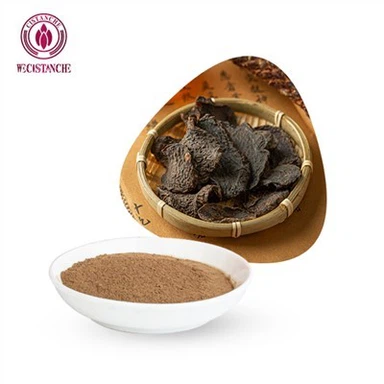
cistanche powder
Click here to view Organic Cistanche Extract Powder products
【Ask for more】 Email:cindy.xue@wecistanche.com / WhatsApp: 0086 18599088692 / Wechat: 18599088692
(3) Content determination
The content determination adopts the HPLC method, which is an efficient and accurate analytical method. When determining the content of echinacoside and verbascoside, a chromatographic column with octadecylsilane bonded silica gel as the filler was used, and acetonitrile 0.1% formic acid solution was used as the mobile phase for gradient elution. The detection wavelength is set to 330nm, which can accurately detect the target component. The column temperature is controlled at 30 ℃, the flow rate is 1.0 mL per minute, and the injection volume is 10 μL. By setting these precise conditions, the content of echinacoside and verbascoside in the decoction can be accurately determined. Then, based on the content determination results, calculate its transfer rate. The calculation formula for transfer rate is: Transfer rate (ingredient content in decoction ÷ ingredient content in decoction pieces) × 100%. The calculation of transfer rate can intuitively reflect the transfer of active ingredients in medicinal materials during the preparation process of decoctions, which is of great significance for evaluating the quality of decoctions.
(4) Determination of paste yield and pH value
When determining the paste yield, accurately weigh the prepared dry paste and calculate the paste yield. The formula for calculating the ointment yield is: ointment yield (dry ointment weight ÷ decoction piece weight) × 100%. The extraction rate is an important indicator for measuring the transfer and concentration effect of substances during the preparation process of soup. It reflects the content of solid substances in the soup and plays an important role in the quality control of the soup. The pH value is measured using precision pH test strips or pH meters at room temperature. The pH value can reflect the acidity and alkalinity of the soup, which has a potential impact on the stability and efficacy of the soup. By measuring the pH value, we can better understand the properties of the soup and provide more basis for quality control.
(5) Establishment of fingerprint map
When establishing the UPLC fingerprint spectrum, suitable chromatographic columns and mobile phases were selected, and gradient elution was used for determination at specific detection wavelengths. Import the chromatograms of 14 batches of Cistanche deserticola standard decoction into the Chinese medicine chromatographic fingerprint similarity evaluation system, and generate control fingerprint spectra through multi-point correction and the median method. In the fingerprint spectrum, six common peaks were identified, and the first peak was successfully identified as echinacoside, the third peak as guanosine A, the fourth peak as verbascoside, and the fifth peak as isoverbascoside. Through fingerprint analysis, the chemical composition characteristics of the standard decoction of Cistanche deserticola can be comprehensively reflected, and its internal quality can be comprehensively evaluated, providing a more comprehensive and accurate basis for quality control.

Phenylethanol glycoside is the main active component of Cistanche deserticola
Full analysis of research results
(1) Component transfer rate
After careful determination and rigorous calculation of 14 batches of standard decoction of Cistanche deserticola, the results showed that the average transfer rate of echinaceae glycoside was 22.99%, and the average transfer rate of verbascoside was 17.09%. From the data, it can be seen that there are certain differences in the transfer rate between different batches. When preparing the standard decoction of Cistanche deserticola slices, the transfer rate of indicator components is relatively stable; The standard decoction prepared from Cistanche deserticola slices has relatively large inter-batch differences in the transfer rate of indicator components. This difference may be due to various factors, such as different origins of medicinal herbs, and environmental factors such as soil and climate in different origins that can affect the accumulation of active ingredients in Cistanche deserticola; The difference in harvesting time is also crucial, as the composition of Cistanche deserticola varies at different growth stages; Different processing methods, such as drying methods, processing techniques, etc., can also affect the transfer rate of components.
(2) Paste yield and pH value
The extraction rate range of 14 batches of standard decoction of Cistanche deserticola is between 25.1% and 56.6%. Among them, the extraction rate of the standard decoction of Cistanche deserticola is generally lower than that of the standard decoction of Cistanche deserticola, mainly because the sugar content of the sliced Cistanche deserticola is relatively low. The high or low extraction rate not only reflects the content of solid substances in the decoction, but also to some extent reflects the degree of concentration of effective ingredients in the medicinal herbs. A higher extraction rate may mean that more effective ingredients are retained in the decoction, but it is not absolute and requires comprehensive judgment based on other indicators.

Main Chemical Constituents of Cistanche deserticola
The pH range of the decoction is between 4.30 and 5.15, indicating that the acidity and alkalinity of the standard decoction of Cistanche deserticola are relatively stable. A stable pH value plays an important role in maintaining the chemical stability and efficacy of soup. Within this pH range, the chemical components in the decoction can maintain a relatively stable state and are less prone to chemical reactions such as decomposition and precipitation, thereby ensuring the quality and efficacy of the decoction.
(3) Fingerprint characteristics
In the fingerprint spectrum of the standard decoction of Cistanche deserticola, six common peaks are present. After in-depth analysis and identification, peak 1 has been successfully identified as echinacoside, peak 3 as guanosine A, peak 4 as verbascoside, and peak 5 as isoverbascoside. These identified peaks are like the "identity identifiers" of the soup, visually displaying the presence and distribution of the main components in the soup.
After evaluating the similarity of 14 batches of standard decoction of Cistanche deserticola, it was found that the similarity range was between 0.789-0.999. The similarity of most batches is relatively high, all above 0.98, but there are also a few batches, such as RCR-9 standard soup, with a similarity of only 0.789. Through careful observation of the fingerprint chromatogram of RCR-9 standard soup, it was found that there were two distinct peaks at retention times of 12.278 and 15.466, which differed from other samples. This may be due to differences in the growth environment, harvesting time, processing methods, and other aspects of this batch of decoction pieces compared to other batches, resulting in changes in their substance accumulation and component content. The similarity evaluation of fingerprint spectra provides a comprehensive and integrated basis for the quality control of standard decoction of Cistanche deserticola, which can more accurately evaluate the quality consistency and stability of the decoction.