Studies On Cistanche Deserticola And Its Host Pests
Mar 13, 2022
Occurrence and control of pests about Cistanche deserticola and its hosts
Contact: joanna.jia@wecistanche.com / WhatsApp: 008618081934791
Chen Jun1, Liu Tongning2, Zhu Xinghua1, Chen Huizhen1
( 1. Institute of Medicinal Plant Development, Chinese Academy of Medical Sciences and Peking Union Medical College, Beijing 100094, China; 2. Ningxia Yongning Plantation of Liquorice Root, Yinchuan 750104, China)
Abstract
Objective: To investigate the kinds and occurrence of pests of Cistanche deserticola and its hosts to find ways of pest control.
Method: Pests of C.deserticola and its hosts were investigated in Xinjiang, Inner Mongolia, and Ningxia where C.deserticola grows, the occurrence of Anomala titanic Reitter was investigated in the field, and phoxim was used for field control.
Result: There are 17 kinds of pests which harm C .deserticola and its hosts.Phoxim 40 % EC 1 000 times, 2 000 times and Phoxim 3% GR [ 8 kg·( 667 m2 ) -1] had 100 % controlling effect, and 3% GR[ 4 kg·( 667 m) -2 -1] had 88 .23% controlling effect .
Conclusion: Many kinds of pests can harm C.deserticola and its hosts. Phoxim is good for killing A .titanis Reitter.
Keywords: Cistanche deserticola, pests investigate, control
Cistanche deserticola Y.C.Ma (hereinafter referred to as Cistanche) is a perennial parasitic plant of the Cistanche genus Cistanche, which is parasitic on the roots of Haloxylon ammodendron (C.A.Mey.) Bunge, a plant of the Chenopodiaceae. The dried fleshy stem is used as a traditional Chinese medicine to nourish the liver and kidneys, nourish the essence and blood, nourish the intestines and relieve bowel movements. It has the reputation of "desert ginseng". Mainly distributed in deserts and desert areas such as western Inner Mongolia, Ningxia, Gansu, Xinjiang, and Qinghai. Due to years of destructive mining, wild Cistanche deserticola resources have been on the verge of exhaustion. Cistanche has been listed as a secondary endangered protected plant and has been included in the "International Wild Plant Protection List". In 2001, the State Economic and Trade Commission stipulated that the same management system for Cistanche cistanche shall be implemented in the "Administrative Measures for the Licorice and Ephedra Francis Franchise License". The mining of wild resources is prohibited and artificial planting is encouraged. The establishment of a Cistanche planting base can fundamentally solve the problems of the protection of the wild resources of Cistanche and the sustainable development of the Cistanche industry. It is also of great significance to the ecological construction of the western region. With the expansion of the scale of artificially planted Cistanche, the problems of diseases and insect pests will become more and more prominent. A timely understanding of the types and hazards of these diseases and insect pests, while researching the prevention and control of major diseases and insect pests, will provide a basis for the construction of the Cistanche cistanche planting base. From 2002 to 2003, the author conducted a preliminary investigation on the species and occurrence of diseases and pests of Cistanche and host plants in the main producing areas of Cistanche in Inner Mongolia, Xinjiang, Ningxia, etc. At the same time, the Cistanche plantation base of Licorice Plantation in Yongning County, Ningxia, has seriously harmed Cistanche. The occurrence and damage of the underground pest Anomala Recoleta Faldermann were investigated and field control experiments were carried out.
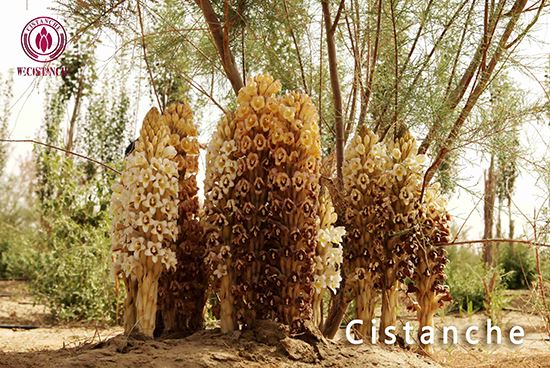
Cistanche deserticola and its hosts
1. Materials and methods
1.1 Investigation on the species and damages of diseases and pests of Cistanche and its host plants
From 2002 to 2003, preliminary investigations were conducted on Cistanche, Cistanche salsa, Cistanche, and host plants in southern Xinjiang, northern Xinjiang, Alashan of Inner Mongolia, Yanchi of Ningxia, and Haiyuan.
1.2 Investigation of the occurrence and harm of the yellow-brown beetle
On June 24, 2002, August 15, September 1, 2003, May 1, 2003, 961 pits inoculated with cistanche were investigated for the occurrence of grubs at the Yongning Cistanche planting base in Ningxia, and the occurrence of the pits was counted. Rate, group incidence, and total hazard group rate.
1.3 Field control test of brown gill beetle
1.3.1 Test site
The test site was the Cistanche deserticola planting base in Yongning, Ningxia, and the soil was sandy loam. The plots where grubs occur frequently throughout the year were selected for the control test.
1.3.2 Test agent and application method
Choose 2 formulations of phoxim, with 2 concentrations for each formulation: 40% phoxim EC (Shandong Shengbang Lunan Pesticide Co., Ltd.), 1,000 times, 2,000 times; 3% phoxim granules (Shandong Shengbang Lunan Pesticide Co., Ltd.) Bangunan Pesticide Co., Ltd.), 4, 8 kg·(667m2) -1, with no application as a blank control.
During the inoculation of Cistanche, the medicine is applied to the inoculation point, the depth of the point is 50 cm, and the amount of medicine per point is converted according to the total number of inoculated plants per mu.
1.3 .3 Treatment number and field layout arrangement
There are 5 treatments in the experiment: 40% phoxim EC 1,000 times; 2,000 times; 3% phoxim granules 4, 8 kg·(667m2) -1; no application is the control, and each treatment is repeated 3 times, Randomly arranged in the field.
1.3.4 Test time
The control was carried out on June 13, 2003, and the control effect was investigated on October 6, 2003. The control effect is calculated by the following formula.
Control effect (%) = ((the number of hazards in the blank control area-the number of hazards in the chemical treatment area) / the number of hazards in the blank control area) × 100%

2. Results and analysis
2.1 Investigation on the types of diseases and pests of Cistanche and its host plants and their damages (see Table 1)
The investigation shows that there are 17 kinds of diseases and insect pests that harm Cistanche and its host plants, including 4 kinds of diseases and 13 kinds of insect pests; 1 kind of disease and 6 kinds of insect pests that directly endanger Cistanche. The investigation results of the artificial planting base of Cistanche show that the grass borer Loxostege stieticatis Linnaeus and the yellow-brown beetle A. exdeta Faldermann are more harmful to the growth of Haloxylon ammodendron and Cistanche, and should be controlled in production. Cistanche fleshy stem rot disease occurs more severely in plots with high soil moisture and should be paid attention to. Other diseases and insect pests mostly occur sporadically, and currently, no control is needed in production.
Cistanche deserticola and its hosts
2.2 Investigation on the occurrence and damage of the underground pest of Cistanche
Chlorophyllum chrysanthemum belongs to the branch beetle family [1], distributed in Ningxia, North China, Northeast China, and other places. Omnivorous, larvae mainly damage the seedlings of food crops [2]. It is an important pest in the arid area of Ningxia, mainly distributed in sandy loam soil and the old course of the Yellow River. In Ningxia, one generation per year, overwintering as larvae[1, 2]. April and May are the peak period of larval damage. From the end of May to early June, the larvae mature and pupate in the soil chamber. Adults emerge in June and July, and a new generation of larvae appear in July and August, which damage autumn crops. Instar larvae overwinter. The larvae harm Cistanche and Haloxylon roots in 20-50 cm deep sandy soil. When harvesting Cistanche in spring, it was found that there are 7 grubs in one hole at most. The grubs bite the fleshy stem of Cistanche into nicks, which affects the appearance quality.
Table 1 Investigation on the types and damages of plant diseases and insect pests of Cistanche and its host plants.

The inoculation investigation found that the larvae of the yellow-brown beetle larvae gnawed on Cistanche and at the same time feeding on the young roots of Haloxylon ammodendron, destroying the parasitic roots, causing damage or death of the cistanche, affecting the success rate of inoculation; a large fleshy stem of Cistanche was found in spring Grubs gnaw seriously, which seriously affects the yield and appearance quality of Cistanche. Field investigations have found that the occurrence of the beetle chrysanthemum is closely related to the application of organic fertilizer and soil moisture. In the plots with a lot of organic fertilizer, the occurrence of this insect is large and the soil moisture is large, the occurrence of grubs is large and the damage is serious, while the grubs are very few in dry plots.
On June 24, 2002, August 25, September 1, and May 1, 2003, the field was investigated for hazards. Five points were checked each time. The results are shown in Table 2.
The survey results in Table 2 show that the incidence of grubs is very high. The incidence of grubs in the surveys in June, August, September 2002, and May 2003 showed an upward trend. The average incidence of grubs was 41.5%, 66.8%, and 67, respectively. .8%, 71.5%; in 2002, the incidence rate of the three investigations and the rate of all-hazard groups showed an upward trend, and the incidence of the investigation group rate and the rate of all-hazard groups were the highest on September 1, which were 96.0% respectively, 42.0 %.
Table 2 Investigation on the occurrence of brown-gilled beetle (2002~2003, Yinchuan, Ningxia)

Note: 1) All the 5 points in each survey are harmed by grubs
2.3 Field control effect of yellow-brown Golden beetle (see Table 3 for the results)
Table 3 shows that of the 4 chemical treatments, only 3% phoxim granules [4 kg·(667 m2) -1] pesticide treatment has 2 points found to have grub hazards, other treatments have no grub hazards, while the control has 17 points Found grub hazards. The control effect showed that the pesticide treatment of 40% phoxim EC 100, 2 000, 3% phoxim granules [8 kg·(667 m2) -1], the field control effect of yellow-brown beetle larvae reached 100%, 3% phoxim granules [4 kg·(667 m2) -1] pesticide treatment, the field control effect of brown beetle larvae reached 88.23%, the control effect is very significant.
Table 3 Field medicament control effect of yellow-brown beetle (2003-10-06, Ningxia)

Note: The survey numbers are all 30 points
3. Conclusion and discussion
3.1 The genus Cistanche has 4 species and 1 variety, and the corresponding host plants have several 10 species. Among them, the species of "Chinese Pharmacopoeia" is desert Cistanche, which is currently planted on a certain scale in Ningxia, Inner Mongolia, and Xinjiang. Due to the shortage of resources, non-pharmacopeia cistanche is also used as a substitute in some areas. At present, the state has banned the mining of wild Cistanche, and investigating the types and hazards of wild and artificially planted Cistanche can provide support and help for the prevention and control of diseases and insects in the construction of standardized cistanche planting bases. Because Cistanche is distributed in deserts and desert areas with harsh environmental conditions, it is difficult to investigate. This study is only a preliminary investigation result.
3.2 The investigation showed that the larvae of the underground pest Yellow-brown beetle have a greater impact on the growth of Cistanche. In addition to chemical control, it can also be controlled from its source. During the production of Haloxylon ammodendron and Cistanche inoculation, organic fertilizers such as sheep dung, camel dung, cow dung, etc. are often used. These organic fertilizers are easy to attract underground pests to lay eggs. According to the survey results, the damage of yellow-brown beetle larvae lasts for a long time. Long, it is probably because the organic fertilizer is not fully decomposed, and it continues to attract underground pests in the field. Therefore, organic fertilizer must be fully decomposed before application.
3.3 Phoxim is a low-toxicity, high-efficiency, broad-spectrum organophosphorus pesticide. It is sensitive to light, and when used in the field, it quickly decomposes and loses efficacy when exposed to light, and has a short residual effect period. However, after the drug is applied to the soil, the residual effect period can reach 12 months, which is suitable for the control of underground pests [3]. The results of this experiment proved that the application of phoxim to control the larvae of the underground pest of Cistanche has a good control effect, and has a good guiding effect on the control of artificially planted cistanche pests.
3.4 The serious period of occurrence and damage of the larvae of Chlorophyllum Chinensis is from late August to early September. At this time, Cistanche has been inoculated with parasitism and is in the early growth stage just after parasitism. At this time, if it suffers from grub damage, it will be directly affected. The success rate of cistanche inoculation, therefore, early prevention and treatment should be paid attention to in production to reduce losses.
3.5 The prevention and control of underground pests are best in the adult stage. The adult beetles come out day and night and have strong phototaxis. Therefore, the use of blacklight traps or frequency-vibration insecticidal lamps has a good trapping effect, and blacklight lamps are installed in the planting base. Frequency vibration insecticidal lamps can achieve a better control effect.

Cistanche deserticola
References
[1] Wu Fuzhen, Gao Zhaoning, Guo Yuyuan. Ningxia Agricultural Insect Pictures. Episode 2. Yinchuan: Ningxia People’s Publishing House, 1982.
[2] Wei Hongjun, Zhang Zhiliang, Wang Yinchang. Underground pests in China. Shanghai: Shanghai Science and Technology Press, 1989.
[3] Zhang Youjun, Wu Qingjun, Rui Changhui, et al. Guidelines for the use of pesticides without pollution. Beijing: China Agriculture Press, 2003.
From: China Journal of Chinese Materia Medica; Vol.29, Issue 8 August 2004