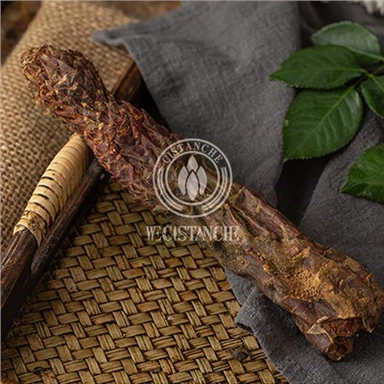
The Artificial Planting Cistanche in Xinjiang
Mar 13, 2022
Probe to Cistanche deserticola Resources and Its Artificial Planting in Xinjiang
Contact: joanna.jia@wecistanche.com / WhatsApp: 008618081934791
Sun Yongqiang1, Zhen Xingguo2, Lu Zhongyuan2, Zhang Xiaofen3, Gao Yuan4
(1. Xinjiang Institute of Ecology and Geography, Chinese Academy of Sciences, Urumqi, 830011; 2. Forestry Seed Station, Jimsar County, Xinjiang 834000; 3. School of Ecological Environment, Inner Mongolia Agricultural University, Hohhot 010019; 4. Wusutu Forest Tourism and Recreation in Inner Mongolia Development Zone 010070)
Abstract: Cistanche was first published in "Shennong Ben Cao Jing". It is a common ingredient in ancient prescriptions for anti-aging and prolonging years. Its appearance probability is second only to ginseng. The author briefly describes the utilization status of Cistanche resources and the analysis of its medicinal value and puts forward the urgency of artificial planting, as well as the research status, problems, and prospects.
Keywords: Cistanche, resources, artificial planting
1. Overview of the resources of Cistanche
Cistanche deserticola is a genus of Cistanche in the family Lidanaceae, a perennial one-time fruiting herbaceous parasitic plant. Scientific name: (Cistanche deserticola Ma emend Ma), common name: Cistanche deserticola, Dayun.
Cistanche is suitable to grow in deserts and saline-alkali lands in desert areas, mainly distributed in Xinjiang, Gansu, Inner Mongolia, Ningxia, and other places in western Asia, as well as the former Soviet Union, Mongolia, and Afghanistan.
Xinjiang is rich in resources of Cistanche, and its output is higher than that of Inner Mongolia, ranking first, with an area of 2.73 million mu. Southern Xinjiang is dominated by Tamarix Dayun, with an annual purchase volume of up to 400 tons. Take Minfeng County in Hotan as an example, the highest annual purchase volume has reached 150 tons; North Xinjiang is dominated by Shusuo Dayun, with an annual purchase volume of up to 100 Ton. According to incomplete statistics, the reserves of wild Cistanche in Xinjiang are more than 5,000 tons.
Attracted by economic interests, people have excavated a lot in recent years, making this wild resource on the verge of extinction, and it is listed as a second-class protected plant by the country. According to reports, since the end of the 20th century, there have been thousands of people in the organized mining of Cistanche, and more than 10,000 people have been in recent years. Digging a plant of Cistanche will destroy one or several psammophytes and halophytes, directly destroying psammophytes and the ecological environment, creating a vicious cycle of ecology in the desert area, making the problem of resource utilization and protection increasingly prominent.
According to the classification of Cistanche by Li Jiazheng [1], classified Cistanche in Xinjiang into three common types, namely: Cistanche, salted cistanche, and cistanche tube flower. The former two are distributed in northern Xinjiang, and the latter is distributed in southern Xinjiang.

The artificial planting of cistanche
Cistanche deserticola Ma emends Ma: Perennial parasitic herb, with yellow underground stems, thick fleshy, flat garden-shaped, densely fleshy scaly leaves. Yellow alternate, no petiole, spirally arranged at the base of the stem, gradually diverging upwards, the base leaves are triangular, the upper leaves are lanceolate or linear-lanceolate, and the terminal cones are inflorescences, and the flowers are numerous and dense. The purple or yellow calyx is bell-shaped, the capsule is ovoid, dilated, brown, with many seeds, the flowering period from April to May, fruit in June. It is parasitic on Haloxylon ammodendron and White Haloxylon ammodendron, distributed in the northern Xinjiang region of Xinjiang.
Cistanche Salsa (C.A.Mey) G.Beck): Perennial parasitic herb with thick underground stems and cylindrical shape. Yellow, sometimes there are more than 2-3 young buds at the base. Scaly leaves, alternate, yellow, triangular-ovate to long garden-lanceolate, shorter in the lower part of the stem, densely arranged, longer in the upper part, loosely arranged, and terminal fleshy spikes, the flowers are numerous and dense, each flower There is a large bract and two symmetrical bracteoles at the base. The calyx is bell-shaped, purple, red-purple, yellow, white, 5 lobed at the apex, 4 stamens, hairy, stigma capitate. Capsules are ovoid-shaped, two-lobed, with brown seeds, and the flowering period is from April to May. The fruiting period is June. There are more than 6 species of parasitic plants, including salt claw, which are distributed in northern Xinjiang.
Cistanche (C.tubulosa (Schenk) wight): also known as Tamarisk Dayan and Dayan Guanhua, it is mainly produced in southern Xinjiang. It is concentrated in Minfeng and Yutian in the Hetian area. It is a perennial parasitic herb and its host is Tamara (Tamara) plants.
2. Development and Utilization Value of Cistanche Resources
2.1 Research on the chemical constituents of Cistanche [11] [3] [2][ 1]
Sheng Wei et al. reported that 9 compounds were separated from the ethanol extract of Cistanche: D-mannitol, B-sitosterol, c, betaine, caffeic acid glycolipid, polysaccharide compounds, succinic acid, triacontane Acid, 8-epimeric acid glucoside; Xu Wenhao and others isolated and identified 16 compounds from the dried fleshy stems of Cistanche deserticola, which were identified as glucose, sucrose, betaine, and mannitol by chemical reaction and spectral analysis. , Succinic acid, B-sitosterol, carotenoids, 8-epimacynic acid glucoside, iridoid glycosides, and 7 phenyl propionic glycosides ergosteroside, 2-acetylergosterol, echinacea Cistanche glycosides A, B, C, H.
2.2 Research on the nutritional components of Cistanche
According to analysis and laboratory tests, the nutrients of Cistanche are: total sugar 23-26%, oil content 0.65-0.66%, protein 20.6-19.3%, and phosphorus pentoxide contains 160-133 mg per 100 grams. , Ash content is 5.1 -57.5%, and 23 kinds of minerals and trace elements such as silicon, manganese, strontium, germanium, zinc, calcium, etc. are contained at the same time.
2.3 Current research status of pharmacological effects and health care functions
(1) Enhance the body's immune function
Relevant experiments show that Cistanche can enhance the phagocytic ability of mononuclear-macrophages, thereby enhancing human immunity.
(2) Strengthening effect
Cistanche is a commonly used traditional Chinese medicine for invigorating the kidney and strengthening the yang. Betaine and ergosteroside in the water-soluble components have male hormone effects. According to experiments, the diluted alcohol extract of Cistanche was added to drinking water to raise young rats, and their body weight increased relatively fast, and they were orally administered to mice separately Three kinds of decoctions (desert, saline, and tube flower) were found to significantly increase the weight of mice, prolong swimming time, and have anti-fatigue effects. Cistanche can significantly increase the DNA synthesis rate in the liver and spleen of yang-deficiency animals with hydroxyl vein type, and it can be considered that it has a strong and therapeutic effect on animals with yang-deficiency diseases.
(3) Anti-aging effect
Feeding mice and fruit flies with Cistanche, it is found that Cistanche can prolong the larval stage and the life of the whole worm. Some studies believe that Cistanche can improve the body's strain capacity, directly or indirectly eliminate the damage of free radicals to the body, and inhibit the activity of type B monoamine oxidase. To achieve the purpose of delaying aging. Cistanche has 2 anti-aging active ingredients: D-mannitol and cistanche polysaccharide. These two components play a significant role in delaying skin aging, enhancing body immune function, activating superoxide dismutase, and reducing lipofuscin accumulation in the body. D-mannitol tends to reverse the LPO/SOD levels of old animals to normal adult animals.
(4) The laxative effect of Cistanche
Cistanche significantly improves the propulsion of the small intestine of mice, shortens the defecation time of mice, can effectively resist the defecation inhibitory effect of atropine, and also has a significant inhibitory effect on the water absorption of the large intestine. It is believed that the laxative components of cistanche-inorganic salts and hydrophilicity Colloid polysaccharides are an effective treatment for Cistanche's "smoothing bowel movement".

The artificial planting of cistanche
(5) Anti-atherosclerosis (AS) ZY effect
Guo Liping’s research has shown that Cistanche has similar effects to vitamins with known anti-AS effects. It can significantly inhibit the degeneration and proliferation of smooth muscle cells of the rabbit AS model, improve their ultrastructural changes, reduce the content of oxidized lipids in smooth muscle cells, and increase their activity of superoxide dismutase, thus playing an antagonistic effect on rabbit AS.
(6) Effects on the nervous system and sexual function
The effect of Cistanche on the gonads is not only a direct effect on the subject but also participates in the neurotrophic effect of thalamic monoamines. In addition, Cistanche can also resist protein distribution, adjust the ultrastructure of liver cells, promote protein synthesis, and lower blood pressure.
2.4 New product development
Cistanche appears frequently in medicinal food therapy and past proved prescriptions, and consumers have a certain understanding and trust in its medicinal use and has a good reputation; currently on the market, Cistanche wine, cistanche health liquid, cistanche oral liquid, and other Cistanche compound preparations They are only generally processed preparations of Cistanche, with low technical content and low curative effect. Xinjiang pharmaceutical manufacturers have invested a lot of money in the research and development of Cistanche glycosides capsules for the treatment of anti-aging and preparations for laxative bowel movements. In addition, the Cistanche tobacco developed by the Hohhot Tobacco Factory has been put on the market and sold well.
3. Artificial planting research
In 1981, the Institute of Medicinal Plant Resources Development of the Chinese Academy of Medical Sciences cooperated with the Inner Mongolia Alxa League Pharmaceutical Company to conduct artificial planting research with Haloxylon ammodendron as the host, which was successful in 1985. (Announced in the 11th issue of the Science and Technology Achievement Bulletin of the National Science and Technology Commission in 1987) The technology has not been reported in pilot trials and yield results. Only the planting method, seed collection, pollination rate, and artificial assisted pollination have been reported. The institute established a Cistanche production plantation in the late 1980s. Since then, there has been no continuous report on the output and production status of the plantation.
Tu Pengfei reported in the article "Investigation of Cistanche Drug Sources and Resource Protection"[6] (1994): "The artificial planting of Cistanche in the A-League of Inner Mongolia has been successful, and it has won the second prize of National Progress Award. It has been extended to 1,334 hectares, but the yield is Not ideal. The author believes that it is necessary to conduct further experiments on water quality, sowing period, sowing depth, optimal humidity for each growth, pest control, etc., and strengthen management to form products as soon as possible." In recent years, the survey results have not changed much. However, the newly invented "cistanche nutrient soil seedbed substrate cultivation method" won the second prize of the Inner Mongolia Autonomous Region Science and Technology Progress Award in 1987. It is a new way to produce cistanche, but it has not yet formed productivity and is still in the research and development stage.
Liu Mingting, Xinjiang Institute of Biotechnology, Chinese Academy of Sciences, succeeded in planting Cistanche with red willow as a host in 1992. Researcher Liu Mingting, who has retired in recent years, has contracted his land in Yutian County, Xinjiang, and planted 3hm2d Cistanche multitubularis in 3-4 years. The newspaper reported the success of the planting but did not see follow-up reports on the yield per unit area or other aspects.
The research on the artificial cultivation technology of Cistanche in the Jimusaer Forest Tree Variety Experimental Station in Changji Prefecture, Xinjiang started in 1991, and the experiment was successful in 1995. In the same year, it achieved the success of "the technique of artificial inoculation of Cistanche with wild hosts" and the technique of artificial cultivation of "one year one system" and passed the recognition of experts. From 1995 to 1999, in addition to the annual repetition of the above two technologies, the "manual multi-year system" and "two-year one system" artificially planted Cistanche stable yield research and various cultivation methods stable yield model research, so that the output can reach 80 -120 The fresh weight of kg/mu is a stable production level that can be repeated annually, and it has begun to take shape in large-scale production capacity.
3.1 Research on increasing the inoculation rate
Cistanche seeds have a thousand-grain weight of 0.9 grams. After the seeds mature under natural conditions, they fall on the ground and contact the new roots of the host through sand burial. They begin to grow and develop until they are unearthed and bloom and complete a life cycle. This process has a long cycle and the inoculation rate is very low. In the early 1990s, artificial planting was to ditch the main distribution layers of the root system of Haloxylon ammodendron and Tamarix to increase the inoculation rate. However, this method is not low-cost and also wastes seeds. The Jimusaer Forest Tree Improved Variety Experimental Station has invented the use of inoculation paper technology in recent years to increase the natural inoculation rate of raw Cistanche from 5-9/10000 to 1-35 %, which is one of the core technologies to break through the large-scale production of Cistanche. The fresh weight per mu has been stabilized at 80-120 kg. There has been no report of unit output in the country before. In recent years, under the guidance of this technology, the highest unit output can reach the level of 270 kg of fresh weight.

Cistanche tablets
3.2 Research on host selection
Under natural conditions, each species of Cistanche has its corresponding host. The Jimusaer Forest Tree Improved Variety Test Station has spent nearly 10 years experimenting with a variety of plants and screening out 6 species of Cistanche parasitic plants that are ideal and suitable for various saline-alkali soils (no record in domestic literature), of which "one-year production" The application of the host Tingzhou No. 2 has broken through the multi-year production technology of Cistanche. The double-effect host Damo No. 1 is a new host for both Cistanche and fine forages. It can obtain a double-effect income of cistanche and forage at a yield level of 800 kg per mu, which is inestimable to the promotion of animal husbandry production in desert areas and the resolution of forestry and animal husbandry conflicts. Potential, these are leading advantages both inside and outside the industry. At the same time, the discovery of new hosts has injected new content into the academic research of Cistanche.
3.3 Experimental study on the planting depth of Cistanche
The Jimusaer Forest Tree Improved Variety Experimental Station has conducted planting experiments at different depths since 1993, with three gradients of 60cm, 80cm, and 100cm, and the host is Haloxylon ammodendron. Unearthed situation: Cistanche was unearthed at a depth of 20cm in 1994-95; it was unearthed at a depth of 40cm in 1996, and it was unearthed at a planting depth of 60cm until 1998. This can also confirm that Cistanche is indeed a perennial plant, but it is quickly unearthed in shallow planting. The individual is small, the number is large, the planting depth is slow to unearth, the individual is large, the number is small, the yield is low, the production cycle is long, and the early economic benefits are low. Therefore, from the perspective of economic benefits, the planting depth should not be too deep to obtain a more stable yield.
3.4 Experimental study on inoculation time and season of Cistanche
According to our many years of mining, the Cistanche was planted in different periods, the inoculation time of the Cistanche began in early June (the year of planting), and it is likely to be inoculated during the subsequent growth period. But to achieve the results of the unearthed in the spring of the second year of planting this year, it must be planted before the end of May, otherwise, it is rarely unearthed in the second spring.
Therefore, the planting will not be unearthed until the next year after June. In recent years, we have also conducted a flat stubble experiment. After flat stubble, the soil is generally not unearthed in the second spring. After the third spring, it can be unearthed continuously and unearthed year after year. It can also achieve the effect of planting and harvesting for many years.
3.5 Experimental study on artificial inoculation of Cistanche with the natural host
A large number of saline-alkali soils grow densely with Cistanche hosts such as Haloxylon ammodendron, Tamarisk, Suaeda salsa, and artificial inoculation of Cistanche with natural hosts that grow vigorously and densely, eliminating the need for arable land, ditching, seeding hosts, watering, and other production processes to reduce production. cost. The disadvantage is that the number of host plants per unit area is not as large as that of artificially planted hosts, and they are uneven. Plants are generally aging. Cistanche deserticola is small in size, which affects the yield. The conditions are poor and dry irrigation. If the conditions are good, it can only be flooded in spring and autumn. The Jimusaer Forest Tree Improved Variety Experimental Station used the natural host Suaeda nang fruit to artificially inoculate about 300 square meters on May 11, 1993. The soil was placed on the soil on May 14, 1994, with a maximum of 1 meter and 8 plants, planting depth 40 cm, and fixed-point observation; 35 plants were unearthed in 1994 on 13 square meters, 20-30 plants were unearthed every year, 16 plants were unearthed in 1999, 15 plants were unearthed in 2000, and it is expected that there will be no problem when planting once and harvesting for 10 years.
3.6 Seed dormancy and maturity period of Cistanche
Judging from the harsh environment of natural growth of Cistanche, the seeds of Cistanche may have a long dormancy period. Whether or not replanting after artificial storage for several years can relieve dormancy, and it can also prove the effect of artificial storage on the vitality of Cistanche seeds. In this regard, the Jimusaer Forest Tree Improved Variety Experimental Station conducted tests on the planting of Cistanche seeds during storage at different ages, and also conducted experiments on the seed dormancy depths of different maturity and different parts of the harvest that year. From the test results, it is confirmed that the seeds of Cistanche have a dormancy period, and the seeds have a good maturity, and the dormancy period is long.
4. Conclusion
Cistanche is a Chinese medicinal material that grows on the roots of wild desert plants. In normal years, the yield is determined by the amount of snowfall, so the yield is extremely unstable. Wild cistanche is digging less and less, and even local areas become extinct; at the same time, the desert ecological environment is deteriorating, sand plant diseases and insects occur, and the decline of its wild species cannot be controlled. Artificial inoculation and large-scale propagation of Cistanche have created a new situation for the preservation and utilization of this precious resource. Through artificial planting, not only provides sufficient raw materials for society and the market but also protects the ecological balance and restores desert vegetation.
The problems with artificial cistanche planting are: planting technology is mostly kept secret, and large-scale planting in various places has been blind in recent years; it is imminent to accelerate the standardized planting of cistanche.

cistanche extract
Reference
[1] Xu Wenhao et al. Comparison of chemical constituents and pharmacological effects of Cistanche and Salt, Chinese Herbal Medicine, Vol. 26, No. 3, 1995;
[2] He Yanping et al. Identification and Commodity Investigation of Cistanche Crude Drugs, Chinese Medicinal Materials Vol. 20 No. 3;
[3] Zhang Yong et al. Comparison of three kinds of Cistanche for nourishing kidney and tonifying yang, Chinese Journal of Chinese Materia Medica, Volume 19, Issue 3, 1994;
[4] Feng Xingmin et al. Current status and investigation of Cistanche, Foreign Animal Husbandry-Grassland, and Pasture, Issue 1, 1997;
[5] Li Jiazheng. Desert Ginseng- Cistanche, Xinjiang Agricultural Reclamation Science and Technology, 1989 No. 1;
[6] Tu Pengfei. Investigation on the source of Cistanche and resource protection, (1994)
[7] Chang Guiying, Ye Cang, Xiao Yancheng. Chemical composition analysis of and Cistanche, Specialty Research, 1998, (4): p29
[8] Edited by Jiangsu New Medical College, Dictionary of Traditional Chinese Medicine, 1583 pages, Shanghai Science and Technology Press, 1996;
[9] Ming·Li Shizhen. Compendium of Materia Medica, 727;
[10] Xue Dejun. Research on the chemical constituents of Cistanche, Chinese Journal of Chinese Materia Medica, 1997, 22(3): 170 [11] Sheng Wei, Wang Mei. Survey of chemical constituents and pharmacology of Cistanche, Inner Mongolia Traditional Chinese Medicine, 1999