Study On The Function Of Cistanche Cistanche Compound Preparation For Relieving Physical Fatigue
Mar 09, 2022
Summary
OBJECTIVE: To observe the effects of different doses of Cistanche cistanche compound preparations on the weight of mice, swimming time under load, serum urea, liver glycogen, and blood lactic acid, and evaluate its anti-fatigue effect. Methods: Randomly divide healthy male mice into 4 groups, namely the control group and the low, medium, and high dose groups. The mice in the experimental group were given 0.2mI/109·bw per day by intragastric administration. Once a day, the changes of each mouse's body weight, weight-bearing swimming time, serum urea, liver glycogen, blood lactic acid, and other indicators were recorded after continuous intragastric administration for 30 days.
Results: Compared with the control group, the high-dose Cistanche tubulosa compound preparation can significantly prolong the load-bearing swimming time of the mice, reduce the serum urea level, increase the liver glycogen reserve after exercise, and have no significant effect on the mouse body weight and blood lactic acid. Influence.
Conclusion: Cistanche tubulosa compound preparation has an anti-fatigue effect.
Keywords: Cistanche tubulosa; compound preparation; anti-fatigue
For more information please contact:ali.ma@wecistanche.com

Click to Cistanche herba for anti-fatigue
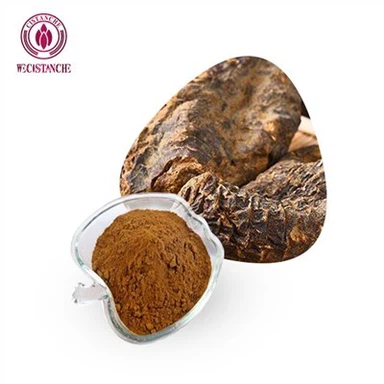
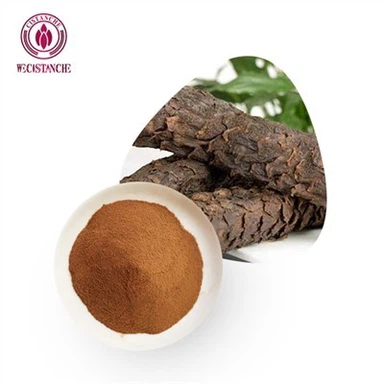
Cistanche tubulosa is mainly produced in southern Xinjiang. It was included in the Chinese Pharmacopoeia in 2005. It has the functions of nourishing kidney yang, nourishing essence, and blood, and has the reputation of "desert ginseng". Modern studies have shown that it has various pharmacological effects such as improving kidney function, anti-aging, anti-fatigue, and regulating immune function [21. The compound preparation of Cistanche tubulosa mainly uses Cistanche tubulosa as the main raw material. Each gram of the preparation contains the original medicinal material of Cistanche tubulosa 2.49. The main components are phenethyl alcohol glycosides, and contains echinacea and ergot glycosides. Detection index A H. In this experiment, mice were intragastrically administered with different doses of Cistanche tubulosa compound preparations, and the effects of compound cistanche cistanche compound preparations on the anti-fatigue effect were studied through the weight-bearing swimming experiment and the determination of biochemical indicators in mice.
1. Materials and reagents
1.1 Sample
The compound preparation of Cistanche cistanche was provided by the Xinjiang Uygur Autonomous Region Institute of Traditional Chinese Medicine and Ethnic Medicine. The recommended oral dose for humans is 2g per day, calculated based on a 60kg body weight per person, equivalent to a dose of 0.033 3g/ks·bw.
1.2. Laboratory animals and grouping
There are 160 SPF-grade Kunming male mice weighing 18-22g, provided by Dongchuang Experimental Animal Science and Technology Service Department, Kaifu District, Changsha City. The experimental animal production license number is scxx (Xiang) 2009—0012, and the feed is provided by the same unit supply. The animals were divided into 4 groups, I, II, III, and IV, each with 40 animals, and the weight-bearing swimming experiment, serotonin, blood lactic acid and liver glycogen were measured. Each large group was randomly divided into a control group and a low, medium, and high dose group, with 10 mice in each group.
1.3. Dose selection and sample processing
According to the recommended oral dosage of the human body, the low, medium, and high dosages of Cistanche cistanche compound preparations are respectively 0.17g/kg·bw, 0.33g/kg·bw, and 1.00g/kg·bw (respectively equivalent to the recommended human dosage 5, l0, 30 times). In the experiment, 1.70g, 3.33g, and 10.00g of Cistanche cistanche compound preparations were added to 200mL with distilled water, and the mice were gavaged at a volume of 0.2mL/10g·bw, once a day, continuously. 30 days. The control group was given an equal volume of distilled water by gavage.
1.4. Main instruments and reagents
Electronic balance, centrifuge, cell disruptor, oscillator, OLYMPUS AU400 automatic biochemical analyzer, SBA40C biosensing analyzer, 722 spectrophotometers, swimming box (about 53cmx40cmx35cm), lead skin, timer, hemoglobin pipette, Sampler, suction
Measuring tubes, test tubes. The serum urea test kit was provided by Shanghai Fosun Long March Medical Science Co., Ltd.; the liver glycogen test kit was provided by the Nanjing Jiancheng Institute of Bioengineering.

2. Test method
2.1. Weight-bearing swimming experiment
After 30 minutes of the last administration of the test substance to the mice, they were placed in a swimming box to swim with a water depth of about 30 cm and a water temperature of 25°C ± 1.0°C. The root of the rat's tail bears 5% of the bodyweight of the lead skin. The time from the beginning of swimming to the death of the mice was recorded as the weight-bearing swimming time.
2.2. Determination of serum urea
After 30 minutes of the last administration of the test substance to the mice, they swim unloaded for 90 minutes in water at a temperature of 30° C., rest for 60 minutes and then pull out the eyeballs to collect blood. After standing at 40°C for 3 hours, it was separated from 1 L at 2 000 revolutions/min for 15 minutes, and the serum was taken to determine the serum urea with an automatic biochemical analyzer.
2.3. Determination of liver glycogen
30 minutes after the last administration of the test substance to the mice, the animals were sacrificed. The liver was rinsed with normal saline and blotted dry with filter paper, and 100 mg of the liver was weighed. The rest of the operation was carried out according to the kit instructions for the determination of liver glycogen.

2.4. Determination of blood lactic acid
Thirty minutes after the last administration of the test substance, 20 LTL of blood was collected from the medial canthal venous plexus, and then the temperature was 30 without weight. C swimming in the water for 10 minutes) the tongue stopped, and 20 L of blood was collected at 0 rain and 20 min after exercise, the blood lactic acid was measured, and the area under the blood lactic acid curve was calculated.
2.5. Experimental data processing
Use Spell. 0 software for statistical analysis. In the analysis, the data is tested for the homogeneity of variance. If the variances are uniform, a one-way analysis of variance is used for overall comparison, and the difference is found, and then the Dunnett method is used to compare the mean of multiple-dose groups and a control group. If the original data is not uniform, perform appropriate variable conversion on the original data, and use the converted data to perform statistics after the variance homogeneity test is satisfied; if the variable does not achieve the uniform variance goal after the variable conversion, use the rank-sum test to perform statistics and find the overall comparison If there is a difference, the uniformity of variance is not required Tamhane’8, T2 test for pairwise comparison.
3. Discussion:
According to the "Technical Specification for Health Food Inspection and Evaluation", the result of the load-bearing swimming test is positive, and any two of the three biochemical indicators of blood lactic acid, serum urea, and liver glycogen are positive, it can prove that the test substance has an anti-fatigue function.
Under the conditions of this laboratory, mice were given 0.17g/kg·bw,0.33g·bw, 1.00g/g·bw of the compound Cistanche tubulosa preparation for 30 days, 1.00g/g·bw dosage can significantly extend the weight-bearing swimming time of mice, increase mouse liver glycogen reserves, and reduce The serum urea level of mice after exercise was significantly different from that of the control group (P≥0.05). Each dose had no significant effect on mouse body weight and area under the blood lactic acid curve (P≥0.05). It is suggested that the compound preparation of Cistanche Tubulosa has an anti-fatigue function.

References:
1. National Pharmacopoeia Committee. Chinese Pharmacopoeia (Part One) [s]. Beijing: Chemical Industry Press.
2. Tang Xiaolei, Sun Pingfei. Research Progress of Cistanche Tubula Tianzhong Medicine Herald, 2009, 15
3. Wang Guoping, Qing Degang. Kath Suleiman, etc. Cistanche pine cones from different origins in southern Xinjiang
Determination of the content of Chrysanthemum Yin. Xinjiang Traditional Chinese Medicine, 2007, 25(4): 85-86.
4. Ma Chunmei, Ni Hui, Qing Degang, etc. Extraction and Purification of Echinacea from Cistanche TubulosaTalk. Xinjiang Traditional Chinese Medicine, 2009, 27(1): 45-47.
5. He Shilin, Wang Jian. Wang Jingjing. Chinese medicine research design and statistics overview]. Changsha: Hunan BranchScience Technology Press, 2003: 316-353.
6. The Ministry of Health of the People's Republic of China. Technical specifications for health food inspection and evaluation.