The Active Components And Antioxidant Activity Of Fresh-cut Cistanchedeserticola Y. C. Ma By Modified Atmosphere Microporous Membrane Packaging②
Dec 16, 2022
2 Results and discussion
2.1 Effects of different treatments on O2, CO2 volume fraction, PPO activity and browning degree
O2 and CO2 concentrations are key parameters in controlled atmosphere storage. It can be seen from Figure 1A and B that the O2 concentration in the CK group showed a gradual downward trend, while the CO2 concentration showed a gradual upward trend. This was due to the poor air permeability of the CK group, and the gas in the package changed rapidly under the respiration of fresh-cut Cistanche, and the O2 concentration was the lowest on the 7th day of storage. On the 4th day, the O2 concentration in the M2 group increased slowly and tended to be flat. On the 6th day, the O2 concentration in the M1 group increased slowly and tended to be flat. It may be due to the higher oxygen permeability of the M2 group than that of the M1 group, and faster dynamic equilibrium [19]. PPO is the main cause of enzymatic browning of fruits and vegetables. It can be seen from Figure 1C that the PPO activity showed a trend of first increasing and then decreasing during storage, and the increase of PPO activity in the early storage period may be due to the injury stress of Cistanche deserticola during the fresh cutting process[20]. During the 1st to 5th day of storage, its activity decreased slowly. On the 7th day, the PPO activity of M1 treatment was 6.76% and 5.01% lower than that of CK and M2 treatments, respectively, indicating that M1 treatment could effectively inhibit the increase of PPO activity and reduce the binding ability to phenolic substances. Browning is one of the key factors affecting the commodity value of fresh-cut Cistanche.

Fig.1 Effects of different treatments on volume fraction ofO2(A)、CO2(B)、PPO activity(C)andbrowning degree (D)of fresh-cut C.deserticola
It can be seen from Figure 1D that the browning degree of fresh-cut Cistanche deserticola in different treatment groups showed an increasing trend during storage. At the end of storage, the M1 and M2 treatment groups were 6.56% and 18.03% lower than the CK group, respectively, and the browning degree of the M2 treatment group was the lowest at 0.51 OD410/g. This may be due to the strong respiration and high PPO activity of fresh-cut Cistanche in the early storage period, and the combination of browning-related enzymes and phenolic substances, resulting in browning. With the exchange of gas, M1, M2

ASK FOR MORE DETAILS:
wallence.suen@wecistanche.com
The treatment group achieved a dynamic equilibrium microenvironment, inhibited the respiratory intensity of fresh-cut Cistanche, slowed down the physiological metabolic rate, and reduced the degree of membrane lipid peroxidation[21-23]. With the gradual decrease of PPO activity, the production of brown polymers was reduced. , thereby inhibiting its browning degree. The air permeability of CK group is poor, anaerobic respiration is easy to occur, and microorganisms are easy to be produced during storage, so the degree of browning is higher than that of M1 and M2 treatment groups, which affects the sensory quality of fresh-cut Cistanche.

Fig.2 Effects of differenttreatments on Vc content (A)、total phenol content (B) and flavonoid content (C) of fresh-cut C.deserticola
Vc is an important nutrient component in fruits and vegetables, and one of the important indicators affecting the storage quality of fruits and vegetables, and plays an antioxidant role in fruits and vegetables. As shown in Figure 2A, during the entire storage period, the Vc content in the different treatment groups showed a gradually decreasing trend. Among them, the M1 treatment group Vc
The content of Vc in the M2 and CK treatment groups was always higher than that of the M2 and CK treatment groups (P<0.05). At the 7th day of storage, the Vc contents of the M1, M2 and CK treatment groups were 1.74%, 1.62% and 1.54%, respectively, and the M1 treatment groups were M2 and CK respectively. 1.07 times and 1.13 times of the treatment group. It may be that fresh-cut Cistanche is affected by mechanical damage and physiological metabolic activities, which accelerates the consumption and oxidation process of Vc in tissues, resulting in a decrease in Vc content [24]. After the microporous membrane modified atmosphere packaging treatment, the gas in the packaging box quickly reached a dynamic equilibrium state through microporous exchange, which inhibited the physiological metabolic rate of fresh-cut Cistanche deserticola, thereby slowing down the oxidative decomposition of Vc. It shows that M1 treatment can effectively slow down the decrease of Vc content in fresh-cut Cistanche deserticola, and maintain its antioxidant activity better. Reche[25] found that by delaying the decrease of O2 and the increase of CO2 in the packaging, the consumption of nutrients can be reduced, thereby reducing the decline of Vc and total phenolic content of jujube fruit during the cold storage process, and delaying fruit ripening and senescence.

Phenolic substances widely exist in plants and play an important role in the process of plant antioxidant. As shown in Figure 2B, the total phenolic content in different treatments showed a trend of first increasing and then decreasing. On the 5th day of storage, the total phenolic content of different treatment groups reached the peak value, and the total phenolic content of M1 treatment group was 1.5% in M2 and CK treatment groups respectively. 1.38 times and 1.11 times of . This may be due to the destruction of the compartmentalized structure of the cells during the fresh-cut process, resulting in an increase in the content of phenolic substances [26]. In the later stage of storage, the aging process of fresh-cut Cistanche was intensified, and the total phenolic content gradually decreased. Among them, the concentration of O2 in the M1 and M2 packages increased, and the oxidation of phenolic substances accelerated. Compared with the M1 treatment, the air permeability of M2 was better, and the oxidation rate of phenolic substances was faster. At the end of storage, the total phenolic content in the M1 treatment group was still the highest. It indicated that the M1 treatment could better maintain the total phenolic content in fresh-cut Cistanche deserticola.
Vc, total phenols and flavonoids are natural antioxidants in fruits and vegetables, which can maintain the antioxidant capacity of the system. As shown in Figure 2C, during storage, the flavonoid content in different treatment groups first increased and then decreased.
The peak value appeared at , and the flavonoid content in the M1 treatment group was the highest during storage. On the 7th day of storage, the flavonoid contents in the M2 and CK treatment groups were 41.41% and 10.10% lower than those in the M1 treatment group, respectively. It shows that M1 treatment can effectively slow down the decline of flavonoid content.
2.3 The effect of different treatments on the total polysaccharide content
Plant polysaccharides have the function of inhibiting free radicals or scavenging free radicals, and are one of the important active ingredients in plants. As shown in Figure 3, during the storage period, the total polysaccharide content of fresh-cut Cistanche deserticola in different treatment groups showed a gradual decline trend, and the CK group decreased the fastest. This may be due to the accelerated consumption of nutrients and substrate organic acids after the fresh-cut treatment of Cistanche deserticola, and the degradation of polysaccharides into monosaccharides [27], resulting in a decrease in the total polysaccharide content. M1 treatment can effectively inhibit the physiological metabolism of fresh-cut Cistanche deserticola and slow down the degradation of total polysaccharides. On the 7th day of storage, the total polysaccharide content of fresh-cut Cistanche in the M1 treatment group was 25.66 mg DE/g DW, which was 6.43% higher than that in the M2 (24.11 mg DE/g DW) and CK (22.42 mg DE/gDW) treatment groups , 14.45%. It indicated that M1 treatment could effectively reduce the loss of total polysaccharide content in fresh-cut Cistanche deserticola.
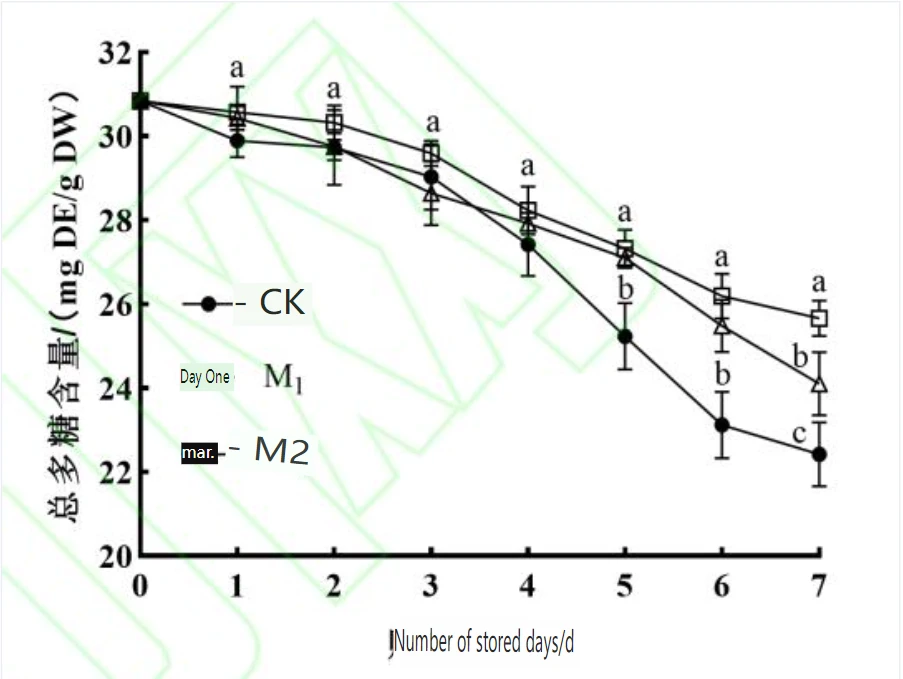
Fig.3 Effects of different treatments on polysaccharide contentof fresh-cut C.deserticola
2.4 Effects of different treatments on the contents of echinacoside and verbascoside

Figure 4A is the standard chromatogram, and Figure 4B is the sample chromatogram; Table 1 shows the corresponding validation parameters for echinacoside and verbascoside. The calibration curve has a good linear regression in the range (R
2=0.9 993-0.9998), therefore, the established method can quantitatively determine the contents of echinacoside and verbascoside in Cistanche sample powder simultaneously. Echinacoside and verbascoside are the main functional components in Cistanche deserticola, which belong to phenylethanol glycosides and have antioxidant effects [28]. It can be seen from Figure 5A and B that the contents of echinacoside and verbascoside in different treatment groups showed a gradual downward trend, and the downward trend was not significant. During the whole storage period, the content of echinacoside and verbascoside in M1 treatment group was always higher than that in CK group. On the 7th day of storage, the content of echinacoside in fresh-cut Cistanche in the M1 treatment group was 5.92 mg/g, which was 1.01% and 1.20% higher than that in the M2 and CK treatment groups, respectively, and the content of verbascoside was 2.04 mg/g , which were 0.49% and 1.47% higher than the M2 and CK treatment groups, respectively. This may be because Cistanche deserticola plants contain enzymes related to the hydrolysis of phenylethanol glycosides, and phenylethanol glycosides will be hydrolyzed into small molecular substances with the increase of storage time, resulting in a decrease in their content[29,30] and affecting the function of Cistanche deserticola sex. In this experiment, fresh-cut Cistanche deserticola was placed in an environment of 4 °C, and the low temperature inhibited the activity of hydrolase related to phenylethanol glycosides, thereby reducing the degree of hydrolysis of phenylethanol glycosides [31] and better maintaining their content. At the same time, M1 treatment can make the gas in the packaging box reach a dynamic balance, inhibit the respiration of fresh-cut Cistanche, and slow down life activities, and the gas is exchanged through micropores to prevent anaerobic respiration, thereby slowing down the pH value of fresh-cut Cistanche. Effectively maintain the stability of phenylethanol glycosides [32]. The results showed that M1 treatment could effectively maintain the content of echinacoside and verbascoside in fresh-cut Cistanche deserticola, maintain its functional components, and improve its medicinal value.

A standard

B standard
Table 1 HPLC method was used to determine the validation parameters of mulin and echinoside in fresh-cut C.deserticola

polysaccharide
Fig.5 Effects of different treatments on the contents of echinoside (A) and calycoside (B) in fresh-cutC.deserticola
2.5 Effect of different treatments on antioxidant properties
DPPH, ABTS+ radical scavenging ability and FRAP reduction ability are important indicators of the antioxidant capacity of fruits and vegetables, and higher radical scavenging rate indicates stronger antioxidant capacity. As shown in Figure 6A and B, with the increase of storage time, the scavenging rate of DPPH and ABTS+ radicals in different treatment groups showed a trend of increasing and then decreasing, which was consistent with the changes of total phenolic content and flavonoid content, indicating that the scavenging rate of DPPH and ABTS+ radicals were closely related to total phenols and flavonoids. The DPPH radical scavenging rate of different treatment groups reached the peak at the 5th d of storage, among which the DPPH radical scavenging rate of M1 treatment group was 92.38%, while the DPPH radical scavenging rate of M2 and CK treatment groups were 79.05% and 88.25%, respectively. This indicates that M1 treatment affected the scavenging rate of DPPH radicals to different degrees and had the best effect. The trend of ABTS+ radical scavenging rate during storage was similar to that of DPPH radical scavenging rate, with a peak of 90.26% at d 5 in the M1 treatment group and 2.28% and 1.70% lower than M1 treatment at d 4 in the M2 and CK treatment groups, respectively (P<0.05 for significant difference). It showed that M1 treatment had a significant effect on the scavenging rate of ABTS+ free radicals in fresh-cut Cistanche, which could delay the oxidative aging of fresh-cut Cistanche.

The higher FRAP content indicated the stronger antioxidant capacity of fruits and vegetables. As shown in Figure 6C, FRAP in fresh-cut cistanches showed an overall decreasing trend, which was consistent with the trend of Vc content and total content, indicating that FRAP reducing ability was closely related to Vc content and total polysaccharide content in fresh-cut cistanches. The FRAP in the M1 treatment group was 0.78 mmol/L by the 7th d of storage, which was 4.00% and 11.43% higher than that in the M2 and CK treatment groups, respectively. The results showed that M1 treatment was the most effective and could better improve the antioxidant properties of fresh-cut Cistanche. In addition, aeration packaging can regulate antioxidant-related enzyme activities, enhance the antioxidant capacity of fruits, and reduce the degree of oxidative stress, thus delaying the decline in quality [33]. It has been shown that the phenolic and flavonoid contents of various fruits are closely related to their own antioxidant properties [34-36]. The present experimental study showed that M1 treatment better maintained the active ingredients of fresh-cut Cistanche, enhanced the antioxidant properties of fresh-cut Cistanche, effectively delayed tissue aging, protected cells from microbial infestation, and thus improved its resilience and better maintained the quality of fresh-cut Cistanche.

3 Conclusion
Active modified atmosphere treatment (6% CO2 + 4% O2 + 90% N2) combined with different packaging materials was studied on fresh-cut Cistanche M1 treatment can significantly inhibit the increase of PPO activity and browning degree in fresh-cut Cistanche, slow down the increase of Vc, total Decreased contents of phenols, flavonoids, total polysaccharides, echinacoside and verbascoside kept DPPH, ABTS+ free radical scavenging rate and FRAP reducing ability at high levels. 6% CO2+4% O2+90% N2+M1 treatment improved the antioxidant capacity of fresh-cut Cistanche, slowed down browning and aging, and maintained the quality of fresh-cut Cistanche. Theoretical basis.