The Anti-tumor Effect Of Phenylethanol Glycosides From Cistanche Deserticola
Aug 25, 2023
Summary
Malignant tumors have always been recognized as a major public health problem endangering human health worldwide. With the acceleration of the aging process of society and the impact of some other factors, the incidence rate of various malignant tumors has shown an upward trend, and most tumors have entered a late stage when they were found, with rapid disease progression and poor prognosis. Although new therapies for cancer treatment have emerged in recent years with significant therapeutic effects, there are still serious adverse reactions and some patients are ineffective. Therefore, exploring and developing new drug candidate compounds with strong anti-tumor effects, low adverse reactions, and low resistance, especially bioactive molecules derived from Chinese herbal medicine, has great clinical practical significance. Cistanche depraved phenylethanol glycosides (CPhGs) are a class of active ingredients contained in the traditional Chinese medicine material Cistanche deserticola. Studies have shown that they have various biological functions such as anti-tumor, immune regulation, and antioxidant activity, demonstrating good application prospects. This article briefly summarizes the anti-tumor effects and mechanisms of phenylethanolamine glycosides from Cistanche deserticola, as well as the current scientific understanding, in order to provide a reference for further research and clinical application of Cistanche deserticola and its phenylethanolamine glycoside extracts.
Keywords
Cistanche deserticola; Cistanche deserticola phenylethanoid glycoside; Tumor; Cell proliferation and apoptosis
The incidence rate of malignant tumors is rising all over the world, and it is increasingly important to explore effective treatment schemes and new drug development from multiple directions and angles. Small molecule compounds derived from plants, especially traditional Chinese medicine, have a broad candidate base and application prospects in the development of new anti-tumor drugs. Cistanche deserticola is a traditional Chinese medicinal herb with a long history. It has traditionally been used as a tonifying ingredient in traditional Chinese medicine formulas and is known as the "desert ginseng". It is widely used in clinical practice, with good effects and high safety. Modern pharmacological research has found that one of the main active components of Cistanche deserticola, Cistanche phenylethanoid glycosides (CPhGs), can enhance immunity and anti-tumor effects by affecting multiple cell signal transduction pathways and regulating gene expression. Its mode of action is the time-dependent killing of tumor cells or inhibiting tumor proliferation, invasion, and metastasis, which has good clinical application prospects. This article summarizes the anti-tumor effects and mechanisms of CPhGs, in order to provide a reference for the application of Cistanche deserticola, a traditional Chinese medicine, and its extract of CPhGs in tumor treatment.
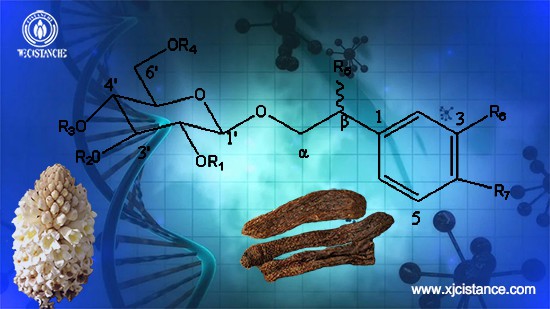
Phenylethanol glycoside is the main active component of Cistanche deserticola
Click here to view Cistanche products
【Ask for more】 Email: xue122522@foxmail.com / Whats App: 0086 18599088692 / Wechat: 18599088692
1 Overview of CPhGs
Since the 1970s, domestic and foreign scholars have begun to systematically study the chemical composition and activity of the genus Cistanche. Up to now, nearly a hundred chemical components and trace elements have been isolated and identified from Cistanche deserticola. Among them, phenylethanol glycosides have the highest content and are one of the main active components of Cistanche plants. They are also the indicator components for identification and content determination under the national regulation of "Cistanche deserticola". After unremitting in-depth research by the Tu Pengfei team at Peking University, nearly 40 types of phenylethanol glycosides have been clearly isolated and identified to date. In addition, phenylethanol total glycosides derived from Cistanche deserticola have been developed, mainly composed of echinaside and piloside.

Main chemical constituents of Cistanche tubulosa—Echinacoside

Main chemical constituents of Cistanche tubulosa—Acteoside
Phenylethanol glycosides (PHGs) are a type of glycoside compound formed by the combination of phenylethanol aglycones and sugar groups. Most of the phenylethanoid glycosides in Cistanche deserticola have a general formula structure, and their constituent sugars are mainly glucose and rhamnose; The central sugar directly connected to the aglycone is glucose; Except for aminoglycosides, all 3 positions of central glucose are linked to rhamnose; The second glucose in the triglycoside is often connected to the 6th position of the central glucose; At positions 4 or 6 of central glucose, it often forms esters with phenylacryloyl groups such as caffeioyl, ferulic, or coumarinyl.
Many research results have shown that the phenylethanol glycosides of Cistanche deserticola act on the cellular level of the body, mainly through regulating relevant cellular mechanisms. At present, many scholars mainly control the content of phenylethanol glycosides in Cistanche deserticola through UV spectrophotometry and high-performance liquid chromatography. The main indicator components are echinaside, anthocyanin A, piloside, and isopiloside. The main effective components of Cistanche deserticola extract are phenylethanoside, piloside, and echinaside.
2 CPhGs and Malignant Tumors

Superman cistanche herb-Antitumor
2.1 Liver cancer
2.2 Lung cancer
2.3 Colorectal cancer
2.4 breast cancer
2.5 Ovarian cancer
2.6 Prostate cancer
2.7 pancreatic cancer
3 Outlook

Desert ginseng-Antitumor
The above research indicates that CPhGs can achieve effects such as inhibiting proliferation and migration, inducing apoptosis, promoting immune function, and inhibiting angiogenesis in various types of tumor cells by influencing various cell signaling pathways. Overall, CPhGs, as effective active ingredients of traditional Chinese medicine Cistanche deserticola, are increasingly recognized for their anti-tumor pharmacological effects, and their anti-tumor mechanisms are gradually becoming clear. They are expected to be developed as new anti-tumor drugs. It is worth mentioning that there is still limited research on the role of CPhGs in lymphoma, and our team's latest research has found that they can simultaneously induce apoptosis and pyroptosis in lymphoma cells, and affect multiple signaling pathways (unpublished data), indicating that the potential therapeutic role of CPhGs in various diseases deserves further in-depth research.

Effects of Cistanche-Antitumor