The Common Complications And Immunosuppression After Kidney Transplant
Mar 15, 2022
Contact: Audrey Hu Whatsapp/hp: 0086 13880143964 Email: audrey.hu@wecistanche.com
PART Ⅰ:Posttransplant Diabetes Mellitus and Immunosuppression Selection in Older and Obese Kidney Recipients
David A & Axelrod, et al.
Introduction
Posttransplant diabetes mellitus (DM)is a serious and common complication following a solid organ transplant, generally occurring within the first 2-3 years after transplant.1-6 Despite efforts to prevent posttransplant DM, it occurs in as many as 10%-20% of nondiabetic kidney transplant recipients and is associated with premature cardiovascular disease, graft loss, and mortality.2,7-17 Previous studies have identified risk factors for posttransplant DM, including obesity, metabolic syndrome, cytomegalovirus infection, hepatitis C viremia, and calcineurin inhibitor (CNI) therapy, especially tacrolimus.4,18-26 In addition, older age is a strong and consistent risk factor for posttransplant DM among kid-ney transplant recipients and has been associated with greater posttransplant morbidity.1.8,14,18,27-29 The median age at the time of kidney transplant has consistently increased worldwide, driven by population aging and increasing acceptance of older(aged ≥55 years) kidney transplant candidates for waitlisting and transplant.30-34 Kidney transplant recipients have been shown to have a 1.5-fold higher risk per decade of the age of developing post-transplant DM. 18,35

Cistanche improves kidney function
Immunosuppression selection has been identified as a potentially modifiable risk factor for developing post-transplant DM.36 Although tacrolimus and sirolimus have been associated with increased risks of posttransplant DM, data on steroid avoidance/withdrawal as a strategy to decrease post-transplant DM risk are conflicting.22-26,37-43 Because the use of regimens that reduced the risk of posttransplant DM [cyclosporine (CSA)-based regimens or steroid avoidance] have historically been associated with an increased risk of rejection, recommendations published in 2014 following an international consensus meeting on posttransplant DM suggested that the immunosuppression regimens should fully optimize patient and allograft survival without concern for enhancing the risk of posttransplant DM.5,44 Similar recommendations were issued by the British Clinical Diabetologists and Renal Association and American Diabetes Association in 2021.5,44,45 These guidelines drew on data mainly from the CsA era, often without effective induction therapy.22-26,37-43 In contrast, transplantation guidelines now recommend that tacrolimus and mycophenolate mofetil be used as first-line maintenance immunosuppression agents with appropriate induction medications, mitigating the risk of rejection associated with steroid avoidance.46,47
Previous studies evaluating the risk of posttransplant DM have not assessed the benefits of alternative immunosuppression strategies, such as steroid avoidance/withdrawal, to reduce the risk of posttransplant DM among older and obese recipients, who are more at risk of metabolic complications.41-43 Older kidney transplant recipients tend to have a lower acute rejection risk due to immunosenescence reducing the risk of rejection and, potentially, the need for long-term triple therapy.48,49 Recent evidence from our team suggests that lower-intensity immunosuppression regimens (eg, steroid-sparing regimens) appear beneficial in older kidney transplant recipients, reducing post-transplant death and graft loss.50 Similarly, obese patients have more than a 2-fold increase in the incidence of posttransplant DM compared with nonobese patients; however, they have an increased risk of rejection.18 In this study, we examined the impact of immunosuppression selection on the development of posttransplant DM in a contemporary national sample of kidney transplant recipients. We specifically considered the risk of posttransplant DM among both older and obese kidney transplant recipients using a linkage of national clinical registry data and Medicare billing claims.

kidney failure: kidney transplant
METHODS
Data Source and Sampling
Study data were drawn from US Renal Data System records, which integrate Organ Procurement and Transplantation Network (OPTN)/United Network for Organ Sharing records with Medicare billing claims. The study identified kidney-only transplant recipients aged ≥18 years from 2005 to 2016 in the United States. Younger and older adults were defined as ages 18-54 years and ≥55 years, respectively. Patients were selected for inclusion if they had Medicare as the primary payer at the time of transplant and had Medicare-reimbursed prescriptions and fills for immunosuppressive medications in the first 3 months after transplant. We excluded patients with documentation of diabetes in the OPTN transplant candidate or recipient registration forms. The cohort included patients with Medicare primary insurance and without pretransplant diabetes (based on OPTN registration information or Medicare claims for diabetes within 1 year before transplant). This study was deemed to be human subjects exempt by the Saint Louis University Institutional Review Board.
Definition of Immunosuppression Regimens
We determined the use of induction agents based on center-reported data from the OPTN. We determined the early immunosuppression regimen based on Medicare pharmacy claims for immunosuppression agents submitted within the first 3 months after transplant and reimbursed through Part B or Part D benefits. We categorized patients based on induction and maintenance immunosuppression regimens into 7 study regimens, as follows:
(1) Triple maintenance (tacrolimus + mycophenolic acid/ azathioprine + prednisone), after T-cell–depleting induction: anti-thymocyte globulin (TMG) or alemtuzumab (ALEM) (reference)
(2) Triple maintenance after IL-2 receptor antibody (IL2rAb): IL2rAb + triple therapy
(3) Steroid avoidance/withdrawal after T-cell–depleting induction: TMG/ALEM + no prednisone
(4) Steroid avoidance after IL-2rAb induction: IL2rAb + no prednisone
(5) Antimetabolite avoidance: tacrolimus alone or tacrolimus + prednisone with any induction
(6) Mammalian target of rapamycin inhibitor (mTOR)– based regimens
(7) CsA-based regimens

cistanche benefit
Outcome Measures
The outcome of interest was posttransplant DM >3 months-to-1 year after transplant. We ascertained the diagnosis of DM from Medicare claims using International Classification of Diseases, Ninth Revision, Clinical Modification (through September 2015) and International Statistical Classification of Diseases and Related Health Problems, Tenth Revision (starting October 2015) diagnosis codes on billing claims (codes 250. x and E08-E13, respectively) that occurred or persisted beyond 3 months after transplant.
Statistical Analysis
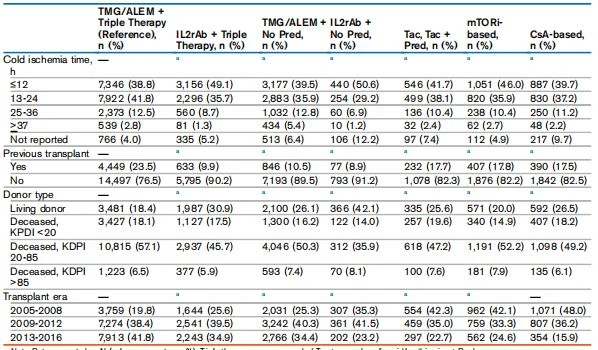
Clinical characteristics of the study sample were described as proportions. We grouped continuous variables into clinically relevant categories. We classified the missing data in the registry as “not reported” and included this indicator in the regression analyses, as per previous methods.51-55 For each variable, the proportion of data that was not reported is summarized in Table 1. We compared distributions of clinical characteristics according to the immunosuppression regimen using the χ2 test.
Table 1. Distributions Early Immunosuppression Regimen Use According to Baseline Kidney Transplant Recipient Traits, Donor Type, and Transplant Factors

We modeled the association between immunosuppression selection and the development of posttransplant DM using a Cox proportional hazard frailty model, allowing for clustering by transplant center and permitting the correlation between failures within the same transplant center, with origin time for models at 3 months after transplant (after the period of immunosuppression classification). The DM incidence >3 months-to-1 year post-transplant associated with each regimen was compared with the reference regimen of TMG/ALEM + triple therapy. We adjusted the model for potentially confounding differences in the distribution of clinical characteristics using inverse probability of treatment weighting, as per previous methods.56,57 The inverse probability of treatment weighting uses propensity weights to create analytic samples that are more similar and allow a better estimation of the independent impact of immunosuppression selection on the development of posttransplant DM. To construct the weights, we modeled the probability of developing post-transplant DM, comparing each immunosuppression regimen with the reference regimen (TMG/ALEM + triple therapy), given the patient’s age, sex, race, number of human leukocyte antigen mismatches, panel reactive antibody, hepatitis C virus status, donor age, donor type (living or deceased), expanded criteria donor, and donation after cardiac death. Weights were stabilized; a robust sandwich estimator was used to prevent the underestimation of the variance. Good balance was achieved on all confounders (standardized absolute mean difference: <0.2 for all covariates and <0.1 overall for all models). Patients with death or graft failure were censored at the time of these events. All other patients were followed to the first post-transplant anniversary or loss of Medicare coverage. Given the known association of recipient body mass index (BMI) and age with the development of diabetes, we performed a prespecified subgroup analysis based on age (<55 years vs ≥55 years) and obesity (BMI < 30 kg/m2 vs BMI ≥ 30 kg/m2 ) and investigated the potential interaction of immunosuppression with age and obesity on the risk of posttransplant DM. A P value of <0.05 was considered statistically significant. The data management and analysis were performed using SAS version 9.4 (SAS Institute Inc).

CLICK HERE TO PART Ⅱ