The Effectiveness Of Mobility Restrictions On Controlling The Spread Of COVID-19 in A Resistant Population Part 1
May 31, 2023
Abstract:
Human mobility plays an important role in the spread of COVID-19. Given this knowledge, countries implemented mobility-restricting policies. Concomitantly, as the pandemic progressed, population resistance to the virus increased via natural immunity and vaccination. We address the question: “What is the impact of mobility-restricting measures on a resistant population?” We consider two factors: different types of points of interest (POIs)—including transit stations, groceries and pharmacies, retail and recreation, workplaces, and parks—and the emergence of the Delta variant.
We studied a group of 14 countries and estimated COVID-19 transmission based on the type of POI, the fraction of population resistance, and the presence of the Delta variant using a Pearson correlation between mobility and the growth rate of cases. We find that retail and recreation venues, transit stations, and workplaces are the POIs that benefit the most from mobility restrictions, mainly if the fraction of the population with resistance is below 25–30%. Groceries and pharmacies may benefit from mobility restrictions when the population resistance fraction is low, whereas, in parks, there is little advantage to mobility-restricting measures. These results are consistent for both the original strain and the Delta variant; Omicron data were not included in this work.
The Delta variant is a mutant strain of the new coronavirus that is more contagious and pathogenic than other variants. For immunity, the Delta variant may have a certain impact on the immunity of some people.
For people who have already been vaccinated, the vaccine increases their resistance to the Delta variant. However, for some people, the protective effect of the vaccine may be weakened, such as those who develop low levels of antibodies after vaccination, or those who are still exposed to high-risk places after vaccination.
In addition, the Delta variant may pose a greater threat to people with weakened immunity, such as the elderly, immunocompromised patients, and patients with chronic diseases. Therefore, maintaining a good immune status, especially after vaccination, continuing to take epidemic prevention measures, such as wearing masks, washing hands frequently, and minimizing crowd gatherings, etc., is of great significance to prevent the spread of Delta variants. Therefore, we need to understand the importance of immunity. Cistanche can significantly improve immunity because meat ash contains a variety of biologically active components, such as polysaccharides, two mushrooms, and Huang Li, which can stimulate the immune system. Various types of cells, increase their immune activity.

Click cistanche tubulosa benefits
Keywords:
COVID-19; Delta-variant; a fraction of resistance; human mobility; pandemic; Pearson correlation method.
1. Introduction
In December 2019, a new coronavirus (COVID-19) was discovered in Wuhan, China. Subsequently, it rapidly spread throughout the world, leading to 6.4 million deaths worldwide as of August 2022 and precipitating a global pandemic [1,2]. It has now been established that COVID-19 is primarily transmitted through in-person interactions between people. Therefore, human behavior and human mobility play an important role in determining how the virus spreads [3,4]. In the absence of vaccination, non-pharmaceutical interventions (NPIs) have been applied by many countries to control the spread of the disease. One widely adopted NPI was human mobility reduction [5–7] implemented via the closure of public spaces.
Many excellent studies have been conducted on the effect of human mobility in the evolution of the COVID-19 pandemic. Prior work can be broadly classified into two categories: foundational and policy studies. In many foundational studies, researchers seek to find correlations between mobility and the evolution of the pandemic at country, county, and point of interest (POI) levels. One such study [8] investigated the spatiotemporal association between mobility and infections in US counties. Researchers used mobile device data to capture the mobility flow within and into each county and compared mobility trends with COVID-19 case counts using a dynamic time-warping method.
They found that the relationship between mobility and infection rates varies both geographically and temporally. A similar study [9], used mobile device data to find the association between mobility and case counts for US counties. Their analysis shows a positive relationship between mobility and the number of cases and suggests that this relationship is stronger in partially reopened regions. In [10], the authors assessed the correlation between mobility and the number of new cases in different Portuguese districts. They found that mobility in retail and recreation, grocery and pharmacy, and transport station POIs exhibited a higher correlation with case counts than in parks and workplaces.
Beyond correlation, some studies expanded their analysis to evaluate the causal factors behind increased rates of transmission. For example, Refs. [11,12] analyzed the effect of temperature on the transmission of COVID-19. Researchers in [11] used a directed acyclic graph (DAG), a graphical representation of the causal effects that may lead to newly reported cases of COVID-19 they found an increase in temperature and high mobility (in pharmacies and groceries), leading to lower case counts. On the other hand, high mobility (in retail and recreation POIs), and rainy days, lead to higher case counts.
While in [12], their estimated results showed that mobility habits, along with daily tests and environmental variables, such as temperature, play a role in explaining the rate of COVID-19 cases. In addition, some studies focused on quantifying the time lag between mobility and COVID-19 cases as in [13]. In that study, researchers combined the mobility index of 80 cities in China along with new case counts and used an autoregressive model to estimate the lag. As a result, they found that mobility is strongly correlated with cases with a lag of 10 days.

The second type of studies focused on policymaking, e.g., testing different mobility interventions to find optimal mobility reductions that balance the cost of viral spread with the economic cost associated with lockdowns, as well as implementing prediction models to advise policymakers. Several studies [13–16] sought to understand how the reduction in mobility affects the spread of COVID-19 cases across different POIs. In [13], researchers used Google mobility data and measured a correlation with the effective reproduction rate Rt. That study reveals that staying at home is effective at reducing Rt, time spent at parks has little effect, while reducing mobility in other POIs has larger positive effects. In [15,16], researchers showed that mobility reduction of up to 40% in transit stations and retail and recreation venues decreased the number of cases and appeared to effectively “flatten the curve”.
Furthermore, Refs. [17,18] examined the effect of the reduction of mobility on the number of cases and deaths. In [17], researchers found a consistent pattern of a sharp reduction in deaths after mobility is reduced. Other groups implemented prediction models [19–25] to estimate the effects of mobility reduction and predict the number of cases and deaths. These models were implemented with varying levels of complexity; for instance, [19,20] added additional variables, including (in [19]) meteorological variables, such as temperature, humidity, and rainfall, along with the correlation between mobility and COVID-19 case counts. In [20], the researchers included several factors such as income, health indicators associated with Asthma, percentage of people staying at home, and testing infrastructure.
None of the studies described above accounted for the fraction of the population with resistance. However, as the pandemic progressed, population resistance increased via natural immunity and vaccination. Many studies were conducted to measure the efficacy of vaccines either in terms of impact on transmission or the number of deaths, but the effects of mobility in these studies are typically either neglected (e.g., the studies considered populations of vaccinated and unvaccinated people with similar mobility patterns) or treated as a confounding variable. One such study [26] used a deep learning approach to simulate vaccination rates and time to reach herd immunity based on the data from eight countries in Asia (many subsequent studies have shown that herd immunity is no longer in our grasp), whereas [27,28] evaluated the impact of vaccination in controlling the pandemic (e.g., reducing the number of incidences and deaths) via an agent-based model. Furthermore, Ref. [29] assessed the association between vaccination and death rates in the US using a regression-based approach and as a result, found that vaccination helped in reducing the death rates in different states in the US.
Taking into account the impact of vaccination and mobility on the transmission, Ref. [30] examined the vaccination and mobility behavior in controlling the pandemic using structural equation modeling; they found that vaccination slows down the spread of COVID-19 in regions where the vaccination is negatively correlated with mobility and vice versa for the regions that have a positive correlation between vaccination and mobility.
Although the previous work has investigated the correlation between mobility and the evolution of the pandemic, including the effect of vaccination as in [30], they did not consider the effect of population resistance (both natural immunity and vaccination) on this correlation. Therefore, the focus of our study is to analyze the correlation between mobility and COVID-19 transmission across different points of interest (POIs) while taking into account population resistance (vaccination—natural immunity (% of the population who recovered from COVID-19)) and the emergence of the Delta variant.
To achieve our goal, we will exploit the Our World in Data COVID-19 case count dataset, along with the Google Mobility dataset. We combine these datasets to test the correlation between mobility and the rate of viral spread while accounting for four additional factors: points of interest (POIs)—including retail and recreation venues, transit stations, parks, groceries and pharmacies, and workplaces; the emergence of the Delta variant; the fraction of the population that has been vaccinated; and the fraction of the population with natural resistance (i.e., those that have recovered from a COVID-19 infection). Note that if there is no correlation between mobility and COVID-19 case counts, then mobility-restricting mitigation measures will have little impact on controlling the spread of the virus.
The remainder of this paper is organized as follows. Section 2 introduces an overview of the dataset and data preprocessing. Section 3 shows our methodology. Sections 4 and 5 show the results of our analysis, along with a discussion. Finally, conclusions are drawn in Section 6.

2. Datasets
The first step in the analysis was to collect and preprocess the data; this section provides an overview of the datasets we used for the study and our country selection process. Our data were pulled from the three datasets shown in Table 1 with a selected time frame of Feb 2020–Jul 2021.

2.1. COVID-19 Dataset
Our World in Data [31] is maintained by a non-profit organization that includes thousands of researchers from around the world. One of the richest datasets they collected during the pandemic is the COVID-19 dataset. This dataset captures epidemic measurements daily (e.g., new cases, new deaths, vaccinations, etc.) along with demographics (e.g., median age) and country-related metrics (e.g., human development index). It covers 231 countries and includes 60 variables. The data collection began in Jan 2020, and, to date, the dataset has been updated every day.
2.2. Google Mobility Dataset
Google provides a publicly available mobility dataset related to the pandemic [32], in which it measures daily visitor numbers to specific POIs as a mobility rate (MR). POIs include transit stations, groceries and pharmacies, retail and recreation venues, workplaces, and parks. Their measurement is based on computing the relative change in visitors from a baseline before the pandemic and covers 123 countries. The data collection began in Feb 2020, and it has been updated daily to date.
2.3. COVID-19 Variants
In addition to the COVID-19 dataset described above, Our World in Data shared a COVID-19 variants dataset [33], which is sourced from GISAID [34]. The dataset periodically captures the number of sequenced samples that fall under a specific variant name. It covers 110 countries. Data collection began in May 2020, and, to date, it has been updated every two weeks.

2.4. Country Selection
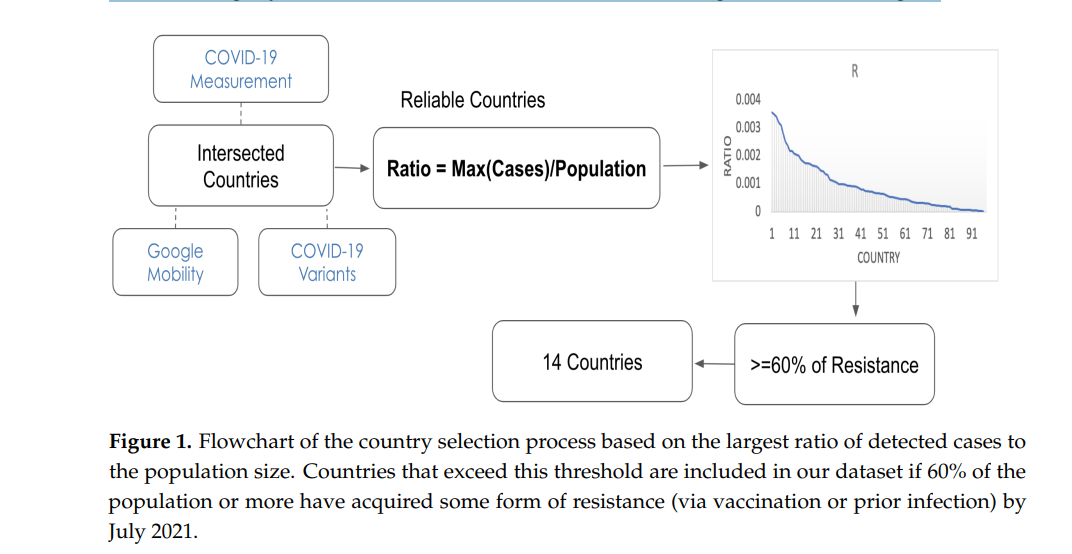
Throughout the pandemic, there have been many inconsistencies and uncertainties surrounding testing and accurately reporting the number of COVID-19 cases in different countries. Given this uncertainty, we endeavored to restrict our study to countries with relatively reliable reported data. Our selection process followed the steps shown in Figure 1. First, we found the intersected countries from the three datasets. Then, to get a rough sense of which countries were detecting a large fraction of cases, we found, for each country, the largest ratio of detected cases (Cnew) to the total population (p):

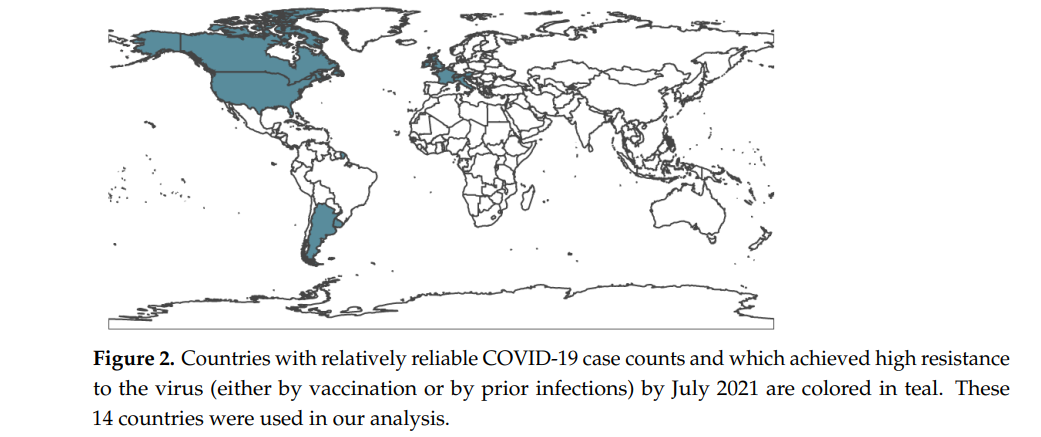
If each country was hit with a wave of cases at some point during the pandemic, the higher this ratio is, the more likely it is that country is reliably detecting and reporting cases; i.e., if a country reports that this ratio is near zero, given the highly transmissible nature of the virus, it is more likely that they are undercounting rather than that they have no COVID-19 cases. There are, of course, exceptions to this; for example, early on in the pandemic, New Zealand enforced draconian measures to prevent the spread and largely kept the virus contained. Countries were then sorted by this ratio, and the highest 50 ratios were selected as regions where COVID-19 is likely to be relatively reliably detected and reported. To focus on the effects of population resistance, out of those 50, we selected the countries that achieved 60% population resistance or more via vaccination or recovery from past infections by July 2021. This left us with our 14 target countries (Argentina, Canada, United States, United Kingdom, Italy, Austria, Ireland, Czech Republic, France, Uruguay, Slovenia, Israel, Switzerland, and Luxembourg), as shown in Figure 2.
For more information:1950477648nn@gmail.com