

The Emerging Scenario Of The Gut–Brain Axis: The Therapeutic Actions Of The New Actor Kefir Against Neurodegenerative Diseases Part 2
May 21, 2024
For decades, we have observed in different models of hypertension that they share a common feature: the imbalance of the autonomic nervous system, mediated by angiotensin II in the nervous areas controlling blood volume by the paraventricular nucleus, subfornical organ, and hypothalamus [47,51,73].
The hypothalamus is an important region of the body that controls many basic physiological functions, including blood pressure, heart rate, hunger and satiety, and more. At the same time, the hypothalamus also plays an important role in human cognition and emotion, affecting human mood and memory.
The hypothalamus is very important in the regulation of blood flow dynamics and circulation. Blood circulation in the body is vital to the functioning of the body, helping it function properly by carrying oxygen and nutrients to every cell in the body. The hypothalamus controls the dilation and contraction of many blood vessels to ensure adequate blood supply to different parts and organs of the body.
In addition, the hypothalamus can influence memory and mood. Research shows that dysfunction of the hypothalamus may lead to cognitive decline, including problems with learning, memory, and attention. By restoring the function of the hypothalamus, people's cognitive and learning abilities can be improved and the healthy development of the brain can be promoted.
Therefore, we should pay attention to maintaining the health of the hypothalamus, including maintaining a good diet and living habits and avoiding negative emotions such as excessive stress and anxiety. At the same time, maintaining a positive attitude, exercising, and improving one's cognitive abilities can enhance the function of the hypothalamus and promote physical and mental health. It can be seen that we need to improve memory, and Cistanche deserticola can significantly improve memory, because Cistanche deserticola can also regulate the balance of neurotransmitters, such as increasing the levels of acetylcholine and growth factors. These substances are very important for memory and learning. In addition, Cistanche deserticola can also improve blood flow and promote oxygen delivery, which can ensure that the brain receives sufficient nutrients and energy, thereby improving brain vitality and endurance.

Click know supplements to improve memory
Based on the above discussion, we can speculate that ND and cardiovascular diseases are linked to the microbiota-gut-brain axis, which can be the result of a malfunction of the vagal afferents and references.
Using classical pharmacological approaches [73,81], our laboratory has demonstrated in renovascular hypertension, SHR, and even in the model of hypertension induced by the blockade of nitric oxide that the sympathetic nervous system is the main cause of sustained hypertension [82].

In 2015, two different research groups observed a possible link between gut dysbiosis and hypertension [83–85]. In subsequent years, several groups (including ourselves) have been deeply dedicated to the elucidation of this issue of how communication between gut microbiota and the sympathetic nervous system occurs.
Klippel and collaborators [64] have provided new insights into the neural control of blood pressure and cardiac rhythm. They demonstrated that the cardiac vagal tonic control that characterizes Wistar-Kyoto (WKY) rats (the control of SHR) is overridden by sympathetic activity. Therefore, hypertensive individuals appear to share the same neural disturbances that trigger augmented vascular resistance and increased cardiac blood pumping to the aorta.
The authors also used classical pharmacological approaches to investigate in the SHR a contribution of a possible beneficial effect of kefir on the brain-mediated reflex control of blood pressure.
They found impaired vagal and sympathetic reflex control (baroreflex), which was significantly attenuated by treating the animals with the probiotic kefir for 60 days [64]. These results were also confirmed by spectral analysis of direct blood pressure recordings. Supporting our finding in the SHR, Toral, et al. [71] demonstrated in the same model that increased sympathetic activity contributes to gut dysbiosis and reinforces neuroinflammation, which compromises blood pressure control [71].
Altogether, tonic and reflex brain control of blood pressure suggest that probiotic kefir is a promising nonpharmacological therapy, at least in primary (SHR) and secondary (two-kidney, one clip (2K1C)) hypertension models.
The possible applicability of this new therapy still needs to be confirmed in further clinical trials. Interestingly, neuronal abnormalities, such as dementia, AD, and obstructive sleep apnea, are also characterized by brain vascular anomalies, such as blood-brain barrier (BBB) disruption [40,85–87], which appears to be related to gut dysbiosis [86]. Probiotic supplementation could be a promising adjuvant strategy against the development of cardiovascular disease and ND (see Figures 3 and 4).
5. Lessons on How to Fight Oxidative Stress
In 1985, when Sies and Cadenas characterized for the first time the terminology "oxidative stress in cells and organs", few researchers or clinicians measured the real impact of this player on the course of several chronic NDs [88].

Over recent decades, this "free radical chemistry" has advanced beyond a subfield of biochemistry, reaching major interdisciplinarity in physiology, microbiology, pathology, and pharmacology. However, it is already known that oxidative stress is an important player in the pathogenesis of several NDs by acting in a "vicious cycle" that negatively impacts aging [40,87].
Classically, this global concept in redox biology and/or medical areas is defined as the state of imbalance between oxidants and antioxidants (favoring oxidants) leading to a disruption of redox signaling, molecular damage [88,89], and inflammation [90–92]. Recent data reveal that this redox balance is fundamental for quartet "gut-brain-microbiota-immune cells", which modulate oxidative stress that is intimately involved in the breakdown of the gastrointestinal tract and BBB [93,94].
In this section, we summarize recent data that reveal robust interactions between oxidative stress and the "amazing world of warriors" fighting to maintain the integrity of the gut-brain axis. It is known that the nervous system requires high energetic demands, enhancing exergonic oxidative processes and culminating in neurons often exposed to ROS such as superoxide anion (O2 •−), hydrogen peroxide (H2O2), nitric oxide (NO) and their conversion into powerful oxidants, such as hydroxyl radical (•OH) and peroxynitrite ion (OONO•−) [40,89,95].
At the same time, several studies have demonstrated that the nervous system presents low levels of antioxidant enzymes such as superoxide dismutase (SOD) in neurons and glutathione/glutathione peroxidase (GSH/GPx) localized in astrocytes, as recently revised by us and others [87,96–98], which are susceptible to apoptosis by p53 signaling [99].
Therefore, these mechanisms appear to contribute to the vulnerability of the central nervous system, as elicited by oxidative stress, and are susceptible to degenerative processes. More recently, studies have revealed that complex microbiota–host cross-talk could also play a modulatory role in oxidative stress in the central nervous system through direct and indirect (such as lipopolysaccharides, amyloid proteins, or antibiotics) pathways, which can reach the brain through circulation or the vagus nerve, activating microglia to overproduce ROS [87,100].
Thus, the microbiota-gut-brain axis has been an "open gate" for new therapeutic strategies for several neurological conditions, as described in the next sections. Although physiological low oxidant exposure normally requires redox control and cell signaling, supraphysiological concentrations address unspecific targets and lead to the inhibition of mitochondrial functions and structural modification of lipids, proteins, carbohydrates, and not the least, damage to DNA [74,89,101–103].
For example, lipid peroxidation triggered by ROS culminates in a crescent loss of membrane fluidity accompanied by an increase in permeability to Ca2+ and a membrane potential drop. In parallel, recent data found that under dubious conditions, the epithelial lining of the gut could also generate basal levels of ROS, contributing to the homeostasis of the gut barrier and indirectly protecting the central nervous system [87].
On the other hand, gut dysbiosis could be both a cause and a consequence of increased levels of ROS in the central nervous system and consequently contributes to pro-oxidative and proinflammatory mechanisms, leading to the neurodegenerative process [95,104,105].
Currently, oxidative stress is researched by traditional indirect methods and is also explored in neurodegenerative diseases by evaluating products of lipid peroxidation (e.g., malondialdehyde [106,107] and 4-hydroxynonenal [108]), products of oxidized proteins (e.g., advanced oxidation protein products (AOPP)) [40], and by "comet assay", an efficient tool to measure DNA breaks at the single-cell level [101,103,109–111].
Furthermore, direct methods of detection were adopted using confocal and live-cell imaging, flow cytometry, and/or HPLC methods (for more details, see Dikalov et al., 2014 [112]), enabling the investigation of the distinct participation of O2 •−, H2O2 and •OH/OONO•− species [40,101–103,113–118]. Since these assays show high analytical sensitivity and precision, indirect and direct methods are complementary tools to investigate possible therapeutic strategies against neurodegenerative diseases, as discussed later.
In summary, in a century marked by pharmacological therapeutic failures despite unparalleled scientific advances, deepening the knowledge of the diversified pathways through which probiotics could exert a role in counteracting NDs appears to be of great relevance.
Given the role of the gut microbiota in health and the prophylactic/therapeutic potential of probiotics, this review will focus on successful probiotic strategies against neurodegenerative abnormalities such as AD and PD and ND-epileptic disorders that manifest as repeated seizure episodes.
6. Probiotics in ND: Why Would It Be a Useful Tool for Drug Interactions?
Emerging studies have shown that the use of probiotics can provide an interesting strategy against the progression of ND, reducing neuroinflammation [40,119–121], ameliorating gastrointestinal function [122,123], and diminishing gut leakiness [124,125].
Drugs do not create any effect but instead modulate physiological functions. Therefore, strategies using probiotics, which improve the performance of the nervous system, can synergically optimize the drug response to maintain and/or recover the drug effects in those patients generally allocated in the "refractory" groups. Some successful examples of different neurodegenerative diseases will be presented below.
Regarding AD, Akbari et al. (2016) [107] demonstrated (for the first time) that chronic probiotic consumption containing Lactobacillus acidophilus, Lactobacillus casei, Bifidobacterium bifidum, and Lactobacillus fermentum (2 × 10⁹ colony forming units CFU/g for each one) improved cognitive function and some oxidative and proinflammatory biomarkers.
However, two years later, another study conducted by the same research group revealed inconsistent effects on patients with dementia, which was justified by some limitations (a common issue in this type of trial), such as a small number of subjects, the inclusion of patients mostly in the severe stage of AD, the dosage and formulation of probiotic bacteria, and a sort of supplement exposure time [126].
Although preliminary animal evidence supports the potential protective role of probiotics on cognitive function, a recent meta-analysis covering AD subjects is controversial, and further large-scale controlled trials with long-term, randomized trials are still needed [127]. The second example is about epileptic patients.
Unfortunately, drug-resistant epilepsy is an associated problem that has higher morbimortality levels and lower quality of life than the general population [128]. In parallel, inflammation is a mainstay in the pathophysiology of human epilepsy, and proinflammatory serum cytokines are associated with the severity and frequency of seizures [128–130].

Although many questions about the biomolecular mechanisms involved remain unanswered, Gómez-Eguílaz et al., (2018) [128] recently observed probiotic supplementation (Lactobacillus acidophilus, Lactobacillus plantarum, Lactobacillus casei, Lactobacillus helveticus, Lactobacillus brevis, Bifidobacterium lactis, B. lactis, and Streptococcus salivarius subsp. Thermophilus, CFU~1011 for each) could decrease the number of seizures and improve the quality of life of patients.
Interestingly, only in three years was a positive effect of probiotic supplementation shown in an experimental model of seizures induced by pentylenetetrazole (PTZ) using Lactobacillus rhamnosus, Lactobacillus reuteri, and Bifidobacterium infantis (CFU~109 for each, via gavage for 3 weeks) [131]. More recently, Kilinc et al. (2021) [132] corroborated the antiepileptic effect of prebiotic + probiotic supplementation in Wistar weaner rats (CFU~109 containing Bifidobacterium lactis, Bifidobacterium breve, Bifidobacterium longum, Bifidobacterium bifidum, Lactobacillus acidophilus, Lactobacillus casei, Lactobacillus plantarum, Lactobacillus salivarius, Lactobacillus rhamnosus, Lactobacillus bulgaricus, Lactobacillus paracasei, Streptococcus thermophilus, Ascophyllum nodosum, and inulin), also exhibiting antioxidative activity and alleviating neuroinflammation.
PD is a multisystemic disease characterized by impairments in motor system function associated with loss of dopaminergic neurons in the substantia nigra [133–135]. Motor impairment (characterized by resting tremors, postural instability, and muscle rigidity) and nonmotor symptoms (sensory disturbances, olfactory dysfunction, pain, and gastrointestinal dysfunction) have long been recognized as classical hallmarks of PD [135–137].
Recent reviews have revealed that modifications of the microbiome and several potential molecular mechanisms of the gut microbiota are linked to the pathogenesis of PD (see [135,137,138]). In 2011, the first clinical study demonstrated that PD patients with chronic constipation receiving fermented milk containing Lactobacillus casei Shirota for 5 weeks improved stool consistency and defecation habits [122].
Five years later, another study using probiotics (60 mg per tablet of Lactobacillus acidophilus and Bifidobacterium infantis) for 3 months also reduced bloating and abdominal pain in subjects with PD [139]. In 2019, a randomized, double-blind, placebo-controlled clinical trial using probiotic products (containing Lactobacillus acidophilus, Bifidobacterium bifidum, Lactobacillus fermentum, and Lactobacillus reuteri) was conducted to observe clinical (movement) and biochemical (metabolic parameters) outcomes in PD patients [140].
Interestingly, supplementation with this product for 3 months resulted in favorable impacts on malondialdehyde (MDA), blood glutathione (GSH) (reducing oxidative stress), insulin sensitivity, and diminished high-sensitivity C-reactive protein (hs-CRP).
Although the potential exists to predict the beneficial effects of probiotics in PD, the mechanisms are still unclear, diverse, and broad. Moreover, experimental and/or clinical evidence that demonstrates the benefits of PD is still very limited, and more studies for confirmation are required [137]. It is well established that levodopa (plus carbidopa or benserazide), a common dopamine-replacing substance, is the most effective drug used to control bradykinetic symptoms.
However, it is known that the "on-off" motor fluctuations in patients with PD are highly dependent on levodopa bioavailability, which is indirectly modulated by dietary amino acids and gut microbiota [121]. Recently, studies by van Kessel et al. (2019) [141] highlighted that the abundance of bacterial tyrosine decarboxylase in the proximal small intestine (e.g., Enterococcus) could explain the increased dosage regimen of levodopa treatment in PD patients due to excessive early degradation of dopamine outside the brain.
Probiotic supplementation could be an interesting strategy to alter gut microbiota composition, reduce neuroinflammation in both gut and brain sites, diminish gut leakiness, avoid bacterial translocation, and improve gastrointestinal function [137,142].
Therefore, considering that probiotic supplementation in neurological patients (including refractory patients) could avoid therapeutic failure and reduce polypharmacy and/or toxicity (due to unnecessary readjustment), probiotic-drug interactions are a promising line of research and could have relevant implications for patients, their families, and person-centered care.
7. The Symbiome and Pathobiome: A New Understanding of the Gut in ND
Although the term "microbiome" has generally been used in the biomedical area, it is important to clarify that this word excludes any eukaryotes, whereas the term "symbiome" describes the whole assemblage of associated organisms, excluding the host [143].
Since in our review, we are showing the relevance of prokaryotes in the luminal gut against ND, the "microbiome" term could be applied throughout the text. Even so, it must be considered that the probiotic kefir also contains fungal species such as Kazachstania, Kluyveromyces, Naumovozyma [144], Saccharomyces cerevisiae, Kluyveromyces marxianus (formerly Candida kefyr) [145] and Candida albicans [7], and we cannot exclude the beneficial involvement of these eukaryotic microorganisms in progressive neurodegenerative diseases. In the same way, the term "pathobiome" refers to a set of host-associated organisms (viruses, prokaryotes, and eukaryotes) linked with decreased health status as a result of interactions in the host.
Additionally, in this review, our emphasis is to demonstrate the impact of prokaryotes on dysbiosis. Therefore, there is an interest in researching the impact of viruses in the neurodegenerative process, such as herpes simplex virus type 1, cytomegalovirus, and varicella-zoster virus encephalomyelitis virus (see [146–149]).
8. Brief History and Biochemical Properties of Kefir: A Basis for Appropriate Supplementation
According to tradition, kefir grains (see Figure 4) were gifted by Allah to the Prophet Mohammed, who passed it to Caucasians who spread it worldwide, passing it hand-to-hand [150].
The origin of fermented milk goes back to antiquity, most likely when man began to use animal milk in his food. Caucasians discovered that fresh milk carried in leather bags (animal skins) could occasionally ferment, resulting in a fizzy drink [151] whose shelf life was longer than that of raw milk [152]. The Bible also describes a product similar to kefir, called "manna", as a food that was miraculously produced, being provided by God to the Israelite people, led by Moses, during his stay in the desert toward the promised land (Exodus 16), which justifies the term "prophet's drink" [153,154].
Kefir is fermented milk also known as tibicos, "the prophet Mohammed's grain", "Tibetan mushrooms", "yogurt plants", "yogurt mushrooms", "kephir", "Kippur", "kefir", "snap on", "kepi and", and "kippa". The term derives from the Turkish "keif", which means "well-being" or "well-living" [100,153–155]. In some parts of the world, kefir is still not yet a popular product.
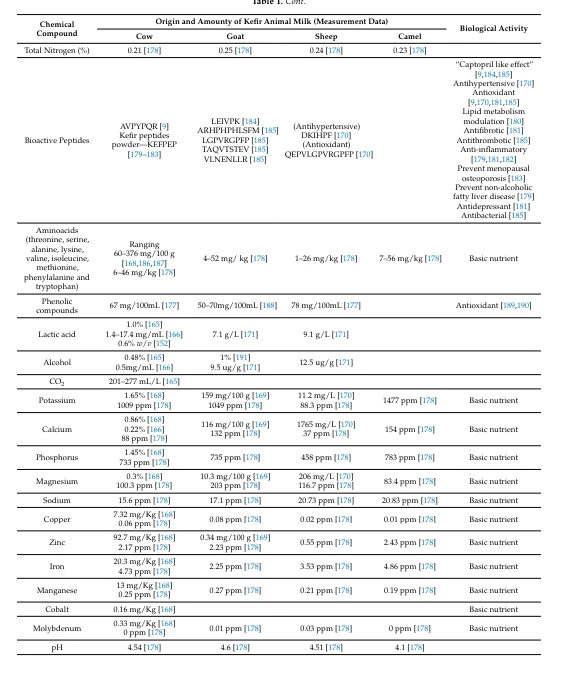
However, in Central Europe, Asia, and some American countries, it has been commercially available and made on an artisanal scale for individual consumption [100,156] by the fermentation of different types of milk (see Table 1).
Even so, this fermented milk gained adherents due to its functional properties. Kefir is a fermented, sour, slightly alcoholic milk produced from grains that contains a relatively stable population of microorganisms [7,157].
The fermentation process generates a series of compounds that impart a characteristic flavor and aroma to kefir, in addition to bioactive substances that are responsible for its nutraceutical properties [158]. Existing data suggest health benefits due to the regular consumption of kefir beverages. These compounds were associated with kefir's biological properties, such as immunomodulatory [159], antimicrobial [160,161], antitumor [162], anti-inflammatory [40,163], and antioxidant [7,14,40,63,101,115] properties.
These health-promoting benefits are associated with kefir microorganisms, the interactions between them, and the bioactive compounds produced from the fermentation of milk [164].
There is a symbiotic association of yeasts, lactic acid bacteria, and acetic acid bacteria, among other microorganisms [100,151]. However, the microbial composition of kefir can vary according to the region of origin, the time of fermentation, the type of substrate, and the manipulation techniques [7,165,166].

The prophylactic and therapeutic effects of lactic acid bacteria were studied at the beginning of the last century when Ilya Ivanovich Metchnikoff (the father of gerontology) launched the theory of prolonging life through regular consumption of fermented milk.
Since then, scientists have corroborated these observations, relating the consumption of probiotic microorganisms with the modulation of disease status in various experimental models [7,63,101].
The most isolated microorganisms from kefir grains comprise the genera Lactobacillus (L. casei, L. acidophilus, L. brevis, L. kefiri, L. plantarum, L. kefiranofaciens subsp. kefiranofaciens, L. kefiranofaciens subsp. kefirgranum, L. parakefir), Lactococcus (L. lactis subsp. lactis), Leuconostoc (L. mesenteroides), Acetobacter, Kluyveromyces (K. marxianus), Saccharomyces [7,165,166] and eventually other genera listed above). Although this microbiota is in symbiotic equilibrium, it does not always remain constant [7,191,192].
The traditional method of kefir production occurs directly by adding 4% of the grains to the milk, preferably pasteurized or boiled, and then cooled to 25 ◦C (room temperature) for grain inoculation [7,9]. After the fermentation period, which varies from 18 to 24 h, at room temperature, the grains are separated from the fermented beverage by filtration and later used for inoculation in a new substrate.
The filtrate submitted to lactic fermentation was transferred to the refrigerator and remained for 24 hours. In this phase, the yeasts will produce alcohol and CO2, making the product more refreshing [7,101,193]. The double fermentation of milk by bacteria and yeasts results in a food rich in lactic, acetic, and glycolic acids, ethyl alcohol, CO2, vitamin B12, and polysaccharides, which give the product unique sensory characteristics [194].
The physicochemical composition of kefir varies considerably with the type of milk used in fermentation. A typical kefir contains 89–90% (m/m) moisture, 0.2% lipids, 3.0% protein, 6.0% carbohydrates, 0.7% ash, and 1% alcohol and lactic acid [195,196].

To summarize, the organoleptic characteristics of kefir could be due to its main end-products [197]. For example, ethanol and CO2 impart a unique and exotic refreshing aroma to kefir [193]. Additionally, lactic acid promotes a slightly acidic and bitter taste, and acetaldehyde is related to the characteristic flavor of fermented milk [198].
For more information:1950477648nn@gmail.com
You Might Also Like
-

Food Grade Cistanche Extract
-
Cistanche Tubulosa Benefits
-

Cistanche Tubulosa Materials Cistanche Root Cistanche Ste...
-

Cistanche Dietary Supplement Energy Supply Phenylethanoid...
-

Cistanche Dietary Supplement Kidney Function Support Phen...
-

Cistanche Dietary Supplement Constipation Relief Suppleme...