Trained Immunity in Atherosclerotic Cardiovascular Disease
Apr 07, 2023
ABSTRACT:
Atherosclerosis is characterized by incessant inflammation in the arterial wall in which monocytes and macrophages play a crucial role. During the past few years, it has been reported that cells from the innate immune system can develop a long-lasting proinflammatory phenotype after brief stimulation not only with microbial products but also endogenous atherogenic stimuli.
This persistent hyperactivation of the innate immune system is termed trained immunity and can contribute to the pathophysiology of atherosclerosis. Trained immunity is mediated via epigenetic and metabolic reprogramming and occurs both in mature innate immune cells as well as their bone marrow progenitors. In addition to monocytes, other innate immune and nonimmune cells involved in different stages of atherosclerosis can develop comparable memory characteristics. This mechanism provides exciting novel pharmacological targets that can be used to prevent or treat cardiovascular diseases.
The innate immune system includes a series of cells and related mechanisms that can defend against foreign infections in a non-specific manner. Cells of the innate immune system recognize and act on pathogens non-specifically. Unlike the acquired immune system, the innate immune system does not provide long-lasting protective immunity but is present in all animals and plants as a rapid defense against infection.
In addition to the innate immune system of the human body, we also need to improve our immunity through daily life, such as a healthy diet and exercise. At the same time, Cistanche can also improve immunity. Cistanche is one of the main components of Cistanche, which has antioxidant and anti-inflammatory effects, can reduce the generation of free radicals, scavenge free radicals, and protect cells from damage from the external environment. At the same time, cistanche can also promote the proliferation and activity of immune cells and enhance human immunity.

Click cistanche deserticola supplement product
GRAPHIC ABSTRACT:
A graphic abstract is available for this article.
Key Words:
atherosclerosis ◼ cardiovascular disease ◼ inflammation ◼ innate immunity ◼ monocyte.
Atherosclerosis is the principal cause of the cardiovascular disease (CVD). In the process of atherosclerosis, monocytes play an important role in the formation, (de)stabilization, and rupture of atherosclerotic plaque.1 Despite what was historically described, cells of the innate immune system can develop a phenotype resembling immunologic memory that is called trained immunity.
This is characterized by a long-lasting proinflammatory phenotype with a stronger cytokine response to subsequent stimulation.2 This persistent overactivation of the innate immune system could contribute to the incessant vascular wall inflammation that is characteristic of atherosclerosis.1
In this review, we will discuss the different triggers and mechanisms of trained immunity in the context of atherosclerosis in vitro and in vivo and how the functional changes of trained cells (immune and nonimmune) could influence the pathophysiology of atherosclerosis.
BRIEF INTRODUCTION TO INNATE IMMUNE MEMORY
Over the past decade, evidence indicated that innate immune cells, such as monocytes, macrophages, and natural killer cells (NK) can develop characteristics of immunologic memory after brief exposure to microorganisms. This innate immune memory, termed trained immunity, is characterized by an enhanced cytokine response to a secondary challenge through functional reprogramming of the cells.2 Short exposure of monocytes to pathogens, such as Bacille Calmette-Guérin, Candida albicans, or its cell wall component β-glucan can alter cell function via epigenetic and metabolic reprogramming, thereby provoking an increased production of proinflammatory cytokines and chemokines in response to a secondary insult, which can be different than the initial insult.3–5 The classical in vitro trained immunity model consists of the exposure of isolated human monocytes for 24 hours to diverse stimuli that could induce training, followed by a 6-day washout and resting phase where monocytes differentiate into macrophages. The monocyte-derived macrophages are then restimulated for another 24 hours with TLR (Toll-like receptor) agonists, mostly lipopolysaccharides.6 For a complete overview of trained immunity, its mechanisms, and its effects, we refer to a future review article by Tercan et al in this series.

From an evolutionary perspective, trained immunity functions as a protective response of the host against recurrent infections, but it can also lead to a maladaptive state.7 This detrimental effect can be present in situations where immune cells contribute to the pathophysiology of chronic inflammatory disorders such as atherosclerosis. First, trained immunity could be one of the mechanisms that contribute to the known epidemiological association between the infectious burden and atherosclerotic CVD.8 Second, in addition to microbial products, trained immunity can also be induced by endogenous atherogenic stimuli, which is highlighted below.

ENDOGENOUS ATHEROGENIC STIMULI THAT CAN INDUCE TRAINED IMMUNITY IN VITRO AND IN VIVO
Nonmicrobial endogenous stimuli that can induce trained immunity include lipoproteins and adrenal hormones among other factors, which are known to contribute to the development of atherosclerotic CVD (ASCVD). In this section, we will discuss some atherogenic endogenous stimuli that trigger trained immunity in monocytes and macrophages in vitro and their associated clinical in vivo scenarios.
Lipoproteins
Lipoproteins are biochemical constructs that allow hydrophobic lipids to be transported in the blood and are of relevance in the development of CVD.9 oxLDL (oxidized low-density lipoprotein) is a modified lipoprotein and is one of the key atherogenic molecules within plaques that activates immune cells, by binding to membrane-bound receptors and triggering foam cell formation after uptake by macrophages.10 Monocyte-derived macrophages briefly exposed to a low concentration of oxLDL in vitro and restimulated with relevant TLR agonists 6 days later, such as Pam3CSK4 and lipopolysaccharides for TLR 2 and 4, respectively, produce more atherogenic cytokines and chemokines, such as TNF (tumor necrosis factor) α, IL (interleukin) 6, MCP1 (monocyte chemoattractant protein 1), and more matrix metalloproteinases than untrained controls.
Furthermore, foam cell formation is enhanced 6 days after initial exposure to oxLDL, due to the overexpression of SR-A (scavenger receptor-A) and CD36 and downregulation of the cholesterol efflux transporters ABCA1 (ATP-binding cassette transporter A1) and ABCG1 (ATP-binding cassette transporter G1).11 Mechanistically, oxLDL-induced training is dependent on TLR2 and 4 activation,11 and on interleukin-1 signaling, since it is prevented by concomitant incubation with IL-1 receptor antagonist.12
Similar to Bacille Calmette-Guérin and β-glucan induced training, these oxLDL-trained macrophages show profound metabolic and epigenetic rewiring.
Glycolysis and oxidative phosphorylation are upregulated in oxLDL-induced cells, and this is dependent on the mTOR/HIF1α (mammalian target of rapamycin/hypoxia-inducible factor 1-α) signaling pathway.13 Pharmacological inhibition of the mTOR pathway and the signaling molecules involved, as well as inhibition of glycolysis with 2-deoxyglucose, prevented the increase in glycolysis and the proinflammatory phenotype in macrophages.14
Further proof of an essential role for glycolysis in ox-LDL-induced training stems from the observation that in a large cohort of healthy subjects, genetic variation in key glycolytic enzymes is associated with the induction of cytokine production following an ex vivo training protocol of isolated monocytes.13 oxLDL-trained macrophages are also characterized by epigenetic reprogramming: there is the enrichment of the activating histone modification H3K4me3 (trimethylation of lysine 4 at histone 3), on promotors of genes encoding for proinflammatory and proatherogenic cytokines and chemokines such as IL6, TNFα, SR-A, and CD36.11 Pharmacological blocking of histone methyltransferases completely prevented training by ox-LDL, indicating that epigenetic changes underly trained immunity by oxLDL.11
Patients with familial hypercholesterolemia who have strongly elevated levels of LDLc (low-density lipoprotein cholesterol) have an increased risk to develop ASCVD. Their monocytes have a trained phenotype in terms of elevated cytokine production, elevated monocyte activation markers, and upregulation of immune activation, metabolic and inflammatory pathways compared with healthy controls.15 This is associated with an enrichment of H3K4me3 and a lower presence of H3K9me3 in the promoter region of TNFα. 15
In contrast to previous studies, where trained immunity was successfully prevented in vitro using statins,16 it was established that treatment with statins for three months does not revert trained immunity in vivo in familial hypercholesterolemia patients.15 Ex vivo analysis of monocytes from familial hypercholesterolemia patients showed that, despite the lowering in cholesterol levels after 3 months of treatment with statins, the proinflammatory phenotype in monocytes persisted, suggesting that statins can prevent training, but not revert it.15
Another lipoprotein that can induce trained immunity is Lp(a) (lipoprotein[a]), the main circulating carrier of oxidized phospholipids, which plays an important role in atherogenesis.17 Monocytes from healthy donors incubated in vitro for 24 hours with Lp(a) isolated from patients with elevated Lp(a) levels show an increased proinflammatory cytokine production after TLR ligand challenge 6 days later compared to untrained controls. This monocyte-derived macrophage training was attenuated by anti–oxidized phospholipid antibodies, indicating that this process is mediated by oxidized phospholipids.18 Monocytes isolated from patients with elevated Lp(a) levels showed increased trans-endothelial migration capacity.
In vivo, patients with elevated circulating Lp(a) levels had an increased binding of leukocytes to the arterial wall and increased arterial inflammation. After ex vivo stimulation with Pam3Cys and lipopolysaccharides, monocytes presented an enhanced capacity to produce proinflammatory cytokines, such as IL6 and TNFα. 18 In a recent study, it was established that potent lowering of Lp(a) levels can reverse the proinflammatory activation of monocytes in patients with CVD, showing that at least part of this proinflammatory effect is reversible.19
A recent study in mice investigated hypercholesterolemia-induced innate immune memory by exposing atherosclerosis-prone Ldlr−/− mouse to a western-type diet. It has been shown that a 4-week period of western-type diet–induced long-term proinflammatory reprogramming of circulating innate immune cells and their myeloid progenitor cells in the bone marrow that persisted after reversing to a normal chow diet for another 4 weeks.
These trained hematopoietic stem and progenitor cells were characterized by an augmented proliferation and inclination towards myelopoiesis and a subsequent heightened inflammatory response towards following subsequent challenges.12 Interestingly, in this model, trained immunity also appeared to be dependent on inflammatory pathways, such as IL1β and NLRP3 (NLR family pyrin domain-containing 3) activation.12 The finding that trained immunity occurs at the level of myeloid progenitors explains the observation in humans in vivo that trained immunity (in this case by Bacille Calmette-Guérin vaccination) persists for at least a few months despite the short half-life of circulating monocytes.3,20 To read more about trained immunity in the bone marrow, the reader is referred to a future article by Chavakis et al in this series.

Adrenal Hormones
Acute stress, for example, in the setting of myocardial infarction, or chronic psychosocial stress is associated with an increased risk of ASCVD and in animal models with a temporary acceleration of atherosclerosis.21 An acute myocardial infarction is known to accelerate atherosclerosis and to increase the future risk of ASCVD by activation of the sympathetic nervous system and subsequent bone marrow release of inflammatory immune cells.22
To understand the link between catecholamines, inflammation, and CVD, it was recently proposed that catecholamines induce trained immunity.23 Indeed, monocyte-derived macrophages exposed to a relevant concentration of epinephrine/norepinephrine showed increased levels of TNFα and IL6 upon lipopolysaccharides restimulation 6 days later. Similar to oxLDL, this trained immunity phenotype was associated with an increased glycolytic capacity and oxidative phosphorylation. Pharmacological inhibition studies showed that the β-adrenergic receptor 1 and 2 and the cAMP-protein kinase A pathway were essential for catecholamine-induced training.23
This proinflammatory monocyte phenotype was also observed in patients with pheochromocytoma, a rare neuroendocrine tumor in the adrenal glands causing overproduction of catecholamines, who are exposed daily to transient bouts of catecholamine release.24 These patients showed signs of systemic inflammation and a more elevated ex vivo cytokine response in stimulated monocytes. Interestingly, the increased TNFα production did not significantly reduce one month after the surgical removal of the tumor. Epigenetic analysis showed that H3K4me3 was enriched in promoter regions of proinflammatory genes, although this did not reach significance because of the low patient number.23
Aldosterone is another adrenal hormone that is associated with CVD. Elevated autonomous adrenal production of aldosterone, also denominated primary hyperaldosteronism, is a common cause of hypertension, which is linked to a higher risk of ASCVD.25 To explore whether innate immune activation is involved in mediating this higher risk, human monocytes were briefly exposed to aldosterone using the classically trained immunity model. Indeed, their production of proinflammatory cytokines upon lipopolysaccharides and Pam3Cys restimulation by monocyte-derived macrophages 6 days later was augmented, which was regulated via the MR (mineralocorticoid receptor).
Mechanistically, aldosterone did not induce any changes in glycolysis and oxidative phosphorylation as seen in oxLDL training, but it did affect the intracellular metabolism by inducing fatty acid synthesis.26 Furthermore, aldosterone-induced training was associated with the enrichment of H3K4me3 at the promoters of proinflammatory cytokines, such as TNFα and IL6, indicating that aldosterone causes training of monocyte-derived macrophages in vitro. In patients with primary hyperaldosteronism, however, circulating monocytes were not characterized by an enhanced cytokine production capacity.
Only after ex vivo differentiation into macrophages in autologous serum, the macrophages of primary hyperaldosteronism patients showed a higher TNFα expression.27 Importantly, patients with primary hyperaldosteronism appeared to have arterial wall inflammation, as assessed by the uptake of radiolabeled fluorodeoxyglucose.27 These findings suggest that aldosterone is different from the well-established trained immunity mechanisms induced by other stimuli and further research should be done to investigate what mechanisms underly the vascular wall inflammation and increased CVD risk in these patients.
Trained Immunity in Patients With Established CVD
In addition to patients with risk factors for atherosclerosis, trained immunity characteristics have also been reported in patients with established ASCVD. Freshly isolated monocytes from patients with symptomatic coronary artery disease showed an enhanced cytokine production capacity compared to healthy controls which persisted after ex vivo differentiation to macrophages for 5 days. This active state of inflammation leads to the generation of reactive oxygen species in the mitochondria regulated by the glycolytic enzyme PKM2 (pyruvate kinase M2) boosting the production of IL6 and IL1β via STAT3 (signal transducer and activator of transcription 3).28
In
an independent study, the enhanced cytokine production capacity of circulating monocytes was associated
with metabolic and epigenetic characteristics of trained
immunity: an upregulation of key glycolytic enzymes and
epigenetic rewiring in histone marks of key proinflammatory genes related to atherosclerosis.29
This inflammatory phenotype was recently shown to be reversed by lifestyle intervention in a small proof of principle study in patients at risk of CVD. In a group of patients with obesity with or without hypertension, an intervention to reduce sedentary behavior for 16 weeks showed favorable results. This intervention resulted in a significant reduction in the cytokine production capacity of isolated monocytes upon ex vivo TLR stimulation. This came along with decreased glycolysis and oxidative phosphorylation rate suggesting that trained immunity is involved. This study, however, did not explore the epigenetic level; thus, it remains to be established whether lifestyle indeed targets trained immunity.30 Altogether, reducing sedentary behavior could represent an important approach to the prevention or reduction of inflammation in atherosclerosis.
In addition, a recent study suggests that trained immunity might also contribute to cerebral small vessel disease. This is the most important vascular cause of the cognitive decline and dementia, which is characterized by arteriolosclerosis and shares important risk factors with atherosclerosis. Within a cohort of patients with cerebral small vessel disease, cytokine production after ex vivo stimulation of isolated monocytes was associated with the rate of progression of the disease on MRI imaging.31 Further analysis of possible underlying epigenetic changes is warranted.

TRAINED IMMUNITY BEYOND THE MONOCYTE
Recent evidence indicates that trained immunity occurs not only in monocytes but also in other innate immune and nonimmune cells that play key roles in atherosclerosis, including NK, endothelial cells, and vascular smooth muscle cells (SMC).
NK cells are innate immune granular cells that provide the host with antitumoral and antiviral protection.32 There is abundant documentation of the presence of NK cells in the atherosclerotic plaque. Chemokines, such as MCP1 and fractalkine (CX3CL1 [chemokine (C-X3-C motif) ligand 1]), can recruit NK cells to the arterial wall and consecutive activation leads to the production of proatherogenic cytokines like IFN (interferon) γ.
Interestingly, the infiltration with NK cells is higher in symptomatic carotid plaques than in asymptomatic plaques.33 In the arterial wall in presence of ox-LDL, NK cells interact with dendritic cells leading to enhanced activation of NK cells and maturation of dendritic cells, subsequently promoting the inflammatory potential of both cell populations and worsening the atherosclerotic lesion.34 Interestingly, similar to other innate immune cells, NK cells have the potential to develop immunologic memory. Bacille Calmette-Guérin vaccination of healthy volunteers increased the production of proinflammatory cytokines in NK cells upon unrelated microbial restimulation via epigenetic reprogramming 3 months after vaccination.35
Similarly, infection with cytomegalovirus confers NK cell memory, independent of T and B cells immunologic memory.36,37 Given that oxLDL has a role in the activation of NK cells and inflammation, it is tempting to speculate about the effect of trained immunity in NK cells and their role in atherogenesis. It is possible that (non)infectious or endogenous stimuli could also induce trained immunity in NK cells contributing to plaque inflammation but further investigation is warranted.
Nonimmune cells have also been shown to exhibit memory phenotypes,38 and, likely, this mechanism could also contribute to atherogenesis. endothelial cells and vSMC, both contributing to plaque formation, have been acknowledged to have immune characteristics with their ability to secrete cytokines, recognize molecular patterns, and present antigens.
In endothelial cell cultures, a brief period of high-glucose exposure induces a long-lasting proinflammatory phenotype with increased cytokine production. This hyperglycemic memory is mediated by epigenetic modifications written by methyltransferase Set7,39 regulating the expression of key atherogenic proteins such as MCP1.40 To read more about the potential role of glucose in trained immunity, we refer to the future article by Choudhury et al in this series. More recently, Lp(a) and specifically its oxidized phospholipids were also shown to be able to reprogram endothelial cells into a more proinflammatory and proatherogenic phenotype via upregulation of glycolysis, similar to the training of monocytes.41
In vSMCs, a series of receptors including LOX-1 (lectin-like oxidized low-density lipoprotein receptor) and TLRs, are of importance in the initiation and progression of atherosclerosis.42 The overexpression of these genes, sometimes driven by the epigenetic modification H3K9me3, results in the activation of proinflammatory pathways and signals that not only affect the cellular metabolism but also induce the production of cytokines and chemokines related to atherosclerosis.43
A similar phenotype was observed after short stimulation of vSMC with oxLDL, indicating a training potential of vascular nonimmune cells.44 Additionally, other nonimmune cells such as fibroblasts, can undergo epigenetic reprogramming and present an increased inflammatory response upon restimulation in arthritis, strengthening the theory of immunologic memory in nonimmune cells.45,46 Although the role of endothelial cells and vSMC in atherosclerosis has been widely established, recent studies suggest that trained immunity can contribute to the long-term functional effects, triggered by atherogenic stimuli.

CLINICAL APPLICATIONS AND REMAINING QUESTIONS
Although in the last few years anti-inflammatory therapies, such as canakinumab47 and colchicine,48 have been shown to reduce CVD, there are important adverse effects and a large residual risk remains. Therefore, novel therapies are urgently needed, and trained immunity might provide exciting novel pharmacological targets that can be used in this regard.
Central mechanisms regulating the inflammatory landscape in trained immunity are metabolic and epigenetic reprogramming of the myeloid cells, which are described in detail by Lutgens et al in this series and previous reviews.2 Theoretically, these processes are amenable for pharmacological modulation, as have been described in detail by Mulder et al.49 Specific epigenetic enzymes that regulate trained immunity are KDM5 (lysine demethyltransferase 5) and Set7 (SET domain containing 7, histone lysine methyltransferase).
In trained immunity specifically, the accumulation of fumarate can induce epigenetic reprogramming by inhibiting the KDM5 histone demethylases.50 Furthermore, the methyltransferase Set7 was found to have an important role in β-glucan–induced trained immunity, regulating H3K4me1-mediated changes in oxidative phosphorylation. Set7 also regulates gene expression previously associated with the induction of myelopoiesis of bone marrow progenitors.51 In addition to histone methylation and histone acetylation (mainly H3K27ac [histone 3 lysine 27 acetylation]), other epigenetic mechanisms are involved in trained immunity, including DNA methylation and long noncoding RNAs, which are described in detail elsewhere.2,4.
In addition to epigenetic remodeling, the metabolic adaptations that occur during training offer potential therapeutic targets. Important metabolic pathways that have been identified are the glycolysis pathway, glutaminolysis, and the mevalonate pathway.2 In isolated human monocytes inhibition of the inducible glycolytic enzyme PFKFB3 (6-phosphofructo-2-kinase/fructose2,6-bisphosphatase 3) with the small-molecule 3PO (3-[3-pyridinyl]-1-[4-pyridinyl]-2-proper-1-one) prevents oxLDL-induced trained immunity in vitro.13 Interestingly, 3PO only partially inhibits glycolysis, and it has recently been reported that systemic administration of 3PO to atherosclerosis-prone mice indeed significantly reduces atherosclerotic lesion development, although the focus of this paper was on endothelial cell glycolytic metabolism.52 Statins can prevent trained immunity induced by β-glucan and oxLDL in vitro.16 It is important to realize, however, that statins were not able to revert the trained immune phenotype in patients with hypercholesterolemia, in whom the epigenetic marks were already written.15
The most important drawback of interfering pharmacologically with epigenetic and metabolic processes is that these processes occur in every single cell in the human body with diverse functions. Therefore, it is critical to combine drugs that specifically target enzymes involved in trained immunity with delivery methods that allow specific targeting of cell types. Nanoparticles have been used in the treatment of inflammatory diseases due to their potential to target specific cells.49
For example, in murine atherosclerosis models, statin-loaded rHDL (reconstituted high-density lipoprotein) nanoparticles were able to block plaque formation by specifically targeting plaque macrophages.53 Similarly, carbon nanotubes loaded with antiphagocytic pathway inhibitors reactivated phagocytosis and decreased the expression of proinflammatory cytokines in lesional macrophages in Ldlr deficient mice.54 Given the versatility of nanoparticles, it is possible to develop diverse immunotherapies that can provide specificity and target only the regions and cell types of interest.
CONCLUSIONS
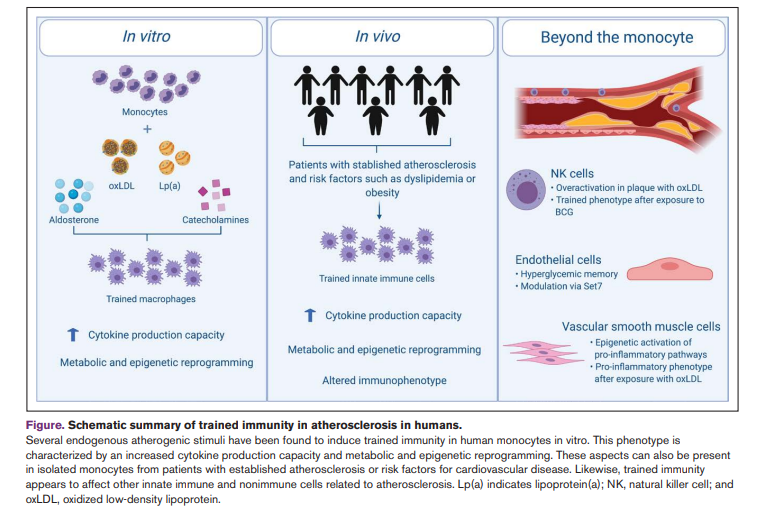
Evidence indicates that low-grade inflammation is part of the pathogenesis of atherosclerosis and is largely mediated by the immune system. In this review, we highlighted the mechanisms that could associate trained immunity to the development and progression of ASCVD based on current clinical and in vitro data (Figure). A better understanding of the molecular and systemic consequences of trained immunity and its effect on atherosclerosis will allow the development of novel targeted treatments to prevent and regulate ASCVD.
ARTICLE INFORMATION
Received June 17, 2020; accepted October 19, 2020.
Affiliations
Department of Internal Medicine and Radboud Center for Molecular Life Sciences, Radboud University Medical Center, Nijmegen, the Netherlands (D.F.-G., S.B., M.G.N., N.P.R.). Department of Immunology and Metabolism, Life & Medical Sciences Institute, University of Bonn, Germany (M.G.N.).
Acknowledgments
The Figure was created with BioRender.com.
Sources of Funding
This work was supported by an IN-CONTROL CVON (CardioVascular Research the Netherlands) grant (CVON2012-03 and CVON2018-27) and the European Union Horizon 2020 research and innovation program REPROGRAM under grant agreement No. 667837 to N.P. Riksen and M.G. Netea. M.G. Netea is supported by a European Research Council (ERC) Advanced grant (ERC 833247) and a Netherlands Organization for Scientific Research Spinoza Grant (NWO SPI 94- 212). N.P. Riksen is the recipient of a grant from the ERA-CVD (European Research Area Network on Cardiovascular Diseases) Joint Transnational Call 2018, which is supported by the Dutch Heart Foundation (JTC2018, project MEMORY); 2018T093). S. Bekkering is supported by the Dutch Heart Foundation (Dekker grant 2018-T028).

Disclosures
M.G. Netea is the scientific founder of Trained Therapeutix Discovery, TTxD.
REFERENCES
1. Moore KJ, Sheedy FJ, Fisher EA. Macrophages in atherosclerosis: a dynamic balance. Nat Rev Immunol. 2013;13:709–721. doi: 10.1038/nri3520
2. Netea MG, Domínguez-Andrés J, Barreiro LB, Chavakis T, Divangahi M, Fuchs E, Joosten LAB, van der Meer JWM, Mhlanga MM, Mulder WJM, et al. Defining trained immunity and its role in health and disease. Nat Rev Immunol. 2020;20:375–388. doi: 10.1038/s41577-020-0285-6
3. Kleinnijenhuis J, Quintin J, Preijers F, Joosten LA, Ifrim DC, Saeed S, Jacobs C, van Loenhout J, de Jong D, Stunnenberg HG, et al. Bacille Calmette-Guerin induces NOD2-dependent nonspecific protection from reinfection via epigenetic reprogramming of monocytes. Proc Natl Acad Sci USA. 2012;109:17537–17542. doi: 10.1073/pnas.1202870109
4. Saeed S, Quintin J, Kerstens HH, Rao NA, Aghajanirefah A, Matarese F, Cheng SC, Ratter J, Berentsen K, van der Ent MA, et al. Epigenetic programming of monocyte-to-macrophage differentiation and trained innate immunity. Science. 2014;345:1251086. doi: 10.1126/science.1251086
5. Cheng SC, Quintin J, Cramer RA, Shepardson KM, Saeed S, Kumar V, Giamarellos-Bourboulis EJ, Martens JH, Rao NA, Aghajanirefah A, et al. mTOR- and HIF-1α-mediated aerobic glycolysis as the metabolic basis for trained immunity. Science. 2014;345:1250684. doi: 10.1126/science.1250684
6. Quintin J, Saeed S, Martens JHA, Giamarellos-Bourboulis EJ, Ifrim DC, Logie C, Jacobs L, Jansen T, Kullberg BJ, Wijmenga C, et al. Candida albicans infection affords protection against reinfection via functional reprogramming of monocytes. Cell Host Microbe. 2012;12:223–232. doi 10.1016/j.chom.2012.06.006
7. Netea MG, Joosten LA, Latz E, Mills KHG, Natoli G, Stunnenberg HG, O'Neill LAJ, Xavier RJ. Trained immunity: a program of innate immune memory in health and disease. Science. 2016;352:aaf1098.
8. Leentjens J, Bekkering S, Joosten LAB, Netea MG, Burgner DP, Riksen NP. Trained innate immunity as a novel mechanism linking infection and the development of atherosclerosis. Circ Res. 2018;122:664–669. doi: 10.1161/CIRCRESAHA.117.312465
9. Burnett JR. Lipids, lipoproteins, atherosclerosis, and cardiovascular disease. Clin Biochem Rev. 2004;25:2.
10. Moore KJ, Tabas I. Macrophages in the pathogenesis of atherosclerosis. Cell. 2011;145:341–355. doi 10.1016/j.cell.2011.04.005
11. Bekkering S, Quintin J, Joosten LA, van der Meer JW, Netea MG, Riksen NP. Oxidized low-density lipoprotein induces long-term proinflammatory cytokine production and foam cell formation via epigenetic reprogramming of monocytes. Arterioscler Thromb Vasc Biol. 2014;34:1731–1738. doi: 10.1161/ATVBAHA.114.303887
12. Christ A, Günther P, Lauterbach MAR, Duewell P, Biswas D, Pelka K, Scholz CJ, Oosting M, Haendler K, Baßler K, et al. Western diet triggers NLRP3-dependent innate immune reprogramming. Cell. 2018;172:162– 175.e14. doi 10.1016/j.cell.2017.12.013
13. Keating ST, Groh L, Thiem K, Bekkering S, Li Y, Matzaraki V, van der Heijden CDCC, van Puffelen JH, Lachmandas E, Jansen T, et al. Rewiring of glucose metabolism defines trained immunity induced by oxidized low-density lipoprotein. J Mol Med (Berl). 2020;98:819–831. doi: 10.1007/s00109-020-01915-w
14. Sohrabi Y, Lagache SMM, Schnack L, Godfrey R, Kahles F, Bruemmer D, Waltenberger J, Findeisen HM. mTOR-dependent oxidative stress regulates oxLDL-induced trained innate immunity in human monocytes. Front Immunol. 2018;9:3155. doi: 10.3389/fimmu.2018.03155.
15. Bekkering S, Stiekema LCA, Bernelot Moens S, Verweij SL, Novakovic B, Prange K, Versloot M, Roeters van Lennep JE, Stunnenberg H, de Winther M, et al. Treatment with statins does not revert trained immunity in patients with familial hypercholesterolemia. Cell Metab. 2019;30:1–2. doi 10.1016/j. cement.2019.05.014
16. Bekkering S, Arts RJW, Novakovic B, Kourtzelis I, van der Heijden CDCC, Li Y, Popa CD, Ter Horst R, van Tuijl J, Netea-Maier RT, et al. Metabolic induction of trained immunity through the mevalonate pathway. Cell. 2018;172:135–146.e9. doi 10.1016/j.cell.2017.11.025
17. Boffa MB, Koschinsky ML. Oxidized phospholipids as a unifying theory for lipoprotein(a) and cardiovascular disease. Nat Rev Cardiol. 2019;16:305– 318. doi: 10.1038/s41569-018-0153-2
18. van der Valk FM, Bekkering S, Kroon J, Yeang C, Van den Bossche J, van Buul JD, Ravandi A, Nederveen AJ, Verberne HJ, Scipione C, et al. Oxidized phospholipids on lipoprotein(a) elicit arterial wall inflammation and an inflammatory monocyte response in humans. Circulation. 2016;134:611– 624. doi: 10.1161/CIRCULATIONAHA.116.020838
19. Stiekema LCA, Prange KHM, Hoogeveen RM, Verweij SL, Kroon J, Schnitzler JG, Dzobo KE, Cupido AJ, Tsimikas S, Stroes ESG, et al. Potent lipoprotein(a) lowering following apolipoprotein(a) antisense treatment reduces the pro-inflammatory activation of circulating monocytes in patients with elevated lipoprotein(a). Eur Heart J. 2020;41:2262–2271. doi: 10.1093/eurheartj/ehaa171
20. Cirovic B, de Bree LCJ, Groh L, Blok BA, Chan J, van der Velden WJFM, Bremmers MEJ, van Crevel R, Händler K, Picelli S, et al. BCG vaccination in humans elicits trained immunity via the hematopoietic progenitor compartment. Cell Host Microbe. 2020;28:322–334.e5. doi 10.1016/j.chom.2020.05.014
21. Song H, Fang F, Arnberg FK, Mataix-Cols D, Fernández de la Cruz L, Almqvist C, Fall K, Lichtenstein P, Thorgeirsson G, Valdimarsdóttir UA. Stress-related disorders and risk of cardiovascular disease: population-based, sibling controlled cohort study. BMJ. 2019;365:l1255. doi 10.1136/bmj.l1255
22. Dutta P, Courties G, Wei Y, Leuschner F, Gorbatov R, Robbins CS, Iwamoto Y, Thompson B, Carlson AL, Heidt T, et al. Myocardial infarction accelerates atherosclerosis. Nature. 2012;487:325–329. doi: 10.1038/nature11260
23. van der Heijden CDCC, Groh L, Keating ST, Kaffa C, Noz MP, Kersten S, van Herwaarden AE, Hoischen A, Joosten LAB, Timmers HJLM, et al. Catecholamines induce trained immunity in monocytes in vitro and in vivo. Circ Res. 2020;127:269–283. doi: 10.1161/CIRCRESAHA.119.315800
24. Pacak K, Tella SH. Pheochromocytoma and Paraganglioma. In: Feingold KR, Anawalt B, Boyce A, et al, eds. Endotext. South Dartmouth, MA: MDText. com, Inc; 2000. Last update January 4, 2018.
25. Monticone S, D’Ascenzo F, Moretti C, Williams TA, Veglio F, Gaita F, Mulatero P. Cardiovascular events and target organ damage in primary aldosteronism compared with essential hypertension: a systematic review and meta-analysis. Lancet Diabetes Endocrinol. 2018;6:41–50. doi: 10.1016/S2213-8587(17)30319-4
26. van der Heijden CDCC, Keating ST, Groh L, Joosten LAB, Netea MG, Riksen NP. Aldosterone induces trained immunity: the role of fatty acid synthesis. Cardiovasc Res. 2020;116:317–328. doi: 10.1093/cvr/cvz137
27. van der Heijden C, Smeets EMM, Aarntzen E, et al. Arterial wall inflammation and increased hematopoietic activity in patients with primary aldosteronism. J Clin Endocrinol Metab. 2020;105:e1967–e1980.
28. Shirai T, Nazarewicz RR, Wallis BB, Yanes RE, Watanabe R, Hilhorst M, Tian L, Harrison DG, Giacomini JC, Assimes TL, et al. The glycolytic enzyme PKM2 bridges metabolic and inflammatory dysfunction in coronary artery disease. J Exp Med. 2016;213:337–354. doi: 10.1084/jem.20150900
29. Bekkering S, van den Munckhof I, Nielen T, Lamfers E, Dinarello C, Rutten J, de Graaf J, Joosten LA, Netea MG, Gomes ME, et al. Innate immune cell activation and epigenetic remodeling in symptomatic and asymptomatic atherosclerosis in humans in vivo. Atherosclerosis. 2016;254:228–236. doi 10.1016/j.atherosclerosis.2016.10.019 30. Noz MP, Hartman YAW, Hopman MTE, Willems PHGM, Tack CJ, Joosten LAB, Netea MG, Thijssen DHJ, Riksen NP. Sixteen-week physical activity intervention in subjects with increased cardiometabolic risk shifts innate immune function towards a less proinflammatory state. J Am Heart Assoc. 2019;8:e013764. doi: 10.1161/JAHA.119.013764
31. Noz MP, Ter Telgte A, Wiegertjes K, Joosten LAB, Netea MG, de Leeuw FE, Riksen NP. Trained immunity characteristics are associated with progressive cerebral small vessel disease. Stroke. 2018;49:2910– 2917. doi: 10.1161/STROKEAHA.118.023192
32. Abel AM, Yang C, Thakar MS, Malarkannan S. Natural killer cells: development, maturation, and clinical utilization. Front Immunol. 2018;9:1869. doi: 10.3389/fimmu.2018.01869
33. Bonaccorsi I, Spinelli D, Cantoni C, Barillà C, Pipitò N, De Pasquale C, Oliveri D, Cavaliere R, Carrega P, Benedetto F, et al. Symptomatic carotid atherosclerotic plaques are associated with increased infiltration of natural killer (NK) cells and higher serum levels of NK-activating receptor ligands. Front Immunol. 2019;10:1503. doi: 10.3389/fimmu.2019.01503
34. Bonaccorsi I, De Pasquale C, Campana S, Barberi C, Cavaliere R, Benedetto F, Ferlazzo G. Natural killer cells in the innate immunity network of atherosclerosis. Immunol Lett. 2015;168:51–57. doi: 10.1016/j.imlet.2015.09.006
35. Kleinnijenhuis J, Quintin J, Preijers F, Joosten LA, Jacobs C, Xavier RJ, van der Meer JW, van Crevel R, Netea MG. BCG-induced trained immunity in NK cells: Role for non-specific protection to infection. Clin Immunol. 2014;155:213–219. doi: 10.1016/j.clim.2014.10.005
36. Schlums H, Cichocki F, Tesi B, Theorell J, Beziat V, Holmes TD, Han H, Chiang SC, Foley B, Mattsson K, et al. Cytomegalovirus infection drives adaptive epigenetic diversification of NK cells with altered signaling and effector function. Immunity. 2015;42:443–456. doi 10.1016/j. immune.2015.02.008
37. Sun JC, Madera S, Bezman NA, Beilke JN, Kaplan MH, Lanier LL. Proinflammatory cytokine signaling is required for the generation of natural killer cell memory. J Exp Med. 2012;209:947–954. doi: 10.1084/jem.20111760
38. Hamada A, Torre C, Drancourt M, Ghigo E. Trained immunity carried by non-immune cells. Front Microbiol. 2018;9:3225. doi: 10.3389/fmicb. 2018.03225
39. Okabe J, Orlowski C, Balcerczyk A, Tikellis C, Thomas MC, Cooper ME, El-Osta A. Distinguishing hyperglycemic changes by Set7 in vascular endothelial cells. Circ Res. 2012;110:1067–1076. doi: 10.1161/CIRCRESAHA.112.266171
40. Siebel AL, Fernandez AZ, El-Osta A. Glycemic memory associated epigenetic changes. Biochem Pharmacol. 2010;80:1853–1859. doi: 10.1016/j.bcp. 2010.06.005
41. Schnitzler JG, Hoogeveen RM, Ali L, Prange KHM, Waissi F, van Weeghel M, Bachmann JC, Versloot M, Borrelli MJ, Yeang C, et al. Atherogenic lipoprotein(a) increases vascular glycolysis, thereby facilitating inflammation and leukocyte extravasation. Circ Res. 2020;126:1346–1359. doi: 10.1161/ CIRCRESAHA.119.316206
42. Lim S, Park S. Role of vascular smooth muscle cell in the inflammation of atherosclerosis. BMB Rep. 2014;47:1–7. doi: 10.5483/bmbrep.2014.47.1.285
43. Harman JL, Dobnikar L, Chappell J, Stokell BG, Dalby A, Foote K, Finigan A, Freire-Pritchett P, Taylor AL, Worssam MD, et al. Epigenetic regulation of vascular smooth muscle cells by histone H3 lysine 9 dimethylation attenuates target gene induction by inflammatory signaling. Arterioscler Thromb Vasc Biol. 2019;39:2289–2302. doi: 10.1161/ATVBAHA.119.312765
44. Schnack L, Sohrabi Y, Lagache SMM, Kahles F, Bruemmer D, Waltenberger J, Findeisen HM. Mechanisms of trained innate immunity in oxLDL primed human coronary smooth muscle cells. Front Immunol. 2019;10:13. doi: 10.3389/fimmu.2019.00013
45. Huber LC, Brock M, Hemmatazad H, Giger OT, Moritz F, Trenkmann M, Distler JH, Gay RE, Kolling C, Moch H, et al. Histone deacetylase/acetylase activity in total synovial tissue derived from rheumatoid arthritis and osteoarthritis patients. Arthritis Rheum. 2007;56:1087–1093. doi 10.1002/art.22512
46. Kawabata T, Nishida K, Takasugi K, Ogawa H, Sada K, Kadota Y, Inagaki J, Hirohata S, Ninomiya Y, Makino H. Increased activity and expression of histone deacetylase 1 about tumor necrosis factor-alpha in synovial tissue of rheumatoid arthritis. Arthritis Res Ther. 2010;12:R133. doi: 10.1186/ar3071
47. Ridker PM, Everett BM, Thuren T, MacFadyen JG, Chang WH, Ballantyne C, Fonseca F, Nicolau J, Koenig W, Anker SD, et al; CANTOS Trial Group. Antiinflammatory therapy with canakinumab for atherosclerotic disease. N Engl J Med. 2017;377:1119–1131. doi: 10.1056/NEJMoa1707914
48. Tardif JC, Kouz S, Waters DD, Bertrand OF, Diaz R, Maggioni AP, Pinto FJ, Ibrahim R, Gamra H, Kiwan GS, et al. Efficacy and safety of low-dose colchicine after myocardial infarction. N Engl J Med. 2019;381:2497–2505. doi: 10.1056/NEJMoa1912388
49. Mulder WJM, Ochando J, Joosten LAB, Fayad ZA, Netea MG. Therapeutic targeting of trained immunity. Nat Rev Drug Discov. 2019;18:553–566. doi: 10.1038/s41573-019-0025-4
50. Arts RJ, Novakovic B, Ter Horst R, Carvalho A, Bekkering S, Lachmandas E, Rodrigues F, Silvestre R, Cheng SC, Wang SY, et al. Glutaminolysis and fumarate accumulation integrate immunometabolic and epigenetic programs in trained immunity. Cell Metab. 2016;24:807–819. doi 10.1016/j. cement.2016.10.008
51. Keating ST, Groh L, van der Heijden CDCC, Rodriguez H, Dos Santos JC, Fanucchi S, Okabe J, Kaipananickal H, van Puffelen JH, Helder L, et al. The Set7 lysine methyltransferase regulates plasticity in oxidative phosphorylation necessary for trained immunity induced by β-glucan. Cell Rep. 2020;31:107548. doi: 10.1016/j.celrep.2020.107548
52. Perrotta P, Van der Veken B, Van Der Veken P, Pintelon I, Roosens L, Adriaenssens E, Timmerman V, Guns PJ, De Meyer GRY, Martinet W. Partial inhibition of glycolysis reduces atherogenesis independent of intraplaque neovascularization in mice. Arterioscler Thromb Vasc Biol. 2020;40:1168– 1181. doi: 10.1161/ATVBAHA.119.313692
53. Duivenvoorden R, Tang J, Cormode DP, Mieszawska AJ, Izquierdo-Garcia D, Ozcan C, Otten MJ, Zaidi N, Lobatto ME, van Rijs SM, et al. A statin-loaded reconstituted high-density lipoprotein nanoparticle inhibits atherosclerotic plaque inflammation. Nat Commun. 2014;5:3065. doi: 10.1038/ ncomms4065
54. Flores AM, Hosseini-Nassab N, Jarr KU, Ye J, Zhu X, Wirka R, Koh AL, Tsantilas P, Wang Y, Nanda V, et al. Pro-efferocytosis nanoparticles are specifically taken up by lesional macrophages and prevent atherosclerosis. Nat Nanotechnol. 2020;15:154–161. doi: 10.1038/s41565-019-0619-3
For more information:1950477648nn@gmail.com