Trifluoromethylated Flavonoid-Based Isoxazoles As Antidiabetic And Anti-Obesity Agents: Synthesis, In Vitro α-Amylase Inhibitory Activity, Molecular Docking And Structure–Activity Relationship Analysis
Feb 22, 2022
Please contact oscar.xiao@wecistanche.com to know more
Faisal K. Algethami 1,*, Ilyes Saidi 2, Hani Nasser Abdelhamid 3, Mohamed R. Elamin 1, Babiker Y. Abdulkhair 1, Amani Chrouda 4 and Hichem Ben Jannet 2,*
Abstract: Diabetes mellitus is a major health problem globally. The management of carbohydrate digestion provides an alternative treatment. Flavonoids constitute the largest group of polyphenolic compounds, produced by plants widely consumed as food and/or used for therapeutic purposes. As such, isoxazoles have attracted the attention of medicinal chemists by dint of their considerable bioactivity. Thus, the main goal of this work was to discover new hybrid molecules with properties of both flavonoids and isoxazoles in order to control carbohydrate digestion. Moreover, the trifluoromethyl group is a key entity in drug development, due to its strong lipophilicity and metabolic stability. Therefore, the present work describes the condensation of a previously synthesized trifluoromethylation flavonol with different aryl nitrile oxides, affording 13 hybrid molecules indicated as trifluoromethylation flavonoid-based isoxazoles. The structures of the obtained compounds were deduced from 1H NMR, 13C NMR, and HRMS analysis. The 15 newly synthesized compounds inhibited the activity of α-amylase with efficacy ranging from 64.5 ± 0.7% to 94.7 ± 1.2% at a concentration of 50 µM, and with IC50 values of 12.6 ± 0.2 µM–27.6 ± 1.1 µM. The most effective compounds in terms of efficacy and potency were 3b, 3h, 3j, and 3m. Among the new trifluoromethylation flavonoid-based isoxazoles, the compound 3b was the most effective inhibitor of α-amylase activity (PI = 94.7 ± 1.2% at 50 µM), with a potency (IC50 = 12.6 ± 0.2 µM) similar to that of the positive control acarbose (IC50 = 12.4 ± 0.1 µM). The study of the structure-activity relationship based on the molecular docking analysis showed low binding energy, a correct mode of interaction in the active pocket of the target enzyme, and an ability to interact with the key residues of glycosidic cleavage (GLU-230 and ASP-206), explaining the inhibitory effects of α-amylase established by several derivatives.
Keywords: α-amylase inhibition; antidiabetic; anti-obesity; cycloaddition; flavonoids; trifluoromethylation flavonoid-based isoxazoles; molecular docking; SAR analysis
1. Introduction
Obesity and diabetes mellitus constitute major human health problems worldwide [1,2]. Indeed, diabetes mellitus is primarily typified by uncontrolled blood sugar. However, type 1 diabetes mellitus results from a disruption in insulin secretion (insulin-dependent), while type 2 usually originates from insulin resistance (alterations of the receptor structure on the target cells, leading to a reduction in hormone–receptor affinity), disruption in insulin secretion, or both [3,4]. Inevitably, inhibiting the degradation of polysaccharides into monosaccharides suitable for absorption into cells implements fundamental strategies to control diabetes and help in the management of obesity [3]. The α-amylase enzyme (EC.3.2.1.1) is a digestive enzyme hydrolyzing α-1,4-glycosidic bonds of carbohydrates, such as starches [5]. Therefore, α-amylase inhibition contributes in one way or another to control the digestion of carbohydrates [6,7]; thus, it constitutes a partial pathway to regulate the enzymatic activity of α-amylase; hence, it is an ideal therapy for the regulation of obesity and diabetes, as well as their related complications [4]. The majority of commercial α-amylase inhibitors—such as acarbose, miglitol, phaseolamine, and voglibose—have been associated with intestinal side effects, such as flatulence, abdominal pain, diarrhea, liver failure, severe skin allergies, and pneumatosis cystoid intestinal infection [6]. The best α-amylase inhibitors are the so-called competitive inhibitors, which inhibit the enzyme irreversibly. A competitive inhibitor binds to the active site of the target enzyme and, thus, prevents the substrate from binding. Therefore, in competitive inhibition, the inhibitor competes with the substrate for the active site. On the other hand, in irreversible inhibition, the inhibitor dissociates very slowly from the target enzyme, as it has become tightly bound to the enzyme. Usually, irreversible inhibitors bind covalently to the active site of the enzyme by modifying the residues or functional groups necessary for enzymatic activity, such that the enzyme is irreversibly inhibited. For a good inhibition of carbohydrate digestion—which can help control obesity, and even type 2 diabetes—we need a non-selective substance capable of inhibiting most of the digestive enzymes of sugars, namely salivary α-amylase, pancreatic α-amylase, and α-glucosidase [8,9]. Previous research on semi-synthesized flavonoids found that isoxazole-based flavonoid derivatives exhibited significant antidiabetic effects by enhancing glucose uptake in insulin-resistant HepG2 cells [10]. Furthermore, flavonoids are the largest group of polyphenolic secondary metabolites, which are commonly found in plants. These secondary metabolites are responsible for the attractive colors of followers, fruits, and leaves [11]. Structurally, flavonoids have a C15 carbon skeleton consisting of two aromatic rings (A) and (B), which are linked together by a C3 chain forming the heterocycle (C) [12]. Many biological proprieties have been reported for this type of polyphenolic compound, such as α-amylase inhibition [7,13–15], anti-diabetic [16,17], anticancer [18,19], and antioxidant effects [20], and other biological activities [21–25]. However, this rich biological profile has motivated several chemical research teams to synthesize flavonoids with special moieties and substituents to target particular biological activities [26–30]. On the other hand, isoxazole is a five-membered heterocycle of great importance in medicinal chemistry. Furthermore, naturally occurring isoxazoles—such as ibotenic acid (hallucinogenic, neurotoxin) and muscimol (hallucinogenic, GABAA receptor antagonist) [31–34]—have attracted increasing attention from chemists and pharmacologists owing to their potent biological and pharmacological properties. Furthermore, isoxazole derivatives are revealed to possess a broad spectrum of biological properties, such as antidiabetic, analgesic, anti-inflammatory, anti-HIV, and anticancer activities [10,35–40]. The isoxazole ring has been widely used as a key building block for drugs such as zonisamide (anticonvulsant) [41], valdecoxib, parecoxib (COX-2 inhibitors) [42], and leflunomide (antirheumatic) [43]. In recent decades, the trifluoromethyl group has been in increasing demand for the development of bioactive compounds, due to its strong electron-withdrawing character, its metabolic stability, and its lipophilic nature, which are considered important physicochemical properties of bioactive molecules [44]. This fluorinated moiety was found to be indispensable in many important drugs, including fluphenazine (antipsychotic, anti-cancer) [45], leflunomide (antirheumatic) [43], celecoxib (COX-2 selective inhibitor) [46], fluoxetine (antidepressant) [47], and fluazinam (fungicide) [48]. One review of the literature mentions that trifluoromethylation 5-amino-nicotinic acid has been reported to exhibit promising α-amylase activity [49]. In addition, the chlorinated hybrid pyrazole–thiazole molecules were found to be good inhibitors of the α-amylase enzyme [50], which also indicates the importance of the chlorine atom in α-amylase inhibitory structures. The above literature data reporting the important physicochemical properties of the trifluoromethyl group—and its contribution, alongside flavonoids and isoxazoles, to inhibiting α-amylase and exerting antidiabetic activities—have encouraged us to prepare a new series of hybrid molecules, where a trifluoromethylation flavonoid has been associated with a series of aryl isoxazoles via a methylene linker, and to evaluate their inhibitory power of the α-amylase enzyme. The structure-activity relationship (SAR) was studied and approved via molecular docking analysis.

Cistanche for immunity improving
2. Results and Discussion
2.1. Chemistry The preparation of a trifluoromethylation flavonol (1)—previously synthesized in our laboratory and showing interesting cytotoxic potential—was reported according to the procedure adopted by Znati et al. (2019) [30]. 5-Chloro-2-hydroxy acetophenone was condensed with 4-(trifluoromethyl)benzaldehyde under reflux of methanol and in the presence of sodium hydroxide for 3 h to produce 5-chloro-40 -(trifluoromethyl)-2-hydroxy chalcone; then, the pyranic ring (C) was cyclized and the C-3 carbon was oxidized by the addition of (H2O2, NaOH) for 2 h at room temperature (Scheme 1). Molecule 1 was obtained with a good yield (79%), after precipitation in ice water. Scheme 1. Synthetic pathway of the trifluoromethylation flavonol (1). The structure of flavonol (1) was confirmed via spectroscopic analysis and by comparison with literature data [30]. The 1,3-dipolar cycloaddition is a chemical reaction between a 1,3-dipole and a dipolarophile to form a five-membered ring. Hence, 1,3-dipolar cycloaddition is considered the most important way of synthesis of a wide range of isoxazoles. Furthermore, the regiospecific synthesis of isoxazoles catalyzed by Cu(I) under microwave irradiation is based on the [3 + 2] cycloaddition between terminal alkynes (dipolarophiles) and aryl nitrile oxides (dipoles), providing exclusively 3,5-disubstituted regioisomers [39,51]. Our approach to target the trifluoromethylation flavonoid isoxazoles (3a–m), firstly started by the preparation of the dipolarophile (2) via the propargylation of the hydroxyl group in position C-3 of the flavonol (1) in anhydrous DMF for 2 h at room temperature, in the presence of K2CO3, as illustrated in Scheme 2. The dipolarophile (2) was prepared with an excellent yield (94%). Scheme 2. Synthetic pathway of the dipolarophile (2).
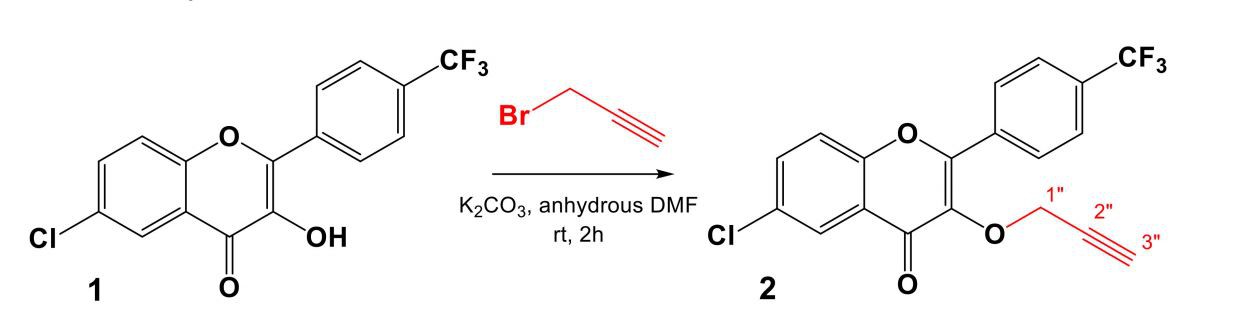
The structure of compound 2 was established according to its spectral data. Indeed, in addition to the signals corresponding to the protons and carbons introduced by the flavonol (1), new signals of the propargyl moiety were detected in the 1H and 13C NMR spectra. Moreover, the 1H NMR spectrum of the dipolarophile (2), recorded in CDCl3 at 300 MHz, showed a doublet at δH 5.06 (2H, d, J = 2.4 Hz) corresponding to the methylene proton H-1” and a triplet at δH 2.36 (1H, t, J = 2.4 Hz) attributable to the proton of the ethynyl group (H-3”). The 13C NMR spectrum confirmed the introduction of the propargyl group by the observation of new signals at δC 78.4, 76.9, and 59.6, attributable to C-2”, C-3”, and C-1”, respectively. Hydroximyl chlorides a–m are the main precursors for the in situ generations of aryl nitrile oxides—reagents that participate in the reaction of 1,3-dipolar cycloaddition for the synthesis of isoxazoles. The precursors (a–m) were synthesized from the appropriate aldehydes according to the general procedure described by Himo et al. (2005) [51]. The desired hydroxyl chlorides (a–m) were obtained with good yields, ranging from 80 to 98% (Table 1). Thus, the corresponding aryl nitrile oxides were formed in situ by dehydrohalogenation of the corresponding hydroxyl chlorides using the triethylamine as a base. Table 1. Structures and yields of hydroxyl chlorides (a–m) and trifluoromethylation flavonoid-based isoxazoles (3a–m).

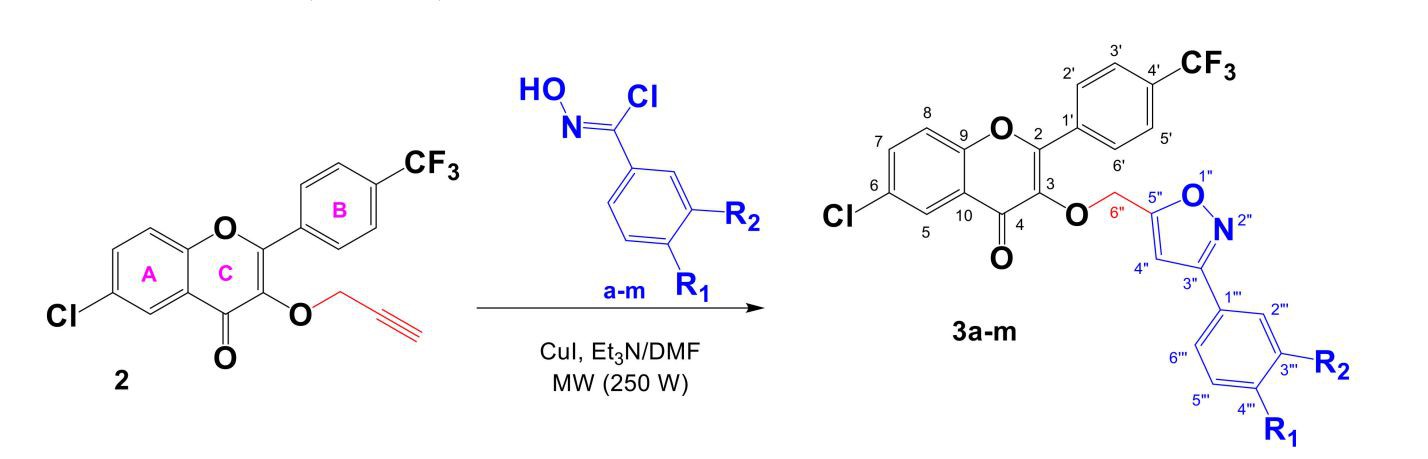
The 1,3-dipolar cycloaddition reaction was applied in a regiospecific approach using the terminal alkyne (2) and the different hydroxyl chlorides (a–m) variously substituted (Scheme 3). The obtained results are listed in Table 1. Scheme 3. Synthetic pathway of the trifluoromethylation flavonoid isoxazoles 3a–m. All of the reactions were conducted under microwave irradiation (250 W) in DMF in the presence of triethylamine and cuprous iodide (CuI) for 5 min. The products were isolated from the reaction mixture by simple purification on a silica gel column. The newly prepared 3,5-disubstituted isoxazoles (3a–m) were obtained in yields ranging from 73 to 96% (Table 1). The structures of the synthesized trifluoromethylation flavonoid-based isoxazoles (3a–m) (Table 1) were determined by means of 1H, 13C NMR, and DEPT 135. The 1H NMR spectra of these compounds showed a singlet resonating at δH 6.30–6.60 attributable to the methine proton H-4” of the isoxazole ring, another singlet at δH 5.35–5.45 attributable to the methylene proton H-6”, and other signals in the aromatic proton zone relating to the protons introduced by the aryl group. Moreover, these structures were confirmed by their 13C NMR and DEPT 135 spectra, showing all of the expected carbon signals—especially the aromatic ones introduced by the used hydroxyl chlorides, as well as the carbon of the methine C-4” of the isoxazole ring resonating at δC 102.5–103.0, and that whose signal is inverted in the DEPT 135 spectrum, resonating at δC 63.5–63.9, attributable to methylene C-6”. 2.2. Valuation of α-Amylase Inhibition To control enzyme activity, inhibition is one of the most successful therapeutic means. Therefore, inhibiting the α-amylase enzyme constitutes a partial pathway to manage diabetes and control weight, by hampering the digestion of carbohydrates. To date, drugs such as acarbose have formed part of the arsenal of drugs used to treat DM and obesity. However, acarbose is not used as monotherapy, because of its efficacy and side effects; instead, acarbose is used as add-on therapy and is very often used in combination with other hypoglycemic drugs. Along with this, this drug is commonly used as a standard compound in the study of α-amylase inhibition. In this study, the 15synthesized compounds (1, 2, and 3a–m) were evaluated for their α-amylase inhibitory activity. The results were expressed in potency (IC50 ± SEM µM) and efficacy (PI at 50 µM) parameters, and are given in Table 2. According to the results, the synthesized molecules (1, 2, and 3a–m) possessed signifies- cant anti-α-amylase activity (p ≤ 0.05), with efficacy ranging from 64.5 ± 0.7 to 94.7 ± 1.2% at a concentration of 50 µM, and potencies of IC50 values varying from 12.6 ± 0.2 to 27.6 ± 1.1 µM. Among the newly prepared trifluoromethylation flavonoid-based isoxazoles, 3b (R1 = F, R2 = H) was found to be the most potent (IC50 = 12.6 ± 0.2 µM) and the most effective (PI = 94.7 ± 1.2% at 50 µM) compound to inhibit the activity of the α-amylase enzyme. These significant values were found to be comparable to those of acarbose (PI = 97.8 ± 0.5% at 50 µM; IC50 = 12.4 ± 0.1 µM), used as a standard substance. Likewise, compounds 3h, 3j, and 3m can be considered to be bioactive in terms of efficacy and potency (PI= 93.1 ± 0.9%–93.5 ± 1.1% at 50 µM; IC50 = 13.3 ± 0.2 µM–13.8 ± 0.1 µM) compared to their analog 3b and acarbose. The rest of the compounds (1, 2, 3a, 3c, 3d, 3e, 3f, 3g, 3i, 3k, and 3l) were also found to be able to inhibit the α-amylase enzyme, but remain less effective (PI= 64.5 ± 0.7%–87.1 ± 0.7% at 50 µM; IC50 = 14.4 ± 0.2 µM to 27.6 ± 1.1 µM) than the aforementioned analogs. The anti-α-amylase activity achieved by the synthesized compounds is consistent with previous reports, among which Nie et al. (2020) [10] reported that flavonoid-based isoxazoles could display valuable scaffolds for antidiabetic drug discovery. By comparing the structures and activities of the synthesized molecules, compounds 3bd, halogenated in the para position of the phenyl group attached to the isoxazole ring, displayed significant efficacy (PI= 85.4 ± 0.9%–94.7 ± 1.2%at 50 µM) and potency (IC50 = 12.6 ± 0.2 µM–14.6 ± 0.3 µM) in inhibiting the α-amylase enzyme. This finding is in good agreement with the literature, showing that the presence of halogen atoms (F, Cl, or Br) in the structure was essential for a potent α-amylase inhibition [49,50]. In addition, the structure-activity relationship study allowed us to conclude that more inductive attractor (−I) and mesomeric donor (+M) effects increase the α-amylase inhibitory efficacy and potency (activity of the fluorinated derivative 3b (R1 = F, R2 = H; PI = 94.7 ± 1.2% at 50 µM; IC50 = 12.6 ± 0.2 µM) is higher than that of the chlorinated derivative 3c (R1 = Cl, R2 = H; PI = 87.1 ± 0.7% at 50 µM; IC50 = 14.4 ± 0.2 µM), followed by the brominated derivative 3d (R1 = Br, R2 = H; PI = 85.4 ± 0.9% at 50 µM; IC50 = 14.6 ± 0.3 µM)), in accordance with previous studies [4,49]. It is evident that the α-amylase inhibition increases with the inductive attractor (−I) and mesomeric donor (+M) effects of halogen atoms.
2.3. Molecular Docking Studies The α-amylase enzyme (EC 3.2.1.1)—a glycosyl hydrolase—hydrolyzes α-1,4-glycosidic bonds in starches, such as amylose. The crystal structure of the α-amylase enzyme (PDB: 7TAA) is composed of a chain A with a sequence length of 478 amino acids [52]. α-Amylase is one of the most important key enzymes responsible for carbohydrate digestion [5]; thus, blocking the α-amylase enzyme offers a strategy to control diabetes and help in the management of obesity [6,7]. Extensive molecular docking analysis was executed to explore the binding mode, determine the likely interactions of synthesized molecules (1, 2, and 3a–m) within the hydrophobic binding pocket of ABC (modified acarbose hexasaccharide) of the protein crystal structure of Aspergillus oryzae α-amylase enzyme (PDB: 7TAA) [52] using AutoDock Vina software, and rationalize the observed in vitro α-amylase inhibitory activity of the newly synthesized compounds. All of the synthesized molecules (1, 2, and 3a–m) —and acarbose, used as a standard substance—were studied in silico. Binding energies and interaction details (number of interactions, number of interacting amino acids, interacting amino acids, and hydrogen bonds) of ligands with the target enzyme are presented in Table 2. From the in silico docking results (Table 2), it was observed that compounds 1 and 2 exhibited good binding energies (−7.7 and−7.8 kcal/mol, respectively) within the binding site of the α-amylase enzyme (PDB: 7TAA). These values are comparable to that of the standard substance (acarbose, −7.9 kcal/mol), allowing them to fit favorably into the active site of the target enzyme. Interestingly, the newly synthesized trifluoromethylation flavonoid-based isoxazoles (3a–m) gave the expected results; they were properly in the bonding pose and exhibited magnificent binding energies ranging from −9.6 to −8.2 kcal/mol (Table 2). This would allow all of them to fit favorably into the active site of the α-amylase enzyme, better than acarbose. The binding mode of the three most active compounds (3b, 3h, and 3j) with the target enzyme is discussed below. Compound 3b—the most potent and effective inhibitor of the α-amylase enzyme in the tested series of trifluoromethylation flavonoid-based isoxazoles—exhibited excellent binding energy of −9.6 kcal/mol. In addition, the binding mode of 3b suggests that it is implicated in 16non-covalent interactions with 10amino acids (Table 2). Thoroughly, the 3-(3-(4-fluorophenyl)isoxazole-5-yl)methoxyl moiety forms two halogens (fluorine) bonds with the ASP-206, a Pi–Pi T-shaped bond with the TYR-82, a Pi–cation bond with the HIS-80, Molecules 2021, 26, 5214 8 of 18 two conventional hydrogen bonds with ARG-344, and a Pi–anion and a carbon-hydrogen bond with ASP-340 residue. Furthermore, the trifluoromethyl group attached to C-40 of the flavonoid skeleton is involved in conventional hydrogen binding with GLY-167 and two alkyl bonds with the LEU-166 and LEU-173 amino acids. On the other hand, the flflavonoid skeleton interacts via a Pi–anion bond with ASP-340, a conventional hydrogen bond with GLN-35, and a Pi–alkyl and two Pi–Pi stacked bonds with TYR-75 (Figure 1).

Figure 1. Compound 3b fits into the hydrophobic binding pocket of ABC in PDB: 7TAA.
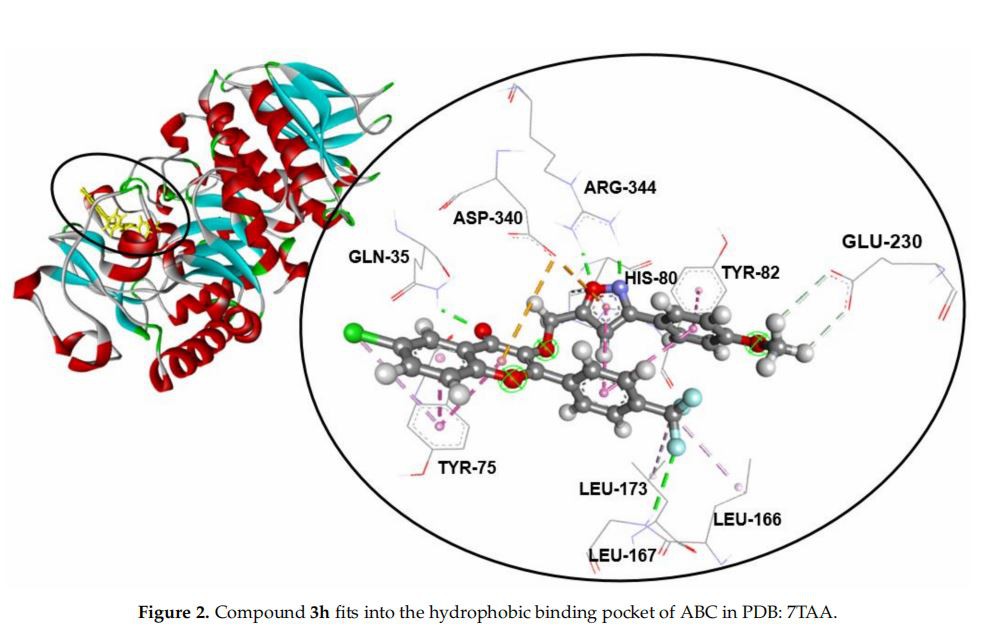
Furthermore, compound 3h exhibited interesting binding energy of −9.3 kcal/mol. Its binding mode shows that it is involved in 15 non-covalent interactions with 10 residues (Table 2). Accordingly, molecular insight from docking analysis suggests that the 3-(3-(4- methoxyphenyl)isoxazole-5-yl)methoxyl moiety forms two carbon-hydrogen bonds with GLU-230, a Pi–Pi T-shaped bond with TYR-82, two conventional hydrogen bonds with ARG-344, a carbon-hydrogen bond with HIS-80, and a Pi–anion bond with the ASP-340 residue. Moreover, the trifluoromethyl group is involved in a conventional hydrogen bond with GLY-167, and two alkyl interactions with the LEU-166 and LEU-173 amino acids. In addition, the flflavonoid skeleton is involved in a conventional hydrogen bond with GLN-35, a Pi–anion bond with ASP-340, two Pi–Pi stacked bonds, and a Pi–alkyl bond with TYR-75 (Figure 2)
On the other hand, compound 3j exhibited significant binding energy of −9.2 kcal/mol. Its binding mode shows that it is implicated in 16non-covalent interactions with 13amino acids (Table 2). Therefore, in-depth analysis of molecular docking suggests that the 3-(3-(4-butoxy-3-chlorophenyl)isoxazole-5-yl)methoxyl moiety forms two conventional hydrogen bonds with ARG-344, three Pi–alkyl bonds with TYR-82, HIS-210, and HIS-296, an alkyl interaction with LEU-232, a carbon-hydrogen bond with the GLU-230 residue, a Pi–anion bond with ASP-340, and a Pi–cation bond with HIS-80. Additionally, the trifluoromethyl group linked to the aromatic ring B of the flflavonoid skeleton is involved in a conventional hydrogen bond with GLY-167 and two alkyl interactions with the LEU-166 and LEU-173 residues. Moreover, the flflavonoid skeleton is involved in a conventional hydrogen bond with GLN-35 and a Pi–alkyl and two Pi–Pi stacked bonds with the amino acid TYR-75 (Figure 3). In the Aspergillus oryzae α-amylase enzyme (PDB: 7TAA), the nucleophile and the catalytic acid/base residues, which are responsible for the cleavage of glycosidic bonds, are the ASP-206 and GLU-230 amino acids, respectively [5]. Therefore, interactions between protein and ligand, primarily via the GLU-230 and ASP-206 residues, are the best way to block the cleavage of glycosidic bonds. In fact, the low binding energy, the correct binding pose, the ability to interact with key residues of glycosidic cleavage (GLU-230 and ASP-206), and a large number of interactions in the active pocket of the target enzyme (Table 2) can explain the strong inhibitory α-amylase efficacy established by most compounds.

Figure 3. Compound 3j fits into the hydrophobic binding pocket of ABC in PDB: 7TAA
3. Materials and Methods
3.1. General Experimental ProceduresAll used solvents were freshly distilled prior to use. All chemical reactions were monitored using commercial TLC plates (Silica gel 60, F254, SDS). A Büchi 510 apparatus was used to determine melting points. All 1H NMR (300 MHz), DEPT 135, and 13C NMR(75 MHz) spectra were recorded in deuterated chloroform and dimethyl sulfoxide-d6 with a Bruker AC-300 spectrometer. All chemical shifts (δ) were reported in parts per million(ppm), coupling constants (J) were given in Hertz (Hz), and residual non-deuterated solvent resonance was used as an internal reference. DCI-HRMS spectra were run in aWaters GCT 1er in the positive ion mode. ESI-HRMS spectra were recorded with ESI-TOF(Waters LCT, Markham, Ontario, Canada) in the positive ion mode using the reflectron mode.
4. Conclusions
The 15newly synthesized trifluoromethylation flavonoid-based isoxazoles (3a–m) were evaluated in vitro for their α-amylase inhibitory activity, and considerable results were noted. The cycloadducts 3b, 3h, 3j, and 3m exhibited comparable efficacy and potency to those of acarbose used as a standard substance to inhibit the α-amylase enzyme. In addition, the analysis of the structure-activity relationship revealed that halogenated and alkoxylated derivatives were the most active compounds. According to the silicodocking analysis, the trifluoromethylation flavonoid-based isoxazoles showed low binding energy, a large number of interactions, and the correct binding position in the active pocket of the target enzyme. Most of them interacted with the nucleophile and the catalytic acid/base residues (GLU-230 and ASP-206), which may explain their efficacy and potency in inhibiting the enzymatic activity of α-amylase. The promising activities displayed by the synthesized hybrid compounds encourage their involvement as candidates for the discovery of new antidiabetic and anti-obesity agents. However, very in-depth studies and safety factors must take into account the risks associated with the novelty of the active substance, toxicity, stability, and solubility in the aqueous medium, and pharmacodynamic characteristics, including the reliability with which side effects can be monitored in humans before potentially serious/irreversible effects develop. Supplementary Materials: The following are available online, NMR Spectra of the synthesized compounds (1, 2, and 3a–m), Table S1: The concentration-response curves used to calculate theIC50 values.Author Contributions: Conceptualization F.K.A. and I.S.; methodology, H.B.J.; software, I.S. andH.N.A.; validation, F.K.A., and A.C.; formal analysis, M.R.E.; investigation, F.K.A. and I.S.; resources, B.Y.A.; data curation, F.K.A. and I.S.; writing—original draft preparation, F.K.A. and I.S.; writing—review and editing, H.B.J.; visualization, F.K.A. and B.Y.A.; supervision, H.B.J.; project administration, F.K.A. and H.B.J.; funding acquisition, F.K.A. All authors have read and agreed to the published version of the manuscript. Funding: This research received no external funding.Institutional Review Board Statement: Not applicable.Informed Consent Statement: Not applicable.Data Availability Statement: Not applicable.Acknowledgments: The authors extend their appreciation to the Deanship of Scientific Research at Imam Mohammad Ibn Saud Islamic University for funding this work through the Research Group. RG-21-09-69.Conflicts of Interest: The authors declare no conflict of interest.Sample Availability: Samples of the compounds are not available from the authors.
References
1. Boutayeb, A.; Boutayeb, S. The burden of noncommunicable diseases in developing countries. Int. J. Equity Health 2005, 4, 1–8. [CrossRef]
2. Wagner, K.H.; Brath, H. A global view on the development of noncommunicable diseases. Prev. Med. 2012, 54, S38–S41. [CrossRef]
3. Tseng, C.H. The potential biological mechanisms of arsenic-induced diabetes mellitus. Toxicol. Appl. Pharmacol. 2004, 197, 67–83. [CrossRef]
4. Sala, D.; Zorzano, A. Differential control of muscle mass in type 1 and type 2 diabetes mellitus. Cell. Mol. Life Sci. 2015, 72, 3803–3817. [CrossRef]
5. Brzozowski, A.M.; Davies, G.J. Structure of the aspergillus oryzae α-amylase complexed with the inhibitor acarbose at 2.0 Å resolution. Biochemistry 1997, 36, 10837–10845. [CrossRef]
6. Jayaraj, S.; Suresh, S.; Kadeppagari, R.K. Amylase inhibitors, and their biomedical applications. Starch-Stärke 2013, 65, 535–542. [CrossRef]
7. Khan, S.; Nazir, M.; Raiz, N.; Saleem, M.; Zengin, G.; Fazal, G.; Saleem, H.; Mukhtar, M.; Tousif, M.I.; Tareen, R.B.; et al. Phytochemical profiling, in vitro biological properties and in silico studies on Caragana ambigua stocks (Fabaceae): A comprehensive approach. Ind. Crops Prod. 2019, 131, 117–124. [CrossRef]
8. Berg, J.M.; Tymoczko, J.L.; Stryer, L. Enzymes can be inhibited by specific molecules. In Biochemistry, 5th ed.; W.H. Freeman: New York, NY, USA, 2002.
9. Kam, A.; Li, K.M.; Razmovski-Naumovski, V.; Nammi, S.; Shi, J.; Chan, K.; Li, G.Q. A comparative study on the inhibitory effects of different parts and chemical constituents of pomegranate on α-amylase and α-glucosidase. Phytother. Res. 2013, 27, 1614–1620. [CrossRef]
10. Nie, J.P.; Qu, Z.N.; Chen, Y.; Chen, J.H.; Jiang, Y.; Jin, M.N.; Yu, Y.; Niu, W.Y.; Duan, H.Q.; Qin, N. Discovery and anti-diabetic effects of novel isoxazole based flavonoid derivatives. Fitoterapia 2020, 142, 104499. [CrossRef]
11. Malešev, D.; Kunti´c, V. Investigation of metal-flavonoid chelates and the determination of flavonoids via metal-flavonoid complexing reactions. J. Serb. Chem. Soc. 2007, 72, 921–939. [CrossRef]
12. Pinheiro, P.F.; Goncalon, C.J. Structural Analysis of Flavonoids and Related Compounds—A Review of Spectroscopic Applications. In Phytochemicals—A Global Perspective of Their Role in Nutrition and Health; InTech: London, UK, 2012.
13. Lo Piparo, E.; Scheib, H.; Frei, N.; Williamson, G.; Grigorov, M.; Chou, C.J. Flavonoids for controlling starch digestion: Structural requirements for inhibiting human α-amylase. J. Med. Chem. 2008, 51, 3555–3561. [CrossRef]
14. Xiao, J.; Ni, X.; Kai, G.; Chen, X. A review on structure-activity relationship of dietary polyphenols inhibiting α-amylase. Crit. Rev. Food Sci. Nutr. 2013, 53, 497–506. [CrossRef] [PubMed]
15. Hua, F.; Zhou, P.; Wu, H.Y.; Chu, G.X.; Xie, Z.W.; Bao, G.H. Inhibition of α-glucosidase and α-amylase by flavonoid glycosides from Lu’an GuaPian tea: Molecular docking and interaction mechanism. Food Funct. 2018, 9, 4173–4183. [CrossRef] [PubMed]
16. Vinayagam, R.; Xu, B. Antidiabetic properties of dietary flavonoids: A cellular mechanism review. Nutr. Metab. 2015, 12, 1–20. [CrossRef] [PubMed] 17. Ghorbani, A. Mechanisms of antidiabetic effects of flavonoid rutin. Biomed. Pharmacother. 2017, 96, 305–312. [CrossRef] [PubMed]