UPLC-Q-Orbitrap HRMS Combined With Molecular Docking To Investigate Material Basis Of Bitter Taste And Flavor-effect Relationship in Cistanchia Desertica
Dec 18, 2024
Abstract
Based on ultra performance liquid chromatography-quadrupole-electrostatic field orbitrap high resolution mass spectrometry (UPLC-Q-Orbitrap HRMS) and molecular docking, the bitter taste presenting substances of Cistanchis deserticola extract were investigated to lay a research foundation for the de-bittering and correcting of the taste, and to investigate their relationship with the bitter taste efficacy. Firstly, UPLC-Q-Orbitrap HRMS was used to characterize the constituents of C. deserticola, and 69 chemical components were identified. Molecular docking of these chemical components with the bitter taste receptor resulted in the screening of 20 bitter-presenting substances, including 6 phenylethanol glycosides, 5 flavonoids, 3 phenolic acids, 2 cycloalkenyl ether terpenes, 2 alkaloids and 2 other components. The extracts of the same origin were collected from the same place of origin, and the bitter-presenting substances were investigated by molecular docking. Other components, nine batches of fresh C. deserticola samples were collected from different months of the same origin, divided into different months and different parts, and the quantitative value of bitterness of the samples was determined by the electronic tongue method, and the contents of six components in the samples (pineconotyloside, trichothecene glycoside, tubulin A, iso-trichothecene glycoside, jinshihuaoside, and jingnipinoside) were determined by high performance liquid chromatography (HPLC), and total phenylethanol glycosides in the samples were determined by the UVvisible spectrophotometric method. photometric method to determine the contents of total phenylethanol glycosides, total polysaccharides, total alkaloids, total flavonoids, and total phenolic acids in the samples, and will be combined with chemometrics analysis on this basis, and verified by Pearson's correlation analysis, gray correlation analysis, and orthogona l partial least squares-discriminant analysis to verify the bitter components in C. deserticola, which were in agreement with the results of the molecular docking; and finally, with the bitter-presenting substances as the object of the study.

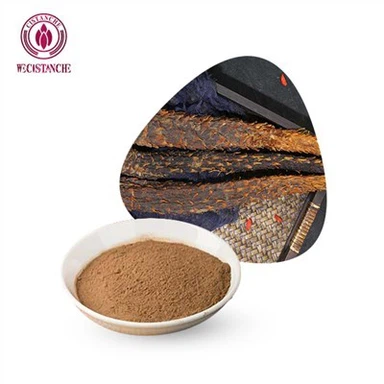
Cistanchis deserticola extract
Finally, network pharmacological prediction and analysis were carried out with the bitter substance as the target, and the relationsh ip between the target of the bitter substance and the bitter efficacy was investigated. The results showed that the key targets of the b itter substance were EGFR, PIK3CB and PTK2, and that the bitter substance might exert the bitter efficacy through the ac tion on the relevant disease targets, which means that the bitter substance of C. desertica is the material basis of the bitter efficacy. In conclusion, this study showed that the phenylethanol glycosides, mainly pinealoside, mauritiana glycoside and gibbe rellin, are the material basis of the bitter taste of C. desertica, and the molecular docking technology has a guiding role in the screening of bitter substances in traditional Chinese medicine, and that the bitter substances of C. desertica have the effect of bitterness, which is a good basis for the "taste-efficacy" of traditional Chinese medicine in future. The bitter substances in C. desertica have bitter taste and effect, which will provide ideas and references for the future research on the relationsh ip between taste and effect in traditional Chinese medicine

Keywords Cistanchis deserticola extract; UPLC-Q-Orbitrap HRMS; network pharmacology; molecular docking; electronic tongue; bitter substances; taste-effect relationship
Cistanche deserticola Y. C. Ma. is a perennial root parasite of the Orobanchaceae family, genus Cistanche, commonly known as desert Cistanche[1]. The Shennong's Herbal Classic states that Cistanche tastes sweet and slightly warm. However, it actually has a persistent and slight bitter taste after being taken. The "flavor" of the five flavors of traditional Chinese medicine was originally determined based on the actual taste of the medicine when tasted, but because the taste of the medicine is closely related to its effect, it gradually evolved into explaining and summarizing the effect of the medicine by "flavor"[2]. Cistanche is recorded in many classic ancient medical books. It has the effects of nourishing the kidney and replenishing essence, moistening the intestines and relieving constipation. Since ancient times, it has been used to treat diseases related to kidney deficiency, including sexual dysfunction, female infertility, loss of essence and blood, soreness of the waist and knees, dry intestines and constipation, etc.[3]. The bitterness of traditional Chinese medicine is one of the five flavors of traditional Chinese medicine theory and is an important theoretical basis for guiding the clinical use of traditional Chinese medicine. Bitterness is one of the five flavors of traditional Chinese medicine. Its characteristics are purgative, drying and firming[4], and it plays an important role in guiding the clinical use of traditional Chinese medicine. Most traditional Chinese medicines and traditional Chinese medicine preparations have a bitter taste. Traditional Chinese medicine believes that the bitter flavoring substances (hereinafter referred to as bitter substances) in bitter medicines are the effective substances[5]. However, the relationship between bitter substances in traditional Chinese medicines and their bitter efficacy is still unclear. There is still a lack of relevant scientific research on whether the bitter substances in bitter traditional Chinese medicines have bitter efficacy. Cistanche contains a variety of chemical components, mainly phenylethanol glycosides, cyclopentane ether terpenes, lignans and their glycosides, sugars, etc. In addition, it also contains flavonoids, phenolic acids, alkaloids, volatile oils, amino acids, inorganic trace elements and other components[6]. Among them, phenylethanol glycoside compounds are considered to be the main effective components in Cistanche[7]. Cistanche deserticola has two harvesting seasons: spring and autumn. Studies have shown that the polysaccharide content of spring Cistanche deserticola is low, the phenylethanol glycoside content is high, and the taste is bitter, but its antioxidant capacity is strong [8]. It can be seen that its bitter components have a certain correlation with the efficacy of the drug, but the material basis of the bitter taste of Cistanche deserticola is still unclear, which may limit its further development.

In order to explore the bitter substance basis of Cistanche deserticola and its relationship with bitter efficacy (taste-effect relationship), this study took Cistanche deserticola extract as the research object, and screened out the bitter substances in Cistanche deserticola by ultra-high performance liquid chromatography-quadrupole-electrostatic field orbitrap high resolution mass spectrometry (UPLC-Q-Orbitrap HRMS) technology and molecular docking; the content of the main bitter medicinal components was determined by high performance liquid chromatography (HPLC), and the content of each major category of bitter substances was determined by UV-visible spectrophotometry. The degree of bitterness was evaluated by electronic tongue, and the bitter components were found in combination with chemometrics; and network pharmacology technology was used to perform KEGG pathway and GO enrichment analysis on the targets of bitter substances in traditional Chinese medicine, and the targets of bitter substances were correlated with the targets of their bitter efficacy, so as to explore the relationship between bitter substances and bitter efficacy in traditional Chinese medicine. The research ideas are shown in Figure 1. This study made full use of modern technology research methods to explore the taste information of Cistanche deserticola, revealing its bitter material basis and taste-effect relationship. It is expected to provide a reference for the scientific analysis of the material basis of taste of traditional Chinese medicine, and provide a basis for the in-depth and precise development and utilization of Cistanche deserticola resources, making the five flavors theory clearer, more objective, and standardized, scientifically explaining the scientific connotation of the bitterness theory, and providing research ideas and references for exploring the true taste and efficacy relationship of the material basis of the nature and flavor of traditional Chinese medicine.


Fig. 1 Route of study on the relationship between bitter-presenting substances and bitter efficacy of Cistanche deserticola extracts
1 Materials
1.1 Medicinal materials
Fresh Cistanche deserticola samples were collected in Aksu, Xinjiang from April to December 2023. The samples were identified by Li Mingjie, a pharmacist at Shaya County People's Hospital, as the dried fleshy stems with scale leaves of Cistanche deserticola, a plant of the genus Cistanche in the family Orobanchaceae. The voucher specimens were stored in the Pharmacy Research Laboratory of Xinjiang Medical University. The samples were cleaned of impurities, sliced fresh and blanched in water for 5 min according to the literature, and then processed, dried at 60 °C, crushed, and sieved through a 40-mesh sieve, see Table 1.
Table Samples information of Cistanche deserticola
| No. | Code | Collection Time | Pretreatment before Drying | Detection Site |
|---|---|---|---|---|
| 1 | M1 | 2023-04-10 | Whole - plant slices | Whole plant |
| 2 | M2 | 2023-05-08 | Whole - plant slices | Whole plant |
| 3 | M3 | 2023-06-15 | Whole - plant slices | Whole plant |
| 4 | M4 | 2023-07-10 | Whole - plant slices | Whole plant |
| 5 | M5 | 2023-08-11 | Whole - plant slices | Whole plant |
| 6 | M6 | 2023-09-10 | Whole - plant slices | Whole plant |
| 7 | M7 | 2023-10-09 | Whole - plant slices | Whole plant |
| 8 | M8 | 2023-11-14 | Whole - plant slices | Whole plant |
| 9 | M9 | 2023-12-10 | Whole - plant slices | Whole plant |
| 10 | P1 | 2023-08-11 | Section - specific slices | Upper epidermis |
| 11 | P2 | 2023-08-11 | Section - specific slices | Upper cortex |
| 12 | P3 | 2023-08-11 | Section - specific slices | Upper pith |
| 13 | P4 | 2023-08-11 | Section - specific slices | Middle epidermis |
| 14 | P5 | 2023-08-11 | Section - specific slices | Middle cortex |
| 15 | P6 | 2023-08-11 | Section - specific slices | Middle pith |
| 16 | P7 | 2023-08-11 | Section - specific slices | Lower epidermis |
| 17 | P8 | 2023-08-11 | Section - specific slices | Lower cortex |
| 18 | P9 | 2023-08-11 | Section - specific slices | Lower pith |
1.2 Databases and software
TCMSP (https://tcmspw.com/tcmsp.php), GeneCards (https://www.genecards.org), OMIM (https://www.omim.org), UniProt (https://www.uniprot.org), PDB (http://www.rcsb.org), STRING (https://string-db.org), PubChem (https://pubchem.ncbi.nlm.nih.gov/), DAVID (https://david.ncifcrf.gov/), AlphaFold Protein Structure Database (https://alphafold.ebi.ac.uk/), AlphaFold2 and AutoDockVina (https://alphafold.ebi.ac.uk/) were used for molecular docking. IBM SPSS Statistis 25 was used for Pearson analysis. Software: Gray association analysis was performed using the online website SPSSPRO (https://www.spsspro.com), orthogonal partial least squares discriminant analysis (OPLS-DA) was performed using SIMCA14.1 software, and network pharmacology analysis was performed using Cytoscape software.
1.3 Instruments and reagents
Vanquish ultra-high performance liquid chromatograph, Orbitrap Exploris 120 high-resolution mass spectrometer (ThermoFisher Scientific, USA); SA-402B electronic tongue (Insent, Japan); LC-20A high-performance liquid chromatograph (Shimadzu, Japan); UV-visible spectrophotometer (Shanghai Youke Instrument Co., Ltd.); AUW2200 electronic balance (Shimadzu Philippines Factory); SK250 ultrasonic cleaner (Shanghai Kedao Ultrasonic Instrument Co., Ltd.); DHG-9246A electric constant temperature blast drying oven (Shanghai Jinghong Experimental Equipment Co., Ltd.); Plusel+Chorusl ultrapure water instrument (Veolia, France).
The reference substances echinacoside (purity ≥98%, batch number PCL-#-A003), verbascoside (purity ≥98%, batch number PCL-#-M235), tubuloside A (purity ≥99%, batch number PCL-#-T003), scutellarin (purity ≥99%, batch number PCL-#-D005), and isovalascoside (purity ≥98%, batch number PCL-#-I236) were purchased from Sichuan Puxi'ao Standard Material Technology Co., Ltd.; the reference substances geniposide (purity ≥98%, batch number WP23120502), rutin (purity ≥98%, batch number WP32110405), gallic acid (purity ≥98%, batch number WP32140706), and betaine (purity ≥98%, batch number WP33654874) were purchased from Sichuan Weikeqi Biotechnology Co., Ltd.; Reinstein's salt, anhydrous glucose (analytical grade), acetonitrile, methanol (chromatographic grade), and phosphoric acid were purchased from Sinopharm Chemical Reagent Co., Ltd.