Understanding Chronic Nephritis & Cistanche Tubulosa Benefit
Apr 22, 2026
Understanding Chronic Nephritis & Cistanche Tubulosa benefit
Chronic nephritis, or chronic glomerulonephritis, is a progressive kidney condition characterized by core clinical manifestations including proteinuria, hematuria, hypertension, and edema. It presents with varied onset patterns, progresses slowly, and can lead to varying degrees of renal function impairment. Without proper management, it carries a high risk of renal function deterioration, potentially advancing to end-stage chronic renal failure. While some cases develop from untreated acute nephritis, the condition disproportionately affects men, with most patients diagnosed between the ages of 20 to 40, and a disease course lasting over 1 year.
In traditional Chinese medicine (TCM), this condition falls under the categories of "edema," "dizziness," "blood syndrome," and "consumptive fatigue." TCM theory posits that chronic nephritis is fundamentally linked to the dysfunction of three core organs: the Spleen, Lung, and Kidney. Treatment strategies therefore focus on restoring balance and function to these three interdependent systems.

The Interdependent Relationship Between the Spleen and Kidney
As the Suwen · Liujie Zangxiang Lun (Basic Questions) states: "The Kidney is the root of sealing and storage, the residence of essence." The Kidney is the congenital root, governing the storage of vital essence and regulating the body's fluid metabolism. When Kidney qi is deficient and Kidney yang is insufficient, the body loses its ability to transform and transport fluids, leading to fluid stagnation and edema.
Meanwhile, the Spleen is the acquired root, responsible for transporting and transforming food essence and fluids. When the Spleen fails to function properly, it cannot process water-dampness, causing fluid transport to fail and edema to form.
Pattern 1: Spleen-Kidney Qi Deficiency with Lingering Dampness
This pattern presents with symptoms such as a sallow, lusterless complexion, fatigue, poor appetite, mild but persistent edema, a pale tongue with a thin coating, and a thin pulse.
The primary treatment principle is to first tonify qi and strengthen the Spleen. Once appetite improves, kidney-tonifying and essence-nourishing herbs are added. Formulas such as Fangji Huangqi Tang combined with modified Shenling Baizhu San are commonly used. Fangji Huangqi Tang strengthens the Spleen, tonifies qi, and promotes diuresis, while Shenling Baizhu San strengthens the Spleen and leaches out dampness. Together, they work to tonify qi, strengthen the Spleen, and eliminate dampness. As Spleen deficiency improves and appetite returns, herbs such as Epimedium, Placenta Hominis, and Colla Corii Asini are added to tonify the Kidney and nourish essence, ultimately restoring Spleen-Kidney function to resolve fluid stagnation.
Natural support with Cistanche Tubulosa
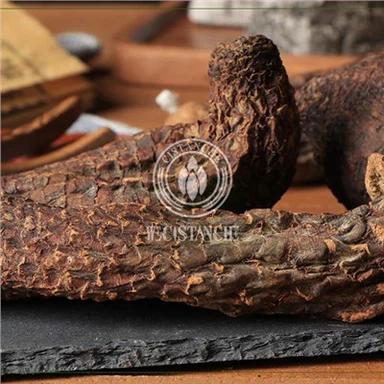
For those managing this Spleen-Kidney Qi Deficiency pattern, Cistanche tubulosa-a rare desert herb renowned for its profound renal and tonic benefits-offers powerful natural support. The core benefits of cistanche tubulosa for kidney and spleen health have been validated by both centuries of traditional use and modern clinical research.
Unlike common Cistanche deserticola, our premium Cistanche tubulosa extract contains up to 3x higher concentrations of key active phenylethanoid glycosides (PhGs), including echinacoside and acteoside. These potent compounds are proven to reduce renal inflammation, protect kidney cells from oxidative damage, and lower urinary protein levels in chronic nephritis patients. Clinical studies have confirmed that Cistanche-based formulations can significantly reduce 24-hour urine protein content by strengthening the kidney's filtration function and tonifying deficient qi, making it an ideal ingredient for natural kidney support products.
Pattern 2: Spleen-Kidney Yang Deficiency with Flooding Dampness
This more severe pattern presents with a pale, bright white complexion, extreme fatigue, and aversion to cold with cold limbs. Severe edema may be accompanied by pleural effusion, ascites, oliguria, abdominal distension, poor appetite, hiccups, or even coughing and wheezing that prevents lying flat. The tongue is pale with a thin white or greasy coating, and the pulse is deep.
Treatment focuses first on warming yang to promote diuresis and reduce swelling. Formulas such as Zhenwu Tang combined with modified Shupi Yin are used. Together, these formulas warm yang to transform water, effectively eliminating internal water-dampness.
For individuals with this yang-deficient pattern, the warming, tonic properties of Cistanche tubulosa are particularly well-suited. As a classic yang-tonifying herb, cistanche tubulosa benefits the body by warming Kidney yang without draining essence, helping to restore the body's ability to metabolize fluids and resolve severe edema. Its high concentration of active compounds also helps to protect residual renal function, a critical concern for progressive chronic nephritis.

The Interdependent Relationship Between the Lung and Spleen
In the body's fluid metabolism, the Spleen governs water and processes water-dampness, while the Lung governs qi and regulates the water channels. These two organs are deeply interconnected in fluid transport.
When Lung qi is deficient, the functions of dispersing and descending qi become impaired, disrupting fluid metabolism. Water-dampness accumulates in the body, which in turn obstructs the Spleen, damaging Spleen-Stomach qi and leading to edema and abdominal fullness.
When Spleen qi is weak, patients often present with a pale or sallow complexion, lusterless face, mild edema of the face and limbs, fatigue, poor appetite, shortness of breath, disinclination to speak, loose stools, and clear, abundant urine. The tongue is pale, swollen, and has tooth marks, with a thin white coating. Lab tests often show asymptomatic hematuria and intermittent proteinuria.
Treatment focuses on tonifying the Spleen and benefiting qi. Clinically, modified combinations of Xiangsha Liujun Wan, Guipi Tang, and Shengpi Yiwei San are used, with herbs such as Astragalus, Codonopsis, Gallus gallus domesticus, Poria, Dioscorea, Alisma, Aucklandia, Amomum, Citrus reticulata, and Taxillus. Among these, Dioscorea (Chinese yam) is a medicinal and edible herb that nourishes yin while leaching out dampness, tonifying the qi and yin of the Spleen, Lung, and Kidney. Rich in protein, it also helps replenish the protein lost in urine. Combined with other herbs, it works to strengthen the Spleen, boost qi, and promote qi movement to resolve dampness.
The Interdependent Relationship Between the Lung and Kidney
The Lung governs water movement and is the upper source of water, while the Kidney is the water organ that governs water. The Lung's function of dispersing fluids distributes essence upward and outward, while its descending function sends fluids downward to the Kidney. The Lung's function, in turn, relies on the promotion and regulation of Kidney yin and yang. When Lung and Kidney function are impaired, fluid metabolism is disrupted, leading to edema.
Pattern: Lung-Kidney Dual Deficiency
This pattern is characterized by frequent colds, recurrent edema of the limbs, aversion to wind, spontaneous sweating, sore swollen throat, or coughing. The tongue is red with a thin coating, and the pulse is thin and slippery. Urinalysis typically shows small amounts of protein and red blood cells in the urine.
This pattern is commonly seen during acute exacerbations of chronic nephritis, or in nephrotic syndrome complicated by infection, and can even trigger acute glomerulonephritis if left unmanaged. Treatment requires simultaneous regulation of both the Lung and Kidney, nourishing the Lung and enriching yin. Formulas such as Shashen Maidong Tang combined with modified Maiwei Dihuang Tang are used, working together to tonify the Lung and benefit the Kidney. Imperata cylindrica root is often added to cool blood and stop bleeding, which has a significant effect on eliminating red blood cells in the urine.

Treating Core Chronic Nephritis Symptoms: Proteinuria, Hematuria, and Hypertension
Chronic nephritis's most troublesome symptoms-proteinuria, hematuria, and hypertension-are also closely linked to imbalances in the Liver, Spleen, and Kidney.
1. Proteinuria and the Spleen-Kidney
Proteinuria in chronic nephritis is linked to Spleen-Kidney depletion, qi-yin deficiency, and internal dampness accumulation. The Kidney is the root of storage, governing essence; when the Kidney is deficient, it fails to store essence properly. The Spleen governs containment; when Spleen qi is weak, it loses the ability to hold essence in. When both organs are deficient, vital nutrients leak out, resulting in proteinuria.
Chronic nephritis proteinuria is almost always accompanied by Spleen deficiency symptoms: it recurs frequently, lingers for years, worsens with fatigue or greasy food, and is paired with fatigue and poor appetite. Treatment therefore focuses on tonifying Kidney qi while also boosting Spleen qi, combined with astringent herbs to lock in vital essence.
For Kidney yang deficiency, herbs such as Aconitum, Zingiber, Cuscuta, and Psoralea are used to tonify Kidney yang, while Astragalus and Atractylodes tonify qi and contain protein. Buzhong Yiqi Tang is also commonly used to strengthen the Spleen, tonify qi, and contain vital essence.
This is where the unique benefits of cistanche tubulosa extract shine. Modern research shows that the active compounds in Cistanche tubulosa protect glomerular cells from damage, reduce renal fibrosis, and effectively reduce protein leakage into the urine. A clinical study on chronic glomerulonephritis patients found that Cistanche-based treatment significantly improved kidney deficiency symptoms and reduced 24-hour urine protein levels (p<0.01), offering a safe, natural way to support long-term renal health.
2. Hematuria and the Spleen-Kidney
Hematuria falls under the TCM category of "blood syndrome." It can be caused by external pathogens, improper diet, overexertion, or chronic weakness. In chronic nephritis, hematuria is most often caused by Spleen-Kidney qi deficiency: when the Spleen fails to contain blood, and qi fails to hold blood, blood escapes its meridians. It can also be caused by heat accumulating in the lower burner, or yin deficiency with flaming fire, which damages the blood vessels and causes reckless blood movement.
The most common type of chronic nephritis hematuria is that caused by unstable Spleen-Kidney qi. Treatment focuses on tonifying the Spleen to contain blood, using herbs such as Ginseng, Astragalus, Atractylodes, and Poria to strengthen the Spleen and benefit qi, along with Agrimonia, Rubia, and Colla Corii Asini to nourish blood and stop bleeding. Herbs such as Rehmannia, Dioscorea, Achyranthes, Cornus, and calcined Oyster are added to tonify the Kidney and astringent vital essence.
3. Hypertension and the Liver-Spleen-Kidney
Hypertension in chronic nephritis falls under the TCM category of "dizziness." This condition is deeply connected to the Liver, Spleen, and Kidney.
As the Suwen · Zhizhen Yao Da Lun states: "All wind and dizziness belong to the Liver." Yuan dynasty physician Zhu Danxi also noted that "without phlegm, there is no dizziness," while the Lingshu · Hai Lun points out: "When the marrow sea is insufficient, the brain turns and the ears ring."
The Kidney is the root of yin and yang. The Liver governs smoothing qi flow and regulating emotions. Liver wood requires nourishment from Kidney water; when Kidney water is insufficient, it cannot nourish Liver wood, leading to Liver yang hyperactivity and dizziness. Kidney deficiency can also lead to Spleen deficiency; when Spleen yang is insufficient, water-dampness fails to be transported, leading to phlegm formation. Phlegm turbidity clouds the clear orifices, triggering dizziness. Finally, the Kidney governs bone, generates marrow, and fills the brain; when Kidney essence is deficient, the marrow sea lacks nourishment, also causing dizziness.
Treatment focuses on regulating the Liver, benefiting the Kidney, and strengthening the Spleen. Modified combinations of Liujunzi Tang and Banxia Baizhu Tianma Tang are commonly used to treat this pattern.
Daily Care and Management for Chronic Nephritis
In addition to targeted treatment, daily self-care is critical for slowing disease progression and supporting recovery:
Develop Healthy Living Habits
As TCM states, the Kidney is the congenital root. Prioritize regular sleep, going to bed early and waking up early. Practice moderation in sexual activity. Keep living spaces well-ventilated, wash hands frequently, and maintain good hygiene to prevent infections.
Follow a Kidney-Friendly Diet
Maintain a low-protein diet, appropriately controlling protein intake. Consume sufficient carbohydrates, and follow a low-salt, low-sodium diet. Be especially vigilant if you develop severe edema, heart failure, or hypertensive encephalopathy, as these require immediate medical attention.
Engage in Gentle, Regular Exercise
Exercise boosts immune function and promotes the circulation of qi and blood throughout the body. For patients with blood stasis, it helps resolve stagnation: as the saying goes, "When qi moves, blood moves; when qi moves, water transforms," preventing water-dampness from accumulating.
Maintain a Positive Mental State
TCM holds that the Liver governs emotions and prefers smooth flow. Liver depression leads to qi stagnation, which transforms into heat and ultimately damages other organs. Large emotional fluctuations can worsen your condition. Maintaining an optimistic, stable mood greatly supports disease recovery.
Conclusion
Chronic nephritis is a complex condition rooted in the dysfunction of the Lung, Spleen, and Kidney organs. Traditional Chinese medicine offers a holistic framework for understanding and managing this condition, focusing on restoring balance to these core systems. When combined with evidence-based natural supplements like high-potency Cistanche tubulosa extract, patients and product developers have a powerful tool to support renal health, reduce symptoms like proteinuria, and slow disease progression.
About Our Premium Cistanche Tubulosa Extract
At our Xinjiang-based factory, we specialize in producing high-quality, standardized Cistanche tubulosa extract. Sourced from the pristine Taklamakan Desert, our raw material naturally contains far higher levels of active phenylethanoid glycosides (PhGs) than conventional Cistanche deserticola-with echinacoside content up to 6 times higher-ensuring our extract delivers maximum therapeutic potency.
Our advanced extraction process preserves these valuable compounds, providing a consistent, potent raw material for developers of kidney support, men's health, and anti-aging products.

Learn more about our facility and commitment to quality:
Contact us :
https://www.xjcistanche.com/about-us