Why Is The Name Cistanche Deserticola Used To Refer To The Meat in The Aphrodisiac Yogurt?
Sep 05, 2024
Have you ever tried a cup of aphrodisiac yogurt with a minimum price of 49 yuan?
A while ago, Blueglass launched a yogurt series targeting male consumers, which was mocked by netizens as "aphrodisiac yogurt" because this series of products, called "Super Boy Boyfriend Power Back the Game", added maca, Cistanche deserticola, Huangjing, ginseng, deer whip, and other ingredients, and the promotional slogan was also very "borderline": "I don't sell under 18 years old, hahaha, don't say you don't understand" "It is recommended to drink more than one cup a day, I won't sell".
After causing controversy, Bluegrass ultimately deleted the relevant text and the words "boyfriend power", and changed the original position of the "18 bans" to "you need to buy again".
While roast about the promotional copy, netizens also focused on the added ingredients of this yogurt. Deer whip, ginseng, Polygonatum, etc. are relatively common. What is this distance? Why is its name "both meat and vegetable"?
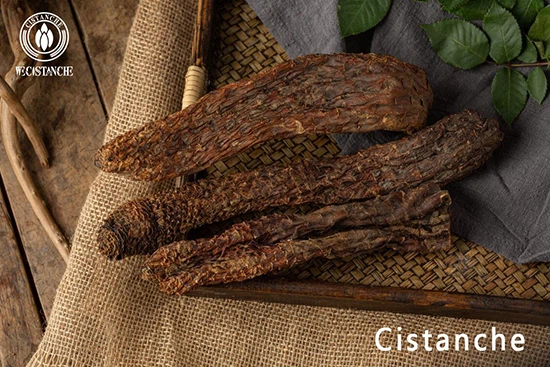
Cistanche deserticola
Why is it called Cistanche deserticola
At first glance, the name Cistanche deserticola sounds like some kind of meat, but it is a proper herbaceous plant.
Cistanche deserticola, also known as goblin, big cloud, inch cloud, and Cistanche deserticola, is a parasitic plant that parasitizes the roots of plants such as red willows, red willows, tamarisk, and white thorns. It generally grows in sandy or semi-fixed dunes, dry old riverbeds, and lowlands of lakes and basins, and is known as the "desert ginseng". There is also a saying among the people that "I would rather have a basket of Cistanche deserticola than a bed full of gold and jade", which shows the preciousness of Cistanche deserticola.
The origin of Cistanche deserticola is also quite legendary.
It is said that Dayu controlled the flood through Zhangye and subdued the evil dragon with a magic needle. Later, the evil dragon turned into dunes and the magic needle turned into red willows. The distance growing under the red willows absorbed the essence of the dragon and benefited the people.
There is also a saying that Cistanche deserticola is a divine artifact bestowed upon Genghis Khan by the divine horse sent by the gods. In the famous "Battle of the Thirteen Wings" in history, Genghis Khan was surrounded by Zhamu and trapped in a sand mountain covered with red willows. Exhausted, the gods sent out divine horses. The horses flew ahead of Genghis Khan, raised their heads to the sky, and let out a long roar, shooting their blood towards the roots of the red willows. Then, they used their hooves to dig out plant roots (such as Cistanche) that looked like the reproductive organs of divine horses. Genghis Khan and his generals ate the roots, and their divine power surged down the sand mountain, crushing the Zhamu tribe in one fell swoop.
Although this is a legend, the two claims are not entirely unreasonable. For example, in these two legends, Cistanche always grows near the red willow tree. This is true because Cistanche naturally grows in desert areas with relatively dry climates, long sunshine hours, and soft sand such as Xinjiang, Ningxia, and Gansu. It needs to "rely" on the roots of the red willow tree to absorb water to grow. Nowadays, when planting Cistanche deserticola, it is still necessary to plant red willow trees and let Cistanche deserticola parasitize at its roots.
Of course, legends are still legends, and it is impossible to verify who first discovered the medicinal properties of Cistanche deserticola. However, people's "wonderful use" of Cistanche deserticola has a long history.
Cistanche deserticola was first recorded in one of the four classic works of traditional Chinese medicine, the "Shennong Bencao Jing". Wu Pu, a disciple of the famous physician Hua Tuo during the Three Kingdoms period, also introduced Cistanche deserticola in "Wu's Bencao", which specifically mentioned its two aliases: Rousongrong and Heisiming. It also described the growth location and harvesting time of Cistanche deserticola.

Cistanche deserticola slice
One is Rou Songrong, and the other is Hei Siming. Shennong and Emperor: Xian. Lei Gong: Sour. Ji Shi: Xiao Wen. Sheng He Dongshan Yin Di. Three or four inches in length, it is a sturdy creature. Or Daijun, Yanmen. It is harvested from February to August and used for shade-drying
So, why is this traditional Chinese medicine called "Cistanche deserticola"?
Let's talk about 'meat' first. Meat mainly refers to its scales, leaves, and fleshy stems. From its appearance, Cistanche deserticola is about 80-100cm tall, with yellow stems buried underground. The flesh is thick and tender, and scale-like leaves are growing on the stems. It can be understood as meat ', which describes its texture as being' chubby '.
Let's take a look at 'Cistanche' again. Cistanche "evolved from the word" calm ". Li Shizhen's" Compendium of Materia Medica "states:" This herb (Cistanche deserticola) is nourishing but not steep, so it has the name calm. It has a calm and gentle appearance. "Li Zhongli's" Primitive Materia Medica "also has a related expression:" Although this herb is nourishing but not steep, it can calm and soothe, so it is called a beautiful name
'Jun' refers to a herb with strong medicinal effects and a fast onset of action. Both works mention that this herb is not Jun 'and has a mild and stable nourishing nature, hence the name' Cistanche '.
In addition, there are also claims that "Cistanche" implies its beneficial effects on the human body, which can harmonize the balance of yin and yang and achieve a calm and gentle state of the body.
One sentence: After eating Cistanche deserticola, one must be calm and composed.

Harvest of Cistanche deserticola
Various strange names of traditional Chinese medicine
Similar to Cistanche deserticola, there are many Chinese herbal medicines named after their characteristics (medicinal properties), such as Wang Buliuxing, whose main function is to promote blood circulation and meridian circulation. Its nature cannot be stopped, and its effect is extremely fast in promoting the flow of milk. Although it has a royal mandate, it cannot be retained, hence the name Wang Buliuxing; There is also Yuanzhi, whose main function is to enhance intelligence, make people's ears and eyes smart, and never forget to strengthen their willpower. The word "Yuanzhi" can be said to vividly describe its efficacy.
Similar to Cistanche deserticola, which is named after its characteristics, it is named based on the outstanding efficacy of the medicine. A typical example is windproof, which has the function of dispelling wind, dispelling wind, preventing wind pathogens, and treating wind diseases, hence the name windproof; There is also the option of continuation, which is mainly used for treating muscle injuries and fractures. It can also be used for bloodline, muscle and bone extension, and treatment of fractures. The name "continuation" is simple and clear.

Cistanche deserticola
In addition, naming based on medicinal parts is also very common. Chinese medicinal materials come from a wide range of sources, some of which can only be used as medicine in special parts, such as ephedra root and kudzu root, bitter neem root bark and mulberry root bark, as well as chrysanthemums, spiral flowers, and winter flowers that use flowers. The same goes for animal-based traditional Chinese medicines, such as buffalo horn, antelope horn, bear bile powder, etc. Just by hearing their names, one can tell where they are used.
As for Patrinia villosa, stinky wutong, houttuynia cordata, licorice, etc., they are named after their smell and taste, and their taste can be understood without having to eat them.
Compared to the more normal situations mentioned above, Chinese herbs named based on their morphology have more interesting names. Cordyceps and Hericium erinaceus are still common. Have you heard of Big Belly Skin?
This name sounds like a joke, but it is indeed a traditional Chinese medicine. It is the dried skin of betel nut. If named according to its medicinal parts, it can also be called betel nut skin, but its appearance is very peculiar, resembling the belly, hence the name "big belly skin".
There is also Golden-Haired Dog Ridge, also known as Golden-Haired Dog, Golden-Haired Lion, etc. The "real body" is the dried rhizome of Golden-Haired Dog Ridge, a plant in the family Clam Shell Fern, with a shape resembling the back of a Golden-Haired Dog.
In addition to being funny, some Chinese medicine names also contain legends and allusions, which have great cultural connotations.
In this case, the drug name is often related to the discoverer or initial user of the drug.
effects of cistanche-improve kidney function
Click here to view Cistanche for Kidney disease products
【Ask for more】 Email:cindy.xue@wecistanche.com / Whats App: 0086 18599088692 / Wechat: 18599088692
A classic example is Xu Changqing. Many people know that he is a character from "The Legend of Sword and Fairy III", but they don't know that he is also a Chinese medicinal herb. Legend has it that during the Tang Dynasty, Li Shimin was bitten by a venomous snake while hunting, and was eventually saved by the folk doctor Xu Changqing using snake dysentery grass. However, when Li Shimin asked him what medicine he was using, Xu Changqing did not know how to answer because after Li Shimin was bitten by a snake, he issued an order that whoever said words with the word "snake" would be punished.
In the end, Wei Zheng helped Xu Changqing out of the situation. He asked if the herb didn't have a name yet, and Xu Changqing immediately responded, saying that the herb was born in the mountains and had no name yet. Li Shimin then directly named the herb after Xu Changqing, but its original name, Snake Fury Grass, was used by fewer and fewer people.
Like Xu Changqing, Liu Jinnu is also a well-known traditional Chinese medicine herb. Legend has it that Liu Jinnu was discovered by Emperor Wu of the Southern Song Dynasty, Liu Yu, during a war while he was ill, and Liu Jinnu is Liu Yu's nickname. Polygonum multiflorum also has a name and a surname. Legend has it that an old man surnamed He named this herb Polygonum multiflorum after eating it. Despite over a hundred years old, his hair remained black and shiny.
The "poetic and picturesque sense of responsibility" in the names of traditional Chinese medicine often appears in herbs named according to their growth characteristics, environment, and season: Pinellia ternata harvested in half of the summer (during the fifth lunar month); Summer dry grass that withers after reaching the summer solstice; When the flowers first bloom, they are as white as silver, and a few days later they turn into golden honeysuckle; Mulberry leaves harvested during frost
Speaking of Cistanche deserticola, do you suddenly feel its name is "unremarkable"?
However, Blueglass's yogurt products with added ingredients such as Cistanche deserticola are fresh. Although many studies have confirmed its anti-fatigue and regulation of kidney yang deficiency-related indicators in mice, it is still uncertain whether it can directly enhance male function in humans. Moreover, how much Cistanche deserticola is added to Bluegrass yogurt products, what quality of medicinal herbs are added, which part is specifically selected, and how it is reprocessed - the dosage and processing method have an impact on the efficacy, and consumers do not know.