Reno-protective Effect of AM6545 and AM4113 Treatments on Metabolic syndrome
Mar 21, 2022
Contact: Audrey Hu Whatsapp/hp: 0086 13880143964 Email: audrey.hu@wecistanche.com
PART Ⅰ:Interference with TGFβ1-Mediated Inflammation and Fibrosis Underlies Reno-Protective Effects of the CB1 Receptor Neutral Antagonists AM6545 and AM4113 in a Rat Model of Metabolic Syndrome
Basma G.Eid, Thikryat Neamatallah, Abeer Hanafy, Hany M.El-Bassossy & et al.
1. Introduction
Metabolic syndrome (MetS), is a combination of metabolic abnormalities that commonly manifests as insulin resistance (IR), abdominal obesity, dyslipidemia, and high blood pressure [1]. Patients with MetS(Metabolic syndrome) are at a high risk of developing diabetes, atherosclerotic cardiovascular disease (CVD), and renal impairment [2]. All of these diseases represent serious and often fatal health conditions that are prevalent in most countries. The prevalence of MetS(Metabolic syndrome) is increasing globally with over a billion people now affected [3]. This increase is associated with physical inactivity, high-calorie food consumption and drinks supplemented with sugars [4,5]. The relationship between MetS(Metabolic syndrome) and chronic kidney disease (CKD)is controversial. However, several studies have reported that a fructose-rich diet induces MetS(Metabolic syndrome) that subsequently progresses into various manifestations of nephropathy such as reduced glomerular filtration, albuminuria, uricosuria, proteinuria and changes in renal morphology [6-8]. Possible mechanisms of renal impairment may include the systemic release of pro-inflammatory cytokine mediators, free radicals and oxidative stress in MetS(Metabolic syndrome)[9,10]. Indeed, the incidence of CKD in patients with MetS(Metabolic syndrome) is 2.6-fold higher than in individuals without any MetS(Metabolic syndrome) components [11].

benefit of cistanche extract: anti-bacterial
Therapeutic interventions for MetS(Metabolic syndrome) include modulation of the overactive endocannabinoid (EC) system through inhibition of the cannabinoid CB1 receptor subtype |12]. Inhibition of CB1 receptor has been demonstrated to regulate appetite, food intake, and lipogenesis in obese rats [13-15]. The CB1 is a class A Rhodopsin-like G-protein coupled receptor (GPCR) that activates mainly Gαi/o proteins [16]. The ubiquitous CB1 receptors are vastly found in the central nervous system(CNS), which may increase the incidence of neuropsychiatric disorders [17]. It has been established that a full system of endocannabinoids exists in the kidney and has a significant role in renal homeostasis as well as in the development of diabetic nephropathy and conditions such as CKD[18].CB1 and CB2 receptors were reported to be present in the various parts of the nephron as well as other renal cells in both humans and rodents [19]. Furthermore, the endocannabinoid system in the kidney plays a predominant role in renal hemodynamics [20].
Rimonabant (SR141716), for example, is a CB1 receptor inverse agonist that was ap-proved clinically in April 2006 to treat metabolic complications and obesity in Europe [21]. However, withdrawal of the CNS penetrating drug rimonabant was pursued by the European Medicines Agency since it was associated with anxiety, depression and an increased tendency to cause suicide [17].
To circumvent the neuropsychiatric side effects of rimonabant, which were attributable to the central effects associated with its inverse agonist profile, we pursued two strategies for the development of efficacious analogs that lack its undesirable side effects. The first of these was the discovery of CB1 neutral antagonists. These compounds, unlike their inverse agonist counterparts that act by promoting the inactive state of the receptor, prevent the endogenously occurring endocannabinoids from interacting with CB1. AM4113 represents a successful CB1 neutral antagonist that shares the desirable effects of rimonabant but lacks its undesirable side effects. Our second strategy was to develop CB1 receptor antagonists that are unable to cross the blood-brain barrier. AM6545 represents a successful peripherally acting ligand, while at the same time maintaining the CB1 neutral antagonist profile. Both drugs were reported to retain the therapeutic activity in different animal models with less adverse effects than rimonabant [22-26].
In the current study, we aimed to determine whether treatment with the CB1 receptor antagonists AM6545 and AM4113 would improve kidney function in a high-fructose high-salt model of metabolic syndrome and to explore the underlying mechanism for the improved function. Such a study would allow us to identify if any of the effects of these compounds have a component related to centrally produced CB1 inactivation.

2. Results
2.1.Effect of AM6545 and AM4113 Treatments on Renal Endocannabinoid Tone
Measurement of anandamide (AEA) and 2-arachidonoyl glycerol (2-AG) in kidney homogenates was performed in order to assess the endocannabinoid tone in the kidney. As shown in Table 1, when control rats(C) were treated with either AM6545(C+ A65) or AM4113(C+A41)there was no significant effect on the content of both AEA and 2-A Gin the kidney. Animals with metabolic syndrome (MetS) displayed elevated levels of both AEA and 2-AG compared to controls(C). After treating the metabolic syndrome rats with either AM6545 (M+A65) or AM4113(M+A41), the animals still showed much higher levels of both AEA and 2-AG in the kidneys relative to the controls.
Table 1. Kidney content of anandamide and 2-arachidonoyl glycerol.

2.2.Effect of AM6545 and AM4113 Treatments on Renal Function in MetS(Metabolic syndrome) Rats
MetS(Metabolic syndrome) due to high-fructose high-salt feeding is associated with deterioration of the kidney function as indicated by the increased albumin excretion rate (AER) and proteinuria in comparison to controls (p<0.05, Figure 1A, B). Both AM6545 and AM4113 significantly inhibited (p <0.05)the elevated proteinuria and albumin excretion rate to similar levels suggesting protection of renal function in MetS(Metabolic syndrome). Neither AM6545 nor AM4113 significantly affected AER or proteinuria when administered in control animals (Figure 1A, B). Creatinine clearance was calculated and was much lower in the metabolic syndrome group(M) in comparison to controls (Figure ]C). Administering either AM6545(M+A65) or AM4113 (M + A41) to the metabolic rats had no effect on the creatinine clearance (Figure 1C).


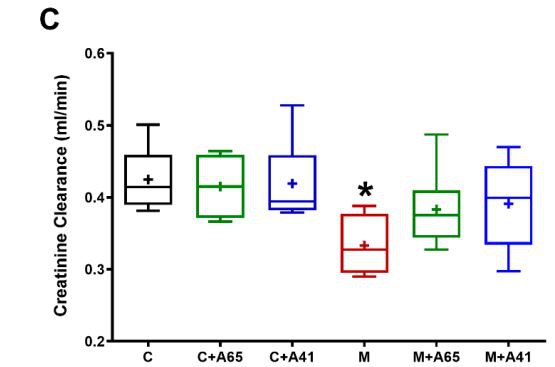
Figure 1. The CB1 receptor antagonists AM6545 and AM4113 improve renal functional parameters in high-fructose high-salt fed metabolic syndrome rats.
(A)shows the albumin excretion rate(AER),(B)shows the proteinuria, and (C) shows the creatinine clearance measured in control
(C) and metabolic syndrome(M)rats as well as after 4 weeks of intraperitoneal injection of AM6545 in control(C+ A65)and metabolic rats(M+A65)or AM4113 in control(C+A41)or metabolic rats(M+A41)at a dose of 10mg/kg/day.
Results are shown as box plots and the mean is shown as(+)(n=8).*p<0.05 relative to the control group and#p<0.05 relative to the metabolic syndrome group by one-way ANOVA followed by Tukey's post hoc test.
2.3.Effect of AM6545 and AM4113 Treatments on Blood Pressure
Measurement of blood pressure using the non-invasive tail-cuff method revealed that MetS(Metabolic syndrome) animals (M, M+ A65, M+ A41)showed significantly higher systolic and diastolic blood pressures in comparison to control animals. Treatment of the animals with either AM6545 or AM4113 did not cause any significant changes in the systolic and diastolic blood pressures (Table 2).
Table 2. Effect of AM6545 and AM4113 on systolic and diastolic blood pressure(BP)of metabolic syndrome (MetS)-induced rats.

2.4.Impact of AM6545 and AM4113 Treatments on Renal Histopathology in MetS(Metabolic syndrome) Rats
Examination of H&E-stained sections from MetS(Metabolic syndrome) rats showed marked histopathological changes, especially in the renal cortex where abnormal changes were seen mainly in the glomeruli and proximal convoluted tubules and renal stroma relative to the control group. The kidney of control rats displayed the normal structure of the renal cortex(Figure 2A, B), which contained mostly renal corpuscles consisting of glomerular capillaries enclosed by Bowman's capsule. Further, there was a capsular space between the proximal (PCT)and distal convoluted tubules (DCT). Tall cuboidal cells having an eosinophilic cytoplasm with central rounded nuclei lined the proximal convoluted tubules. Tall microvilli filled the lumen of the tubules, which showed a brush luminal border. The distal convoluted tubules were scarce relative to the PCT. In MetS(Metabolic syndrome) rats, the kidney showed variable degrees of changes (Figure2C-E) where some glomeruli were hypertrophied with dilated glomerular capillaries while other glomeruli appeared atrophic. Additionally, most PCTs were dilated with loss of brush borders; their cells had vacuolated cytoplasm and dark pyknotic nuclei. Moreover, the DCT displayed some degenerative changes with walls and vacuolated cytoplasm. In addition, interstitial spaces, peritubular hemorrhage, and mononuclear inflammatory cellular infiltration were seen in different areas of the renal cortex. Interestingly, MetS(Metabolic syndrome) rats treated with AM6545(Figure 3A, B) and AM4113(Figure3C, D) showed a marked improvement in the renal histological profile manifested by nearly normal glomeruli and PCT without signs of degeneration and/or inflammatory cells infiltration.


Figure 2. Representative photomicrographs of the histological structure of renal cortex in control and metabolic syndrome rats.
Control group(A, B) shows normal renal glomeruli(G) and tubules (PCT, DCT), while in the metabolic syndrome group (C-E) some glomeruli appeared atrophied (G1) while others appeared hypertrophied (G2) with dilated capillaries ().
Most of the PCT appeared degenerated with widened lumen, loss of brush border, and pyknotic nuclei (inside a circle).
Note the presence of interstitial wide spaces (*), blood extravasation (*), and infiltration with inflammatory cells (ICI). (H&E—A, C ×200—B, D, E×400).

Figure 3. Representative photomicrographs of the histological structure of the renal cortex in the rat's groups of metabolic syndrome treated with AM6545(A, B) and AM4113(C, D) CB1 receptor antagonists.
Notice the restoration of nearly normal appearance as compared to the control group regarding the glomeruli (G) and tubules(PCT, DCT). (H&E—A, C×200—B, D ×400)

2.5. Effect of AM6545 and AM4113 Treatments on UIric Acid Levels in MetS(Metabolic syndrome) Rats
Given the importance of uric acid in kidney inflammation and progression to chronic kidney disorder, Figure 4 shows that MetS(Metabolic syndrome) animals had a ten-fold increase in the urine uric acid content relative to controls (p <0.05). However, both CB1 antagonists, AM6545 and AM4113, significantly (p <0.05) inhibited this increased uric acid content while restoring it to near normal values. Meanwhile, neither AM6545 nor AM4113 significantly affected the urine content of uric acid in control animals.
2.6. Effect of AM6545 and AM4113 Treatments on TGFβ1 Levels in MetS(Metabolic syndrome) Rats
The study further investigated the role of TGFβ1 as a major mediator of pro-inflammation and fibrosis. As shown in Figure 5, the tissue concentration of TGFβ1 in kidneys isolated from MetS(Metabolic syndrome) rats was markedly (p <0.05) increased than in normal animals. However, the four weeks of treatment with AM6545 and AM4113 resulted in a significant (p<0.05)reduction of TGFβ1 concentrations, restoring it to normal values. While neither AM6545 nor AM4113 significantly affected TGFβ1 tissue concentrations in control kidneys. This result suggests that the CB1 receptor has a critical role in mediating inflammation and kidney fibrosis.
The correlation coefficient was computed to evaluate the correlation between the albumin excretion rate and the kidney level of TGFβ1(Table 3). A strong correlation was present between the AER and TGFβ1 in control and metabolic syndrome animals. The correlation was also present in the animals treated with AM6545, but not with AM4113.
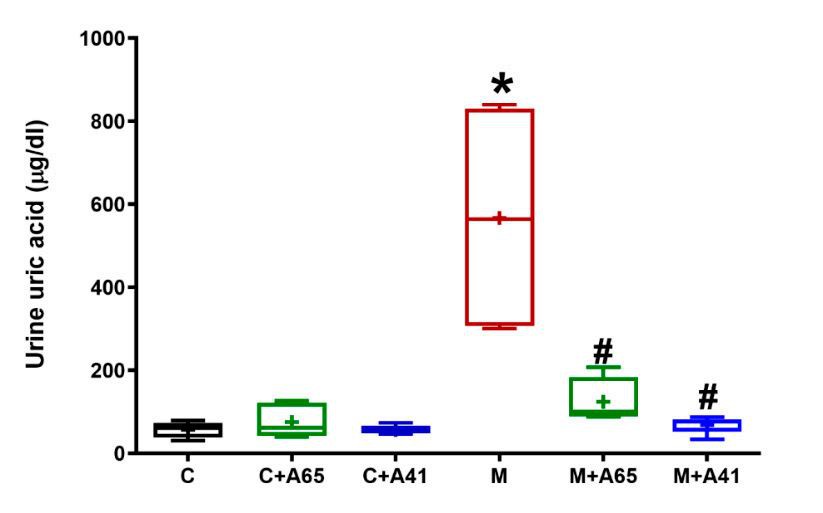
Figure 4. The CB1 receptor antagonists AM6545 and AM4113 blocked the tenfold elevation in urine uric acid content in high-fructose high-salt induced metabolic syndrome rats.
The concentration of uric acid was measured in the urine of the control (C) and metabolic syndrome (M) rats as well as control and metabolic rats treated with AM6545 (C+ A65) and (M+A65) respectively or AM4113(C+A41)and (M+A41)respectively at a dose of 10 mg/kg/day. Results are shown as box plots and the mean is shown as (+)(n=8).*p<0.05relative to the control group and #p<0.05 relative to the metabolic syndrome group by one-way ANOVA followed by Tukey's post hoc test.

Figure 5. The CB1 receptor antagonists AM6545 and AM4113 reduce TGFβ1 production in fructose-induced metabolic syndrome rats.
The concentration of TGFβ1 was measured in the control(C)and metabolic syndrome (M) rats as well as control and metabolic rats treated with AM6545(C+A65)and (M+ A65), respectively, or AM4113(C+A41) and(M+A41), respectively, at a dose of 10mg/kg/day. Results are shown as boxplots and the mean is shown as(+)(n=8).*p<0.05 relative to the control group and#p<0.05 relative to the metabolic syndrome group by one-way ANOVA followed by Tukey's post hoc test.
Table 3. The effects of AM6545 and AM113 on the correlation between albumin excretion rate(AER)and kidney level of the transforming growth factor-beta 1(TGF1).

2.7.Effect of AM6545 and AM4113 Treatments on Renal Fibrosis in MetS(Metabolic syndrome) Rats
Figure 6 shows the kidney sections from different groups stained by Masson's Trichrome to assess the collagenous fibers, which appeared as a bluish coloration. The renal cortex showed a marked increase of collagenous fibers in kidneys taken from MetS(Metabolic syndrome) rats(Figure 6B)as compared to the control rats (Figure 6A). In the interstitium and glomeruli, there was a surplus of collagen fiber deposition. In contrast, there was reduced deposition of collagenous fibers in the renal cortex with AM6545(Figure 6C)and AM4113 (Figure 6D)treatments. Quantification of Masson's Trichrome staining revealed a higher percentage in the metabolic syndrome (M) as well as in the metabolic treated groups(M + A65, M+A41)in comparison to controls. However, treatment of MetS(Metabolic syndrome) animals with AM6545 and AM4113 caused a significant lowering of Masson's staining relative to the non-treated metabolic group.


Figure 6. Representative photomicrographs of renal cortex of different groups stained with Masson's Trichrome. Notice the marked increase of collagenous fibers.
(A)in the kidney of metabolic syndrome (B) around the glomeruli(G) and tubules(PCT, DCT) as compared to the control(A). In contrast, AM6545-treated metabolic syndrome
(C) and AM4113-treated metabolic syndrome(D)showed a noticeable reduction of collagenous fibers. (Masson's Trichrome, A, B, C& D×200).
(E) shows the quantification of Masson's Trichrome staining expressed as a %. Results are shown as box plots and the mean is shown as(+)(n=8).*Significantly different from"C" at p<0.05,# Significantly different from"M" at p <0.05.