Xinjiang People, Your Treasure Is Being Cherished By Japanese People
May 14, 2024
In the early 1980s, Japanese experts discovered a "nourishing factor" from the desert plant "Cistanche deserticola". Its main active ingredients, "echinoside" and "piloside," can increase the proliferation rate of kidney cells by six times within 24 hours.

Phenylethanol glycoside is the main active component of Cistanche deserticola
When it comes to Guanhua Cistanche, one cannot help but mention Hotan in Xinjiang. If the southern edge of the Taklamakan Desert is home to Guanhua Cistanche, then the Hotan region and its people are the guardians of Guanhua Cistanche, and both sides are interdependent.
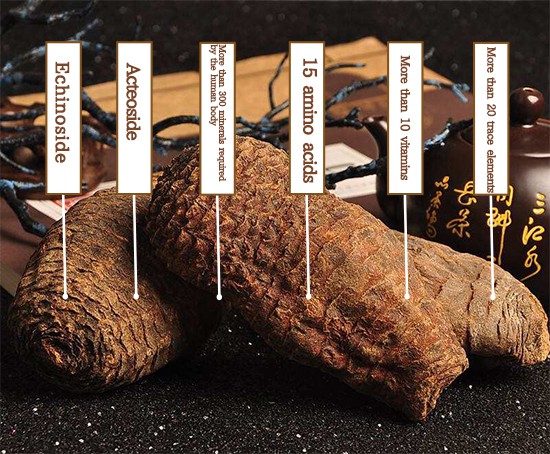
Main Chemical Constituents of Cistanche deserticola
"Jing Wei" skillful hand in sand control
If you have been to Hotan, you must have experienced the power of wind and sand.
"The wind blows the sand away, lifting your feet without a trace" was once a true portrayal of the ecological situation in Aireke Township, Hotan Ying. The houses of local farmers are located on the edge of the desert. If they are not protected from wind and sand, and not to mention the 2 acres of arable land per person, their homes may be submerged by sand.
The Hotan region is located at the southernmost point of Xinjiang Uygur Autonomous Region, adjacent to the Taklamakan Desert, forming a warm temperate and extremely arid desert climate.
Sandstorms are often linked to poverty. According to incomplete statistics, the direct economic losses caused by sandstorms to farmers and herdsmen in the entire autonomous region each year are as high as 3 billion yuan.
The project of planting trees for sand prevention and fixation by the State Forestry Administration is rare because it cannot generate economic value. There is a common shrub called red willow in the desert beaches of Xinjiang. The branches of the red willow are pink, purple, or black red. It is an excellent tree species for soil and water conservation, as well as a windproof and sand-fixing plant. The plant has a high survival rate and strong adaptability through cutting propagation and is recognized as a saline-alkali plant among afforestation tree species in China. Growing in poor soil, it is an excellent greening tree species in various saline-alkali areas.

Cistanche deserticola florescence
As one of the nine immortal herbs recorded in the Chinese Pharmacopoeia, Cistanche deserticola, combined with the growth environment and soil conditions of its family, as well as factors such as the growth rate, adaptability, and seedling survival rate of Red Willow, is the most suitable host for artificial cultivation of Cistanche deserticola in Hotan, Xinjiang. To explore a new model for desert governance, the government of the Hetian region has partnered with the Hetian Emperor Chen Company to carry out large-scale commercial development of Cistanche deserticola. This not only promotes the cultivation of red willows and desert governance in expanding raw material bases but also helps the government quickly achieve targeted poverty alleviation and relief. At the same time, it will also effectively assist Hotan in accelerating the pace of "mode transformation, structural adjustment, investment promotion, and people's livelihood", improving the quality and efficiency of development, and promoting the sustained and healthy development of the local economy.
Emperor Chen leads farmers to become rich
The implementation of the "Belt and Road" strategy has made this ancient Silk Road city shine a new light on its dusty history. The poverty alleviation work in Xinjiang is focused on southern Xinjiang, while Hotan is a difficult point. Hotan is a gathering place for Uyghur people, with a current poverty population of 704000, accounting for a quarter of the total population in Xinjiang, exceeding 30% of the region's total population. The per capita arable land area is less than 1 mu, and the poverty alleviation situation is extremely severe. Due to the fragile ecological environment, lagging transportation infrastructure, and lack of industrial support, the development of traditional industries and the modern economy in Hotan is severely constrained.
Cistanche deserticola, also known as Dayun. September to November is the harvest season for Dayun every year. At this time, Uyghur farmers in Yingairike Township of Hotan County and Hanggui Township of Luopu County are extremely busy. More than half of the farmers in the village make a living by directly or indirectly participating in the artificial planting of red willow tube flowers and Cistanche deserticola, as well as the construction of desert greening projects. The busy harvest brings about an increase in income.

Planting of Cistanche deserticola
"Guanhua Cistanche can be planted in the Gobi Desert desert, and the government has introduced drip irrigation. Scientists from Emperor Chen Company teach us planting techniques and also come to purchase them, so we don't have to worry too much about it. It can not only fix sand and protect the garden but also earn a large amount of extra income," sighed Abulikemu Niyazi, a rural resident of Hotan Ying'ereke.
The Hotan region is an important production area for Dayun. With the favorable market conditions in both international and domestic markets, planting Red Willow and Cistanche not only improves the ecology but also becomes a new economic growth point. It is precisely based on such resource endowments and unique advantages that many enterprises have targeted business opportunities, and Hetian Dichen Pharmaceutical Biotechnology Co., Ltd. is one of them. So far, it has integrated and completed the construction of a 10000-acre breeding base for high-quality seeds, 500000 acres for order cooperation promotion and planting, a 15000-ton fresh product storage system, and a 20000-ton fresh product processing production line and supporting plant extraction capacity. It not only completely acquires the raw materials of Cistanche deserticola, but also leaves Uyghur farmers with no sales burden. We have also developed and jointly established the "Red Willow Pipe Flower and Cistanche Cistanche" poverty alleviation and education fund with the government of the Hotan area, to solve the problem of Uyghur farmers' children going to university in the local area. Provide free seeds to farmers, call on society to help farmers obtain loans, have the township provide guarantees for farmers, drill wells, buy drip irrigation belts, and provide a series of services, management, and tracking measures.

Effects of Cistanche-Immprove kidney function
Click here to view Cistanche for Kidney disease products
【Ask for more】 Email:cindy.xue@wecistanche.com / Whats App: 0086 18599088692 / Wechat: 18599088692
National unity and common prosperity are not slogans but actions, and common prosperity is not the government's pure work and obligation. The Emperor Chen Company stepped forward and taught farmers to plant Guanhua Cistanche hand in hand, which is a series of actions to stabilize traditional advantages and extend the industrial chain; Extracting Cistanche deserticola, promoting the extract and ethnic medicine to the whole country, and even the world, many Japanese companies purchase Cistanche deserticola extract from Emperor Chen to make cosmetics and hair growth agents. This is a series of goals to increase added value, expand features, and strengthen advantages. It is also the common expectation of people of all ethnic groups in the Hotan region.