A Multi-Herb TCM Formula For Supporting Early-Stage ALS-Related Symptoms: Composition, Rationale, And Potential Applications
Oct 23, 2026
Keywords (SEO): ALS herbal formula, natural botanical support for ALS, traditional Chinese medicine for neuromuscular weakness, Cistanche (Rou Cong Rong) extract, ginseng astragalus formula, Rhodiola rosea, Epimedium, Huang Qi, Ren Shen, spleen-kidney deficiency, early-stage functional support, motor coordination support, muscle strength support.
1) Why This Topic Matters: ALS Has Complex Needs, Especially Early On
Amyotrophic Lateral Sclerosis (ALS) is a rare, progressive neurodegenerative disorder characterized by damage to both upper and lower motor neurons. Clinically, it often presents with progressive weakness, declining motor coordination, muscle wasting, swallowing difficulties, nutritional challenges, and increasing systemic burden over time.
A key challenge is that ALS progression is stage-dependent, and different stages may involve different dominant mechanisms. In early stages, the body may still have partial compensatory capacity-creating a meaningful window for supportive interventions aimed at maintaining function and nutritional status.
Important note (consumer-facing): This article is for educational and R&D communication purposes. It does not provide medical advice and does not claim to diagnose, treat, cure, or prevent any disease. ALS patients should consult qualified clinicians.
2) Current Mainstream Therapies (Context for Readers)
Therapeutic options for ALS are limited and primarily focus on slowing progression and supporting function.
As of 2025, the U.S. FDA had approved three medicines referenced in your source text:
Riluzole – reduces excitotoxicity related to glutamate signaling; may modestly extend survival for some patients.
Edaravone – antioxidant/free-radical scavenging approach; clinical impact on overall outcomes can be variable.
QALSODY (tofersen) – intended for a subset of patients with SOD1 mutations; functional improvements may be limited and access/adherence can be challenging.
This context helps explain why many patients and companies explore integrative strategies, including dietary, rehabilitation, and botanical approaches, particularly for quality-of-life and functional maintenance.
3) The TCM Perspective: "Wei Syndrome" and Stage-Oriented Support
Traditional Chinese Medicine does not historically label ALS as "ALS," but many clinicians map its symptom pattern to "Wei syndrome" (痿证), often involving:
constitutional deficiency as the root (本虚),
sometimes mixed deficiency and excess (虚实夹杂),
early stages often associated with spleen-stomach weakness,
mid-to-late stages often shifting toward spleen-kidney yang deficiency,
with a persistent backbone pattern of spleen–kidney deficiency across the course.
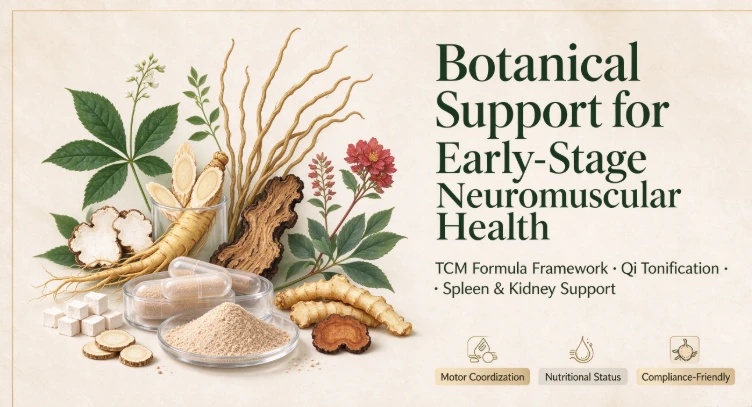
A practical implication for product developers: formulas designed for early-stage functional support often emphasize qi-tonifying, spleen-supporting, and kidney-essence nourishing strategies-while avoiding overly cloying supplementation that burdens digestion.
4) The Herbal Composition: A 10-Botanical Formula (Weights by "Parts")
4.1 Formula Name (from your text)
"A pharmaceutical composition for ALS and its application"
(For marketing, you may choose to brand this as a "neuromuscular vitality botanical formula" or "early-stage functional support formula," depending on jurisdiction.)
4.2 Composition (by weight parts)
The formula contains the following raw materials:
Panax ginseng (Ren Shen): 6–15 parts
Astragalus membranaceus (Huang Qi): 15–35 parts
Cistanche deserticola / Cistanche spp. (Rou Cong Rong): 10–20 parts
Atractylodes macrocephala (Bai Zhu): 8–15 parts
Poria cocos (Fu Ling): 8–15 parts
Glycyrrhiza uralensis (Gan Cao, Licorice): 5–15 parts
Rhodiola (Hong Jing Tian): 5–15 parts
Epimedium (Yin Yang Huo): 8–15 parts
Polygonatum (Huang Jing): 8–15 parts
Rehmannia (Di Huang): 8–15 parts
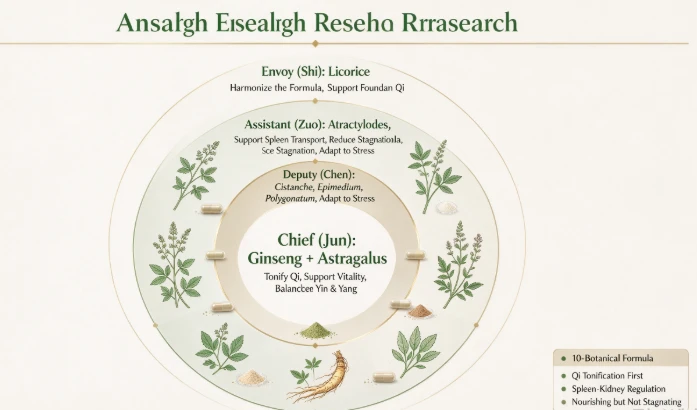
4.3 TCM role design (Jun–Chen–Zuo–Shi)
According to the source text, the formula follows a classic hierarchical design:
Chief (Jun): Ginseng + Astragalus
→ "Tonify qi, support vitality, strengthen the body's foundation."
Deputy (Chen): Cistanche, Epimedium, Polygonatum, Rehmannia
→ "Support kidney essence, balance yin–yang, nourish without leaning too far in one direction."
Assistant (Zuo): Atractylodes, Poria, Rhodiola
→ "Strengthen spleen transport to prevent cloying stagnation; support fatigue resistance and adaptation to hypoxia/stress (Rhodiola)."
Envoy (Shi): Licorice
→ "Harmonize the formula and support spleen qi."
Formulation theme: "Qi-tonification first; spleen and kidney regulated together; yin and yang both supported; nourishing but not stagnating."
5) Claim Scope and Intended Use (How to Communicate It Commercially)
5.1 What the underlying document claims (technical)
Your text states the composition was experimentally verified to improve, in London stage I–II ALS model mice, measures such as:
motor coordination,
muscle strength,
nutritional status,
thereby supporting early-stage intervention outcomes in the model.
5.2 How a commercial blog can phrase it more safely (marketing-compliant tone)
For most commercial settings, consider wording like:
"Designed to support early-stage neuromuscular function and fatigue resilience."
"May help maintain muscle performance and mobility-related capacity when combined with lifestyle support."
"Built on a TCM rationale for spleen–kidney support and balanced nourishment."
If you plan to sell in the U.S., EU, UK, etc., avoid explicit disease treatment claims on public pages unless you are operating as an approved drug product with the required evidence and approvals.
Cistanche Extract Supplement For Cognitive Function Improvement
6) Representative Formulas (Specific Embodiments)
Below are examples given in your text (weights in "parts" / grams for the preparation examples):
Embodiment A (Example formula 1)
Ginseng 9
Astragalus 35
Cistanche 18
Atractylodes 15
Poria 15
Licorice 15
Rhodiola 15
Epimedium 15
Polygonatum 15
Rehmannia 15
Embodiment B (Example formula 2)
Ginseng 6
Astragalus 15
Cistanche 10
Atractylodes 9
Poria 9
Licorice 9
Rhodiola 9
Epimedium 9
Polygonatum 9
Rehmannia 9
Embodiment C (Example formula 3)
Ginseng 12
Astragalus 30
Cistanche 18
Atractylodes 15
Poria 15
Licorice 15
Rhodiola 15
Epimedium 15
Polygonatum 15
Rehmannia 15
Other adjustable-ratio embodiments listed
Ginseng 6 / Astragalus 15 / Cistanche 18 / Atractylodes 15 / Poria 15 / Licorice 9 / Rhodiola 9 / Epimedium 9 / Polygonatum 9 / Rehmannia 9
Ginseng 9 / Astragalus 15 / Cistanche 18 / Atractylodes 15 / Poria 15 / Licorice 9 / Rhodiola 12 / Epimedium 12 / Polygonatum 12 / Rehmannia 12
7) Dosage Forms and Manufacturing Flexibility (Great for B2B SEO)
The source text states the composition can be used as an active component to prepare products in multiple forms, including:
granules
pills
decoction (tea/soup)
tablets
powders
capsules
oral liquids
herbal paste (gao fang)
It also notes conventional pharmaceutically acceptable excipients may be included (fillers, lubricants, dispersants, wetting agents, binders, antioxidants, etc.), supporting stability and manufacturability.
For factories and brand owners: This is ideal for:
OEM/ODM customization
dosing convenience for different markets
scalable production and standard quality control processes
8) Example Preparation Processes (Granules, Pills, Decoction, Tablets, Powder)
8.1 Granules (Example)
Process summary based on your text:
Weigh herbs per formula → remove impurities → wash → cut → mix
Add purified water (10× total herb weight), soak 1.5 h
Decoction extraction:
First extraction: 1.5 h → filter
Second extraction: add 8× water, extract 1 h → combine filtrates
Filter, vacuum concentrate to relative density 1.20–1.35 at 60°C
Add excipients → wet granulation → drying → sizing → finished granules
8.2 Pills
Pulverize herbs, sieve (80–120 mesh), mix
Use honey binder or water-based pill-making binder
Form pills, low-temperature drying, sizing
8.3 Decoction
Soak 40 min, decoct:
1st: 1.5 h, filter
2nd: 1 h, combine, filter → final decoction
8.4 Tablets
Extract/concentrate (as granule method) → dry extract powder
Add excipients → granulate → dry → compress into tablets
8.5 Powder
Low-temperature dry → mill → sieve (100–200 mesh) → blend
9) Preclinical Evaluation (Mouse Study Summary, Early-Stage Window)
9.1 Model and stage definition (as provided)
AR2 mice model (linked in your text to ADAR2 insufficiency and GluR2 Q/R editing issues)
"Early stage" corresponds to a window intended to match London stage I–II characteristics:
generally stable condition and feeding/drinking
no persistent severe hindlimb dragging/paralysis
reproducible mild motor changes (rotarod decline, grip strength decrease, mild gait changes)
weight in growth/plateau with mild fluctuation (supportive indicator)
The text notes early stage often falls around 6–12 weeks post-birth, but stage is judged mainly by phenotype, not only age.
9.2 Groups and dosing (as provided)
Control group: saline
Treatment groups (gavage, daily for 12 weeks):
low dose: 20 mg/kg/day
medium dose: 40 mg/kg/day
high dose: 60 mg/kg/day
The text states 60 mg/kg/day in healthy mice for 12 weeks showed no significant adverse impact on weight, nutrition, or motor capacity.
9.3 Outcomes monitored (as provided)
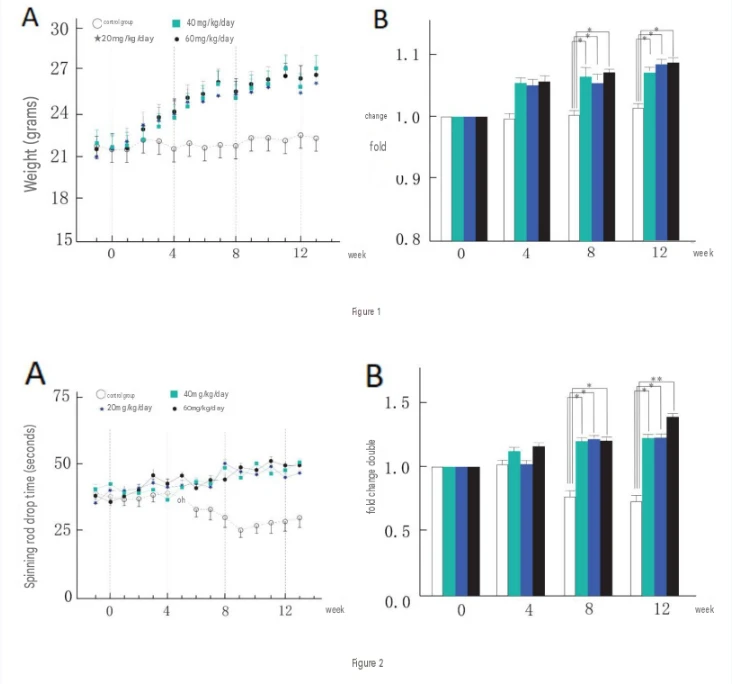
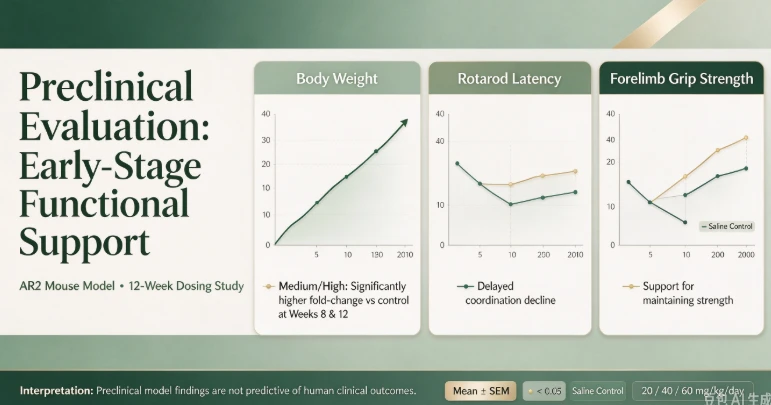
Body weight at week 0, 4, 8, 12 (and fold-change vs baseline)
Rotarod latency to fall (motor coordination), weeks 0, 4, 8, 12 (fold-change vs baseline)
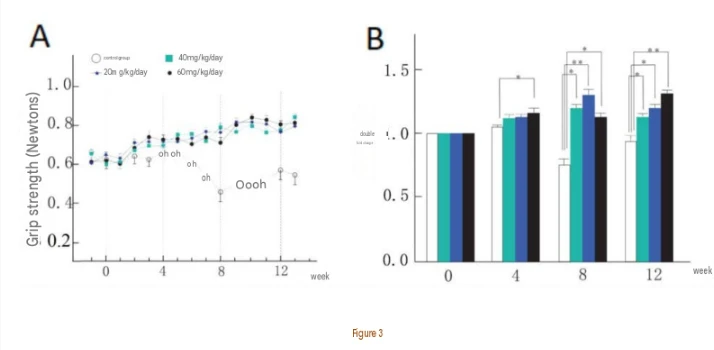
Forelimb grip strength, weeks 0, 4, 8, 12 (fold-change vs baseline)
Statistics: mean ± SEM; SPSS 18.0; one-way ANOVA with post hoc; nonparametric test for two-group comparison; P<0.05P<0.05P<0.05 significance threshold.
9.4 Results summary (as provided)
Body weight: treatment groups showed continued weight increase; medium/high tended to exceed control; at weeks 8 and 12, fold-change significantly higher vs control → suggests improved nutritional status.
Rotarod: by week 8 and 12, control declined, while medium/high maintained or improved; fold-change better vs control → suggests delayed decline in coordination.
Grip strength: by week 8 and 12, control declined while treated groups remained higher; fold-change better vs control → suggests support for maintaining strength.
(Your text refers to figures showing these trends.)
10) Why Cistanche (Rou Cong Rong) Matters for Botanical Businesses (Factory/Brand Angle)
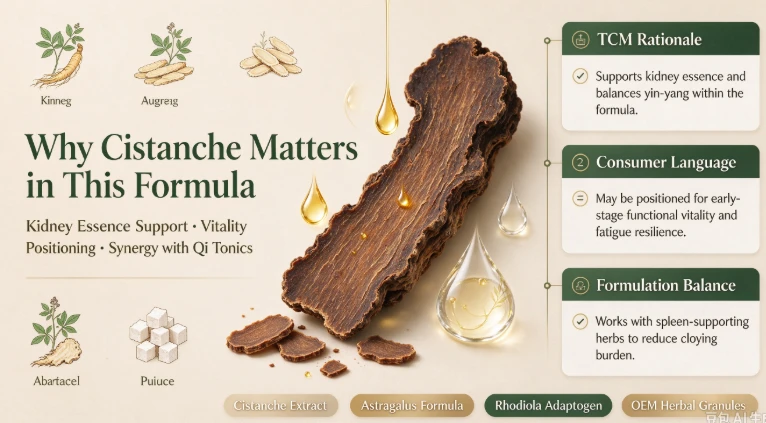
For a Cistanche-focused factory or ingredient supplier, this composition highlights Rou Cong Rong as a key "Deputy" herb aligned with:
kidney essence support strategy (TCM theory)
functional vitality positioning (consumer language)
synergy with qi-tonics like ginseng and astragalus
formulation balance using spleen-supporting herbs (Atractylodes, Poria) to reduce cloying burden
Suggested SEO landing-page clusters (you can build internal links)
"Cistanche extract for vitality & endurance support"
"Cistanche + Astragalus formula: qi support and fatigue resilience"
"Rhodiola + Cistanche: adaptogenic energy support"
"Multi-herb TCM granules: OEM/ODM manufacturing guide"
"How to standardize Cistanche raw materials: quality, authentication, and testing"
11) Compliance-Friendly Disclaimer (Recommended for Publishing)
Disclaimer:
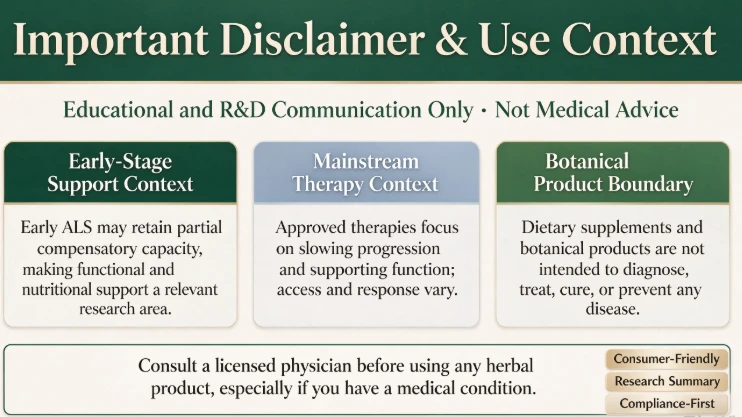
This content is for informational and industry communication purposes only. It is not intended as medical advice and does not replace diagnosis or treatment by qualified healthcare professionals. Dietary supplements and botanical products are not intended to diagnose, treat, cure, or prevent any disease. If you have a medical condition such as ALS, consult a licensed physician before using any herbal product.