Cistanche, The Desert Ginseng: How Its Natural Glycosides May Protect The Brain After Stroke
Oct 23, 2026
Introduction: A Plant That Survives Where Almost Nothing Else Can
In the vast, sun-scorched deserts of northern China and Mongolia, where rain is measured in millimeters and life is an endurance test, grows one of the most fascinating plants in traditional medicine: Cistanche, known in Chinese as Rou Cong Rong, and often called the "desert ginseng."
For centuries, Cistanche has held an honored place in Chinese herbal medicine. Herbalists praised it for supporting vitality, strengthening the kidneys in the traditional sense, and nourishing the body over time. But in recent years, modern science has begun to look much more closely at this unassuming desert plant - not through the lens of folklore, but through the lens of molecular biology. Researchers want to know: what is actually in Cistanche, and can the compounds found in it genuinely help protect our most important organ - the brain?
This article is a plain-language tour of that research. We will explore what Cistanche contains, why a stroke causes so much hidden damage, what scientists have recently discovered about how Cistanche's active ingredients may shield brain cells, and what this might mean for anyone interested in natural ways to support brain health.

Part One: Getting to Know Cistanche
What Is Cistanche?
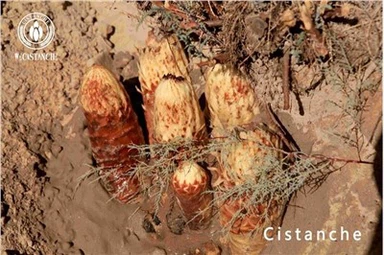
Cistanche is a parasitic plant. Unlike most plants, which grow their own roots in soil, Cistanche attaches itself to the roots of other desert plants - most famously the salt-tolerant shrub Haloxylon ammodendron - and draws water and nutrients from its host. It has no leaves that photosynthesize in the usual way and no green pigment to speak of. Instead, it survives by being a quiet, efficient borrower.
The part of the plant used in medicine is its thick, fleshy stem, which rises above the desert sand. When dried, it looks like a sturdy, brownish stalk, and for centuries it has been prepared as a tea, a decoction, or a powdered supplement. In traditional Chinese medicine, it is classified as a "tonic" herb - something that supports the body's foundational energy rather than attacking a specific disease.
The "Desert Ginseng" Nickname
Why "desert ginseng"? Ginseng is perhaps the most famous tonic herb in Asia, prized for its energizing and restorative properties. Cistanche earned a similar reputation in the desert regions where it grows. Local healers used it for general weakness, for supporting physical stamina, and - importantly for this article - for conditions related to the brain and the circulation.
Today, Cistanche is no longer just a regional folk remedy. It has become one of the more studied Chinese herbs in modern laboratories, and scientists have isolated and identified many of the specific molecules it contains.
What's Actually Inside: The Active Compounds
When researchers look inside Cistanche, they find a complex chemistry. Among the most notable groups of compounds are the phenylethanoid glycosides - long, complicated molecules that include echinacoside and acteoside (also called verbascoside). Together with related compounds, these are often grouped as the total glycosides of Cistanche, usually abbreviated in research as GCs.
These glycosides are the stars of the modern research story. They are what give Cistanche much of its antioxidant and cell-protective activity. When a research paper speaks of "GCs protecting the brain," it is essentially saying that this specific family of natural compounds is doing the heavy lifting.
One important point: the amounts and proportions of these compounds can vary a great deal depending on where the plant was grown, how it was harvested, and how it was processed. That is why companies that work with Cistanche - including producers of standardized extracts - pay careful attention to which species they use and how they measure the active ingredients. For this reason, scientific studies use purified, standardized glycoside preparations so that the results are reproducible.
Part Two: The Health Problem That Inspired the Research
Stroke: A Silent Emergency
To understand why Cistanche's glycosides matter, we first need to understand the medical problem at the center of the research: ischemic stroke.
A stroke happens when the blood supply to part of the brain is interrupted. The brain is an extremely hungry organ. It uses a huge share of the body's oxygen and glucose, yet it has almost no way to store energy for emergencies. When blood flow stops, brain cells begin to suffer within minutes.
The most common type of stroke is the ischemic stroke, caused by a blood clot or a blocked artery that starves a region of the brain of oxygen. Less common is the hemorrhagic stroke, caused by a burst blood vessel. Ischemic stroke is a major cause of death and long-term disability worldwide, and it places an enormous burden on families and health-care systems.
The Paradox of "Reperfusion"
Here is the tricky part that even many non-specialists don't fully appreciate: restoring blood flow can itself cause additional damage.
When doctors treat an ischemic stroke, the goal is to reopen the blocked blood vessel as quickly as possible - through clot-busting drugs or mechanical removal of the clot. This is absolutely necessary, and it saves lives. But the moment blood rushes back into tissue that has been starved, it triggers a second wave of injury. This is called cerebral ischemia-reperfusion injury, or CIRI.
Think of it like a parched field suddenly hit by a flood. The rain is desperately needed, but the sudden rush of water can also wash away the soil. In the brain, the sudden return of blood brings a surge of oxygen and other changes that, under the stressed conditions inside damaged cells, can paradoxically cause more harm.
This "reperfusion injury" is a serious problem. It can undo some of the benefit of a successful clot removal, and it can expand the zone of damage beyond the original stroke. Researchers have spent years looking for ways to protect brain tissue during this vulnerable window.
Why the Timing Is So Cruel
Part of the tragedy of stroke is the narrow window for effective treatment. Many patients do not reach a hospital in time to receive clot-busting therapy. The result is that a large fraction of stroke patients do not get the full benefit of reperfusion treatment, and those who do still face the risk of reperfusion injury. This is why there is such strong interest in finding protective substances - molecules that could be given alongside or after treatment to shield brain cells from the additional damage.
This is exactly the context in which scientists began to wonder: could the glycosides from Cistanche step in as a natural protective agent?

Part Three: The Two Hidden Culprits - Oxidative Stress and Cell Suicide
Before we describe the study itself, we need to introduce two scientific concepts that form the heart of the research: oxidative stress and apoptosis. These are not just technical jargon - they are the two processes that Cistanche's glycosides appear to fight.
Culprit Number One: Oxidative Stress
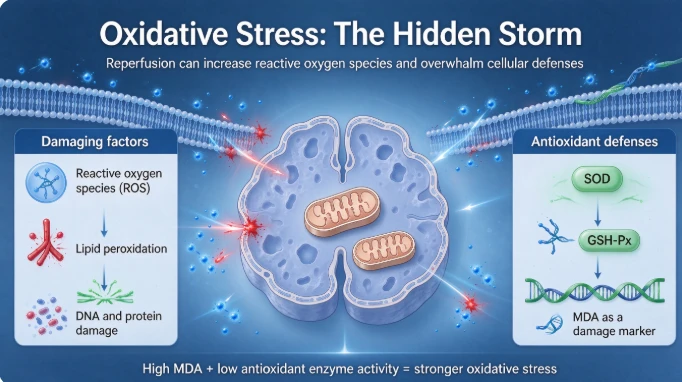
Our cells constantly use oxygen to produce energy. As a byproduct of this process, they generate highly reactive molecules called free radicals, or reactive oxygen species (ROS). A small amount of ROS is normal and even useful - the immune system uses them to fight invaders. But when cells are under stress - such as during a stroke and the subsequent reperfusion - ROS production can spiral out of control.
This creates a situation called oxidative stress: the production of damaging free radicals overwhelms the cell's ability to neutralize them. Like sparks landing on dry wood, these unstable molecules attack the cell's membranes, its proteins, and even its DNA.
Two types of "good guys" usually keep this in check:
Antioxidant enzymes, such as superoxide dismutase (SOD) and glutathione peroxidase (GSH-Px), which act like tiny fire brigades, disarming free radicals.
Small-molecule markers that scientists can measure to see how much damage is occurring. The most famous of these is malondialdehyde (MDA), a byproduct formed when free radicals attack the fats in cell membranes. High MDA levels are a red flag that oxidative damage is happening.
In a healthy brain, the balance is maintained. In a stroked brain, the balance collapses: ROS flood the tissue, antioxidant enzymes get depleted, and MDA levels climb. This oxidative storm is a major driver of the tissue damage seen in reperfusion injury.
Culprit Number Two: Cell Suicide (Apoptosis)
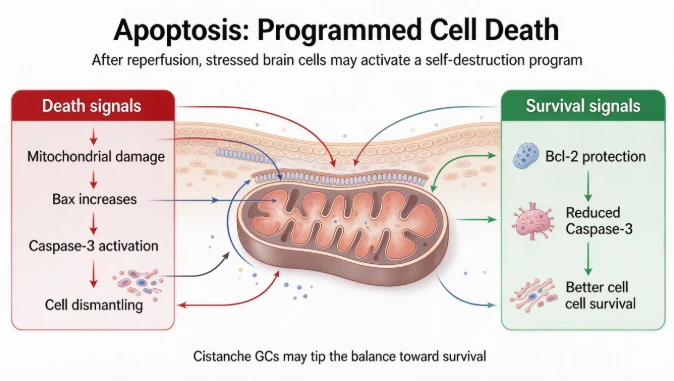
The second culprit is apoptosis - a carefully controlled form of programmed cell death. Apoptosis is not always bad; the body uses it all the time to remove old, damaged, or unneeded cells. But under severe stress, apoptosis can be triggered in cells that should be saved, causing them to die en masse.
The control of apoptosis depends on a delicate tug-of-war between two families of proteins:
Bcl-2 is the "protector." It keeps cells alive by blocking the death signals.
Bax is the "promoter." When it is active, it punches holes in the cell's energy-producing structures (mitochondria), releasing the molecules that set off the death cascade.
Once the death signal is fully triggered, the cell activates Caspase-3, sometimes called the "executioner" enzyme. Caspase-3 systematically dismantles the cell from the inside. If researchers see elevated Bax and Caspase-3 alongside reduced Bcl-2, they know that the cells are being pushed toward apoptosis.
In the context of a stroke, oxidative stress and apoptosis feed into each other. Free radicals damage the mitochondria, which triggers apoptosis; apoptosis releases more damaging molecules, which worsens oxidative stress. Together they expand the zone of brain damage.
Part Four: The Study in Plain Language
How Scientists Tested Cistanche on the Brain
To test whether Cistanche's glycosides could protect the brain, researchers turned to a well-established animal model. They used rats and created a condition that mimics ischemic stroke followed by reperfusion - the medical version of a "clot then reopen the vessel" scenario. This is called the middle cerebral artery occlusion (MCAO) model.
Here is the setup in simple terms:
The sham group: Rats that went through the surgery but did not have a blood vessel blocked. These are the "healthy baseline" controls.
The model group: Rats that had a blood vessel in the brain blocked for two hours and then reopened, creating the ischemia-reperfusion injury. These are the "injury without treatment" controls.
The treatment (GCs) group: Rats that received the same injury, but were then given 50 milligrams of Cistanche total glycosides per kilogram of body weight by mouth every day for 14 days.
After the treatment period, the researchers measured several things:
Neurological function - using a standard scoring system to see how well the rats could move and behave.
Brain damage size - using a special dye (TTC) that stains healthy tissue red and leaves damaged tissue pale, so the area of injury could be measured.
Oxidative stress markers - measuring blood levels of MDA, SOD, and GSH-Px.
Key proteins - measuring the levels of Nrf2, HO-1, Bcl-2, Bax, and Caspase-3 in the brain tissue.
This is a thorough experimental design, and it lets scientists see the whole picture: the behavior, the physical damage, the chemical stress, and the molecular machinery underneath.
Part Five: What the Study Found
The results paint a clear and encouraging picture.
The Treated Rats Fared Better Neurologically
First, the rats that received Cistanche glycosides showed better neurological function than the untreated injury group. Their scores on the standard neurological scale improved, meaning they behaved more normally and showed fewer signs of motor and coordination damage. In short, the treatment helped them "bounce back" more.
The Brain Damage Was Smaller
Second, the physical damage was reduced. The dye-stained brain slices showed that the treated rats had a smaller area of infarction - the dead zone of tissue caused by the stroke. A smaller infarct means a better chance of functional recovery and less long-term harm. This was one of the most direct pieces of evidence that the glycosides were genuinely protecting brain tissue.
The Oxidative Storm Was Calmed
Third, the chemical evidence pointed the same way. In the treated group:
MDA levels dropped, indicating less oxidative damage to cell membranes.
SOD and GSH-Px activity rose, indicating that the body's natural antioxidant defenses were stronger.
In other words, Cistanche's glycosides helped restore the balance that the stroke had upset. They turned down the production of damaging free radicals and turned up the cells' own defensive systems.
The Cells Were Saved From Suicide
Fourth, and perhaps most interestingly, the molecular machinery of cell survival changed in the right direction. In the treated rats:
The protective protein Bcl-2 went up.
The death-promoting protein Bax went down.
The "executioner" enzyme Caspase-3 went down.
This is a clear molecular signature of reduced apoptosis. The brain cells in the treated rats were less likely to be pushed into programmed cell death. Combined with the smaller infarct size, this strongly suggests that the glycosides were helping brain cells survive the reperfusion storm rather than merely shrinking the visible damage.
Taken together, the study concluded that Cistanche total glycosides can effectively reduce ischemia-reperfusion injury, and that the protection appears to work through a specific molecular pathway that we'll look at next.
Part Six: The Molecular "Master Switch" - The Nrf2/HO-1 Pathway
Meet Nrf2, the Cell's Emergency Coordinator
If there is one hero molecule in this story, it is Nrf2 (nuclear factor erythroid 2-related factor 2).
Nrf2 is sometimes described as a "master regulator" of the cell's antioxidant defenses. Normally, it is kept inactive by a partner protein called Keap1, which holds it in the cytoplasm. But when the cell detects stress - including oxidative stress - Nrf2 is released and travels into the nucleus. There, it switches on a whole battery of protective genes, including the genes for antioxidant enzymes.
Think of Nrf2 as the building's emergency-response coordinator. When smoke is detected, it flips the switches that activate the fire hoses, the sprinklers, and the evacuation alarms - all at once.
HO-1: The Key Downstream Defender
One of the most important genes that Nrf2 switches on is for HO-1 (heme oxygenase-1). HO-1 is a protective enzyme that breaks down a molecule called heme - a component of blood proteins - into substances that, in this context, act to neutralize free radicals and reduce inflammation.
When Nrf2 activates HO-1, the cell gains a powerful shield against oxidative damage. HO-1's upregulation is widely considered a protective, adaptive response: it's the cell's way of saying "I'm under attack, time to reinforce the walls." Elevated HO-1 is associated with reduced oxidative stress, reduced inflammation, and reduced cell death in a range of tissues.
Connecting the Dots
Here is how everything fits together in the Cistanche study:
The stroke and reperfusion create a storm of free radicals and push cells toward apoptosis.
Treatment with Cistanche glycosides activates Nrf2.
Activated Nrf2 turns up HO-1 and other antioxidant defenses.
This strengthens SOD and GSH-Px activity, cleaning up the free radicals.
Less oxidative stress means less MDA accumulation and less mitochondrial damage.
Less mitochondrial damage means less apoptosis - Bcl-2 rises, while Bax and Caspase-3 fall.
The net result: smaller brain damage and better neurological function.
This is the proposed mechanism in a nutshell: Cistanche glycosides protect the brain by switching on the Nrf2/HO-1 antioxidant pathway, calming oxidative stress, and stopping brain cells from committing suicide.

Part Seven: Why This Matters Beyond the Laboratory
A Natural Ally for the "Reperfusion Window"
The most immediately relevant implication is for stroke care. Because reperfusion injury can shrink the benefit of clot removal, any safe substance that shields brain tissue during this window could be valuable. The research suggests Cistanche glycosides may be worth investigating as an adjunct - something used alongside standard treatment to limit the collateral damage.
Of course, it's important to be clear: this is an animal study, and we cannot directly translate rat results to humans. But animal models are the standard first step in medical research, and a consistent, well-designed result like this justifies further investigation.
The Bigger Picture of Brain Health
Beyond acute stroke, the Nrf2/HO-1 pathway is relevant to many conditions involving oxidative stress and brain cell survival. Chronic oxidative stress is implicated in aging, in memory decline, and in a range of neurological conditions. Anything that strengthens the brain's natural antioxidant defenses is of broad interest - not just for treating emergencies, but potentially for supporting long-term brain health.
Cistanche has also been studied for its possible effects on memory, learning, and cognitive function. The compound family it contains, and the pathway it activates, point toward a general theme: this is a plant that supports the brain's resilience.
For People Interested in Natural Supplements
For consumers, this research helps explain why Cistanche extract has gained attention as a wellness product. It contains natural compounds that, at least in animal models, activate the body's own protective machinery. That is a more sophisticated and appealing story than simply "it's an antioxidant" - because it suggests the plant works with the body's systems rather than just flooding them with foreign molecules.
Part Eight: Choosing Quality Cistanche Products
If the research interests you, the next question is practical: not all Cistanche products are equal. Here are a few things that matter, based on how the science actually works:
1. Species and Origin
There are several species of Cistanche. The two most commonly studied are Cistanche deserticola and Cistanche tubulosa. The concentrations of the active phenylethanoid glycosides differ between species and growing regions. Standardized extracts will specify which species they use.
2. Standardization and Measurement
The research uses standardized preparations of total glycosides (GCs), with clear amounts of key markers such as echinacoside and acteoside. When you look at a supplement, checking whether it provides a measurable, standardized amount of these compounds is a good sign of quality. Producers that publish their assay data (for example, in a Certificate of Analysis) are being transparent about what's actually in the bottle.
3. Extraction Method
How the plant is processed matters. Gentle, controlled extraction that preserves the fragile glycoside molecules will yield a different product than harsh processing. Well-established manufacturers invest in consistent, high-quality extraction to protect the active compounds.
4. Independent Testing
Reputable producers test their products for purity and contamination. Looking for products with third-party testing is a reasonable way to ensure you are getting what the label claims.
For anyone sourcing Cistanche extract - whether as a consumer or a business - these factors are worth taking seriously. The science only delivers value if the product actually contains what it claims.

Part Nine: An Honest Look at Safety and Limitations
No article about a promising natural substance would be complete without a dose of honesty.
What This Study Does and Doesn't Show
This study is a well-executed animal experiment, and it provides strong evidence for a mechanism. But:
It does not prove that Cistanche glycosides prevent or cure stroke in humans.
It does not replace emergency stroke treatment. Anyone experiencing stroke symptoms should seek immediate medical attention - this is not a substitute for medical care.
More research, including human clinical trials, is needed before firm conclusions can be drawn about dosing and effectiveness in people.
General Safety Considerations
Cistanche has a long history of traditional use and is generally considered well-tolerated, but:
Pregnant or nursing women, and people with chronic health conditions, should consult a health-care professional before using new supplements.
People taking blood-thinning or other prescription medications should discuss interactions with their doctor.
Quality and dosage matter. More is not necessarily better, and the right dose for research animals does not automatically translate to a human dose.
This honest framing is important. It builds trust with readers, and it keeps the content responsible.
Part Ten: The Big Picture - A Desert Plant With a Modern Message
There is something quietly poetic about this research. A plant that survives in one of the harshest environments on Earth contains compounds that, inside a stressed brain, help cells survive their own storm.
Cistanche has been a "tonic" in Chinese medicine for centuries, but the word "tonic" has always been a bit vague. Modern research is filling in the details. It tells us, molecule by molecule, why this desert plant earned its reputation. The Nrf2 pathway is one of the body's most important self-protection systems, and here we have a natural plant that appears to help switch it on.
For stroke patients, the hope is that someday, such natural compounds might be part of a comprehensive strategy to limit brain damage and support recovery. For the rest of us, the research is a reminder that the foods and herbs we consume can influence how well our cells defend themselves - and that resilience, at the cellular level, is something worth nurturing.
Conclusion: What This Means for You
To bring everything together:
Ischemic stroke is a major killer, and the damage doesn't stop when blood flow is restored - reperfusion injury can add to it.
That extra damage is driven largely by oxidative stress and programmed cell death (apoptosis).
Cistanche total glycosides (GCs) - natural compounds from the desert ginseng - were shown in an animal model to reduce brain damage and improve neurological recovery after ischemia-reperfusion.
The mechanism runs through the Nrf2/HO-1 pathway: the glycosides activate the cell's master antioxidant switch, boosting defenses, calming the oxidative storm, and preventing brain cells from dying.
This is early-stage science, but it is consistent, well-designed, and mechanistically coherent - a strong foundation for further study.
If you're interested in Cistanche as a wellness product, choose standardized, high-quality extracts with measurable levels of the key active compounds, and always use them responsibly as part of a healthy lifestyle, never as a replacement for medical care.
The desert ginseng has been quietly working in the background of traditional medicine for centuries. Now, one storm-tested molecule family at a time, modern science is bringing its protective powers into the light.
Disclaimer: This article is for general educational and informational purposes only and is not medical advice. It describes scientific research findings and does not claim to diagnose, treat, cure, or prevent any disease. Always consult a qualified health-care professional before using any supplement, especially if you have a medical condition or take medications. If you suspect a stroke or other medical emergency, seek immediate professional medical care.