A TCM-Inspired, Step-By-Step Perspective On Erectile Difficulties (ED): Patterns, Mechanisms, And Practical Takeaways
Sep 07, 2026
Important note (for readers in the US/EU/UK):
This article is for education only. It does not replace medical diagnosis or treatment. Erectile dysfunction (ED) can be an early sign of cardiovascular disease, diabetes, hormonal imbalance, medication effects, depression/anxiety, or other conditions. If ED is persistent, consult a qualified clinician. Do not self-prescribe traditional formulas-many botanicals and animal-derived materials can interact with medications or carry safety risks and should only be used under licensed professional supervision.
1) What people mean by ED in plain language
Erectile dysfunction (ED) generally refers to difficulty achieving or maintaining an erection firm enough for satisfactory sexual activity-especially when the desire is present but the erection is unreliable or insufficient.
This is more common than many people think, and it can occur at different ages for different reasons. For some, it's occasional and stress-related; for others, it's persistent and tied to circulation, metabolic health, hormones, or nervous system regulation.

2) A simplified biomedical explanation: blood flow + nerve signaling + "venous trapping"
Modern medicine often explains erection as a coordinated process involving:
Arterial dilation (more blood flows into the erectile tissues),
Smooth muscle relaxation in the erectile tissue,
Venous compression ("trapping") so blood stays in the tissue long enough to maintain firmness,
Nervous system signaling (including the balance between stress responses and parasympathetic activation),
Hormonal and psychological factors that influence desire, arousal, and response.
Because circulation is central to erection, it's not surprising that some ED medications-originally explored in cardiovascular contexts-ended up being used for ED by acting on vascular smooth muscle pathways.
Practical takeaway: if ED is persistent, it's worth checking cardiovascular and metabolic health, not just sexual performance.

3) How Traditional Chinese Medicine (TCM) describes the same problem: "patterns," not one label
TCM does not treat ED as one single disease with one single solution. Instead, it describes patterns-clusters of symptoms and constitution signs-and selects strategies accordingly.
A common TCM way of describing erection difficulty is that qi and blood do not flow smoothly to the "sinews" and channels, leading to insufficient nourishment and function. In many TCM discussions, this is framed as combinations of:
Deficiency (low foundational vitality),
Stagnation (poor flow, constraint, stress-related tension),
Heat/damp-heat (inflammatory-style presentations),
Blood stasis (long-standing stagnation with impaired circulation),
Imbalance between Yin and Yang (recovery vs. activation).
This perspective can be surprisingly useful for Western readers because it encourages looking beyond a single symptom to the broader context: sleep, stress load, digestion, recovery, mood, and long-term vitality.
Click the picture to get more details

Supportive Service Of Wecistanche-For more details about cooperation
Email:wallence.suen@wecistanche.com
4) Common TCM pattern categories often discussed in clinical practice
In the clinical TCM tradition, erectile difficulties are often discussed under multiple possible patterns. Examples include:
"Mingmen fire decline" / Kidney Yang deficiency (coldness, fatigue, low drive, reduced warmth and vigor)
Kidney Yin deficiency (restlessness, dryness, night warmth/sweats, insomnia)
Liver qi constraint (stress, frustration, chest/abdominal tension, mood-driven performance issues)
Damp-heat in the Liver channel (heaviness, irritability, possible inflammatory signs)
Fear/shock affecting the Kidney (performance anxiety, startle, persistent nervous tension)
Heart–Spleen deficiency (overthinking, poor sleep, low appetite, fatigue)
Blood stasis / impaired circulation patterns (long-standing issues, localized "not enough flow" presentation)
Why this matters: two men can both say "I have ED," yet one is mostly a stress-and-sleep pattern while another is mostly a circulation/metabolic pattern, and another is more of an aging-related vitality pattern. TCM tries to match the strategy to the pattern.
5) A "three-strategy" model (TCM-style) that many readers find actionable
The original Chinese text emphasizes a combined approach. In a Western-friendly framing, those three strategies can be translated as:
Strategy 1: Strengthen the foundation (tonify what is deficient)
Many TCM clinicians consider "Kidney" vitality (a functional concept) central to long-term reproductive and endurance capacity. Supporting the foundation may include focusing on recovery, restorative sleep, nutrition, and-under professional guidance-traditional tonic approaches.
What this can inspire in real life:
prioritize sleep consistency and recovery,
build strength and aerobic capacity gradually,
address nutrient deficiencies,
reduce alcohol/smoking,
manage stress load.
Strategy 2: Differentiate patterns and personalize
TCM's key strength is personalization: rather than giving everyone the same "ED formula," practitioners adjust strategies depending on whether the dominant picture is heat, cold, deficiency, stagnation, dampness, or anxiety-driven dysregulation.
Western parallel: personalization based on root causes-hormones, medications, mental health, vascular risk, pelvic floor factors, etc.
Strategy 3: Improve "flow" (address stagnation and circulation)
The Chinese article stresses that many ED patterns-whether "excess" or "deficiency"-often include some degree of poor flow (qi stagnation, blood stasis). In modern terms, this aligns with the idea that circulation, endothelial function, stress physiology, and nervous system balance play major roles.
Practical takeaway: even if you work on "foundation," don't ignore circulation and stress regulation.
6) About classical formulas and "strong" ingredients: why self-treatment is not recommended
The original text lists two internal formulas and multiple modifications, and includes ingredients that can be highly potent or risky if used without supervision.
For Western readers, the key point is not "copy this recipe," but rather:
TCM formulas are system designs, not single-ingredient hacks.
Some traditional substances have narrow safety margins or are regulated/illegal in many countries.
If you want to explore TCM therapeutics, do it with a licensed professional who can assess your pattern, medical history, and medication interactions.
7) "What should I do tomorrow?"-a grounded action plan for people struggling with ED
To make this genuinely helpful (and not just theoretical), here's a practical plan that respects both modern medicine and the best spirit of TCM:
Get a medical check if ED is persistent
Especially if you have chest discomfort, shortness of breath, diabetes risk, hypertension, high cholesterol, or you're over 40. ED can be a cardiovascular warning sign.
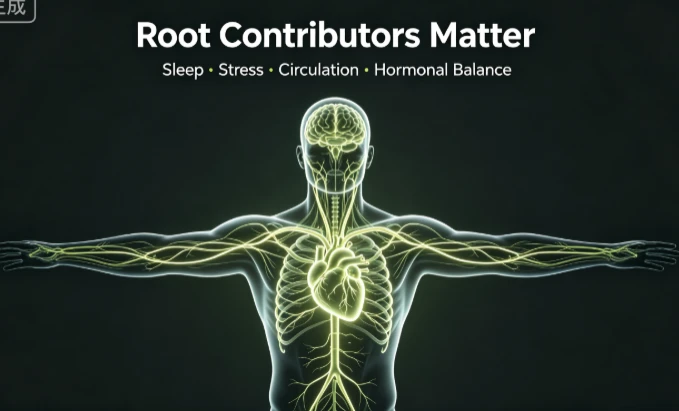
Audit the major "root contributors"
sleep duration/quality
stress/anxiety and relationship context
alcohol, nicotine, recreational substances
medications (SSRIs, blood pressure meds, etc.)
exercise and body composition
Use a "pattern lens" to personalize lifestyle changes
If you're wired-and-tired, prioritize recovery and stress downshift.
If you're fatigued and cold, focus on foundational energy and strength.
If you're inflamed/heavy/irritable, focus on diet, alcohol reduction, and metabolic health.
If exploring TCM, seek professional, regulated care
Look for licensed acupuncturists/TCM herbalists who can coordinate with your physician and avoid unsafe ingredients.
Be cautious with online "miracle cures"
Avoid guaranteed timelines ("works in 10 days") and avoid formulas with unclear sourcing or illegal drug adulteration-this is a known risk in sexual-performance products.
8) The bigger picture: what TCM can offer Western audiences-without hype
TCM's most valuable contribution for many Western men is not a single "magic pill," but a coherent framework that connects:
stress physiology + sleep + digestion + recovery
with
circulation + vitality + sexual function
When combined with modern evaluation and safe, individualized care, this perspective can help people move from shame and quick fixes toward a more sustainable, whole-body plan.