Aptamer-Based Strategies To Boost Immunotherapy in TNBC Part 2
May 23, 2023
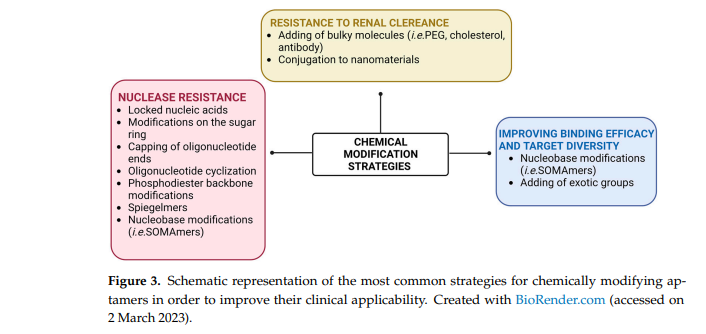
In addition, aptamers tolerate several chemical modifications that improve targeting efficacy, pharmacokinetic profile, and stability in biological environments, which are required for their in vivo applications [47]. As extensively reviewed elsewhere [27,48], the most used modifications applied to aptamers, either during SELEX or post-SELEX, to increase their resistance against nucleases include (Figure 3): the replacement of the 2 0 -OH groups of ribose with fluoro, methoxy, thiol or amino groups; the capping or the cyclization of the oligonucleotides’ ends; the substitution of the phosphodiester backbone with a phosphorothioate backbone; and the introduction of locked nucleic acids. Moreover, L-aptamers, called spiegelmers, can be generated that are not recognized by nucleases because they are enantiomers of natural nucleic acids. Chemical modifications are also applied to overcome the rapid renal filtration of small-size aptamers by conjugating them too bulky molecules, such as polyethylene glycol (PEG) or cholesterol, thus increasing their circulation time without affecting the accessibility to the target. Sophisticated approaches have also been developed to chemically conjugate aptamers with secondary therapeutics in combination therapy, and interestingly, innovative strategies have been explored to introduce exotic chemical groups in the aptamer molecule to extend their functionality and overcome the lack of chemical diversity in nucleic acids [49].
Nucleases refer to enzymes that can accelerate the hydrolysis reaction of RNA or DNA and have a wide range of biological functions. In the immune system, nucleases are important tools for recognizing and clearing viral infections. After the virus infects a cell, it will release RNA or DNA into the cell. These nucleic acid molecules will be recognized and hydrolyzed by the nuclease of the infected cell, thereby preventing virus replication and the spread of infection.
In addition, nucleases are also involved in the regulation of innate and adaptive immune responses. Nucleases can regulate gene expression levels by regulating the degradation and stability of RNA or DNA. In immune cells, nucleases regulate immune responses such as apoptosis, antigen presentation, and T-cell differentiation.
Overall, nucleases play an important role in the immune response, recognizing viral infection, modulating gene expression, and modulating the immune response. Thus, multiple mechanisms exist for the impact on immunity. From this point of view, it is necessary to pay attention to the improvement of immunity. Cistanche enhances immunity. Cistanche is rich in various antioxidant substances, such as vitamin C, vitamin C, carotenoids, etc. These ingredients can remove free radicals, reduce oxidative stress, and improve immunity. immune system resistance.

Click cistanche tubulosa benefits
Another strategy to improve binding affinity, target selectivity, and in vivo bioavailability of aptamers is represented by the generation of slow-off-rate modified aptamers (SOMAmers). These are DNA aptamers that bear chemically modified nucleotides functionalized at the 5-position of uridine with moieties that can not only participate in interactions with the target protein but also form novel secondary and tertiary structural motifs that greatly increase the repertoire of targets accessible to aptamers [50].
To date, one extensively chemically modified aptamer (named Macugen), targeting the isoform 165 of vascular endothelial growth factor, has been approved for the treatment of age-related macular degeneration, and eleven aptamers are in clinical trials for the treatment of different human diseases [51,52]. Among them, the anti-nucleolin AS1411 aptamer and the anti-stromal cell-derived factor 1 NOX-A12 aptamer have already completed phase II clinical trials for cancer therapy. Moreover, the anti-protein tyrosine kinase-7 Sgc8 DNA aptamer, labeled with 68 Ga, is in early phase I for assessing its diagnostic value in colorectal patients (ClinicalTrials.gov Identifier: NCT03385148).
3. Aptamer-Based Immune Strategies for TNBC Treatment
Genetic and epigenetic mutations in cancer cells lead to the presence of many tumor-associated antigens that the IS recognizes as nonself and, therefore, destroys mutated cells. However, it is well known that cancer cells evolve several mechanisms to escape from immune destruction and change the surrounding microenvironment in their favor resulting in tumor growth, invasion, and metastasis (53 55].
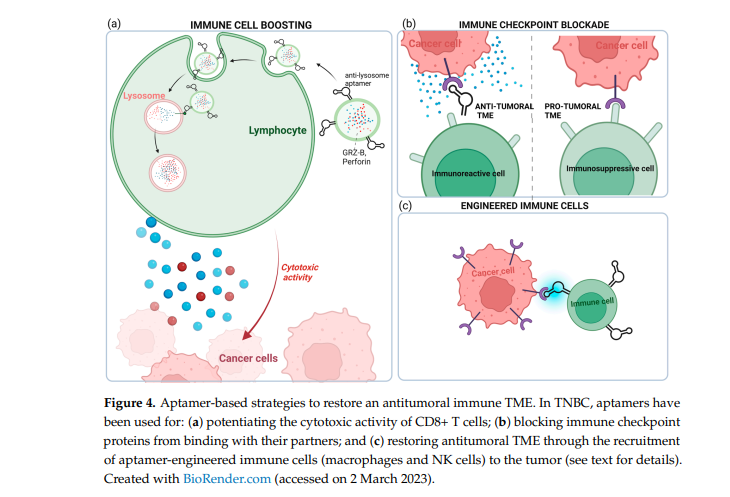
The goal of cancer immunotherapy is to enhance or restore the IS's ability to detect and destroy cancer cells by overcoming the mechanisms by which tumors evade and suppress the immune response. Striking aptamer-based strategies have been developed in the last few years to restore the Is toward an antitumor condition in TNBC. As discussed below increasing evidence shows aptamer's ability to potentiate the cytotoxic activity of immune cells, block immune checkpoints, or recruit immune cells to cancer cells (Figure 4).
3.1. Tumor-Infiltrating Lymphocytes
The major types of immune cells in the TNBC microenvironment are TILs, and their presence is significantly associated with better survival outcomes in patients with early-stage untreated tumors [56]. TILs include all CD3+ T cells, which may promote tumor destruction (CD8+ cytotoxic T cells) and an antitumor response (CD4+ T-helper 1) or limit antitumor immune responses (CD4+ T-helper 2, including Forkhead box P3 (FOXP3), CD4+ regulatory T cells).
Recently, Zhao et al. proposed an original strategy that exploits the targeting capability of aptamers to construct a “super-cytotoxic T lymphocyte” for enhanced antitumor response in cancer immunotherapy [59]. They generated acid-degradable metal–organic-based and lysosome-targeting nanoparticles that were loaded with perforin and granzyme B, two antitumor toxins contained in lysosomes of CD8+ T cells, and functionalized with an aptamer targeting the CD63 receptor on lysosome. Ca2+ was deposited on the nano platform to improve its biocompatibility and stability and potentiate toxin activity. The authors succeeded in using such an aptamer-guided platform (named LYS-NPs) for enriching lysosomes’ cytotoxic content of CD8+ T cells.
When tested in the TNBC 4T1 mouse model, T cells preactivated with processed 4T1-specific antigens and recombined by LYS-NPs and released the lysosomal content into immunological synapses, triggering a strong antitumor reaction (Figure 4). The proposed aptamer-based immunotherapy has great potential to overcome significant challenges in T cell immunotherapy for solid tumors mainly represented by strong immunosuppressive signals, which induce low T cell activation and decreased synthesis and release of cytotoxic proteins [60].

3.2. Immune Checkpoint-Expressing Cells
Alatrash's group reported that the expression of the PD-L1 gene in TNBC patients is significantly higher than in non-TNBC (19]. PD-L1, one of the major tumor cell-associated immune checkpoints, is expressed in a variety of immune cells, such as macrophages, some activated T cells, B cells, and in many solid tumor cells, including BC cells. Its receptor the transmembrane protein PD-1, is expressed on the membrane surface of TILs, NK cells, macrophages, dendritic cells, and monocytes [61]. The binding between PD-L1 and PD-1 causes the inhibition of CD8+ TILs, transforming them into an anergic form and, consequently, cancer immune evasion.
Moreover, the PD-1/PD-L1 axis modulates within tumor cells various proliferative and survival signaling pathways such as PI3K/AKT, MAPK, and JAK/STAT [62], and, very importantly, in TNBC, the activation of this axis promotes epithelial–mesenchymal transition (EMT), a phenotype associated with highly aggressive and metastatic tumors [63].
Different aptamer-based approaches in TNBC are currently being explored to revert PD-1/PD-L1 effects (Figure 5).
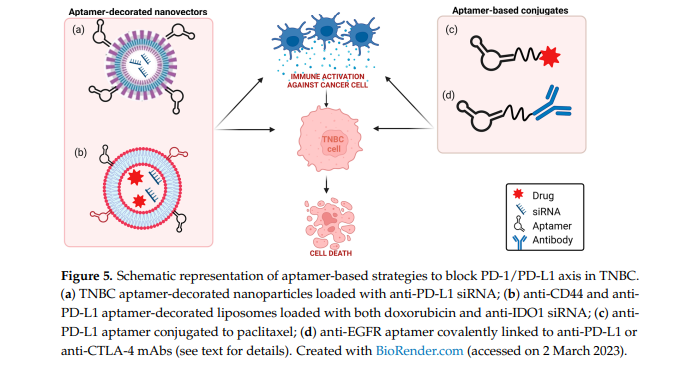
Figure 5. Schematic representation of aptamer-based strategies to block PD-1/PD-L1 axis in TNBC. (a) TNBC aptamer-decorated nanoparticles loaded with anti-PD-L1 siRNA; (b) anti-CD44 and antiPD-L1 aptamer-decorated liposomes loaded with both doxorubicin and anti-IDO1 siRNA; (c) antiPD-L1 aptamer conjugated to paclitaxel; (d) anti-EGFR aptamer covalently linked to anti-PD-L1 or anti-CTLA-4 mAbs (see text for details). Created with BioRender.com (accessed on 2 March 2023).
In this context, our group investigated, for the first time, a combination between an anti-PD-L1 mAb with an anti-platelet-derived growth factor receptor β (PDGFRβ) aptamer, named Gint4.T, in TNBC [64]. Gint4.T is a nuclease-resistant 20 -fluoropyrimidines (20F-Py) RNA aptamer which binds to and inhibits PDGFRβ expressed on the surface of different human cancer cells, including TNBC cells [65], and TNBC TME components, including mesenchymal stem cells [66], and T cells [64]. Interestingly, when intravenously injected in TNBC 4T1 syngeneic mice, the aptamer strongly potentiates the effect of antiPD-L1 mAbs in inhibiting tumor growth and lung metastases formation by acting on both tumor cells and TME components [64].
Furthermore, the combined blockade of PDGFRβ and PD-L1 causes the depletion of FOXP3+ Treg cells and an increase in CD8+ T cells and granzyme B more consistently than single monotherapies. These results lay the foundation to construct a bispecific immunoconjugate consisting of an anti-PD-L1 antibody covalently linked to Gint4.T aptamer, thus optimizing the effectiveness of combination therapy. Bispecific constructs obtained by covalently linking an anti-epidermal growth factor receptor (EGFR) 20F-Py RNA aptamer to immunomodulators anti-PD-L1 (10_12) [67] or anti-CTLA-4 (ipilimumab) [68] mAbs were generated by Passariello et al. and proved to maintain the biological functions of both parental moieties, thus exerting a potent cytotoxic activity against BC cells.

An alternative strategy to anti-PD-L1 mAbs for PD-L1 targeting is represented by the suppression of PD-L1 through gene silencing, which has the potential to overcome some recurring obstacles of mAbs-based treatments, such as their time- and cost-consuming production, the potential for immunogenicity, and low stability. Furthermore, this strategy allows the blocking of the intrinsic pro-tumorigenic role of cytoplasmic PD-L1 [69] that, instead, is not accessible by antibodies. The possibility of synthesizing cancer-cell-targeting aptamers with functional groups at their extremity, allowing the conjugation to nano vectors, is a striking approach to deliver, specifically to the tumor, small-interfering RNA (siRNA) cargos, loaded in the nano vector, thus overcoming the vulnerability of siRNAs to nucleases and their inability to enter into target cells. Recently, poly(lactic-co-glycolic)-block-PEG (PLGAb-PEG)-based nanoparticles have been loaded with anti-PD-L1 siRNA and decorated with a 20F-Py RNA aptamer able to bind and internalize specifically into TNBC cells [70,71].
The resulting aptamer-conjugated nano vectors, upon 90 min incubation on TNBC cells, efficiently delivered siRNA into target cells, which was competent to cause an almost complete suppression of PD-L1 expression [72]. Notably, aptamer-decorated nanocarriers offer the possibility to link different ligands to the surface of the NPs, thus increasing the specificity of targeting, and to encapsulate in the NPs multiple therapeutics, thus allowing for efficacious combined therapies. For example, the concomitant administration of cisplatin [40] and siPD-L1 [72] by the PLGA polymeric nanoparticles, which we equipped with TNBC aptamers, may not only promote a reduction in toxic side effects but also counteract the reported negative effect of cisplatin administration on the enrichment of PD-L1+ immune evasive TNBC cells [73].
In this regard, Kim et al. prepared a multifunctional nanosystem having two DNA aptamers conjugated on the external surface of liposomes and two different therapeutics inside nano vectors for synergistic chemoimmunotherapy in TNBC [74]. Specifically, they used, for TNBC cells targeting, the previously selected anti-CD44 [75] and anti-PD-L1 [76] DNA aptamers, each thiol-modified and covalently conjugated to maleimide groups of PEGylated-DSPE micelles by thiol–maleimide chemistry. Nanosized liposomes were loaded with both doxorubicin and siRNA interfering with the expression of IDO1, a protein that favors an immunosuppressive TME and is upregulated by doxorubicin treatment. When intravenously injected into TNBC 4T1 tumor-xenograft mice, the nano vectors strongly reduced tumor growth and inhibited metastasis formation by synergistically combining cancer-cell-targeted immunogenic cell death induction and reversal of immunosuppression [74].
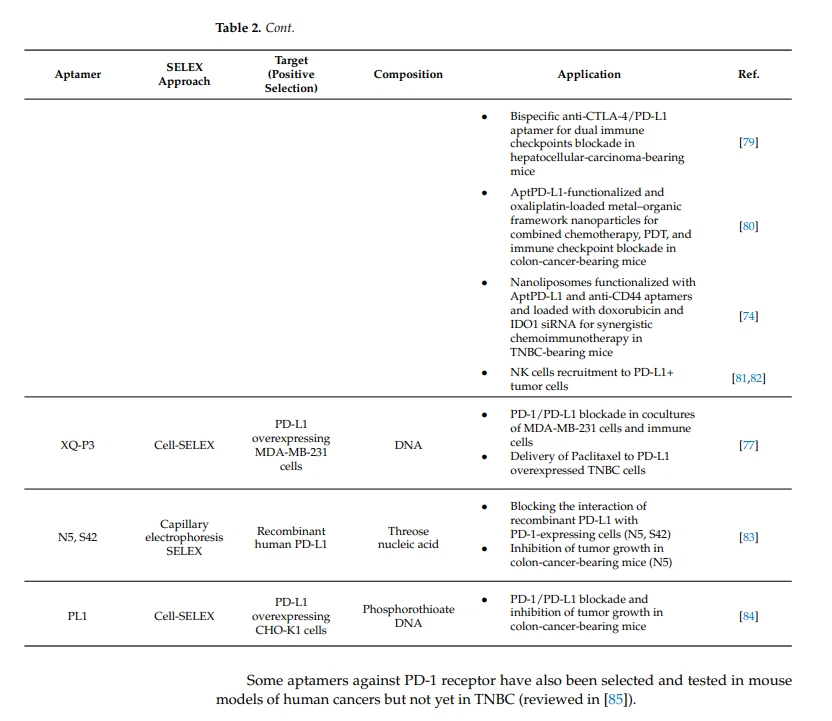
Recently, different PD-L1 aptamers have been generated and tested as stand-alone antagonists, bispecific conjugates, and delivery agents of therapeutics in lung, liver, and colon tumor mouse models, which, similar to anti-PD-L1 antibodies, interfere with the PD-1/PD-L1 axis by blocking the PD-L1 (Table 2). One aptamer, named XQ-P3, has been generated by positive selection on PD-L1 overexpressing MDA-MB-231 cells by using PD-L1 knockout cells for counterselection [77]. Even if not yet tested in vivo, it appears highly effective in co-cultures of TNBC MDA-MB-231 cells and immune Jurkat cells by blocking the interaction with PD-1 and restoring T cell function. Furthermore, an XP-Q3 aptamer-paclitaxel conjugate showed anti-proliferation efficacy in PD-L1 overexpressed TNBC cells [77].

3.3. Macrophages
Tumor-associated macrophages (TAMs) are among the most abundant immune cells in the TME of a broad range of cancers and may act to promote or suppress antitumor immune responses [86,87]. Indeed, due to their high degree of plasticity, they shift to two diverse phenotypes in response to various micro-environmental stimuli: classically activated, proinflammatory M1, and alternatively activated anti-inflammatory M2, which display a differential expression profiles to cell surface markers and different cytokine and chemokine production. M1 macrophages typically exert antitumor functions, while M2 macrophages promote tumor progression. In most aggressive tumors, including TNBC, TAMs tend to resemble an M2-like phenotype that largely accounts for the failure of conventional therapies and immune checkpoint inhibition therapies. For this reason, several innovative immunotherapeutic approaches aim to target and deplete M2 macrophages or reprogram them to the desired phenotype [88,89].
To select aptamers targeting human M2-like macrophages, the first cell-SELEX approach was applied to human macrophages derived from monocytes of several donors and polarized to the M2-like phenotype [90]. Although the best M2-targeting DNA aptamer coming from the selection was not able to discriminate the target cells from undifferentiated M0-like and monocytes and also bound at a lower extent to M1-like macrophages, it rapidly internalized into CD14+ monocytes, thus holding potential for monocyte-targeted drug delivery applications.
Another striking application of aptamers for solid tumor immunotherapy consists of potentiating M1 macrophage specificity for tumor cells by engineering them with cancer cell-targeting aptamers. Chimeric antigen receptor T (CAR-T) cell immunotherapy, which infuses patients with CAR-T cells, has shown great efficacy in the treatment of some leukemias and lymphomas but only modest results in solid tumors due to the difficulty of penetrating tumors [91]. Because of the intrinsic capacity of macrophages to penetrate tumor tissues, several approaches have been recently proposed that genetically engineer them to express chimeric CARs (CAR-M) for targeting tumor cells and initiate a targeted antitumor response [92]. To overcome major drawbacks associated with traditional CAR-M therapies, such as the low reproducibility of engineered proteins and safety issues, Qian et al. proposed a new CAR-M approach based on the use of aptamers [93].
The murine stable macrophage cell line, RAW 264.7, was first incubated with an azide-containing metabolic glycoprotein labeling reagent and lipopolysaccharide to generate azido sugars on the M1 cell surface. Then, M1 cells were conjugated by click chemistry reaction to both the AS1411 aptamer, which binds to nucleolin expressed on several cancer cells, and a PD-L1 aptamer, for simultaneous tumor targeting and immune checkpoint blockade. Importantly, in vivo, imaging of mice bearing 4T1 TNBC and intravenously injected with M1 cells, functionalized with fluorescent aptamers, showed a greater accumulation in tumors compared with unmodified M1 cells. Furthermore, when tested for antitumor activity, the dual-aptamer-engineered M1 caused a strong reduction in tumor growth and metastasis formation, which was accompanied by immune TME reprogramming with increased T cell infiltration in the tumor and enhanced T cell cytotoxicity.

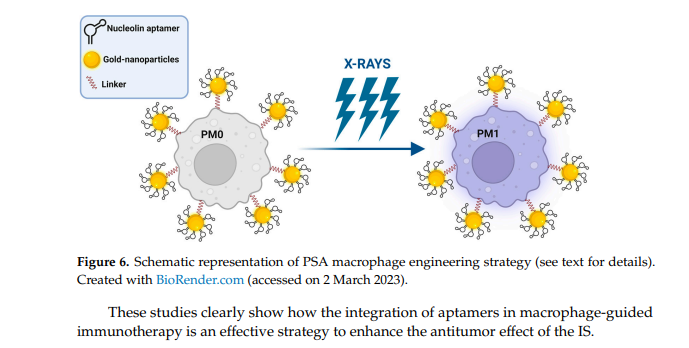
Alternatively, Chen et al. proposed polyvalent spherical aptamers (PSAs) as a macrophage engineering strategy [94]. PSAs were generated through the functionalization of gold nanoparticles with both the thiol-modified AS1411 aptamer and a DNA linker that carries, at the free extremity, a functional group for reacting with azide tags created on M0 macrophages through the abovementioned metabolic labeling and biorthogonal click reactions (Figure 6). The phenotypic transformation of engineered non-polarized macrophages into the M1 subtype was activated by X-rays in vitro and confirmed in mice bearing 4T1 tumor xenografts, causing potent tumor-specific killing without signs of systemic toxicity.
3.4. Natural Killer Cells
NK cells are cytotoxic lymphocytes belonging to the innate IS, able to produce inflammatory cytokines and chemokines. They are called the “first line of defense” because, different from T lymphocytes, they do not express antigen-specific T cell receptors but act against mutated cells without prior sensitization or clonal expansion [95]. NK cell adoptive immunotherapy failed to show efficacy in the treatment of solid tumors, partly due to the immunosuppressive TME and lack of NK cell specificity to the tumor [96].
Therefore, among the approaches for improving NK cell anticancer therapeutic efficacy, a great effort is focused on conferring cancer specificity through the expression of CARs or the conjugation of tumor-targeting ligands [97]. Zu and colleagues explored aptamers as active cancer-targeting agents by linking an aptamer, capable of specifically recognizing the CD30 receptor, on lymphoma cells to the surface of either an NK commercial cell line or NK cells obtained from three healthy donors [98]. This DNA-type aptamer was previously selected by the same group through a hybrid SELEX approach, in which steps of selection on CD30+ lymphoma cells were followed by selection steps on the CD30 recombinant protein [99]. The aptamer was modified at the 30 ends with lipophilic double C18 hydrocarbon chains for anchoring into the membrane of NK cells, which are so guided specifically to lymphoma cells to kill them [98]. More recently, the same authors applied the same approach in TNBC by attaching a DNA aptamer capable of binding a not-yet-known protein expressed on TNBC cells to the surface of NK cells. Aptamer-engineered NK cells inhibited lung metastasis from MDA-MB-231 cells intravenously injected in mice without side toxicity to normal tissues [100].
To further enhance the tumor-specificity of NK cells in solid tumors, dual aptamer-equipped NK cells were generated by using both an aptamer targeting hepatocellular carcinoma cells and the AptPD-L1 aptamer [81]. The resulting engineered NK cells were more effective than cells unconjugated or conjugated with only one of the two aptamers in inhibiting the growth of hepatocellular carcinoma in adoptively transferred mice. Another limit to the efficiency of immunotherapy with NK cells is their insufficient infiltration in solid tumors. Once again, aptamers have proved to be excellent tools for overcoming this problem. Hock’s group generated a bispecific aptamer-based conjugate capable of simultaneously binding to c-Met, a receptor highly expressed on several tumor cells, and to the Fcg receptor III (CD16a), a protein expressed on NK cells [101]. The conjugate is made up of the two highly specific c-Met and CD16a DNA aptamers that were fused by different linkers, preserving the ∼65 Å-ideal distance for simultaneously binding to the two receptors. The conjugate was able to efficiently mimic antibody-dependent cellular cytotoxicity by recruiting NK cells to cancer cells. Later, the same CD16 aptamer was fused to a PD-L1 DNA aptamer to generate a construct able to both recruit NK cells to PD-L1+ tumor cells and impair the PD-1/PD-L1 immunosuppressive axis by reactivating TILs against tumor cells in tumor-bearing mice [82]. This approach is particularly indicated for those solid tumors with high levels of PD-L1, such as TNBC.
4. Conclusions
The recent studies discussed here clearly demonstrate the great potential of oligonucleotide aptamers to amplify our IS to fight cancers. Aptamers can be used as anticancer agents in the same way as mAbs but are cheaper, produced more rapidly and at a greater reproducibility, and less immunogenic than antibodies. However, it must be recognized that the arrival of aptamers in the clinic is proving to be slower than expected; in fact, although more than 30 years have passed since the first SELEX [25,26], only three aptamers are currently in clinical trials for cancer treatment [51].
This slowdown is mostly due to some challenges that limit aptamers’ efficacy in patients, such as their uncertain stability and half-life, especially in the complex and continuously evolving microenvironment that surrounds the tumor. Nevertheless, the astonishing strategies that have been developed in the very few last years to overcome the abovementioned limiting issues and the recent progress in aptamer discovery and modifications for adapting them to any desired applications make it reasonable to argue that the practice use of aptamers will soon be realized for cancers such as TNBC, which urgently need new therapeutic options.
Author Contributions:
Conceptualization, L.C.; writing—original draft preparation, L.C.; writing— review and editing L.A., A.d., R.N., M.F., S.C., and L.C. All authors have read and agreed to the published version of the manuscript.
Funding:
This research was funded by Fondazione AIRC per la Ricerca sul Cancro, IG 23052, to L.C. L.A. was supported by an AIRC fellowship for Italy.
Institutional Review Board Statement:
Not applicable.
Data Availability Statement:
Not applicable.
Acknowledgments:
We are grateful to A. Caliendo for insightful discussions.
Conflicts of Interest:
The authors declare no conflict of interest.
References
1. Dent, R.; Trudeau, M.; Pritchard, K.I.; Hanna, W.M.; Kahn, H.K.; Sawka, C.A.; Lickley, L.A.; Rawlinson, E.; Sun, P.; Narod, S.A. Triple-negative breast cancer: Clinical features and patterns of recurrence. Clin. Cancer Res. 2007, 13, 4429–4434. [CrossRef]
2. Derakhshan, F.; Reis-Filho, J.S. Pathogenesis of Triple-Negative Breast Cancer. Annu. Rev. Pathol. 2022, 17, 181–204. [CrossRef]
3. Lu, J.Y.; Alvarez Soto, A.; Anampa, J.D. The landscape of systemic therapy for early-stage triple-negative breast cancer. Expert Opin. Pharmacother. 2022, 23, 1291–1303. [CrossRef]
4. Lehmann, B.D.; Bauer, J.A.; Chen, X.; Sanders, M.E.; Chakravarthy, A.B.; Shyr, Y.; Pietenpol, J.A. Identification of human triple-negative breast cancer subtypes and preclinical models for selection of targeted therapies. J. Clin. Investig. 2011, 121, 2750–2767. [CrossRef]
5. Lehmann, B.D.; Jovanovic, B.; Chen, X.; Estrada, M.V.; Johnson, K.N.; Shyr, Y.; Moses, H.L.; Sanders, M.E.; Pietenpol, J.A. Refinement of Triple-Negative Breast Cancer Molecular Subtypes: Implications for Neoadjuvant Chemotherapy Selection. PLoS ONE 2016, 11, e0157368. [CrossRef]
6. Burstein, M.D.; Tsimelzon, A.; Poage, G.M.; Covington, K.R.; Contreras, A.; Fuqua, S.A.; Savage, M.I.; Osborne, C.K.; Hilsenbeck, S.G.; Chang, J.C.; et al. Comprehensive genomic analysis identifies novel subtypes and targets of triple-negative breast cancer. Clin. Cancer Res. 2015, 21, 1688–1698. [CrossRef]
7. Park, J.H.; Ahn, J.H.; Kim, S.B. How shall we treat early triple-negative breast cancer (TNBC): From the current standard to upcoming immuno-molecular strategies. ESMO Open 2018, 3, e000357. [CrossRef]
8. Li, S.; Bao, C.; Huang, L.; Wei, J.F. Current Therapeutic Strategies for Metastatic Triple-Negative Breast Cancer: From Pharmacists’ Perspective. J. Clin. Med. 2022, 11, 6021. [CrossRef]
9. MROSS, K.; Kratz, F. Limits of conventional cancer chemotherapy. In Drug Delivery in Oncology: From Basic Research to Cancer Therapy; Kratz, F., Senter, P., Steinhagen, H., Eds.; John Wiley & Sons, Ltd.: Hoboken, NJ, USA, 2011; Volume 1, pp. 1–31.
10. Ferrari, P.; Scatena, C.; Ghilli, M.; Bargagna, I.; Lorenzini, G.; Nicolini, A. Molecular Mechanisms, Biomarkers and Emerging Therapies for Chemotherapy Resistant TNBC. Int. J. Mol. Sci. 2022, 23, 1665. [CrossRef]
11. Gonzalez-Angulo, A.M.; Timms, K.M.; Liu, S.; Chen, H.; Litton, J.K.; Potter, J.; Lanchbury, J.S.; Stemke-Hale, K.; Hennessy, B.T.; Arun, B.K.; et al. Incidence and outcome of BRCA mutations in unselected patients with triple receptor-negative breast cancer. Clin. Cancer Res. 2011, 17, 1082–1089. [CrossRef]
12. Robson, M.; Im, S.A.; Senkus, E.; Xu, B.; Domchek, S.M.; Masuda, N.; Delaloge, S.; Li, W.; Tung, N.; Armstrong, A.; et al. Olaparib for Metastatic Breast Cancer in Patients with a Germline BRCA Mutation. N. Engl. J. Med. 2017, 377, 523–533. [CrossRef] [PubMed]
13. Eikesdal, H.P.; Yndestad, S.; Elzawahry, A.; Llop-Guevara, A.; Gilje, B.; Blix, E.S.; Espelid, H.; Lundgren, S.; Geisler, J.; Vagstad, G.; et al. Olaparib monotherapy as primary treatment in unselected triple-negative breast cancer. Ann. Oncol. 2021, 32, 240–249. [CrossRef] [PubMed]
14. Litton, J.K.; Rugo, H.S.; Ettl, J.; Hurvitz, S.A.; Gonçalves, A.; Lee, K.H.; Fehrenbacher, L.; Yerushalmi, R.; Mina, L.A.; Martin, M.; et al. Talazoparib in Patients with Advanced Breast Cancer and a Germline BRCA Mutation. N. Engl. J. Med. 2018, 379, 753–763. [CrossRef]
15. Keung, M.Y.; Wu, Y.; Badar, F.; Vadgama, J.V. Response of Breast Cancer Cells to PARP Inhibitors Is Independent of BRCA Status. J. Clin. Med. 2020, 9, 940. [CrossRef] [PubMed]
For more information:1950477648nn@gmail.com