BCG-induced Trained Immunity Enhances Acellular Pertussis Vaccination Responses in An Explorative Randomized Clinical Trial
Apr 20, 2023
INTRODUCTION
Pertussis is a highly transmissible acute respiratory disease caused by the bacterium Bordetella pertussis and has re-emerged as a serious public health issue despite high vaccine coverage1. For years, the disease was controlled in industrialized countries through vaccination with whole-cell pertussis vaccines (wPs) that were implemented in the 1940s-1950s. These vaccines were highly effective and induced long-term protection.
However, high reactogenicity and safety concerns led to their replacement in the 1990s–2000s by acellular pertussis vaccines (aPs). aP booster vaccines, including combination vaccines that contain tetanus and diphtheria toxoid (Tdap) either with or without inactivated poliovirus (IPV) (Tdap-IPV), were introduced shortly thereafter. aP vaccines are now widely used to boost immunity in preschool children, adolescents, and adults. Despite these measures and their improved safety profile, multiple studies have shown that induced immunity remains suboptimal2 and wanes over time3. Furthermore, the duration of protection after repetitive aP doses progressively shortens4–6. The growing need for new and improved vaccination strategies has led to the exploration of new adjuvants that target innate immunity and enhance specific immunity to aPs7–9.
Combination vaccines can boost immunity. Combination vaccines are a combination of several different disease-preventing vaccines that provide multiple protections to patients at the same time, reducing the stress and pain of receiving multiple injections. At the same time, the combination vaccine can also improve the immunity of the vaccinated, because it can stimulate more immune responses and produce more antibodies and immune cells, effectively improving the ability to prevent many different diseases. Improving immunity is very important in our daily life. Cistanche can enhance immunity. The polysaccharides in meat can regulate the immune response of the human immune system, improve the stress ability of immune cells, and enhance the sterilization of immune cells effect.

Click to learn what is cistanche
The Bacille Calmette-Guérin (BCG) vaccine protects against mycobacterial infections such as tuberculosis10, as well as protection against secondary infections with unrelated pathogens in mouse models1. In humans, these non-specific beneficial effects have been linked to reduced infant mortality11,12 and have been validated in randomized clinical trials10,13. BCG induces long-term changes in innate immune cells that enhance their responsiveness to stimulation with unrelated pathogens. This process called trained immunity, involves the epigenetic reprogramming of monocytes and persists for up to a year after BCG vaccination14. The clinical relevance of trained immunity has been demonstrated in humans through studies that use BCG as the prototype for the induction of trained immunity and vaccination or experimental human infection as the secondary immune perturbation15–17. There is accumulating evidence that BCG vaccination modulates adaptive immune responses to vaccines. Among eight studies that were evaluated in a recent review, five showed enhanced vaccine-specific humoral responses18.
Efforts to delineate the interacting effects of BCG and pertussis vaccines suggest that BCG-induced trained immunity may have a positive effect on the immune response to pertussis. In mice, prior vaccination with BCG enhanced Th1 and humoral immune responses following aP, but not wP vaccination19. In humans, one population-scale study showed that co-administration of BCG with pertussis vaccination reduced mortality in infants20 compared to receiving the vaccines sequentially. To the best of our knowledge, no study to date has investigated in a randomized controlled study whether trained immunity modulates immune responses to pertussis vaccines or has compared the timing of administration of BCG vaccination relative to a second vaccination or challenge.
Here, we tested whether BCG vaccination impacts the adaptive immune response to a vaccination, and whether trained immunity is associated with those responses. We show that BCG-induced trained immunity enhances aP-specific antibody, aP-specific Th1 cell responses, and total memory B cell responses 2 weeks post Tdap-IPV immunization. These increases were positively correlated with increased trained immunity biomarkers, including IL-1β and IL-6. Our findings highlight a role for trained immunity induced by BCG vaccination in potentiating immunity to pertussis vaccines.
RESULTS
Study design
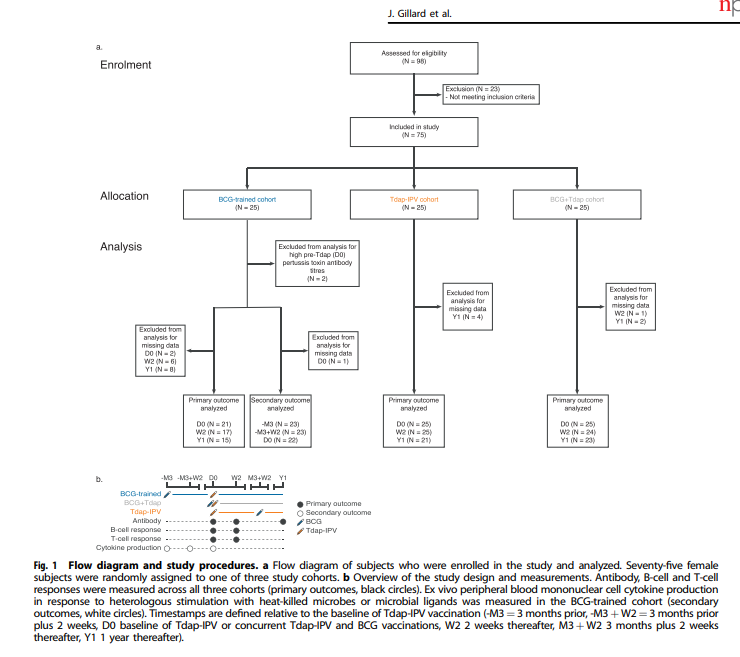
Seventy-five healthy female volunteers were randomized to one of three cohorts to receive BCG and Tdap-IPV vaccines in different orders21. We chose to enroll only women since gender-specific effects of pertussis vaccines have been reported 22. The median age of the volunteers was 23, with no significant difference in age between cohorts (Kruskal–Wallis test; P = 0.6), as previously reported21. Two subjects were excluded from analysis for having a high anti-pertussis toxin IgG concentration before Tdap-IPV vaccination (>100 IU/ml), indicative of recent infection with pertussis23,24 (Fig. 1a).
To identify changes in the TdapIPV vaccine response that are associated with trained immunity, the “BCG-trained” cohort received BCG 3 months before TdapIPV. We also included two control cohorts to account for the timing of the BCG vaccination. The “BCG + Tdap” cohort received both vaccinations in opposite limbs at the same time, and the “Tdap-IPV” cohort received Tdap-IPV first and BCG 3 months later (Fig. 1b). Blood was collected at several time points before and after the vaccinations. Timestamps are defined relative to the baseline of Tdap-IPV vaccination (-M3 = 3 months prior, -M3 + W2 = 3 months prior plus 2 weeks, D0 = baseline of Tdap-IPV or concurrent BCG and Tdap-IPV vaccinations, W2 = 2 weeks thereafter, M3 + W2 = 3 months plus 2 weeks thereafter, Y1 = 1 year thereafter). Primary outcomes were specified as increases in adaptive immune responses 2 weeks or 1 year after Tdap-IPV vaccination.
In total, we assessed 31 immunological outcomes across three vaccination cohorts. We used a bead-based multiplex immunoassay to measure antibody concentrations of IgG against pertussis antigens pertussis toxin (PT), filamentous haemagglutinin (FHA), pertactin (PRN), as well as diphtheria toxoid (DIPH) and tetanus toxin (TET)25. Total B-cell and PRN-specific B-cells were measured directly in whole blood by flow cytometry using fluorescently labeled PRN (Supplementary Fig. 1). Th1 and Th17 T-cell responses against pertussis antigens were measured by stimulating peripheral blood mononuclear cells (PBMCs) with either PRN, PT, or FHA for 7 days and measuring secreted IFNγ, IL22, and IL-17 by ELISA26.
BCG vaccination enhances immune cell cytokine responses to unrelated stimuli, a phenomenon that has been explained by two different biological mechanisms. The first process is called heterologous immunity and depends on the non-specific activation of T cells27,28. The second process called trained immunity, results in increased proinflammatory cytokine production by innate immune cells14. We defined secondary outcomes for the BCGtrained cohort as changes in cytokine production of PBMCs following stimulation with heat-killed Candida albicans (C_alb), Staphylococcus aureus (S_aur), Bordetella pertussis (Bp), or lipopolysaccharide (LPS). As in previous studies16,21, we quantified Th1/ 17 cytokines IFNγ, IL-22, or IL-17 after 7 days as a readout for heterologous immunity, or monocyte-derived cytokines IL-10, IL-6, IL-1β, or TNF after 24 h as a readout for trained immunity (Fig. 1b). Cytokine production in response to sonicated Mycobacterium tuberculosis (Mtb) was measured to quantify anti-mycobacterial immunity.

Prior BCG vaccination enhances Tdap-IPV-induced adaptive immune responses
To quantify the effects of trained immunity on Tdap-IPV vaccination, for each primary endpoint, we constructed a linear mixed-effects model with sample time, cohort membership, as well as the interaction of time and cohort as covariates. We examined two contrasts: (i) differences compared to baseline (D0) within each cohort (post-vaccination effects, Supplementary Table 1), and (ii) between-cohort differences in the magnitude of those changes (differential effects, Supplementary Table 2). All cohorts mounted significant increases in antibody responses to the five antigens following Tdap-IPV immunization. Antibody concentrations remained higher than baseline up to a year post-vaccination (Y1), except TET, which had waned in the BCGtrained and BCG + Tdap cohorts (Supplementary Fig. 2a).
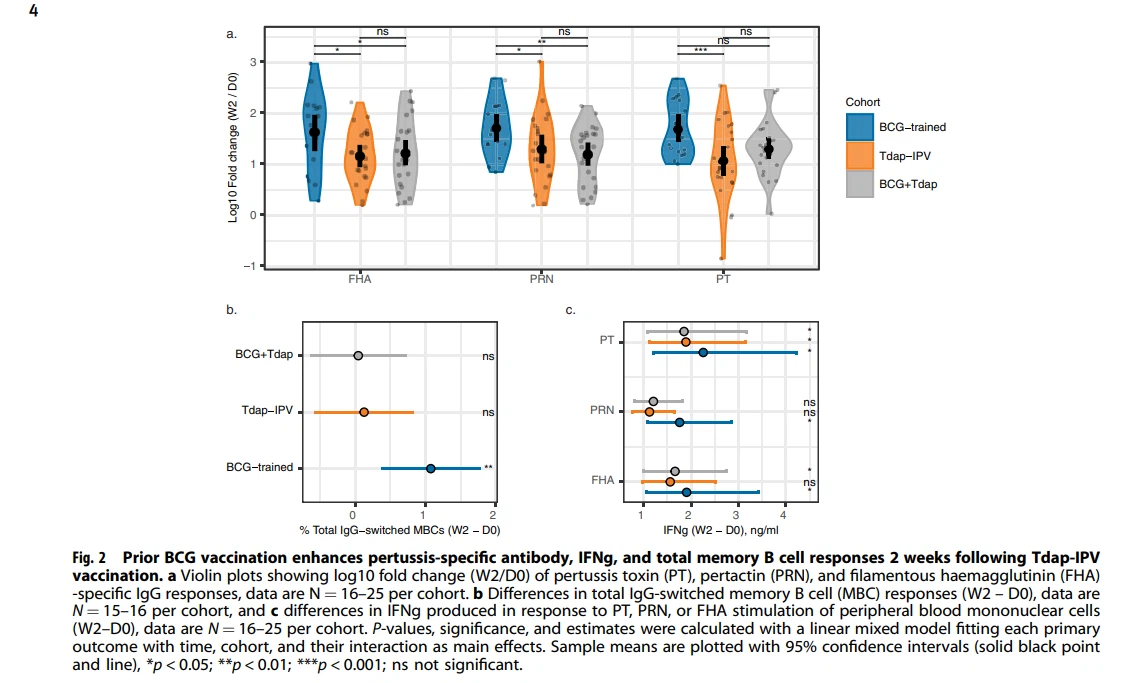
All cohorts had significantly increased numbers of circulating PRN + B cells 2 weeks post-immunization, which were mainly memory B cells (MBCs) (Supplementary Fig. 3a). We did not observe differences between cohorts (Supplementary Table 2 and Supplementary Fig. 3b). Compared to the Tdap-IPV cohort, the BCG-trained cohort displayed enhanced baseline-normalized log10 fold changes (W2/D0) for IgG responses for PT, FHA, and PRN. A similar pattern was observed when comparing these responses to the BCG + Tdap cohort (Fig. 2a). We also observed elevated pertussis-specific IgG concentrations in the BCG-trained cohort 2 weeks post-vaccination (Supplementary Fig. 2b), although the difference in the absolute values was less pronounced than the difference in the increases that are relative to the baseline at D0.
Furthermore, subjects in the BCG-trained cohort displayed significantly increased total MBC responses, including IgG class-switched MBCs (Fig. 2b and Supplementary Fig. 4). Subjects in the BCG-trained cohort also displayed elevated IFNγ secretion in response to stimulation with all three pertussis antigens. Conversely, significant increases were observed for a single pertussis antigen in the Tdap-IPV cohort (PT) and two pertussis antigens in the BCG + Tdap cohort (PT and FHA, Fig. 2c and Supplementary Fig. 5). We also observed a trend where increases in IFNg production were higher in the BCG-trained cohort than in the other cohorts, although this did not reach statistical significance (Supplementary Table 2 and Supplementary Fig. 5b). Pertussis-specific IL-22 and IL-17 responses were weak for all cohorts (Supplementary Table 1). Altogether, these findings point to enhanced pertussis-specific antibody responses, enhanced total IgG-switched MBC responses, and broader pertussis-specific IFNγ responses in the BCG-trained cohort compared to the other two cohorts.
We explored the relationships between the increases in primary outcomes that were enhanced in the BCG-trained cohort. For this exploratory analysis, correlations between antibodies, B-cells, and cytokines were calculated for each cohort. The BCG-trained cohort displayed many significant and quantitatively stronger positive correlations between these responses, while the Tdap-IPV and BCG + Tdap cohorts displayed weaker or inverse correlations, with the strongest pattern corresponding to changes in IFNγ responses (Fig. 3a). Correlation coefficients between responses in the BCGtrained were significantly greater than those in the control cohorts, altogether pointing towards the induction of a more highly coordinated pertussis-specific adaptive immune response in the BCG-trained cohort (Fig. 3b).
IL-1β and IL-6 cytokine production is associated with pertussis-specific adaptive immune responses
The BCG-trained cohort displayed enhanced total IgG-switched MBC and pertussis-specific IFNγ responses. Furthermore, compared to the Tdap-IPV and BCG + Tdap cohorts, the BCG-trained cohort also displayed higher pertussis antibody responses. Since BCG vaccination in humans can increase cytokine production of circulating immune cells in response to heterologous stimulation, weeks to months after vaccination27, we evaluated whether these BCG-induced cytokine responses were associated with changes in pertussis-specific immune responses following Tdap-IPV vaccination. Two weeks and 3 months after BCG vaccination, there was a significantly enhanced anti-mycobacterial response characterized by increased IL-22 and IFNγ production compared to the BCG vaccination baseline (Supplementary Fig. 6a, b).
Overall, the BCG-trained cohort did not show increased production of
heterologous immunity or trained immunity-associated cytokines,
as previously observed (Supplementary Figs. 6 and 8)21. However,
since the induction of cytokine production varied between
individuals, we calculated changes between 2 weeks post BCG
and 3 months post BCG compared to BCG baseline (Supplementary Figs. 7 and 9). Pearson correlations were calculated to
determine the strength of the association between these
measurements at each time point. Three months after BCG
vaccination, i.e. at the Tdap-IPV baseline, cytokine responses to
in vitro stimulation were highly correlated. Heterologous
immunity-associated cytokine responses were negatively correlated with trained immunity-associated cytokine responses, and
amongst those, correlations between IL-6 and IL-1β were
strongest (Fig. 4), as has been previously described16. Correlation
patterns 2 weeks post BCG vaccination were similar for heterologous immunity-associated cytokines but correlations between
trained immunity-associated cytokines were much weaker, except IL-10 responses. Taken together, these results
point to coordinated innate immune activation 3 months, but not
2 weeks post BCG immunization in the BCG-trained cohort.
Next, we explored whether variations in the cytokine responses of the BCG-trained cohort were associated with changes in TdapIPV adaptive immune endpoints. We examined changes in cytokine production 2 weeks and 3 months post BCG vaccination. We found that increases in heterologous immunity-associated cytokines tended to be weakly, and negatively, correlated with the primary endpoints at both 2 weeks (Supplementary Fig. 10) and 3 months post BCG vaccination (Fig. 5a). By contrast, increases in trained immunity-associated cytokines 3 months after BCG vaccination, particularly IL-1β/IL-6 in response to LPS stimulation, were significantly positively correlated with PRN and FHA antibody responses, IFNγ production in response to PT stimulation, and total IgG-switched MBC responses (Fig. 5b, c).
In line with this, we did not observe changes in the relative abundance of peripheral blood cell numbers (Supplementary Fig. 11a), nor were changes in cellular abundance 3 months post-BCG vaccination positively correlated with pertussis endpoints (Supplementary Fig. 11b). Increases in IL-1β production in response to LPS stimulation (IL1b. LPS) 3 months post BCG vaccination showed a strong association with multiple Tdap-IPV responses and was selected to determine how much of the variation of each response they could explain. The total variance explained (predicted Rsq) for each outcome was calculated and changes in IL-1β could explain up to 60% of the response variation (Fig. 5d). Overall these results highlight that trained immunity-associated cytokine responses 3 months after BCG vaccination are correlated with increases in pertussis-specific antibody responses and IFNγ production, as well as total IgG-switched MBC responses.
DISCUSSION
Induction of trained immunity in humans occurs weeks to months after BCG vaccination14 and can affect the response to subsequent immunization in humans16,17. Here, we show that trained immunity that is induced by BCG vaccination 3 months before, but not concurrent with, a booster dose of Tdap-IPV, augments pertussis IgG responses and modulates pertussis-specific cellular responses. Several studies have investigated the interacting effects of BCG and other vaccines, with most of these studies reporting a positive effect of BCG on pertussis immune responses20,21,29,30. However, to the best of our knowledge, no study to date has investigated the timing of BCG vaccination on the response to pertussis or studied which features of the BCGinduced trained immunity response are correlated with enhanced vaccine responsiveness.
Subjects in all three cohorts mounted anti-pertussis humoral and PRN + B cell responses 2 weeks post-vaccination with TdapIPV. Although PRN antibody responses were much higher in the BCG-trained cohort, we did not observe a similar pattern in PRNspecific B cell responses. This could be explained by a faster induction of antibodies in the BCG-trained cohort, which accumulates over time due to their long half-life.
However, since antibody concentrations were not measured before 2 weeks postvaccination, it was not possible to estimate differences in the kinetics between cohorts. Alongside increased PRN antibody responses, we also found that FHA and PT antibody responses were higher in the BCG-trained cohort. We were, unfortunately, unable to measure PT- and FHA-specific B cell responses due to the high non-specific binding of FHA and PT to B cells. Still, it is promising that total IgG MBC responses were increased in the BCG-trained cohort and that these increases were correlated with increases in antibody responses. We also found that IFNγ responses in response to pertussis antigen re-stimulation were enhanced in the BCG-trained cohort. Although these changes were relatively small, we observed a trend where W2–D0 changes were higher than in the other cohorts. Further studies with more subjects may help validate this pattern, which has been confirmed in a mouse study19. Similarly, neonatal BCG vaccination has also been shown to potentiate Th1 responses to tetanus toxoid31.

Increases in pertussis antibodies, total IgG MBC responses, and
pertussis IFNg responses were strongly correlated with each other
in the BCG-trained cohort, suggesting the coordinated activation
of effector and memory functions. Furthermore, increases in
pertussis antibodies, total IgG-switched MBC responses, and IFNγ
in response to PT restimulation in the BCG-trained cohort were
associated with innate responses, in particular IL-1β and IL-6.
These results are in line with a previous human study from our
group where we studied the effect of BCG on influenza
vaccination17. The importance of the IL-1β/IL-6 pathway as a
biomarker of trained immunity has also been highlighted in a
model of experimental viral infection following yellow fever
vaccination16. Overall, we did not observe correlations between
particular microbial stimuli and the primary outcomes, which
suggests that overall changes in cytokine response pathways and
not any particular stimulation condition are linked to enhanced
responsiveness to pertussis vaccination. While we expect the
predominant IL-6 and IL-1β response to microbial stimulation to
be derived from monocytes and dendritic cells16, B cells may also
contribute to cytokine production32 and we cannot rule out their
potential contribution.
A key question has been how long BCG-induced trained
immunity persists post-vaccination. In vitro, signatures of BCG-induced trained immunity in humans have been identified as early
as 2 weeks and up to 1-year post vaccination14. Clinical studies in
humans that have aimed to translate these findings to in vivo
responsiveness have restricted the window of observation to up
to 5 weeks post-BCG vaccination15–17. We observed a weaker
induction of the trained immunity-associated cytokines IL-6 and
IL-1β than in previous studies16, as has been previously reported21.
Batch-to-batch variations in the production of the BCG vaccine
may influence the induction of trained immunity and may explain
the effect that we observed in this study 33.
Furthermore, variations between BCG strains have also been observed that impact their immunogenicity and clinical efficacy34–36. Despite this, we nonetheless demonstrate that heterologous IL-1β and IL-6 responses 3 months after BCG vaccination, i.e. at the moment of Tdap-IPV vaccination, but not 2 weeks after BCG vaccination is associated with enhanced pertussis humoral and cellular immunity. These findings imply that trained immunity continues to develop the past 2 weeks after BCG vaccination, and emphasize that the baseline functional ‘responsiveness’ of circulating innate immune cells may be critical for the development of a more potent vaccine response.
This study demonstrates that prior BCG vaccination can enhance responsiveness to aP vaccine antigens. Surprisingly, we did not observe this effect for TET and DIPH. This may be explained by the fact that all adults had received a prior booster vaccination with Td-IPV but not with aP at the age of 9 years, as recommended in the national immunization program. In line with this, we found that the baseline antibody concentrations of aP antigens were highly correlated across the subjects in our study, but were not correlated with DIPH and TET, suggesting that humoral immunity to these components is not synchronized with the aP antigens (Supplementary Fig. 12). Baseline DIPH and TET antibody levels were highly intercorrelated, which is consistent with their co-administration in vaccines. Thus, variations in pre-existing immunity against different vaccine components may play a role in the capacity of BCG vaccination and trained immunity to influence the response to a Tdap-IPV.
Although our study was not designed to investigate vaccine efficacy, a major question is whether the enhanced antibody response that we observed in the BCG-trained cohort may translate into better clinical protection. There is much debate about the correlates of protection against pertussis37. Nonetheless, PT antibodies have previously been used to correlate with clinical protection against disease (>25 IU/ml)29. Using this threshold, near-complete seroprotection was achieved 2 weeks post-TdapIPV in the BCG-trained and BCG + Tdap cohorts, while a fraction of subjects in the Tdap-IPV cohort were not seroprotected (Supplementary Fig. 13).
Besides antibodies, T-cell immunity and in particular Th1 and Th17 responses have also been highlighted as important for protection against pertussis in animal models2,38. We found that the BCG-trained cohort displayed augmented IFNγ in response to pertussis antigen re-stimulation, which is a readout for Th1 immunity and may therefore suggest improved clinical protection against pertussis. Finally, current immunological endpoints aimed at quantifying pertussis-specific adaptive immunity, such as T-cell, B-cell, or humoral responses, have not yet been validated as immunological correlates of protection. There are several possibilities for closing this knowledge gap, for example, by conducting epidemiological studies or by the use of the recently established controlled human infection model for B. pertussis39.
A limitation of our explorative study is that the study population consisted of adults who were primed in infancy with the whole-cell DTP vaccine, which is known to influence the adaptive response to pertussis decades after priming and affects the induction of T-cell immunity in response to a booster vaccination40. Thus, it will be important to determine whether our findings translate to children born in the era of routine pediatric aP vaccination. Additionally, since we included only females, it will be important to determine if differences exist with males. In this explorative study, we measured anti-pertussis immunogenicity endpoints including antibody responses, total and PRN + B cell responses, and antigen-specific T-cell responses. P-values were not corrected for multiple testing due to the targeted nature of the immune responses assessed. Importantly, this study was performed on volunteers of Western European (Dutch) descent, and future studies should investigate whether similar effects can be found in populations of different genetic backgrounds. Another limitation is that only a subset of cytokines was measured. While this was appropriate for the specific hypotheses we aimed to test, a more comprehensive, unbiased profiling of cytokine and other responses may yield new insights.

In conclusion, in the present study, we report that BCG vaccination administered 3 months before Tdap-IPV vaccination significantly enhances anti-pertussis immunity and that biomarkers of trained immunity are the most reliable correlates of these enhanced vaccination responses. Additional validation studies will be necessary to evaluate these findings across diverse study populations, and further immunological and genetic studies are needed to mechanistically validate the role of the IL-1 and IL-6 pathways. Altogether, the delineation of baseline innate immune function, which can be modulated by BCG, will be essential for understanding how to guide vaccine-induced adaptive immune responses toward superior immunogenicity and protection against disease.
METHODS
Clinical trial
This single-center, randomized open-label trial was performed at the Radboud University Medical Center (Nijmegen, the Netherlands) from March 2015 to July 201621. The study protocol is registered at clinical trials. gov (NCT02771782) and was approved by the Arnhem-Nijmegen Medical Ethical Committee. Volunteers were recruited using bulletin boards and at Radboud University in Nijmegen and received moderate compensation. Volunteers who had not been previously vaccinated with BCG or recently with pertussis vaccines were included. Exclusion criteria were (i) previous BCG vaccination or recent vaccination with pertussis-containing vaccines, (ii) allergy to neomycin, polymyxin, or allergic reaction to previous vaccination with diphtheria, tetanus, pertussis, or polio vaccines, (iii) use of systemic medication other than oral contraceptive drugs, and (iv) pregnancy or history of diseases resulting from immunodeficiency. Cohort size was determined based on previous studies performed by our group in which we investigated the effects of BCG vaccination on innate immune responses16. Randomization across the study arms was performed with a software-based algorithm. All subjects had a history of priming with whole-cell pertussis in the first year of life. Seventy-five female volunteers were included. After written informed consent was obtained, blood was collected in ethylenediaminetetraacetic acid (EDTA) or lithium heparin (LiHep) tubes, and vaccinations were administered. Complete blood counts were obtained using a Sysmex XN-450 hematology analyzer. Subjects received BCG Danish 1331 (Staten Serum Institut, Copenhagen, Denmark; 0.1 ml intradermally) and Tdap-IPV (Boostrix Polio, GlaxoSmithKline; 0.5 ml intramuscularly). Sera were stored at −20 °C until analysis, and whole blood was processed for further analysis as described below. The Consolidated Standards of Reporting Trials (CONSORT) guidelines were used to prepare this manuscript (Supplementary Fig. 14).

Serological analysis
Sera were analyzed for PT-, FHA-, PRN-, TET-, and DIPH-specific IgG antibody concentrations using a fluorescent-bead-based multiplex immunoassay25. Antigens were covalently coupled to distinct color-coded activated carboxylated MicroPlex Microspheres (beads) (Luminex, Austin, Texas, USA). The following antigens were used for coupling: highly purified PT (Netherlands Vaccine Institute), FHA (Kaketsuken, Kumamoto, Japan), P.69 PRN expressed and purified from an E. coli construct41, diphtheria toxoid (Netherlands Vaccine Institute), and tetanus toxin (T3194, Sigma-Aldrich, Saint Louis, Missouri, USA). After a wash step in PBS, 12.5 × 10⁶ carboxylated beads/mL were activated in PBS containing 2.5 mg of 1-ethyl3-(-3-dimethyl aminopropyl)-carbodiimide hydrochloride (Thermo Fisher Scientific, Waltham, Massachusetts, USA) and 2.5 mg of N-hydroxysulfosuccinimide (Thermo Fisher Scientific, Waltham, Massachusetts, USA). The antigens for coupling were diluted in PBS to a concentration of 10 μg of PT, FHA, or PRN, 100 μg of DT, or 25 μg of TET per 12.5 × 10⁶ activated beads and incubated for 2 h at room temperature in the dark under constant rotation. After three wash steps, the antigen-coupled beads were stored in the dark in PBS containing 0.03% (wt/vol) sodium azide and 1% (wt/vol) bovine serum albumin at 4 °C until use. Sera diluted 1/200 and 1/4000 in PBS containing 0.1% (vol/vol) Tween 20 and 3% (wt/ vol) BSA were incubated with antigen-coupled beads in a 96-well filter plate for 45 min at room temperature at 750 pm in the dark. Reference sera in a dilution series, quality control sera, and blanks were included on each plate.
The in-house reference standard for pertussis was calibrated against WHO 1st IS Part 06/140 and serially diluted 4-fold over 6 wells (1/ 200 to 1/204800). The in-house reference standard for DIPH and TET was calibrated against WHO NIBSC DI-3 and TE-3 and serially diluted 4-fold over 8 wells (1/50 to 1/819200). Following incubation, wells were washed 3 times with PBS, incubated with R-phycoerythrin-labeled goat anti-human IgG antibody (Jackson Immunoresearch Laboratories, West-Grove, PA, USA) for 30 min, and washed. Beads were included in PBS and median fluorescence intensity (MFI) was acquired on a Bio-Plex LX200. MFI was converted to IU/mL by interpolation from a 5-parameter logistic standard curve using Bioplex Manager 6.2 software (Bio-Rad Laboratories, Hercules, California, USA) and exported to Microsoft Excel.
PBMC Isolation, stimulation, and cytokine detection
PBMCs were isolated by Ficoll density gradient centrifugation and resuspended at 5 × 10⁶ /ml in RPMI culture medium (Roswell Park Memorial Institute medium; Invitrogen, CA, USA) supplemented with gentamycin, Glutamax (GIBCO), and pyruvate. In all, 100 μl was aliquoted per well in round-bottom 96-well plates (Corning) and stimulated with one of RPMI (negative control), Escherichia coli lipopolysaccharide (LPS; 10 ng/ml, Sigma-Aldrich), sonicated Mycobacterium tuberculosis H37Rv (5 μg/ml), heat-killed Staphylococcus aureus (1 × 10⁶ /ml, clinical isolate), heat-killed Candida albicans (1 × 10⁶ /ml, UC820 strain), and heat-killed Bordetella pertussis (1 μg/ml, B1917 strain), PT (2 μg/ml), PRN (4 μg/ml, ReagentProteins, PFE-031), and FHA (2 μg/ml). PT and FHA were kindly provided by A. M. Buisman at the National Institute for Public Health and Environment (RIVM, Bilthoven, the Netherlands). Cells were incubated at 37 °C and 5% CO2 for 24 h for detection of IL-1β, IL-6, IL-10, and TNF or 7 days for IFNγ, IL-22, and IL-17. Supernatants were stored at −20 °C. Cytokines were measured in PBMC culture supernatants using enzyme-linked immunosorbent assay (ELISA) kits from R&D systems (IL-1β, TNF, IL17, IL-22) or Sanquin (IL-6, IL-10, IFNγ) according to the manufacturer’s instructions.
B-cell flow cytometry
B cell staining was performed directly on whole blood with an antibody staining panel (Supplementary Table 3) including fluorescently labeled PRN for the detection of antigen-specific B cells. To label PRN-specific B cells, PRN (ReagentProteins, PFE-031) was conjugated to fluorescein (FITC Antibody labeling kit, Pierce) according to the manufacturer’s protocol (PRN-FITC). In total, 1–2 ml of freshly drawn whole blood collected in LiHep tubes was diluted in FACS buffer (PBS + 0.09% NaN3 + 0.2% bovine serum albumin, Calbiochem) and cells were pelleted and then washed twice with FACS buffer. Cells were resuspended in FACS buffer and then stained with the B cell phenotyping antibody cocktail for 15 min, fixed (FACSLysing, BD Biosciences), and after another wash with FACS buffer were analyzed within 1 h of staining. Flow cytometry of PRN-antigen-specific B cells in whole blood was performed on an LSRII (BD Biosciences) flow cytometer with standardized instrument settings42. Flow cytometry data were analyzed with Infinicyte (Version 2.0, Cytognos). Per sample, 2 × 10⁶ cells were acquired in the lymphocyte gate (Supplementary Fig. 1a). Lymphocytes were gated following the removal of doublets and debris. B cells were identified as CD45 + CD19 + and PRN-FITC-specific B cells were identified. B cell subsets were identified using an adapted gating strategy43. We attempted to detect PT-specific B cells by flow cytometry, but we were unsuccessful due to the high background caused by nonspecific staining.
Statistics
Cytokine and antibody values were log10-transformed to account for their skewed distribution. Analysis of primary or secondary outcome responses was analyzed in a mixed-effects regression model using the ‘lme4’ 44 R package. For each outcome, the formula for the model (in R notation) is:

Comparisons were calculated with the ‘means’ 45 R package and we examined two contrasts. First, we examined whether primary endpoints were significantly different compared to the Tdap-IPV vaccination baseline within each cohort (post-vaccination effects were defined as W2–D0 within each cohort, Supplementary Table 1). Next, we examined between-cohort differences in the magnitude of those changes (differential effects, Supplementary Table 2, defined as (W2c1 – D0c1) – (W2c2 – D0c2) where c1 and c2 refer to different cohorts for a given comparison). Changes in heterologous or trained immunity cytokines in the BCG-trained cohort were analyzed similarly. The P-values are reported using the Kenward-Roger degrees of freedom method. Statistical parameters are reported directly in the figures and figure legends. Due to the explorative study design and the targeted immune responses assessed, no multiple testing correction was performed. Pairwise correlations were performed with log10-fold change values over baseline. The estimation of variance explained by cytokine measurements on primary outcome variables was performed using the R package ‘caret’ 46. To account for potential overfitting, 10 times repeated, 4-fold cross-validation was performed. We analyzed seroprotective antibody titers against PT, TET, or DIPH with a Fisher exact test. Associations between seroprotection status and cohort were determined by examining residuals of a chi-square test. Threshold values for seroprotection to PT were 25 IU/ml18 and 0.1 IU/ml for DIPH and TET37).

Reporting summary
Further information on research design is available in the Nature Research Reporting Summary linked to this article.
DATA AVAILABILITY
The data that support the findings of this study are available from the corresponding author upon reasonable request.
CODE AVAILABILITY
The R-code that supports the findings of this study is available from the corresponding author upon reasonable request.
REFERENCES
1. Tan, T. et al. Pertussis across the globe: recent epidemiologic trends from 2000 to 2013. Pediatr. Infect. Dis. J. 34, e222–e232 (2015).
2. Warfel, J. M., Zimmerman, L. I. & Merkel, T. J. Acellular pertussis vaccines protect against disease but fail to prevent infection and transmission in a nonhuman primate model. Proc. Natl Acad. Sci. USA 111, 787–792 (2014).
3. Huang, L. M. et al. Responses to primary and a booster dose of acellular, component, and whole-cell pertussis vaccines initiated at 2 months of age. Vaccine 14, 916–922 (1996).
4. Klein, N. P., Bartlett, J., Rowhani-Rahbar, A., Fireman, B. & Baxter, R. Waning protection after fifth dose of acellular pertussis vaccine in children. New Engl. J. Med. 367, 1012–1019 (2012).
5. Misegades, L. K. et al. Association of childhood pertussis with receipt of 5 doses of pertussis vaccine by time since last vaccine dose, California, 2010. JAMA 308, 2126–2132 (2012).
6. Hendrikx, L. H., Berbers, G. A., Veenhoven, R. H., Sanders, E. A. & Buisman, A. M. IgG responses after booster vaccination with different pertussis vaccines in Dutch children 4 years of age: effect of vaccine antigen content. Vaccine 27, 6530–6536 (2009).
7. Misiak, A. et al. The addition of a TLR7 agonist to an acellular pertussis vaccine enhances Th1 and Th17 responses and protective immunity in a mouse model. Vaccine 35, 5256–5263 (2017).
8. Dunne, A. et al. A novel TLR2 agonist from Bordetella pertussis is a potent adjuvant that promotes protective immunity with an acellular pertussis vaccine. Mucosal Immunol. 8, 607–617 (2015).
9. Sugai, T. et al. A CpG-containing oligodeoxynucleotide as an efficient adjuvant counterbalancing the Th1/Th2 immune response in the diphtheria-tetanus-pertussis vaccine. Vaccine 23, 5450–5456 (2005).
10. Colditz, G. A. et al. Efficacy of BCG vaccine in the prevention of tuberculosis. Meta-analysis of the published literature. JAMA 271, 698–702 (1994).
11. Kristensen, I., Aaby, P. & Jensen, H. Routine vaccinations and child survival: a follow-up study in Guinea-Bissau, West Africa. BMJ 321, 1435–1438 (2000).
12. Hirve, S. et al. Non-specific and sex-differential effects of vaccinations on child survival in rural western India. Vaccine 30, 7300–7308 (2012).
13. Aaby, P. et al. Randomized trial of BCG vaccination at birth to low-birth-weight children: beneficial nonspecific effects in the neonatal period? J. Infect. Dis. 204, 245–252 (2011).
14. Netea, M. G. et al. Trained immunity: a program of innate immune memory in health and disease. Science 352, aaf1098 (2016).
15. Walk, J. et al. Outcomes of controlled human malaria infection after BCG vaccination. Nat. Commun. 10, 874 (2019).
16. Arts, R. J. W. et al. BCG vaccination protects against experimental viral infection in humans through the induction of cytokines associated with grained immunity. Cell Host Microbe 23, 89–100 e105 (2018).
17. Leentjens, J. et al. BCG vaccination enhances the immunogenicity of subsequent influenza vaccination in healthy volunteers: a randomized, placebo-controlled pilot study. J. Infect. Dis. 212, 1930–1938 (2015).
18. Zimmermann, P. & Curtis, N. The influence of BCG on vaccine responses - a systematic review. Expert Rev. Vaccines 17, 547–554 (2018).
19. Broset, E. et al. BCG vaccination improves DTaP immune responses in mice and is associated with lower pertussis incidence in ecological epidemiological studies. EBioMedicine 65, 103254 (2021).
20. Aaby, P., Andersen, A., Ravn, H. & Zaman, K. Co-administration of BCG and diphtheria-tetanus-pertussis (DTP) vaccinations may reduce infant mortality more than the WHO-schedule of BCG first and then DTP. A re-analysis of demographic surveillance data from rural Bangladesh. EBioMedicine 22, 173–180 (2017).
21. Blok, B. A. et al. Interacting, nonspecific, immunological effects of bacillus calmette-guerin and tetanus-diphtheria-pertussis inactivated polio vaccinations: an explorative, randomized trial. Clin. Infect. Dis. 70, 455–463 (2020).
22. Aaby, P., Ravn, H., Fisker, A. B., Rodrigues, A. & Benn, C. S. Is diphtheria-tetanus-pertussis (DTP) associated with increased female mortality? A meta-analysis testing the hypotheses of sex-differential non-specific effects of DTP vaccine. Trans. R. Soc. Trop. Med. Hyg. 110, 570–581 (2016).
23. van der Lee, S. et al. Enhanced Bordetella pertussis acquisition rate in adolescents during the 2012 epidemic in the Netherlands and evidence for prolonged antibody persistence after infection. Euro Surveill. https://doi.org/10.2807/1560-7917. ES.2017.22.47.17-00011 (2017).
24. Berbers, G. et al. Circulation of pertussis and poor protection against diphtheria among middle-aged adults in 18 European countries. Nat. Commun. 12, 2871 (2021). 25. van Gageldonk, P. G., van Schaijk, F. G., van der Klis, F. R. & Berbers, G. A. Development and validation of a multiplex immunoassay for the simultaneous determination of serum antibodies to Bordetella pertussis, diphtheria, and tetanus. J. Immunol. Methods 335, 79–89 (2008).
26. Schure, R. M. et al. T-cell responses before and after the fifth consecutive acellular pertussis vaccination in 4-year-old Dutch children. Clin. Vaccine Immunol. 19, 1879–1886 (2012).
27. Mathurin, K. S., Martens, G. W., Kornfeld, H. & Welsh, R. M. CD4 T-cell-mediated heterologous immunity between mycobacteria and poxviruses. J. Virol. 83, 3528–3539 (2009).
28. Lertmemongkolchai, G., Cai, G., Hunter, C. A. & Bancroft, G. J. Bystander activation of CD8+ T cells contributes to the rapid production of IFN-gamma in response to bacterial pathogens. J. Immunol. 166, 1097–1105 (2001).
29. Zimmermann, P. et al. The influence of neonatal Bacille Calmette-Guerin (BCG) immunization on heterologous vaccine responses in infants. Vaccine 37, 3735–3744 (2019).
30. Ritz, N., Mui, M., Balloch, A. & Curtis, N. Non-specific effect of Bacille CalmetteGuerin vaccine on the immune response to routine immunizations. Vaccine 31, 3098–3103 (2013).
31. Libraty, D. H. et al. Neonatal BCG vaccination is associated with enhanced T-helper 1 immune response to heterologous infant vaccines. Trials Vaccinol. 3, 1–5 (2014). 32. du Plessis, W. J. et al. The functional response of B cells to antigenic stimulation: a preliminary report of latent tuberculosis. PLoS ONE 11, e0152710 (2016).
33. Biering-Sorensen, S. et al. Variation of growth in the production of the BCG vaccine and the association with the immune response. An observational study within a randomized trial. Vaccine 33, 2056–2065 (2015).
34. Ru, H. et al. The impact of Genome Region of Difference 4 (RD4) on Mycobacterial virulence and BCG efficacy. Front. Cell. Infect. Microbiol. 7, 239 (2017). 35. Cho, T. et al. A review of the BCG vaccine and other approaches toward tuberculosis eradication. Hum. Vaccine. Immunother. 17, 2454–2470 (2021).
36. Brosch, R. et al. Genome plasticity of BCG and impact on vaccine efficacy. Proc. Natl Acad. Sci. USA 104, 5596–5601 (2007).
37. Plotkin, S. A. Correlates of protection induced by vaccination. Clin. Vaccin. Immunol. 17, 1055–1065 (2010).
38. Ross, P. J. et al. The relative contribution of Th1 and Th17 cells in adaptive immunity to Bordetella pertussis: towards the rational design of an improved acellular pertussis vaccine. PLoS Pathog. 9, e1003264 (2013).
39. de Graaf, H. et al. Investigating Bordetella pertussis colonization and immunity: protocol for an inpatient controlled human infection model. BMJ Open 7, e018594 (2017).
40. da Silva Antunes, R. et al. Th1/Th17 polarization persists following whole-cell pertussis vaccination despite repeated acellular boosters. J. Clin. Investig. 128, 3853–3865 (2018).
41. Hijnen, M., van Gageldonk, P. G., Berbers, G. A., van Woerkom, T. & Mooi, F. R. The Bordetella pertussis virulence factor P.69 pertactin retains its immunological properties after overproduction in Escherichia coli. Protein Expr. Purif. 41, 106–112 (2005).
42. Kalina, T. et al. EuroFlow standardization of flow cytometer instrument settings and immunophenotyping protocols. Leukemia 26, 1986–2010 (2012).
43. Blanco, E. et al. Age-associated distribution of normal B-cell and plasma cell subsets in peripheral blood. J. Allergy Clin. Immunol. 141, 2208–2219. e2216 (2018).
44. Bates, D., Machler, M., Bolker, B. M. & Walker, S. C. Fitting linear mixed-effects models using lme4. J. Stat. Softw. 67, 1–48 (2015).
45. Lenth, R. Emmeans: estimated marginal means, aka least-squares, means (2018).
46. Kuhn, M. Building predictive models in R using the caret Package. J. Stat. Softw. 28, 1–26 (2008).
ACKNOWLEDGEMENTS
We would like to thank Anne-Marie Buisman (RIVM) for supplying the PT and FHA antigens that were used for PBMC re-stimulation experiments. We thank all the volunteers who participated in the trial. This work was supported by the National Institute of Public Health and the Environment (RIVM), The Netherlands (SPR project S112200). M.G.N. was supported by an ERC Advanced Grant (#833247) and a Spinoza grant from the Netherlands Organization for Scientific Research.
AUTHOR CONTRIBUTIONS
Conceptualization: B.A.B., M.G.N., R.v.C., and D.A.D.; methodology: E.S., M.J.E., G.A.M.B., P.G.M.v.G., B.A.B., and L.C.J.d.B.; investigation: E.S., M.J.E., G.A.M.B., P.G.M.v.G., B.A.B., L. C.J.d.B., and J.G.; formal analysis: J.G.; writing-original draft: J.G. and D.A.D.; writingreview and editing: all.
COMPETING INTERESTS
M.G.N. has a patent in Nanobiologics to inhibit trained immunity licensed to TTxD, and a patent in nanobiology to stimulate trained immunity licensed to TTxD. All other authors report no potential conflicts. All authors have submitted the ICMJE Form for Disclosure of Potential Conflicts of Interest.
ADDITIONAL INFORMATION
Supplementary information The online version contains supplementary material available at https://doi.org/10.1038/s41541-022-00438-4.
Correspondence and requests for materials should be addressed to Dimitri A. Diavatopoulos.
Reprints and permission information are available at http://www.nature.com/ reprints
Publisher’s note Springer Nature remains neutral about jurisdictional claims in published maps and institutional affiliations.
Open Access
This article is licensed under a Creative Commons Attribution 4.0 International License, which permits use, sharing, adaptation, distribution, and reproduction in any medium or format, as long as you give appropriate credit to the original author(s) and the source, provide a link to the Creative Commons license, and indicate if changes were made. The images or other third party material in this article are included in the article’s Creative Commons license unless indicated otherwise in a credit line to the material. If material is not included in the article’s Creative Commons license and your intended use is not permitted by statutory regulation or exceeds the permitted use, you will need to obtain permission directly from the copyright holder.
For more information:1950477648nn@gmail.com