Building A Large Industry Of Cistanche Deserticola And Cultivating 50 Billion Varieties Of Traditional Chinese Medicine
May 09, 2024
Overview: Cistanche deserticola is a famous nourishing traditional Chinese medicine, listed as a top-grade herb in the "Shennong Bencao Jing" and listed as one of the "Nine Immortal Grasses of China" in the "Daozang" during the Kaiyuan period of the Tang Dynasty.

cistanche tubulosa benefits and side effects
Indications: Tonifying kidney yang, nourishing essence and blood, moistening intestines, and promoting bowel movements. Used for deficiency of kidney yin, deficiency of essence and blood, impotence, and infertility, soreness and weakness of the waist and knees, weakness of muscles and bones, intestinal dryness, and constipation. The highest frequency of use has been observed in prescriptions for tonifying kidney yang throughout history.
Modern pharmacological research: improving sexual function, anti-aging, improving learning and memory ability, anti-Alzheimer's disease and Parkinson's disease, regulating immune function, anti-fatigue, defecation, liver protection, etc. Known as "desert ginseng" and "treasure in medicine".
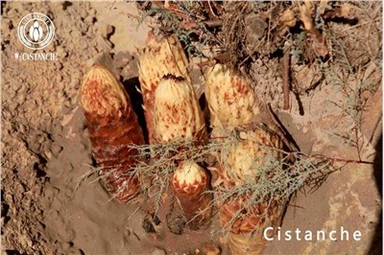
The Chinese Pharmacopoeia (2015 edition): Cistanche deserticola is a fleshy stem with dried scaly leaves, belonging to the family Orobaceae.
Plant characteristics: root parasitism, hosted by desert pioneer plants such as Haloxylon ammodendron and Tamarix; The natural reproductive ability is very weak, coupled with long-term indiscriminate mining, its wild resources are on the brink of depletion. Desert deserticola has been listed in Appendix 2 of the Convention on International Trade in Species of Wild Fauna and Flora (CITES), and tubular deserticola has also been listed as a protected plant in China.
The Chinese government's major policy of vigorously developing traditional Chinese medicine provides a good opportunity for the cultivation of large varieties of Cistanche deserticola

Cistanche deserticola
The Traditional Chinese Medicine Law of the People's Republic of China: The state vigorously develops the traditional Chinese medicine industry, implements the policy of balancing traditional Chinese and Western medicine, establishes a management system that conforms to the characteristics of traditional Chinese medicine, and fully utilizes the role of traditional Chinese medicine in China's medical and health undertakings.
The Outline of the Strategic Plan for the Development of Traditional Chinese Medicine (2016-2030) states that by 2020, everyone will have basic access to traditional Chinese medicine services, and the traditional Chinese medicine industry will become one of the important pillars of the national economy; By 2030, the field of traditional Chinese medicine services will achieve full coverage, significantly enhance the capacity of traditional Chinese medicine health services, and make greater contributions to economic and social development.
The Protection and Development Plan for Traditional Chinese Medicine (2015-2030) states that by 2020, the protection and monitoring system for traditional Chinese medicine resources will be basically improved, and the supply-demand contradiction of endangered traditional Chinese medicine will be effectively alleviated. The production of commonly used Chinese medicinal materials has steadily developed, and the technological level of Chinese medicinal materials has significantly improved, with continuous quality improvement. The modern production and distribution system for traditional Chinese medicine has been preliminarily established, with sufficient product supply and stable market prices. The level of protection and development of traditional Chinese medicine has significantly improved.

Cistanche deserticola efficacy-Tonifying kidney
On February 14, 2016, Premier Li Keqiang presided over an executive meeting of the State Council, which determined measures to further promote the development of traditional Chinese medicine and leverage the advantages of traditional medicine to benefit the people.
The Ministry of Science and Technology has clearly stated that 6-10 large varieties of Chinese medicinal materials with an output value exceeding 50 billion yuan will be cultivated nationwide.
Discussion on the Function of Cistanche deserticola in Various Dynasties of Materia Medica
Shennong Materia Medica Classic: Sweet taste, slightly warm. Treating five labor and seven injuries, tonifying the middle, removing cold and heat diseases in the stems, nourishing the five internal organs, strengthening yin, nourishing essence, and qi, having multiple children, treating women's abdominal pain, and taking it for a long time to lighten the body.
Famous Doctors: Sour, salty, non-toxic. Eliminate bladder evil energy, and lower back pain, and stop dysentery.
Annotations to the Compendium of Materia Medica: When it is raw, it flesh. To make lamb soup. Excellent for tonifying deficiency and fatigue. It can also be eaten raw.
The Treatise on Medicinal Properties: Benefiting the marrow, pleasing the color, and prolonging life. Treating women with blood loss and promoting male health. The Japanese imperial examination has greatly benefited.
The Compendium of Materia Medica: Western people often use it as a food seasoning, scraping off scales, washing with wine, removing black juice, thinly cutting, and making soup with taro and lamb, which is extremely beautiful and beneficial to people. Eating is better than taking tonics.
"Compendium of Materia Medica": This substance supplements but is not severe, so it is called "calm". Calm down,
Compendium of Materia Medica: Functional for promoting yang, nourishing essence, and strengthening muscles and bones. Treat neurasthenia and impotence.
Function summary:
1. Tonify kidney yang. Used for men with insufficient kidney yang, deficiency of essence and blood, impotence, premature ejaculation, hematuria, dripping, cold and hot pain in the penis, soreness and weakness in the waist and knees, and weakness in muscles and bones.
2. Nourishing kidney yin. Used for women with kidney yin deficiency, abdominal syndrome, blood avalanche, red and white discharge, Yin cold infertility, semen failure, and black face.
3. Nourishing marrow and enhancing intelligence. Used for neurasthenia, insomnia and forgetfulness, and senile dementia.
4. Runchang laxative. Used for constipation caused by intestinal dryness, especially in the elderly, weak, and pregnant women.
5. Nourishing the five internal organs. Anti-aging, prolonging life.

Effects of Cistanche-Immprove kidney function
Click here to view Cistanche for Kidney disease products
【Ask for more】 Email:cindy.xue@wecistanche.com / Whats App: 0086 18599088692 / Wechat: 18599088692
6. Cistanche deserticola belongs to non-toxic traditional Chinese medicine. Traditional Chinese medicine, which is used as food, is a very good medicinal food with the same origin.
Chemical composition of Cistanche deserticola:
Phenylethanolamine glycoside, oligosaccharide ester, cyclic ether terpenoids and their glycosides, lignans and their glycosides, polyols, polysaccharides
Modern pharmacological effects of Cistanche deserticola:
Anti-aging, improving learning and memory ability, anti-Alzheimer's disease and Parkinson's disease, anti-fatigue and strengthening physical strength, regulating immune function, improving sexual function, catharsis, liver protection, anti myocardial ischemia, and cerebral ischemia, promoting bone growth and anti-inflammation.

Desert ginseng-Improve immunity
The traditional efficacy and modern pharmacological evidence of Cistanche deserticola confirm:
1. The increasing pressure of work and life: anti fatigue, improving immune function, and enhancing learning and memory abilities
2. Aging of social population: anti-aging, anti-oxidation, anti-Alzheimer's disease, Parkinson's disease, osteoporosis
3. Various types of constipation: moistening the intestines and relieving constipation
4. Chronic diseases and cardiovascular and cerebrovascular diseases: prevention and treatment of cardiovascular and cerebrovascular diseases, anti-inflammatory measures
5. Drug induced and alcohol-induced liver injury: liver protection