Chinese Medicinal Herb: Cistanche
Dec 31, 2024
Cistanche is a commonly used Chinese medicinal herb. It was first recorded in "Shennong's Classic of Materia Medica" and listed as a top-grade herb.
1. Basic Information

Pinyin: Ròu Cōnɡ Rónɡ
Aliases: Rou Songrong, Heisiling, Zongrong, Dijing, Mazu, Mazhi, Dayun, Cunyun
Source: It is the dried fleshy stem of the perennial parasitic herbaceous plant Cistanche in the Orobanchaceae family. It is wild and grows in the Haloxylon ammodendron forest by the lake and parasitizes on the roots of Haloxylon ammodendron.
Harvesting and Storage: In early April to May, dig out the newly emerged Cistanche, keep the small ones and harvest the large ones. Remove the inflorescence or the head of Cistanche, and dry it on the beach or the roof. After more than one month, it turns from yellowish-white to fleshy brown, which is called sweet Dayun. The ones harvested in autumn have a large amount of water and are not easy to dry. Therefore, the large and fleshy ones are put into the salt lake and pickled for 1 - 3 years. When used, wash off the salt, and it is called salted Dayun.
Origin: Mainly produced in Inner Mongolia, Ningxia, Gansu, and Xinjiang.
2. Plant Morphology

Cistanche: A perennial parasitic herb, 15 - 40 cm high. The stem is fleshy, thick, cylindrical, yellow, unbranched or sometimes divided into 2 - 3 branches from the base. It is covered with many fleshy scale-like leaves, yellow to brownish-yellow, arranged in an imbricate pattern, ovate to oblong-lanceolate, 1 - 2.5 cm long, 4 - 8 mm wide. The leaves on the lower part of the stem are shorter and more closely arranged, and those on the upper part are longer and more loosely arranged. The spike inflorescence is cylindrical, 8 - 25 cm long, 6 - 8 cm wide, with many and dense flowers. At the base of each flower, there is 1 large bract and 2 symmetrical small bracts. The large bract is ovate or oblong-lanceolate, with a pointed tip. The small bract is oblong-lanceolate, almost as long as the calyx. The calyx is campanulate, pale yellow or white, 1 - 1.3 cm long, shallowly 5-lobed, the lobes are nearly circular, hairless or more or less covered with woolly hairs. The corolla is tubular-campanulate, shallowly 5-lobed, the lobes are nearly circular, purple, and the tube part is white. There are 4 stamens, the anthers are obovate, with a short-pointed connective at the tip, and the anthers and the base of the filaments are covered with long curly hairs. The ovary is superior, long elliptical, and the style is slender. The capsule is elliptical and 2-lobed. There are many seeds. The flowering period is from May to June, and the fruiting period is from June to July. It grows in saline-alkali land, dry riverbed sandy land, and Gobi desert areas. It parasitizes on the roots of plants such as Reaumuria soongarica, Kalidium foliatum, Kalidium gracile, Pterocarpus santalinus, and Nitraria sibirica. Distributed in Inner Mongolia, Shaanxi, Gansu, Ningxia, Xinjiang, and other places.
Cistanche deserticola: A perennial parasitic herb, up to 1 m high. Similar in shape to Cistanche, but the scale-like leaves on the stem are lanceolate or linear-lanceolate, 1.5 - 4 cm long, 4 - 8 mm wide, and gradually pointed at the tip. The flowers are yellow, the large bracts are linear-lanceolate, almost smooth, the small bracts are lanceolate or linear-lanceolate, slightly longer than the calyx. The calyx is smooth and hairless, and the edges of the lobes are finely serrated. It grows by the lake, in sandy land, and in the Haloxylon ammodendron forest and parasitizes on the roots of Haloxylon ammodendron. Distributed in Inner Mongolia and other places.
Cistanche salsa: A perennial parasitic herb. The base of the stem is especially thick, 30 - 45 cm in diameter, with scale-like leaves that are ovate-lanceolate. The middle part of the stem is thinner, 15 - 25 cm in diameter, and the scale-like leaves are long-oblong-lanceolate. The spike inflorescence is oblong or cylindrical. The bracts are densely covered with woolly hairs at the edges. The lobes of the corolla are fringed with fine hairs. It grows in sandy land and in the Haloxylon ammodendron forest and parasitizes on the roots of Haloxylon ammodendron. Distributed in Inner Mongolia and other places.
3. Medicinal Material Characters
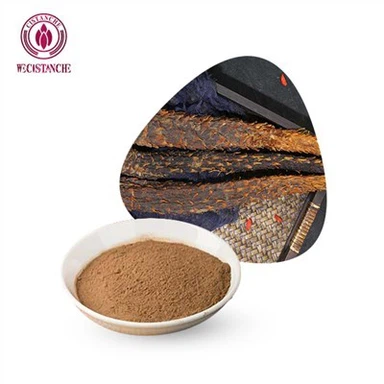
Sweet Cistanche: Cylindrical and slightly flattened, slightly thinner at one end, slightly curved, 10 - 30 cm long, 2 - 6 cm in diameter. The surface is grayish-brown or brown, densely covered with thick fleshy scales, arranged in an imbricate pattern. It is firm, slightly tough, fleshy and oily, not easy to break. The cross-section is brown, with white spots or cracks. The odor is faint, and the taste is slightly sweet.
Salted Cistanche: The shape is less regular, blackish-brown, relatively soft, and covered with salt frost on the outside. The cross-section is black. The odor is faint, and the taste is salty. The above are all of good quality when they are fleshy, thick and long, brownish, tender and moist. Produced in Inner Mongolia, Gansu, Xinjiang, Qinghai, and other places. Inner Mongolia has the largest output.
4. Main Components
It contains trace alkaloids and crystalline neutral substances. There are also reports that it contains glycosides and organic acid-like substances.
5. Efficacy and Action
Nourishing the kidney and replenishing essence, invigorating yang and moistening the intestines. Its functions are strengthening the body and relieving constipation. Appendix: The aqueous extract has a blood pressure-lowering effect on experimental animals and can also promote saliva secretion in mice.
6. Processing

Cistanche: Remove impurities, soak in clean water, change the water 1 - 2 times a day (if it is salted Cistanche, soak until the salt is removed), moisten thoroughly, cut into slices (longitudinal slices), and dry in the sun.
Wine-processed Cistanche: Take Cistanche slices, mix well with yellow rice wine, put them in a jar and seal tightly, place the jar in a water bath, and steam until the wine is evaporated. Take out and dry. (For every 100 catties of Cistanche, use 30 catties of yellow rice wine.)
Black Bean-processed: Soak Cistanche in rice washing water for 3 days, change the water once a day to remove the saltiness, scrape off the surface scale leaves, and cut into slices 1.5 cm thick. Then stir-fry 5 kg of black beans until fragrant, divide them into 3 parts. Each time, take 1 part, add water and Cistanche, and cook over low heat until dry. Take out until half-dry, steam thoroughly, and then dry in the sun. Take another part of black beans and cook and steam and dry in the same way. Repeat 3 times and dry in the sun. For every 500 kg of Cistanche, use 50 kg of black beans.
Processing in "Lei Gong's Treatise on Processing of Chinese Materia Medica": When using (Cistanche), it must first be soaked in clear wine overnight. The next day, use a palm brush to remove the floating soil and scales completely, split it open in the center, and remove a layer of white membrane like bamboo grass. Then steam it from noon to evening and then roast it with butter until it is properly processed.
7. Properties and Taste
Sweet and warm.
8. Meridian Tropism
It enters the kidney and large intestine meridians.
9. Functions
Nourishing essence and blood, tonifying the kidney and assisting yang, and moistening the intestines and relieving constipation.
10. Indications
Impotence in men, infertility in women, cold and painful waist and knees, dry constipation, etc.
11. Clinical Applications
Treatment of Kidney Deficiency Patients: It has a certain effect on both tonifying yang and nourishing yin. It is especially suitable for patients with kidney deficiency type neurasthenia, such as lack of energy, fatigue, low back pain, forgetfulness, and hearing loss. It is often combined with Lycium barbarum, Schisandra chinensis, Ophiopogon japonicus, Polygonatum sibiricum, and Polygonatum odoratum. It can also treat kidney deficiency impotence, premature ejaculation, female infertility, uterine bleeding, and leucorrhea. Although its tonifying power is not strong enough, its medicinal properties are mild. When combined with Psoralea corylifolia, Dodder seed, Astragalus complanatus, and Cornus officinalis, it can still play a role in invigorating yang.
Treatment of Constipation Caused by Qi and Blood Deficiency in the Elderly: Generally, Cistanche can be used to boil pork soup. For constipation due to blood deficiency, it is combined with Angelica sinensis, Rehmannia glutinosa, and Cannabis sativa seed, and the formula is Cistanche Runchang Decoction. For deficiency constipation with excessive sweating and discomfort in the lower abdomen, it needs to be combined with Aquilaria sinensis.
12. Cautions for Use
General Characteristics: Generally, yang-tonifying substances are often dry, and yin-nourishing substances are often greasy. However, Cistanche tonifies without being dry and nourishes without being greasy. Its effect is not slow, so it is named Cistanche (homophonic with "calm and unhurried"). Kidney deficiency patients with concurrent exterior syndromes can also use it.
Types of Use: Generally, sweet Cistanche is used, and occasionally salted Cistanche is used for its astringent effect to treat frequent urination and spermatorrhea.
Contraindications: It is not suitable for those with loose stools and excessive heat constipation.
13. Dosage
Oral administration: Decoction, 10 - 15g; or made into pills or powders; or soaked in wine.
14. Storage
Store in a ventilated and dry place to prevent moth infestation.
15. Cistanche and Constipation: A Natural Solution
One of the common concerns among patients is constipation. It can cause a great deal of discomfort, including abdominal pain, bloating, and a general feeling of sluggishness. In modern medicine, constipation can be caused by a variety of factors such as an unbalanced diet, lack of physical activity, and stress.
Cistanche offers a natural and effective way to address constipation. Modern research has shown that Cistanche contains certain substances that can have a beneficial effect on the digestive system. It can help to increase the water content in the feces, making it softer and easier to pass. This is especially important for those who struggle with hard and dry stools. Additionally, Cistanche can stimulate the peristalsis of the intestines, promoting the regular movement of feces through the digestive tract. This gentle yet effective action can provide relief for constipation without the harsh side effects that some chemical laxatives may have.
16. Beyond Constipation: Other Potential Benefits and Considerations
In addition to its constipation-relieving properties, Cistanche holds great potential in other aspects of health. Its ability to nourish the kidney and replenish essence may have implications for overall energy levels and vitality. By improving kidney function, it may also help with other issues related to kidney health, such as maintaining proper fluid balance in the body.
Moreover, the fact that it has been used in traditional medicine for centuries adds to its allure. In a world where people are increasingly looking for natural alternatives to synthetic medications, Cistanche represents a connection to ancient healing traditions. Its long history of use suggests that it may have a holistic approach to health that goes beyond just treating symptoms.

However, it is important to note that like any herbal remedy, Cistanche should be used with caution. While it has many potential benefits, it may interact with certain medications or have different effects on different individuals. For example, it is always advisable to consult with a healthcare professional before using Cistanche, especially if you have underlying health conditions or are taking other medications.
In conclusion, Cistanche is a remarkable herb with a rich history and a promising future in modern health. Its unique properties and potential benefits make it a subject worthy of further exploration. Whether you are interested in its traditional uses or its modern applications, Cistanche has the potential to offer a natural and effective solution for various health concerns. By understanding its value and using it responsibly, we can tap into the power of nature to enhance our well-being. But always remember to prioritize your health and make informed decisions when it comes to using herbal remedies.