Cistanche Deserticola Ameliorates Nerve Cell Injury Of Hippocampus in Parkinson's Disease Rats Through Regulating Keap1/Nrf2/HO-1 Antioxidant Pathway
Nov 22, 2024
Abstract:
Objective To explore the effect of Cistanche deserticola on nerve cell injury in Parkinson's disease (PD) rats and its related mechanism. Methods Sprague-Dawley (SD) male rats were randomly divided into three groups (10 rats in each group) : control group, model group and Cistanche group. The rats in the model group and the treatment group were intracranially injected with 6-hydroxydopamine (6-OHDA). Rats in Cistanche group were given 0.216g/mL of cistanche solution, rats in blank group and model group were given normal saline irrigation, the amount of irrigation was 1mL/ (100g·d) for two weeks.. The morphology and ultrastructure of nerve cells in hippocampus were observed by hematoxylin-eosin staining and transmission electron microscopy. The morphology of Nishi bodies in the Hemimani region was observed by Nishi's staining. The levels of malondialdehyde (MDA) and superoxide dismutase (SOD) were detected by thiobarbituric acid method and nitroblue tetrazolium method. The changes of Kelch-like ECH-related protein 1 (Keap 1), nuclear factor E2-related factor 2 (Nrf 2) and heme cyclooxygenase 1 (HO-1) proteins were analyzed by Western blot. Results After the treatment of Cistanche deserticola medication, the hippocampal tissue structure of PD rats was improved, the morphology of neurons was improved, nuclear pyretosis was relieved, the content of antioxidant enzyme SOD in hippocampus was gradually increased, while the content of oxidative stress product MDA was gradually decreased, and the expression of Keap 1 protein in hippocampus was decreased. The protein expression of Nrf 2 and HO-1 increased. Conclusions Cistanche deserticola can improve the damage of hippocampus neurons, and reduce the level of oxidative stress response in hippocampus of PD rats. The effect of Cistanche deserticola in the treatment of PD rats is closely related to the regulation of Keap-1 /Nrf 2/HO-1 signaling pathway.
High-Quality Cistanche For Treatment Of PD
Keywords: Cistanche deserticola; Parkinson's disease; Oxidative stress; hippocampus;Neurons; Keap1; Nrf2; HO-1
According to statistics from the Global Disease Data Study, neurological diseases have become the leading cause of disability worldwide. In this field, Parkinson's Disease (PD) has become one of the fastest growing diseases with its significant age-standardized prevalence increase, increasing disability cases, and rising mortality rate. one.
From 1990 to 2020, the number of PD patients worldwide increased by 118%, reaching 6.2 million, and the incidence is still increasing year by year [1-2]. PD patients usually present with motor symptoms such as tremor, muscle stiffness, bradykinesia, and balance difficulty in the late stage. However, non-motor symptoms such as cognitive decline can occur in the early stage of the disease. As the disease progresses, cognitive impairment will progressively worsen and become more severe.

High-Quality Cistanche For Treatment Of PD
Affect patients' quality of life [3]. The hippocampus is an important organization in the brain for spatial learning and receiving external information. It is the main structure for realizing human cognitive functions. Hippocampal dysfunction is closely related to the onset of cognitive dysfunction in PD patients. Oxidative stress is involved in the development of nerve cells in hippocampal tissue. Damage[4-5]. Therefore, if hippocampal neurons are protected in patients with PD, it may improve the patient's cognition and delay the progression of the disease.
In recent years, a variety of Chinese herbal medicines have been proven to be effective in treating neurological-related diseases [6]. Cistanche deserticola is a traditional Chinese medicine that can nourish kidney yang and replenish essence and blood. It has been used to treat neurological diseases such as ischemic stroke and neuromyelitis [7]. Previous studies by the research group have shown that Cistanche deserticola can improve the behavior of PD model rats and reduce the apoptosis of dopamine nerve cells in the substantia nigra area of the midbrain [8-9]. However, it is unclear whether Cistanche deserticola can improve hippocampal tissue damage in PD model rats. Therefore, this study established a PD rat model to observe the effect of Cistanche deserticola on hippocampal tissue damage and explore its mechanism, in order to provide new ideas for PD treatment.Tian Biological Company); Nissl staining reagent (Nanjing Senbeijia Biological Company); isoflurane (Shanghai Yaji Biological Company).
1 Materials and methods
1.1 Materials
1.1.1 Experimental animals
30 6-week-old SD male rats weighing 210-230 g were used. The Experimental Animal Center of Fujian University of Traditional Chinese Medicine provided experimental animals and general medical experimental animal environment facilities. The experiment was approved by the Animal Ethics Committee of this institution, and the ethics registration number is 1N2023019.
1.1.2 Experimental reagents
Cistanche deserticola granules (Fujian Third People's Hospital); 6-hydroxydopamine (6-OHDA) reagent (Beijing Biolabor Technology Co., Ltd.); Hematoxylin-eosin (HE) staining reagent (Taizhou Yunke Biotechnology Co., Ltd.); Animal tissue protein lysate (Beijing Solebao Biological Company); Protein phosphatase inhibitors (Wuhan Pujian Biological Company); Protease inhibitors (Hunan Yunbang Biotechnology Company); Kelch-like ECH-associated protein-1 (Keap1) monoclonal antibody (Wuhan Sanying Biotechnology Company); Glyceraldehyde 3-phosphate dehydrogenase (GAPDH) monoclonal antibody (Wuhan Huamei Biological); Nuclear factor E2 related factor 2 (Nrf2), heme oxygenase 1 (hemoxygenas-1, HO-1) monoclonal antibody (Wuhan Pujian Biotechnology Co., Ltd.); superoxide dismutase (SOD) and malondialdehyde (MDA) detection kits (Shanghai Biotech Co., Ltd.); Nissl staining reagent (Nanjing Senbeijia Biotechnology Co., Ltd.); isoflurane (Shanghai Yaji Biotechnology Co., Ltd.).
1.1.3 Instruments
JEA3001 electronic balance (Shanghai Puchun Measuring Instrument Co., Ltd.); BSA224S electronic balance (Sartorius, Germany); Stab S2T low temperature shaker (Shanghai Hetian Scientific Instrument Co., Ltd.); RM2235 fully automatic paraffin slicer (Leica, Germany); pectraMax i3x multifunctional microplate reader (Molecular Devices, USA); BX63
fluorescence microscope (Olympus, Japan); DLAB handheld centrifuge D1008/D1008E (Beijing Dalong Xingchuang Experimental Instrument Co., Ltd.); CryoCube F740hi ultra-low temperature refrigerator (Epend, Germany); MiniPro EpBasic basic electrophoresis instrument power supply (Shanghai Yisheng Biotechnology Co., Ltd.); constant temperature drying oven (Hangzhou Notting Scientific Equipment Co., Ltd.); Ascent MAX ductless fume hood (Shanghai Yishike Enterprise Development Co., Ltd.).

1.2 Methods
1.2.1 Model establishment and animal grouping
Rats were placed in an environment with a temperature of 24-25℃, a humidity of 55%-60%, and a 12/12 h light/dark cycle, with free access to food and water. SD rats were randomly divided into 3 groups (10 rats in each group): blank group, model group, and Cistanche deserticola group. According to the PD animal model establishment method [5], SD rats in the model group and Cistanche deserticola group were anesthetized by 2% isoflurane inhalation and fixed on a brain stereotaxic instrument. The skin was incised along the midline of the skull, and the skull membrane was bluntly separated. The coordinates of the right striatum were determined by referring to the rat brain stereotaxic atlas. 8μL of 6-OHDA was injected intracranially at the above target at a concentration of 2μg/μL, and the blank group rats were injected with an equal volume of saline. Successful modeling criteria: One week after modeling, apomorphine (0.5 mg/kg) was intraperitoneally injected to induce rat rotation. The rats rotated from the healthy side to the affected side, and the number of rotations within 30 min was >210 circles, which was considered a successful modeling. After that, the rats in the Cistanche deserticola group were gavaged with 0.216 g/mL Cistanche deserticola solution every day, and the blank group and model group were gavaged with normal saline. The gavage volume of the three groups of rats was 1 mL/(100 g·d) for two weeks [9]. After the treatment of each group of rats was completed, the rats were euthanized by 2% isoflurane inhalation anesthesia and brain tissues were collected for subsequent experimental studies.
1.2.2 Observation of pathological changes in hippocampal tissue by hematoxylin-eosin staining
The hippocampal tissues of rats in each group were collected, placed in formaldehyde solution, dehydrated with gradient ethanol, baked in a drying oven, dissolved wax, dried, dewaxed, stained with HE, transparentized with xylene, sealed with neutral gum, and observed under a microscope.
1.2.3 Transmission electron microscopy observation of the ultrastructure of hippocampal nerve cells
The hippocampal tissue was placed in 3% glutaraldehyde fixative, dehydrated with gradient ethanol, embedded (epoxy resin), and ultrathin sections were prepared. Lead citrate and uranyl acetate staining were used to observe the ultrastructural changes of hippocampal nerve cells (under transmission electron microscopy).
1.2.4 Nissl staining to observe the changes of Nissl bodies in hippocampal tissue
The above-mentioned hippocampal tissue paraffin sections were hydrated in anhydrous ethanol, 95% and 70% gradient ethanol, respectively. After washing with distilled water 3 times, stain with Nissl staining solution for 5 min, then wash with dehydrated gradient alcohol and distilled water, and clear with xylene. The sections were sealed with neutral glue, and observed and recorded under an optical microscope after solidification.
1.2.5 Chemical colorimetric method to detect the content of MDA and SOD in hippocampal tissue
After the hippocampal tissues of different experimental groups were homogenized, they were centrifuged at 1000 g for 20 min and the supernatant of each experimental group was collected. According to the instructions of the kit, the MDA and SOD assay kits were used to detect the content of MDA and SOD in each group of experimental samples.
1.2.6 Protein immunoblotting to detect the specific expression of Keap1, Nrf 2, and HO-1 proteins in hippocampal tissue
The hippocampal tissues of each group were added with lysis buffer and centrifuged at 12,000 r·min -1 for 15 min. The supernatant was collected for standby use. The protein concentration was determined by BCA method. According to the protein quantification results, the corresponding volume of total protein was added and loaded with protein gel electrophoresis. The samples were denatured at 95 °C for 10 min, transferred to the membrane, cut, and blocked in blocking solution for 1 h. The diluted primary antibodies Keap1, Nrf 2, HO-1, and GAPDH (1:500) were added, reacted overnight at 4 °C, washed with 1×TBST, incubated with secondary antibodies (1:4000), and washed with 1×TBST again for color imaging.
1.3 Statistical analysis
The counting data were expressed as mean ± standard deviation. The data that conformed to normal distribution and homogeneity of variance were subjected to t test, the data that conformed to normal distribution and unequal variance were subjected to corrected t test; the data that did not conform to normal distribution were subjected to nonparametric test. One-way ANOVA was used to compare the differences between different groups, and then the LSD method was used to compare the two groups. P < 0.05 was considered statistically significant.
2 Results
2.1 Effect of Cistanche deserticola on the morphological structure of the hippocampal CA1 region in PD model rats HE staining results showed that the neurons in the CA1 region of the hippocampus of the blank group rats were arranged neatly and tightly, with regular morphology and uniform distribution, and no obvious neuronal cell damage; the neuronal cells in the model group were arranged more disorderly, the cell nuclei were shrunken, the nuclear staining was deepened, and the neuronal cell damage was obvious; the neuronal cells in the Cistanche deserticola group were arranged more regularly than those in the model group, the number of nuclear condensation was relatively reduced, and the neuronal cell damage was alleviated. The results are shown in Figure 1.

Figure 1 Effect of Cistanche deserticola on pathological structure in the CA1 region of hippocampus in Parkinson's rat(HE,×400) Note: A: control group; B: model group; C: Cistanche group. Black arrows indicate damaged nerve cells.
2.2 Effect of Cistanche deserticola on the ultrastructure of hippocampal neurons in PD model rats
In the blank group, when observing the hippocampal neurons, it can be observed that the cell structure maintains a clear morphology, the nucleus presents a regular round or oval shape, the nuclear membrane remains smooth and intact, and the chromatin in the nucleus is evenly distributed, and there is no edge aggregation of nuclear chromatin. In contrast, the hippocampal neurons of the model group showed obvious changes: the overall electron density of the cells increased, the nucleus condensed, the chromatin in the nucleus aggregated and attached to the bottom of the nuclear membrane, the nuclear membrane thickened, and vacuoles were seen in the cytoplasm. After intervention with Cistanche deserticola, compared with the model group, the hippocampal neurons of the Cistanche deserticola group showed a certain recovery trend: the size of the neuronal cell body was restored, the cell membrane remained intact, the edge aggregation of nuclear chromatin was alleviated to a certain extent, the thickening of the nuclear membrane was also alleviated, and the number of vacuoles in the cytoplasm decreased, indicating that Cistanche deserticola has a certain protective or repair effect on nerve cells. See Figure 2.

Figure 2 Effect of Cistanche deserticola on neuronal Ultrastructure in hippocampus of Parkinson's disease rats(×7000) Note: A: control group; B: model group; C: Cistanche group.
2.3 Effect of Cistanche deserticola on Nissl bodies in hippocampal neurons of PD model rats
Nissl staining results showed that the neurons in the blank group were closely arranged, with regular morphology, abundant Nissl bodies and dark staining; the neurons in the model group were loosely arranged, swollen, and most of the Nissl bodies were dissolved and lightly stained; the neurons in the Cistanche deserticola group were closely arranged, with regular morphology, and the number and staining of Nissl bodies were improved compared with the model group. The results are shown in Figure 3.
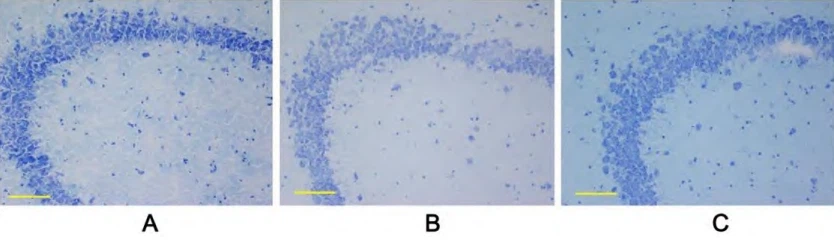
Figure 3 Effect of Cistanche deserticola on Nissl's body of hippocampal nerve cells in Parkinson's disease rat(Nissl,×200) Note: A: control group; B: model group; C: Cistanche group.
2.4 Effects of Cistanche deserticola on SOD and MDA contents in hippocampus of Parkinson's disease rats
Compared with the blank group, the SOD content in hippocampus of the model group decreased, while the MDA content increased; compared with the model group, the SOD content in hippocampus of the Cistanche deserticola group increased, while the MDA content decreased. See Table 1.
Tab. 1 Effects of Cistanche deserticola on SOD and MDA contents in hippocampus of Parkinson's disease rats
| Group | SOD (pg/mL) | MDA (pg/mL) |
|---|---|---|
| Control | 12.36±2.75 | 2.85±0.83 |
| Model | 2.75±0.83* | 9.95±0.37* |
| Rhynchophylla | 7.22±1.32# | 5.16±1.75# |
Note: Compared with control group, *P<0.05; compared with model group, #P<0.05.
2.5 Effect of Cistanche deserticola on expression of Keap1, Nrf2, and HO-1 proteins in hippocampus of Parkinson's disease rats
The results of western blot experiments showed that the expression of Nrf2 and HO-1 proteins in the hippocampus of rats in the model group decreased, while the expression of Keap1 protein increased; compared with the model group, the expression of Nrf2 and HO-1 proteins in the hippocampus of rats in the Cistanche deserticola group increased, while the expression of Keap1 protein decreased. See Figure 4 and Table 2.
Figure 4 Effect of Cistanche deserticola on expression of Keap1, Nrf2, and HO-1 in hippocampus of Parkinson's disease rats

Note: A: control group; B: model group; C: Cistanche group
Tab. 2 Effect of Cistanche deserticola on expression of Keap1,Nrf2,HO-1 in hippocampus of Parkinson's disease rats
| Group | Keapl | Nrf2 | HO-1 |
|---|---|---|---|
| Blank group | 0.16±0.05 | 0.38±0.07 | 0.33±0.05 |
| Model group | 0.85±0.23* | 0.12±0.09* | 0.11±0.02* |
| Positive group | 0.22±0.03# | 0.86±0.06# | 0.79±0.05# |
Note: Compared with the control group, *P < 0.05; Compared with the model group, #P < 0.05.