Cistanche,Tonify Kidney Yang And Restore Full Bodied Physical Vitality
Sep 17, 2026
That feeling of "still exhausted after sufficient sleep"
The alarm clock rings three times, yet you struggle to get out of bed. You can doze off leaning on a handrail on the subway, and even after sleeping in all weekend, you remain listless on Monday. Many people attribute this state simply to "being overworked", only to find that rest cannot fully recharge the body.

From the perspective of Traditional Chinese Medicine (TCM), this persistent fatigue that cannot be relieved by rest often points to one key term: kidney-yang deficiency. Kidney-yang is known as the fundamental yang-qi of the human body, comparable to a stove inside the body. When the fire burns vigorously, qi and blood circulate smoothly, and one is full of vitality. When the fire weakens, symptoms such as cold intolerance, soreness and weakness of the lumbar and knee regions, and lack of energy will occur.
Among numerous tonic medicinal herbs, there is one herb with an exceptionally mild and gentle nature, ideal for long-term conditioning. Listed as a top-grade herb in Shennong's Classic of Materia Medica, it is reputed as "Ginseng of the Desert". Its very name embodies the meaning of composure: Cistanche.

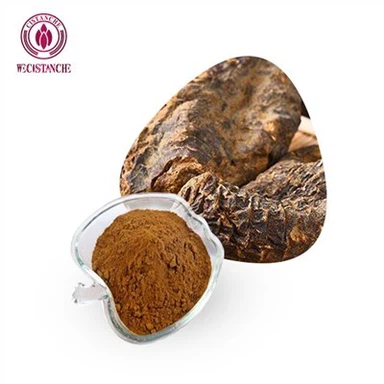
Cistanche tubulosa
Why Modern-day People Are Prone to Kidney-Yang Deficiency
Kidney-yang does not become deficient without cause. TCM holds that "over-exertion consumes qi", "prolonged lying injures qi, prolonged sitting injures muscles". Many details of modern life gradually drain this internal stove-fire.
Four Typical Behaviors That Deplete Yang-Qi
Long-term staying up and over-exertion: Nighttime is supposed to be for yang-qi to store and yin-blood to regenerate. Staying up late forcibly consumes kidney essence and qi, and over time, yang-qi fails to generate sufficiently.
Excessive cold food-drink intake and sedentary lifestyle: Cold beverages, air-conditioned environments, and lack of physical activity suppress the generation and circulation of yang-qi, leaving the body increasingly sensitive to cold.
Aging and physical debilitation after illness: Kidney-qi naturally declines with age. Chronic diseases, post-operative recovery, and convalescence after severe illness also tend to impair yang-qi.
Emotional stress and excessive sexual activity: Long-term anxiety and unrestrained sexual activity are also regarded in TCM theories to directly consume kidney essence and kidney-yang.

Common Signs of Kidney-Yang Deficiency
Manifestations of kidney-yang deficiency usually appear as a set of symptoms: cold intolerance with cold extremities hard to warm up; soreness and weakness of the lumbar and knee regions aggravated by prolonged standing or walking; mental lassitude, drowsiness, and poor memory; frequent nocturia with clear and profuse urine; pale and dull complexion; loose stools, or in some cases, intractable dry stools. For men, it may manifest as impotence and premature ejaculation; for women, irregular menstruation and cold-womb infertility.

Effects of Cistanche-Improve kidney function
Understanding Cistanche: A Gentle Treasure from the Desert
What Exactly Is It
Cistanche refers to the dried scaly-leaf-bearing fleshy stems of Cistanche deserticola or Cistanche tubulosa in the Orobanchaceae family. It parasitizes the roots of desert plants such as Haloxylon ammodendron and Tamarix ramosissima. It is mainly produced in Inner Mongolia, Xinjiang, Gansu, and Qinghai, with authentic producing regions in Inner Mongolia, Xinjiang, and Gansu. It is harvested in early spring when shoots just emerge from the ground or before the soil freezes in autumn, then cut into sections and sun-dried. Once endangered in wild populations, it is now widely artificially cultivated, forming an ecological chain combining desert control and industrial development.

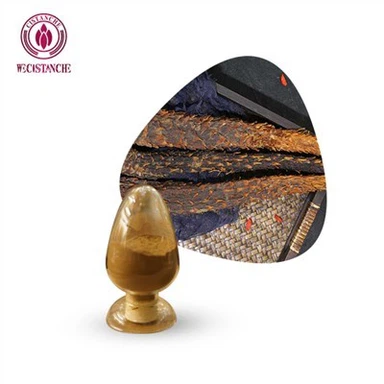
Cistanche tubulosa extract
Records in Chinese Pharmacopoeia
Chinese Pharmacopoeia records its nature-flavor and meridian tropism: "Sweet, salty, warm; acting on the kidney and large intestine meridians". Its functions and indications are "tonifying kidney-yang, benefiting essence-blood, moistening intestines to relieve constipation". It applies to kidney-yang deficiency, essence-blood depletion, impotence and infertility, soreness-weakness of lumbar-knee joints, tendon-bone debilitation, and intestinal-dry constipation. The dosage is 6-10 g. In 2023, cistanche was included in the catalogue of substances both traditionally used as food and medicinal herbs. Its dual identity as food and medicine makes it widely used in daily dietary therapy.
The Meaning Behind Its Name "Composure"
Materia Medica Assembly comments: "It nourishes the life-gate, tonifies kidney-qi and replenishes essence-blood… It is a mild tonic agent: warm yet not heat-inducing, tonifying yet not harsh, comforting yet not dry-generating, moistening yet not purging - hence the name 'Cistanche' (Composure)." Shennong's Classic of Materia Medica states that it "treats five types of fatigue and seven kinds of injuries, tonifies the middle burner… nourishes five zang-organs, strengthens yin, boosts essence-qi and improves fertility".
This highlights cistanche's most valuable property: unlike acrid-hot herbs such as Aconite and Cinnamon, which exert fierce tonifying effects, and unlike Rehmannia root, which nourishes yet easily causes stagnation due to greasiness. Its mild, soothing tonifying nature makes it suitable for gradual, long-term conditioning, which is why it is often used in ancient kidney-tonifying prescriptions.
Four Functional Mechanisms of Cistanche for Tonifying Yang
1. Warm-tonify Kidney-Yang: Ignite the Basal Stove-fire of the Body

Effects of Cistanche: Improve Kidney Function
Click here to view Cistanche for Kidney disease products
【Ask for more】 Email:cindy.xue@wecistanche.com / WhatsApp: 0086 18599088692 / WeChat: 18599088692
Kidney-yang is the foundation of bodily yang-qi. Sweet-warm in nature and acting on the kidney meridian, cistanche warms and tonifies the kidney primordial yang, relieving symptoms caused by insufficient bodily warming, such as cold-limb aversion, cold pain of the lumbar-knee joints, and low spirits. Ancient records about its "warming lumbar-knee joints" and "treating five-types of fatigue and seven-kinds of injuries" correspond to this effect.
2. Benefit Essence-blood: The Key to Tonifying Yang without Damaging Yin
TCM states: "Those good at tonifying yang must seek yang reinforcement from yin." Salty-flavored and soft-textured, cistanche enters the kidney meridian. While warming yang, it replenishes essence-blood, so yang can generate infinitely with the assistance of yin. This feature differentiates it from pure hot-nature aphrodisiac herbs; long-term conditioning rarely leads to side effects such as dry mouth, sore throat, and yin impairment. Rihua-zi Materia Medica notes that it "treats male impotence and female infertility… warms lumbar-knee joints", embodying simultaneous tonification of yin and yang.
3. Moisten Intestines to Relieve Constipation: Targeting Deficiency-type Constipation
Constipation in many middle-aged and elderly people is not caused by excessive internal heat, but by kidney-yang deficiency and impaired fluid distribution, resulting in intestinal-dry constipation. Cold-nature purgatives will aggravate deficiency instead of relieving symptoms. Salty-moist cistanche replenishes essence-blood and lubricates intestines, "promoting defecation without consuming body fluids". The classic Jichuan Decoction from Jing-yue's Complete Works combines cistanche with Angelica sinensis, Achyranthes root, and Alisma orientalis, specifically for constipation with kidney-qi deficiency, clear profuse urine, and lumbago-cold-back symptoms.
4. Strengthen Tendons-Bones and Improve Hearing-Vision: Manifestations of Kidney Essence
"The lumbar region is the residence of the kidney"; "The kidney opens into the ear". Sufficient kidney essence ensures strong bones and sharp hearing-vision. By tonifying kidney essence, cistanche is used for soreness-weakness of lumbar-knee joints, tendon-bone debilitation and kidney-deficiency tinnitus. Representative formula: Jin-gang Pill from Su-wen Pathogenesis & Manifestations combines cistanche with Eucommia ulmoides, Cuscuta seed, and Dioscorea hypoglauca for kidney-deficiency flaccidity syndrome of bones; Cistanche Pill from Important Prescriptions Worth a Thousand Gold Pieces pairs cistanche with Morinda officinalis, Cornus officinalis, Magnetite, and Acorus tatarinowii for kidney-deficiency tinnitus-deafness.
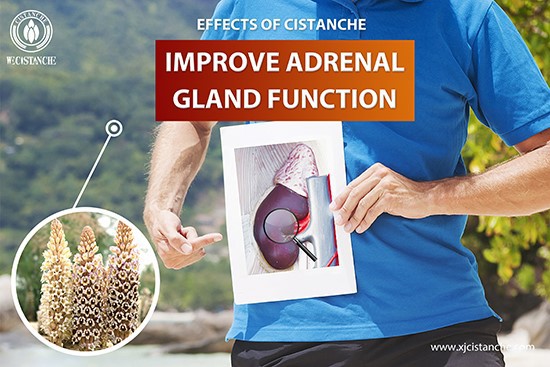
Cistanche tubulosa efficacy: Tonifying the kidney
Modern Research: Scientific Evidence for Traditional Efficacy
Major Active Components
Modern research shows cistanche mainly contains phenylethanoid glycosides (e.g., echinacoside, acteoside, cistanoside A/B/C/H), polysaccharides, betaine, iridoids, lignans, amino acids, and various trace elements. Chinese Pharmacopoeia specifies echinacoside and acteoside as marker compounds: for dried Cistanche deserticola, total content of the two compounds shall not be less than 0.30 %; for Cistanche tubulosa, not less than 1.5 %. Alcohol-soluble extractives shall be no less than 35.0 % and 25.0 %, respectively.
Pharmacological Research Directions
Sex-hormone-like and reproductive regulatory effects: providing partial experimental support for its traditional "essence-replenishing and yang-boosting" function.
Anti-fatigue: Phenylethanoid glycosides reduce lactic acid accumulation in blood and muscle tissue, accelerate lactic acid clearance, and shorten fatigue recovery time.
Immunomodulation: Polysaccharides serve as key immunomodulatory ingredients, promoting lymphocyte proliferation and enhancing macrophage activity.
Antioxidant and anti-aging: Echinacoside and acteoside scavenge free radicals and regulate antioxidant pathways.
Neuroprotection: A research team led by Professor Tu Pengfei from Peking University found that phenylethanoid glycosides exhibit potential benefits against Alzheimer's disease, Parkinson's disease, and ischemic stroke. One direct molecular target of echinacoside is protein kinase CK2α′, offering molecular evidence for the TCM concept "tonify kidney-narrow marrow". The developed Cistanche Total Glycosides Capsule was approved for marketing in 2005 for vascular dementia.
Gastrointestinal function regulation: Offering modern explanations for its traditional intestinal-moistening laxative effect.
Four Home-made Dietary Therapy Recipes
① Cistanche Lamb Soup (Classic Recipe for Warming Yang and Tonifying Kidney)
Ingredients: Cistanche 10 g, lamb 100 g, Cinnamon bark 2 g, Sichuan pepper 10 grains, ginger 2 g, star anise 2 g, green onion 5 g. Preparation: Blanch lamb chunks; wrap spices in a cloth bag. Place the spice bag, cistanche, and lamb in a clay pot. Bring to a boil, skim off foam, and simmer over low heat. Add green onion when lamb is half-cooked; cook until tender; season with salt. Efficacy: Tonify kidney-essence, warm middle-burner. Suitable for cold intolerance, soreness and weakness of the lumbar and knee joints, frequent urination, and constipation.
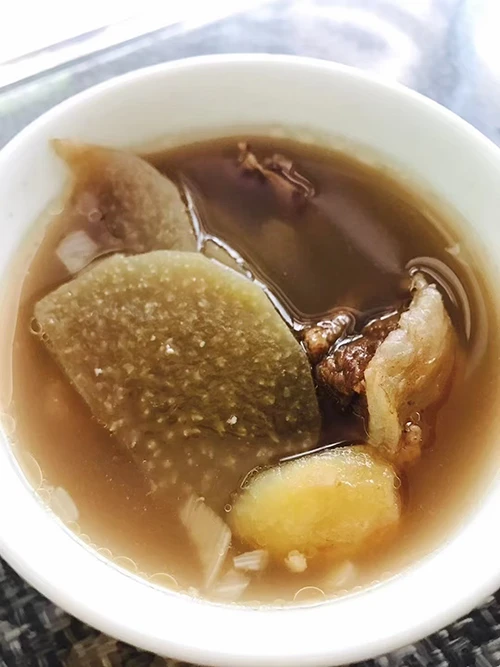
Stewed Cistanche tubulosa soup
② Cistanche-Goji-Berry Chicken Stew
Ingredients: Chicken 500 g, Goji berry 15 g, Cistanche 15 g, ginger 20 g. Preparation: Blanch chicken pieces; rinse and soak goji berries and cistanche; slice ginger. Add water, ginger slices, cistanche, and chicken into pot; bring to a boil, then simmer for 30 min over low heat. Add goji berry and cook for another 10 min. Suitable for insufficient qi-blood, dizziness-fatigue, and blurred vision.
③ Cistanche-Black-Bean Congee
Ingredients: Cistanche 5 g, black bean 50 g, rice 100 g. Preparation: Soak black beans for 6-8 hours; soften cistanche by soaking. Cook black beans and rice together; add cistanche and simmer for another 10 min when nearly done. Black-colored ingredients act on the kidney in TCM theory. It is suitable to consume in the evening to assist bowel movement.
④ Cistanche-Red-Date Tea
Ingredients: Dried cistanche 5 g, red jujube 3-5 pieces, water 400 ml. Preparation: Rinse ingredients, boil for 20 min. Honey may be added according to taste; serve warm. Suitable as a mild conditioning drink in the afternoon.
Administration Guidelines, Compatibility and Contraindications
Cycle: 1-3 months is a common conditioning cycle for daily use. Observe physical responses before deciding whether to continue. Long-term uninterrupted intake is not recommended.
Timing: Yang-tonifying herbs are better taken in the daytime or morning; autumn-winter tonification is especially appropriate.
Compatibility: Frequently combined with Cynomorium songaricum, Cuscuta seed, Eucommia ulmoides, Goji berry, Angelica sinensis and Rehmannia root. Cistanche is mild-warm and superior at moistening intestines and tonifying essence-blood; Cynomorium songaricum is relatively warm-dry and stronger in stimulating yang. Combined use enhances the effects of tonifying kidney-yang, replenishing essence-blood, and relaxing bowels.
Dietary notes: Avoid cold food during administration. Traditionally, heavy intake of radish and strong tea is discouraged, as they may interfere with medicinal effects.
Stopping cues: Reduce dosage or suspend intake and consult a TCM practitioner if dry mouth, sore throat, nosebleed, aggravated acne, abdominal distension, or diarrhea occur.