Cistanche Tubulosa For Autumn Wellness:A Complete Guide To Tea-Infusing, Wine-Soaking And Soupmaking
Oct 16, 2026
1. Cistanche tubulosa: A "Gentle Tonic" from the Desert
Cistanche tubulosa consists of the dried, scale-bearing succulent stem of Cistanche tubulosa deserticola (desert Cistanche tubulosa) or Cistanche tubulosa tubulosa (tuberous Cistanche tubulosa), both plants in the Orobanchaceae family. Mainly produced in the arid regions of Inner Mongolia, Gansu, and Xinjiang, it has long been known as the "ginseng of the desert." It is a perennial parasitic herb that grows on the roots of saxaul (Haloxylon) or tamarisk shrubs, and was listed as a top-grade herb in the ancient Shennong Ben Cao Jing.

Cistanche tubulosa
In terms of traditional Chinese medicine, it tastes sweet and salty, is warm in nature, and enters the kidney and large intestine meridians. Its core effects fall into three areas: first, warming kidney yang and replenishing essence-blood, which corresponds to lower-back and knee soreness, cold intolerance, and low energy due to kidney-yang deficiency; second, moistening the intestines and promoting bowel movement by nourishing body fluids, a gentle approach particularly suited to the dry-type constipation seen in the elderly or the frail; third, a balanced character described in the classical literature as "tonifying without being harsh, warming without being drying."
Modern pharmacological studies point to active constituents such as phenylethanoid glycosides (including echinacoside and verbascoside), iridoids, polysaccharides and lignans, with research suggesting antioxidant, anti-fatigue, immune-supporting and memory-related effects, as well as a mild promotion of intestinal motility. It should be emphasised that this belongs to the realm of traditional use and laboratory research, and does not amount to a treatment claim for any specific disease.

Main Chemical Constituents of Cistanche tubulosa
2. Why Autumn Is the Right Season
To see why Cistanche tubulosa fits autumn so well, it helps to start with the season's governing principle. Traditional Chinese health practice speaks of "nourishing yang in spring and summer, nourishing yin in autumn and winter." For autumn, the key word is "nourishing restraint" (yang shou): as the heat recedes, yang in nature turns from outward expansion to inward consolidation, and our daily rhythm, diet, and mood are meant to follow suit. But this restraint is not static - it is about building reserves within that consolidation, laying the groundwork for the cold of winter.

The practical difficulty is that summer's expenditure often leaves behind a deficit of essence and blood. Days of heavy sweating, restless sleep in the heat and poor appetite can translate, by early autumn, into low energy, a dull complexion and soreness in the lower back and knees. At the same time, autumn dryness sets in: humidity falls, and the immediate sensations are a dry mouth and throat, tight skin and stubbornly dry stools. On one side is a cold underlying constitution; on the other, the invasion of external dryness. The result is the classic "dryness outside, cold within" picture - too forceful a warming tonic will add heat and aggravate the dryness, while an exclusively moistening, cooling approach will burden the digestion and worsen cold intolerance or loose stools.
Cistanche tubulosa sits precisely in the middle of this contradiction. Its warmth is the kind that "warms without drying," its tonification "builds without being harsh," and its moistening "nourishes without greasiness." It warms kidney yang and lays up energy for the cold months ahead; it moistens the intestines and relieves the constipation that autumn dryness brings; yet it is neither as sharply warming as prepared aconite or cinnamon bark nor as rich and cloying as donkey-hide gelatin or prepared rehmannia. For most people without a pronounced hot or cold tendency, who simply want a mild seasonal adjustment at the turn of autumn, it offers the lowest barrier to entry and the widest margin of error.

Stewed Cistanche tubulosa soup
Cistanche tubulosa addresses both sides of this seasonal conflict at once. On one hand, it gently warms kidney yang and helps build up reserves for the colder months ahead; on the other, it moistens the intestines and eases autumn dryness. Its reputation for "tonifying without greasiness, moistening without stagnation" means it seldom burdens the digestion at a time of year when the spleen and stomach tend to be weaker. This is precisely why it is often recommended as a first choice for light, gradual autumn nourishment.
The key is moderation. Autumn calls for mild, balanced supplementation: use small amounts, keep the frequency low, and take a break of several days after two to three weeks of continuous use rather than dosing heavily throughout the entire season.
3. Choosing and Preparing It Correctly

Chinese herb cistanche
3.1 What Good Quality Looks Like
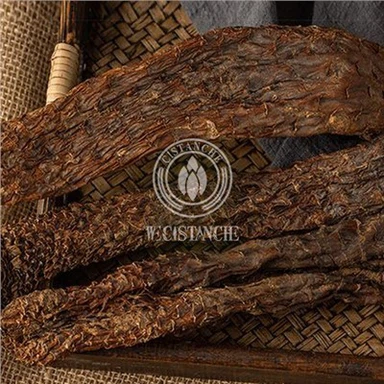
A quality piece is flattened-cylindrical or slightly curved, brown or grey-brown on the surface with densely overlapping fleshy scales, relatively heavy, hard yet slightly pliable, and not easily broken. The cut surface shows pale brown dotted vascular bundles arranged in wavy rings. It has a faint odour and a sweet, slightly bitter taste. Pieces with intact shape and a visibly oily texture are preferable. Avoid any product that is dark and dull, shows mould spots, or carries a pungent sulphur smell.
3.2 Before You Cook
Rinse the dried herb quickly under running water to remove dust; do not soak it for long, as water-soluble constituents will be lost. Pieces that are very hard may be softened in warm water for 20 to 30 minutes, then sliced or cut into sections. Autumn-harvested Cistanche tubulosa contains more moisture and is traditionally salt-cured ("salted Cistanche tubulosa"); this type should be thoroughly desalted by soaking before use. Spring-dried "sweet Cistanche tubulosa" can go straight into the pot.
A note on "salted Cistanche tubulosa." In the past, autumn-harvested material, being harder to dry, was often pickled in salt lakes for one to three years. Such pieces are high in salt, require repeated rinsing that both wastes water and leaches out active constituents, and taste unpleasantly salty and astringent - not ideal for the kitchen. Today the mainstream product is sun-dried "sweet Cistanche tubulosa," which retains more of its constituents and is far easier to cook with. If a piece noticeably tastes salty or shows a whitish efflorescence on the surface, it is almost certainly a salted product and needs several changes of soaking water; only the unsalted kind belongs in tea or soup.
On the harvest season: the best quality comes from material gathered in late spring to early summer (March to May), before the shoot emerges - the flesh is full and less hollow. Material dug in late autumn, just before the ground freezes, has a higher water content and is somewhat inferior after processing. For everyday cooking, spring-processed slices of sweet Cistanche tubulosa offer the best balance of price, flavour and effect. Buy from reputable dispensaries or producers with traceable origin labels, and steer clear of suspiciously cheap, unlabelled bulk goods in order to reduce the risk of heavy-metal or pesticide contamination.

Fresh Cistanche
4. Tea-Infusing: The Easiest Daily Habit
Take 3 to 5 g of sliced Cistanche tubulosa, place it in a cup, pour in boiling water, cover, and steep for 10 to 15 minutes. Refill with hot water until the flavour fades, then chew and eat the softened slices. This is the most convenient method, ideal for busy people who cannot spare time to decoct herbs, and it gently supports the kidney-warming and intestine-moistening actions.

cistanche tea
Recommended Combinations
|
Formula |
Amounts |
Best for |
|
Plain Cistanche tubulosa tea |
3–5 g sliced Cistanche tubulosa |
Everyday light support, office替代drink |
|
Cistanche tubulosa, red date & goji tea |
5 g Cistanche tubulosa, 3–5 dates, 5–6 g goji berries |
Sedentary, tired, essence-blood deficiency |
|
Cistanche tubulosa, Suoyang & goji tea |
3 g Cistanche tubulosa, 2 g Suoyang, 2 g goji, 2 dates |
Warming yang on cold autumn days |
On the palate: after steeping, the liquor is clear and pale yellow with a mild, faintly sweet herbal note and no bitterness; it still yields a pleasant aftertaste after several refills. If the flavour is unfamiliar, a little honey or rock sugar may be added. Those with a weak, cold digestion can add two or three slices of fresh ginger to the cup.
5. Soupmaking: Warm, Rounded Flavours for the Table
For a family-sized pot, 6 to 10 g of Cistanche tubulosa is sufficient. Simmered with meat, it slowly releases an herbal aroma and cuts through the richness of the broth. The softened pieces become tender rather than woody, soak up the savoury stock, and are acceptable to the whole family.
Recipe 1: Cistanche tubulosa and Goji Black-Silkie Soup (Light yet Nourishing)
Ingredients: half a black Silkie chicken, about 500 g; 15 g Cistanche tubulosa; 15 g goji berries; 20 g ginger. Method: blanch the chicken pieces; rinse and soak the Cistanche tubulosa, slice the ginger; put everything into a pot, bring to a rolling boil, then simmer on low heat for 30 minutes; add the goji berries and simmer 10 minutes more, then season. Traditional orientation: warms kidney yang and replenishes essence-blood, suited to cold intolerance and lower-back soreness in early autumn.
Recipe 2: Cistanche tubulosa Mutton Soup (The Classic Warming Dish)

Stewed Cistanche tubulosa soup
Ingredients: 500 g mutton; 20 g Cistanche tubulosa; 3 slices of ginger. Method: Blanch the mutton to remove odour, then simmer together with the Cistanche tubulosa and ginger over low heat for about 2 hours, seasoning only at the end. The combination of mutton and Cistanche tubulosa gives a pronounced warming effect and is better suited to late autumn and winter as the weather turns cold. Those with a hotter constitution can replace the mutton with pork ribs or black Silkie to avoid excess warmth.
Recipe 3: Cistanche tubulosa and Black-Soybean Congee (A Night-Time Bowel Moisturiser)
Ingredients: 5 to 10 g Cistanche tubulosa; 50 g black soybeans; 100 g rice. Method: Soak the soybeans for 6 to 8 hours in advance and soften the Cistanche tubulosa; cook the soybeans and rice into congee, add the Cistanche tubulosa when nearly done, then simmer for 10 more minutes on low heat. This mild, easily digested form is appropriate as a supportive measure for dry-type constipation in the elderly or for recovery from illness.
Recipe 4: Cistanche tubulosa Stewed with Egg (A Breakfast Moisturiser)
Ingredients: 5 to 10 g dried Cistanche tubulosa; 2 eggs. Method: soften the Cistanche tubulosa, cut into short sections, boil in water for about 5 minutes, beat in the eggs and stir, then cook through on low heat. Simple to prepare, it makes a gentle intestine-moistening breakfast.
General Principles for Soupmaking
Blanch meat first to remove odour; add the Cistanche tubulosa with ginger and dates. Simmer gently for 1 to 2 hours so the active constituents are released slowly. Salt should be added only towards the end, and kept to a minimum for anyone managing blood pressure. In a single pot, 6 to 10 g of Cistanche tubulosa is enough - more is not better.
6. Wine-Soaking: Rich Flavour, Strict Limits
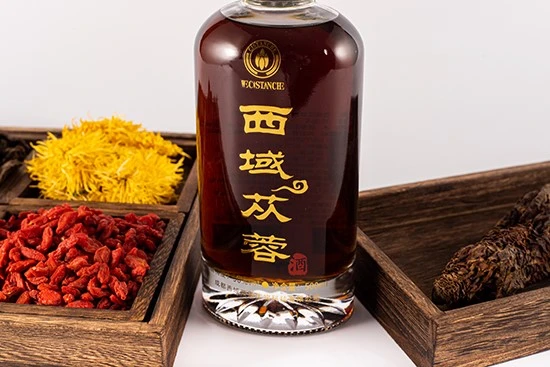
Cistanche wine
Click here to view Cistanche Black Platinum 50° herbal liquor
【Ask for more】 Email:cindy.xue@wecistanche.com / WhatsApp: 0086 18599088692 / WeChat: 18599088692
Take 30 to 50 g of dried Cistanche tubulosa, rinse and slice it, place it in 500 ml of baijiu or yellow rice wine, seal and soak for 15 to 20 days, shaking the container occasionally to help extraction. The liquor will take on a warm amber hue. The common herb-to-liquid ratio is about 1 to 10, and alcohol assists in extracting fat-soluble components. Cistanche tubulosa may be combined with other food-medicine dual-use ingredients such as Suoyang, goji berry, and Eucommia.
The Dosage Red Line
Drink only 10 to 20 ml per day, as a small measure - never as a way to consume large amounts of alcohol. It is strictly prohibited for minors, pregnant or breastfeeding women, people with impaired liver function, those taking hypoglycaemic, antihypertensive or anticoagulant medication, and anyone who needs to drive. Wine-soaking is only suitable for adults who already drink modestly; those who do not drink should not take up alcohol for the sake of supplementation and are better served by soup or tea.