Cistanche And Inflammatory Bowel Disease: What New Science Is Discovering About An Ancient Desert Herb
Oct 22, 2026
A Quiet Health Crisis on the Rise
Inflammation of the digestive tract is one of the most stubborn and distressing problems in modern medicine. Among the many forms it can take, few are more challenging than inflammatory bowel disease (IBD) - a term that covers two chronic, relapsing conditions: Crohn's disease and ulcerative colitis. Unlike a passing stomach bug that clears up in a few days, IBD is a lifelong companion for those who live with it, marked by cycles of flare-ups and remission, abdominal pain, persistent diarrhea, fatigue, and a constant need to plan life around bathrooms and appointments.
For a long time, IBD was considered a disease of the Western world. That picture is changing fast. In China, the number of people living with IBD has been climbing year after year for the past two decades, and projections suggest the figure could reach roughly 150,000 by the middle of this decade - the highest burden in Asia. This is not a niche problem. It is a growing public-health challenge that researchers, clinicians, and pharmaceutical companies around the world are scrambling to address.
The reasons behind this rise are complex. Scientists generally point to a combination of factors: genetic susceptibility, environmental triggers, an overactive or misdirected immune response, changes in the gut microbiome, and damage to the intestinal barrier - the thin, delicate layer of cells that must keep the "inside" of the body separate from the "outside" world of the digestive tract.
Conventional medicine has made real progress in managing IBD, but no cure exists. The most common treatments - aminosalicylates, antibiotics, corticosteroids, and immunosuppressive drugs - can be effective, yet they carry a familiar set of drawbacks: side effects that are hard to tolerate, loss of effectiveness over time, and a tendency for the disease to return once treatment is stopped. This is precisely why researchers keep searching for gentler, more sustainable options - and why an ancient desert plant called Cistanche has recently stepped into the spotlight.
What Is Cistanche?
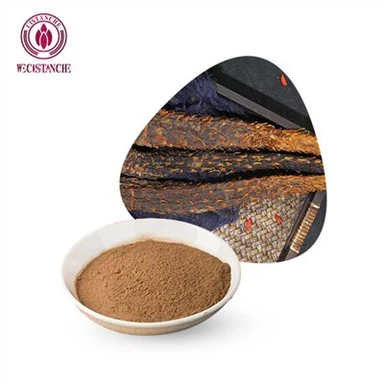
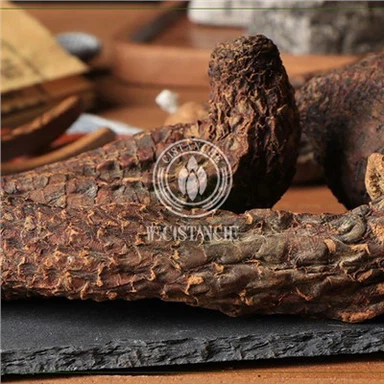
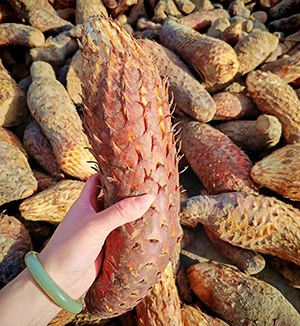
Cistanche - known in Chinese as Roucongrong (肉苁蓉) and nicknamed "desert ginseng" - is a parasitic herb that grows in some of the harshest environments on Earth: the arid deserts of northwest China, including the Xinjiang region. It has no leaves of its own in the usual sense; instead, it lives by attaching its roots to host desert shrubs and drawing water and nutrients from them. What is harvested and used is the plant's fleshy, scale-covered stem.
In traditional Chinese medicine, Cistanche has been valued for centuries as a warming, nourishing tonic. Its two best-known traditional roles are tonifying the kidneys and supporting vitality and moistening the intestines to relieve constipation. Because it has long been regarded as gentle rather than harsh, it has been trusted for prolonged use, particularly among older adults.
Modern science has begun to explain why this humble desert stem carries so much biological activity. Cistanche is chemically rich, containing a wide array of naturally occurring compounds - most notably a family called phenylethanoid glycosides (PeGs), along with terpenes, polysaccharides, and various other small molecules. The two PeGs that appear most often in research are echinacoside and verbascoside (acteoside) - in fact, the 2020 edition of the Chinese Pharmacopoeia lists these two compounds as the official marker components used to identify and standardize Cistanche.
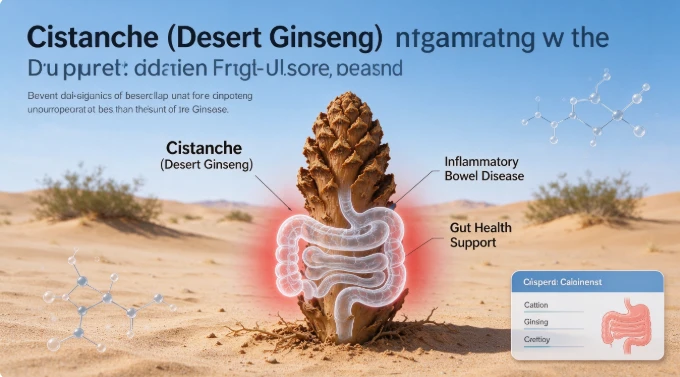
This is where the story gets interesting for anyone concerned about gut health. Even before the study we are about to discuss, researchers had already reported that echinacoside can improve colitis in mice by helping the cells lining the intestine grow and resist premature death, and that verbascoside - a powerful antioxidant - can slow the progression of experimentally induced colitis in rats. These hints raised an obvious and important question: Cistanche clearly seems to help the gut, but exactly which of its many compounds are responsible, and through what molecular machinery do they work? A team of researchers in Xinjiang set out to answer precisely that question - using a combination of computer-based prediction and real animal experiments.
Why It's So Hard to Study a Whole Herb
Before we look at what they found, it helps to understand why studying a plant like Cistanche is so much more complicated than studying a single drug.
A modern pharmaceutical is typically one molecule with one well-defined target. A medicinal plant, by contrast, is a cocktail - sometimes hundreds of different compounds, each of which can interact with many different proteins in the body. Traditional medicine has long insisted that herbs work through the combined action of many ingredients, a concept often described as "synergy." But synergy is hard to prove, and even harder to study. If you give an animal the whole extract and it gets better, you don't automatically know which ingredient mattered. If you isolate one ingredient and test it alone, you may lose the benefit that came from the combination.
This is the classic dilemma of herbal research. In recent years, however, a set of powerful computational tools has emerged to help solve it. The approach is called network pharmacology. Instead of studying one chemical against one protein, network pharmacology maps the entire web of interactions - every active compound in the herb, every protein each compound can bind to, and every protein linked to the disease - and then looks for the points where they overlap. It's a way of asking the whole ecosystem of a herb, "Which of you are actually relevant to this disease?" - before spending time and money on animal experiments.
This is exactly the strategy the researchers used, and it's worth explaining because it's the heart of the whole study.
Step One: Finding the Active Ingredients
The first task was to identify which compounds in Cistanche are worth studying at all. Not every molecule in a plant is absorbed well enough, or drug-like enough, to matter inside the body. So the team used a well-known database (TCMSP) to screen Cistanche's components using two practical criteria: whether a compound is likely to be absorbed when taken by mouth, and whether it resembles a typical drug molecule. They then added other active compounds that had been reported in the scientific literature for their effects on the gut.
The result was a list of 39 active ingredients - a manageable, evidence-backed set of candidates. These ranged from well-known plant compounds like quercetin and β-sitosterol to Cistanche-specific molecules like cistanoside H and suchilactone, along with sugars, sugar alcohols, and various other small molecules.
Step Two: Connecting the Herb to the Disease
Next, the researchers needed to find out which of these compounds could plausibly affect IBD. They did this in two parallel tracks:
First, they used a predictive tool (Swiss Target Prediction) to identify the proteins that each active ingredient is likely to bind to in the human body. This gave them a list of the herb's "reach."
Second, they used disease databases (GeneCards and OMIM) to gather the proteins that are known to be involved in IBD.
Then they compared the two lists and kept only the overlap - the proteins that Cistanche can touch and that matter for IBD. The intersection contained 232 potential targets. In other words, Cistanche's compounds appear capable of reaching more than two hundred proteins that are relevant to inflammatory bowel disease. That single number begins to explain the herb's broad potential: it isn't hitting one switch, it's reaching across an entire network.
Step Three: Zeroing In on the Key Players
Having a list of 232 overlapping proteins is useful, but it's too many to focus on. The researchers needed to find which compounds and which proteins were the true hubs - the ones with the most connections, and therefore the greatest influence.
To do this, they built two kinds of networks.
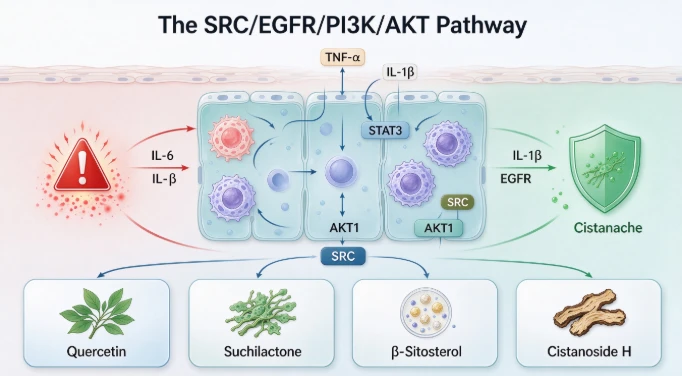
The compound network. They constructed a "drug-compound-disease-target" network - a visual map in which compounds, targets, and the disease are linked by lines showing their relationships. By counting how many connections each compound had (a measure called "degree"), they identified the four core components of Cistanche most likely to drive its effect on IBD:
Quercetin - a widely studied plant antioxidant with well-documented anti-inflammatory activity
Suchilactone - a compound reported to support immune-cell activity and to boost the release of a key signaling protein called interferon-gamma
β-Sitosterol - a common plant sterol that has been shown to lower inflammatory signals in the gut
Cistanoside H - a Cistanche-specific glycoside linked to regulation of oxidative stress and inflammation
The protein network. They then mapped how all the potential targets interact with each other (a protein-protein interaction network) and again counted connections. This time, five proteins stood out as the central hubs:
TNF-α - a master inflammatory signaling molecule, often one of the first to be released during inflammation
AKT1 - a protein that sits at the center of a major cell-survival and inflammation pathway
STAT3 - a signal transducer that, when switched on, drives the release of many inflammatory molecules
EGFR - a receptor on cell surfaces that can trigger downstream inflammatory signaling
SRC - a kinase that acts as an upstream switch for several of these pathways
Here is the crucial insight: the four core compounds and the five core targets are not random. When you lay them side by side, they line up along a connected chain of molecular events - a pathway. The researchers' prediction was that Cistanche works by interfering with this chain, calming the inflammation at its source.
Step Four: Does the Chemistry Actually Fit?
A prediction on paper is one thing; a physical interaction is another. To test whether the key compounds really can attach to the key proteins, the researchers used a technique called molecular docking - a computational method that simulates whether and how well a small molecule "docks" into the pocket of a protein, much like testing whether a key fits a lock.
The results were encouraging. Every one of the four core compounds showed a strong predicted binding to the five core targets, with binding energies well below the threshold considered meaningful for a good fit. Particularly striking was the interaction between β-sitosterol and AKT1, which showed the tightest binding of all. The consistent pattern across all the pairings supported the idea that Cistanche's compounds genuinely can engage the proteins involved in IBD inflammation.
But computational predictions, no matter how elegant, are not proof. The real test had to happen in a living organism.
Step Five: Putting It to the Test in Animals
To verify whether Cistanche actually protects the gut, the team turned to a well-established laboratory model of IBD: mice given a chemical called dextran sulfate sodium (DSS) in their drinking water. DSS damages the intestinal lining and triggers a colitis that closely resembles ulcerative colitis in humans - with weight loss, diarrhea, blood in the stool, shortening of the colon, and inflammation visible under a microscope. It is the standard way researchers model IBD before moving toward human studies.
Forty-eight male mice were divided into groups: a healthy control group, an untreated colitis ("model") group, a group receiving a standard anti-inflammatory drug (dexamethasone) as a positive control, and three groups receiving Cistanche extract (CE) at low, medium, and high doses. The extract was a standardized preparation with a high content of phenylethanoid glycosides - more than 40% echinacoside and more than 16% verbascoside. For seven days, the animals received their treatment daily while the colitis was being induced.
The results told a consistent and striking story.
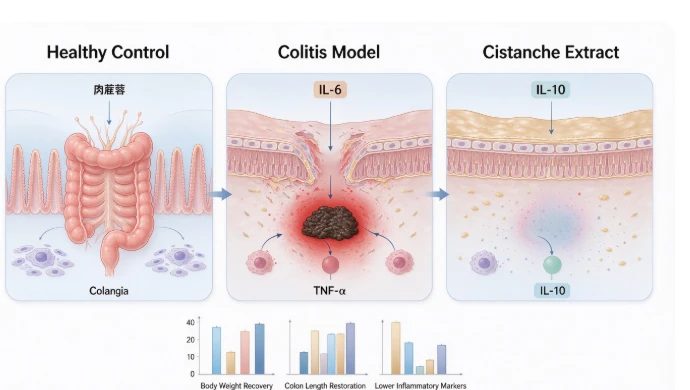
Weight and disease activity. The untreated colitis mice lost significant body weight, as expected. Every group receiving Cistanche extract gained more weight than the untreated model group - and the higher the dose, the better the recovery. The researchers also scored a "disease activity index" based on weight loss, stool consistency, and blood in the stool. In the untreated mice, this score was high, indicating severe illness. In the Cistanche-treated mice, it dropped substantially, in a dose-dependent way.
Colon length. One of the hallmark physical signs of colitis is that the colon becomes shorter and more damaged. In this experiment, the untreated colitis mice had noticeably shortened colons. Treatment with Cistanche restored colon length toward normal, with the highest dose producing almost complete recovery - nearly matching both the healthy controls and the standard drug group.
Tissue health under the microscope. Perhaps the most telling evidence came from looking directly at the colon tissue. In the healthy mice, the intestinal lining was intact, with clear structure and no signs of inflammation. In the untreated colitis mice, the picture was grim: the lining was broken, most of the glands were destroyed, some mucus-producing cells had disappeared, and immune cells had flooded into the tissue. In the Cistanche-treated mice, this damage was visibly reduced - less inflammatory infiltration, fewer destroyed glands, and lower pathology scores. Again, the effect grew with the dose.
Inflammatory signals. To understand what was happening at the molecular level, the team measured the levels of key inflammatory molecules in the colon tissue. In the untreated colitis mice, the levels of pro-inflammatory factors - IL-6, IL-1β, TNF-α, and an enzyme called MPO that marks immune-cell activity - were dramatically elevated, while the level of IL-10, an anti-inflammatory molecule that helps keep the immune system in check, was very low. Treatment with Cistanche reversed this pattern: the pro-inflammatory factors dropped, and IL-10 rose back toward normal. This is exactly the balance shift you want to see in a recovering gut - turning down the fire while strengthening the protective brake.

Step Six: Confirming the Predicted Pathway
The most exciting part of the study came at the end, when the researchers checked whether the proteins predicted by the computer analysis were actually changing in the animals' tissue.
They measured the levels of the five core targets - PI3K, EGFR, TNF-α, STAT3, AKT1, and SRC - plus their "activated" (phosphorylated) forms. In the untreated colitis mice, all of these were switched on and elevated. After treatment with Cistanche extract, the levels of these proteins, and especially their activated forms, dropped significantly, back toward the healthy baseline.
This is a powerful result. It means the computer model didn't just make a plausible-sounding guess. The specific proteins it predicted to be central - the ones on the SRC/EGFR/PI3K/AKT axis - were the very ones whose activity decreased when the herb improved the disease. Prediction and observation lined up, which is exactly what researchers hope to see.
Putting the Mechanism in Plain Words
If all these acronyms feel overwhelming, here's the story in simple terms.
Imagine inflammation in the gut as a fire alarm that has jammed in the "on" position. Cells in the damaged intestine send out distress signals (like TNF-α), which attract more immune cells to the area. Those cells, in turn, send their own alarm signals (like IL-6 and IL-1β), which amplify the fire. A chain of signaling proteins inside the cells - SRC acting as the trigger, EGFR as the receiver on the cell surface, and the PI3K/AKT pathway as the amplifier inside the cell, with STAT3 helping to shout the message even louder - keeps the whole cycle running.
What this study suggests is that Cistanche acts like a hand reaching into the system and turning down the volume at multiple points along that chain. It doesn't knock out one protein; it nudges several of the most important ones down at once. That's the essence of how a multi-compound herb differs from a single-target drug - and it may be exactly why plants like Cistanche have historically been trusted for chronic, stubborn conditions where the body's signaling has gone haywire.
Why This Matters for People Living With IBD
It's important to be clear about what this study does - and does not - prove.
What it shows is strong, promising evidence that Cistanche has a real, measurable effect on gut inflammation in a well-established animal model, and that this effect involves a specific, identifiable molecular pathway. That's a meaningful step forward, because it moves the conversation about Cistanche and the gut from vague tradition to testable science. When researchers can name the pathway, other labs can try to reproduce the finding, and eventually researchers can design human studies to see whether the same thing happens in people.
What it does not show is that Cistanche is a treatment or cure for IBD in humans. A mouse model is not a person. Human IBD is far more varied, and human responses to herbs are far more complex, than anything a laboratory can fully capture. No one with IBD should stop their prescribed medication or replace it with a herbal extract based on this study. The right way to read this research is as a promising signal that deserves further investigation - a reason for cautious optimism, not a reason for unproven self-treatment.
There are also practical caveats. The dose, the standardization of the extract, and the way it's prepared all matter enormously. A random Cistanche product bought online is not the same as a carefully standardized extract with a documented content of active compounds. And, as with any botanical, interactions with medications and individual sensitivities are always possible - which is why anyone considering it should talk to a qualified healthcare professional first.
The Bigger Picture: Ancient Herb, Modern Method
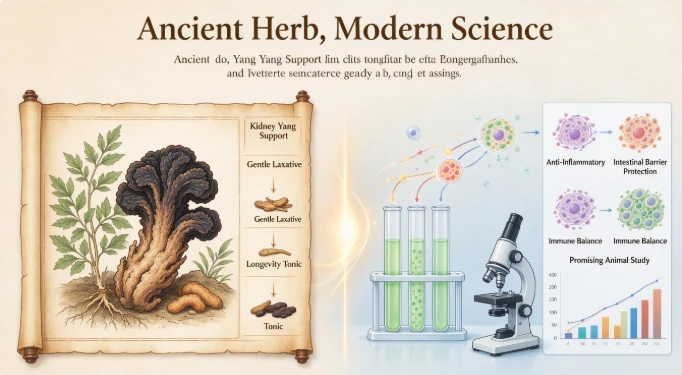
There's something quietly remarkable about how this study was done. The herb itself is ancient - Cistanche has been used and trusted for over two thousand years. But the methods used to study it are at the absolute cutting edge of science: massive public databases, computer models of protein networks, simulated molecular docking, and precision laboratory experiments. The ancient and the modern are working together.
And the conclusion they point to is fitting. Traditional medicine always said Cistanche was good for the digestive system. Modern science is now saying the same thing - but with a much more precise vocabulary. We can name the compounds (Cistanche's phenylethanoid glycosides and related actives), the proteins (TNF-α, AKT1, STAT3, EGFR, SRC), and the pathway (SRC/EGFR/PI3K/AKT) that appear to carry the effect. We can watch the herb reduce inflammatory signals, protect the intestinal lining, restore the colon, and rebalance the gut's immune environment in living animals.
None of this means the story is finished. It means the story has found a solid new chapter. Inflammatory bowel disease is a growing, difficult, and deeply personal illness for millions of people, and the world urgently needs options that are gentler, more durable, and more tolerable than what we have today. If a humble desert herb - one that has survived centuries of scrutiny and earned the trust of generations - can help point the way, then it deserves our attention.
The next steps are clear: reproduce these findings in other labs, identify which compounds matter most, work out the safest and most effective dosing, and eventually test Cistanche in carefully designed human trials. If those studies succeed, this ancient plant may earn a genuinely modern role in the care of people living with inflammatory bowel disease. And if they don't, we will at least have learned something important about how herbs, inflammation, and the gut truly interact.
Either way, the desert ginseng has proven that it is far more than a piece of traditional folklore. It is a plant with a chemical treasury, a measurable biological effect, and - thanks to modern network science - a story we can finally begin to read in detail.