Cloning, Functional Identification And Expression Analysis Of Chalcone Synthase From Cistanche Tubulosa Ⅱ
Mar 25, 2024
3 Results and analysis
3.1 Cloning of CtCHS gene
Four sequences annotated as "chalcone synthase" were screened out using the transcriptome data of Cistanches tubulosa flowers. Through NCBI's Blast comparison, it was found that only one sequence had the full length of the CHS gene and had an FPKM greater than 10. Specific primers were designed based on this sequence, and a fragment of about 1200 bp was obtained by PCR amplification using Cistanches tubulosa flower cDNA as a template (Figure 1). The PCR product was gel recovered and connected to the pCE2TA/Blunt-Zero vector. The sequencing results were consistent with the transcriptome analysis. The gene was named CtCHS. The sequence length is 1173 bp and encodes 390 amino acids.
Supportive Service Of Wecistanche-The largest cistanche exporter in the China:
Email:wallence.suen@wecistanche.com
Whatsapp/Tel:+86 15292862950
Shop For More Specifications Details:
https://www.xjcistanche.com/cistanche-shop
3.2 Bioinformatics analysis of CtCHS
3.2.1 CtCHS physical and chemical properties and transmembrane domain analysis
The online software ProtParam was used to analyze the physical and chemical properties of the protein encoded by the CtCHS gene. CtCHS encodes 390 amino acids, the molecular formula is C1908H3041N511O562S22, the relative molecular mass is 42 836.54, the theoretical isoelectric point is 5.85, and it is unstable. The coefficient II is 43.24, which is an unstable protein, and the overall average hydrophilicity (GRAVY) is −0.052, which is a hydrophilic protein. The Prot Scale online tool was further used to analyze the protein hydrophilicity/hydrophobicity. The analysis results showed that the maximum value of CtCHS protein hydrophilicity/hydrophobicity was 2.422 (342) and the minimum value was −2.489 (119). The amino acid peptide chain encoded by the CtCHS gene has more hydrophilic amino acid residues than hydrophobic amino acid residues, so it is a hydrophilic protein. The online software TMHMM was used to predict the transmembrane structure of the protein. The CtCHS protein has no transmembrane domain.

Fig. 1 PCR amplification of CtCHS gene
3.2.2 Prediction of secondary structure and tertiary structure of CtCHS protein
The online tool SOPMA was used to predict the protein secondary structure. The results are shown in Figure 2-A. 44.87% α-helices, 31.03% random coils, 15.64% extended chains and 8.46% β-sheets constitute the secondary structure of the CtCHS protein. level structure. The online analysis software SWISS-MODEL was used to predict the tertiary structure of the protein, and the crystal structure of rice CHS1 was used as a template to predict the three-dimensional structure of the CtCHS protein. The results are shown in Figure 2-B. The consistency between Cistanche tubulosa CtCHS and rice CHS1 is 83.55%.
3.2.3 Sequence comparison and phylogenetic tree analysis and application
DNAMAN software performs homology comparison between CtCHS and the CHS amino acid sequences of other species. The results are shown in Figure 3-C. The CtCHS amino acid sequence is consistent with Sesamum indicum L. (XP_011091402.1) and Antirrhinum majus L. (P06515. 1), Mazus pumilus (N. L. Burman)Steenis (AAN05791.1), Erythranthe lewisiiG. L. Nesom & N. S. Fraga (AHJ80976.1), Perilla frutescens (L.) Britton (O04111.1 ) and Arabidopsis thaliana (L.) Heynh. (NP_196897.1). The amino acid sequences of CHS are highly similar, with the similarity being 90.93%, 90.68%, 90.18%, 89.42%, 89.42%, and 81.61%.

NATURAL ORGANIC CISTANCHE EXTRACT WITH 30% ECHINACOSIDE AND 12% ACTEOSIDE

In addition, multiple sequence alignment also showed that CtCHS has conserved catalytic residues Cys164, His303, and Asn336. In order to further understand the evolutionary position of Cistanche tubulosa CtCHS in the plant CHS family, MEGA-X software was used to construct a phylogenetic tree between CtCHS and CHS proteins of other plants. The results are shown in Figure 3-D. E. lewisii AHJ80976.1) ElCHS is closely related.
3.3 CtCHS prokaryotic expression and purification
The pET-28a-CtCHS plasmid was transformed into E. coli expression strain BL21 (DE3), and protein expression was induced by IPTG at low temperature. The protein was purified using a nickel ion affinity chromatography column, and the purified protein was detected by 10% SDSPAGE. The results are shown in Figure 3. The CtCHS protein band appeared near 40,000, which is consistent with the relative molecular mass of the CtCHS protein of 42,800.
3.4 CtCHS enzyme activity analysis
To identify the function of CtCHS, the purified CtCHS protein was incubated with malonyl-CoA, 4-coumaroyl-CoA and the products were detected using HPLC and MS. Under natural conditions, naringenin-chalcone is unstable in solution and is easily cyclized into naringenin. Therefore, naringenin-chalcone and naringenin were selected as standard controls.
The HPLC test results are shown in Figure 4-A and B. The retention time of the enzyme reaction product is similar to that of the naringenin standard. Both have maximum absorption at 289 nm in the UV absorption spectrum, which is different from the retention time of naringenin-chalcone. The time and UV absorption spectra were different, but as a negative control, the product after incubation of the high-temperature inactivated CtCHS protein with the substrate did not contain naringenin, chalcone and naringenin. Further detection through mass spectrometry, the first-level mass spectrum (Figure 4-C, D) showed that the enzyme reaction product has [M-H]-peak m/z271.060 97, while naringenin has [M-H]-peak m/z 271.060 91.
Comparing the MS2 spectra (Figure 5-E, F), the CtCHS enzyme reaction product and naringenin both have characteristic fragment peaks at m/z 107, 151, and 177, which is consistent with the literature report [19], indicating that CtCHS has chalcone complex. Enzymatic activity, it can catalyze the reaction of malonyl-CoA and 4-coumaroyl-CoA into naringenin-chalcone.
3.5 Subcellular localization analysis
In order to study the role of CtCHS protein in cells, the pCAMBIA1300-35S-GFP-CtCHS plasmid was constructed and transformed into Arabidopsis thaliana protoplasts to observe its subcellular localization. The results are shown in Figure 5. As a control, the pCAMBIA1300-35S-GFP protein was distributed in the nucleus and cytoplasm, while the pCAMBIA1300-35S-GFP-CtCHS fusion protein was mainly distributed in the cytoplasm, indicating that the CtCHS protein may function in the cytoplasm of plant cells. Function.

3.6 CtCHS expression pattern analysis
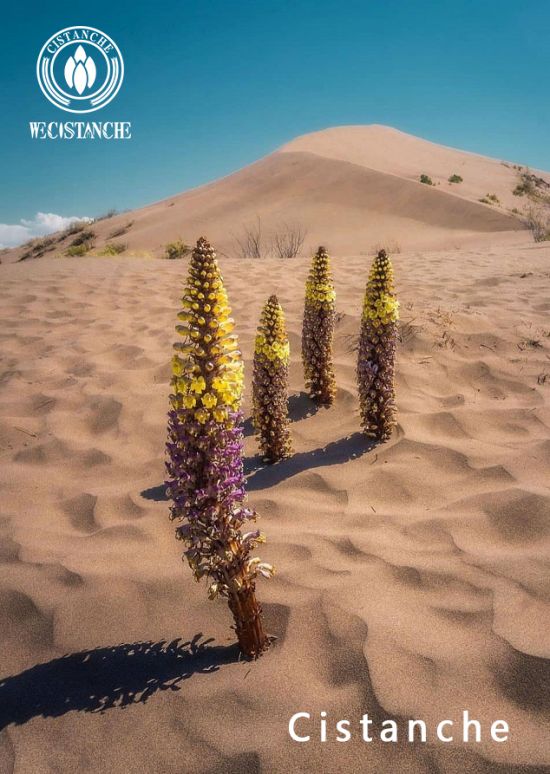
qRT-PCR was used to detect the relative expression of CtCHS in Cistanche deserticola flowers with three colors: white, purple and red. The results are shown in Figure 6. The expression of CtCHS in purple and red flowers was significantly higher than that in white flowers. quantity. Compared with white flowers, the expression level of CtCHS in purple flowers is 8.44 times higher, and the expression level of CtCHS in red flowers is 3.21 times higher. These results indicate that changes in CtCHS expression levels may be related to the difference in flower color of Cistanche deserticola. The higher the expression level, the darker the flower color. , the lower the expression level, the lighter the flower color.
****P<0.000 1Fig. 6 Relative expression level of CtCHS in flowers with different colors

4 Discussion
CHS is a key enzyme in the flavonoid biosynthetic pathway and is related to the regulation of flower color in many plants. For example, the flower color of Dianthus chinensis L.[20] and Petunia × hybrida Hort. exVilm.[22] are all affected by CHS. control. Cistanches tubulosa mainly has three flower colors: white, red, and purple, but its flower color regulation mechanism has not yet been reported. In this study, a CtCHS gene was cloned using RT-PCR through transcriptome data analysis of Cistanches tubulosa flowers, and its
Bioinformatics analysis was conducted, and the results showed that CtCHS has high similarity and close genetic relationship with the amino acid sequence of ElCHS of Physalis nigra (AHJ80976.1). CHS is a type III polyketide synthase (PKSIII), and studies have found that CHS has a conserved Cys-His-Asn catalytic triad [23]. In this study, amino acid sequence alignment analysis showed that CtCHS has conserved catalytic residues Cys164, His303, and Asn336, indicating that CtCHS may have a typical chalcone synthase function.
able. Enzyme activity analysis was performed using prokaryotic expression of CtCHS protein in Escherichia coli and detected by HPLC and MS. It was found that CtCHS protein can catalyze 4-coumaroyl-CoA and malonyl-CoA to produce naringenin-chalcone.
CHS is involved in the synthesis of flavonoids in many plants, but its subcellular location is different in different species. For example, Carthamus tinctorius L. CtCHS1[24], Morus atropurpurea Roxb. MaCHS[25], Eupatorium adenophorum Spreng. EaCHS[26] are all located in the cytoplasm, while Paeonia delavayi var. lutea (Delavay ex Franch.) Finet et Gagnep. PdCHS
[27], eggplant Solanum melongena L. SmCHS [28] is located in the cytoplasm and nucleus, and in grape Vitis vinifera L. VvCHS is located in the cytoplasm, nucleus and cell wall [29]. In this study, pCAMBIA1300-35S-GFP-CtCHS plasmid was used to transform Arabidopsis thaliana protoplasts and it was observed that CtCHS protein was mainly localized in the cytoplasm, and may catalyze the production of naringenin-chalcone in the cytoplasm to promote the accumulation of flavonoids.
The phenylpropanoid pathway branches from 4-coumaroyl-CoA into the flavonoid synthesis pathway and the lignan biosynthesis pathway. CHS catalyzes 4-coumaroyl-CoA and malonyl-CoA to generate naringenin and chalcone to initiate flavonoids. The biosynthetic pathway of compound-like compounds is the first key enzyme in this pathway [30]. Therefore, highly expressed CHS is beneficial for plants to accumulate higher levels of flavonoids and produce darker flowers. For example, the expression level of CHS in purple-flowered varieties of Hosta plantaginea (Lam.) Aschers is higher than that of white-flowered varieties. Hosta HpCHS is transformed into tobacco to obtain Compared with wild-type tobacco, overexpression plants have darker petals and higher total anthocyanin content [31].
In this study, the expression level of the CtCHS gene is related to the color of Cistanches tubulosa flowers. It is highly expressed in darker purple flowers and red flowers, and is low in light-colored white flowers. The expression difference of CtCHS may be due to the difference in Cistanches tubulosa flowers. One of the reasons for having different suits and colors. In summary, this study cloned a CtCHS gene from Cistanche deserticola flowers and conducted bioinformatics analysis on it. The CtCHS recombinant protein was obtained by exogenous expression in Escherichia coli. The enzyme activity analysis proved that the CtCHS protein can catalyze 4-coumaroyl coenzyme. A and malonyl-coenzyme A generate naringenin-chalcone. It was found that the CtCHS gene is highly expressed in purple and red flowers and low in white flowers. These results indicate that the CtCHS gene may regulate the production of different flower colors in Cistanche deserticola, which is beneficial to further research on the regulatory mechanism of Cistanche tubulosa flower color and provides a reference for subsequent research on the role of CtCHS in the regulation of flower color in Cistanche deserticola.